

Pidurangala Rock – a Guide to Hiking Sigiriya’s Most Captivating View Point
Scribbled by Claire ◊ 16 Apr 2025
Are you trying to decide if the hike up Pidurangala Rock is worth it? Here, we’ve written everything you need to know about the beautiful Sigiriya view point, with all the hiking information, including the best time to visit, difficulty, cost, dress code, and more.
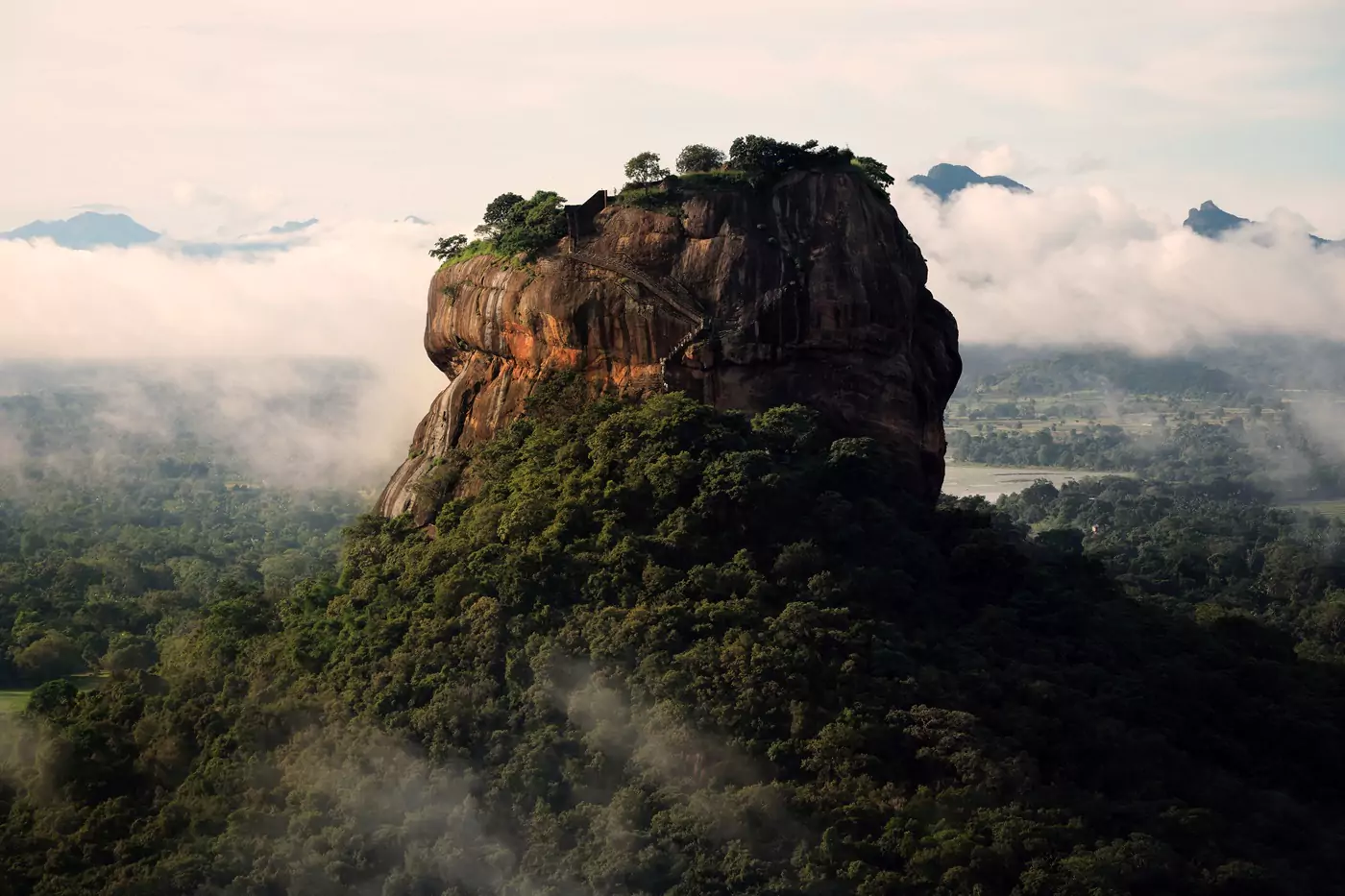
It’s just past sunrise and I’m sat, kind of sweaty, softly gazing northward from atop Sigiriya’s famous Lion Rock Fortress.
Pidurangala Rock, a symmetric hill carpeted in dense, wooded wilderness, draws my eye. Protruding dramatically from the otherwise flat, seemingly endless jungle-carpeted plains of central Sri Lanka, it’s an oddly striking sight. At the summit, I can just about spot the shifting specs of hikers, a bit like ants, circling the exposed rocky peak while the misty clouds swirl the hilltop.
‘I want to go there’ I immediately uttered aloud (I’m pretty basic like that), despite being super gross from my current climb up the adjacent and more famous Sigiriya landmark. (Even early in the morning, Sri Lanka is *warm*).
So, the next morning, we went searching for the special Sigiriya view point atop Pidurangala Rock I’d spotted the day before.

IN THIS GUIDE //
Pidurangala Rock Hike Guide
WHAT IS PIDURANGALA ROCK?
PIDURANGALA ROCK ENTRANCE FEE
GETTING TO PIDURANGALA ROCK
HIKING PIDURANGALA ROCK
– HIKING ROUTE
– THE SUMMIT
– IS PIDURANGALA ROCK HARD TO CLIMB?
– PIDURANGALA ROCK HIKE TIPS
WHAT TO WEAR
BEST TIME TO HIKE PIDURANGALA
– THE BEST MONTH TO VISIT
WHAT TO BRING
CAN YOU HIKE PIDURANGALA AND SIGIRIYA IN ONE DAY
PIDURANGALA VS. SIGIRIYA
WHERE TO STAY
FINAL THOUGHTS – PIDURANGALA ROCK HIKE
This post may contain affiliate links. If you book through these links we may make a small commission at zero cost to you. It helps us pay for the upkeep of this blog. Thank you!
What is Pidurangala Rock?
Pidurangala is a 200-metre-tall volcanic hill, rising 340 metres above sea level up out of the jungle. It is a little under two kilometres north of the famous Sigiriya Rock, situated in the lowlands of central Sri Lanka, smack bang in the middle of an area dubbed the ‘Cultural Triangle’. This region, famed for its historic significance, is dotted with stupas and ancient cities, four of which are UNESCO designated sites.
Beyond being a tourist site famed for its panoramic view point of Sigiriya, Pidurangala is locally known for being a centre of religious significance. Pidurangala Sigiri Rajamaha Viharaya, a Buddhist temple, sits at the rock base, and a huge 12-metre reclining Buddha resides in a cave part way up.
The area is an active place of worship, so be aware of your clothing and noise levels at all times.
Pidurangala Rock Entrance Fee
The entrance ticket to Pidurangala Rock in 2025 for non-nationals is 1000 LKR for adults and 500 LKR per child between 6 and 12. Entry is free for residents and under 6s.
This is currently payable only in cash at Pidurangala Sigiri Rajamaha Viharaya Temple, located at the base of the rock, after passing through a tall white archway.
Someone will take your fee in the building to the right after entering and give you a little brochure which they stamp. This is your ticket (not that it was checked for us at any point further along the route or on exit).

How to get to Pidurangala Rock
Pidurangala Rock is located a little under three kilometres to the north of Sigiriya, a small town in the Cultural Triangle of central Sri Lanka. There are several ways to reach Pidurangala Rock: tuktuk, on foot, bicycle or self-drive.
For directions, search for “Pidurangala Rock Temple Ticket Office” on Google Maps, where you purchase your ticket.
Self-Drive
If you are self-driving, search for “Vehicle Park of Pidurangala Rock & Temple” on Google Maps. This is where you leave your vehicle, free of charge.
We self-drove to Pidurangala Rock in our trusty little blue tuktuk and turned off from Sigiriya Road at 7.959605, 80.765855, before taking the route in from the south. As a result of some overnight rain, the unpaved road was really wet and muddy. In places, water filled large potholes dotted across the road and I was scared we’d tip our tuktuk (it’s hard to gauge the depth!). Despite this, we didn’t have much trouble and watched other tuktuks and motorbikes drive the route quite happily.
Walking and Cycling
Whether you should walk or cycle to Pidurangala totally depends on exactly where you stay and how energetic you are feeling. You may choose a hotel within a few kilometres, or as far as ten (or more) kilometres away.
Note | if you walk or cycle to Pidurangala early in the morning, be aware of an increased chance of seeing elephants at that time of day (we didn’t see any on our way in, thankfully). Some hotels even have signs outside saying when the last elephant sighting was (it was zero days for ours!).
If you do see an elephant, keep your distance. They can flip a tuktuk easily (I was living in fear of this – read more about our elephant tuktuk experience), so respect their personal space. They are very dangerous animals.
There are plenty of tuktuk drivers available in Sigiriya which your hotel can arrange for you. Alternatively, there are loads hanging around the junction at 7.950626, 80.759403.
Tuktuk
There are plenty of tuktuk drivers available in Sigiriya which your hotel can arrange for you. Alternatively, there are loads hanging around the junction at 7.950626, 80.759403.
PIDURANGALA ROCK QUICK FACTS
Height | 200 metres
Opening hours | 5am-6pm daily
Cost | 1000 LKR per adult (12 and above)
Hike length | 60 minutes, round trip
Hike difficulty | moderate but short (about 1 mile)
Nearest town | Sigiriya
Best month to visit | Dec – March
–
DRIVING A TUKTUK IN SRI LANKA | THREE WEEKS IN SRI LANKA
Hiking Pidurangala Rock
The Pidurangala Rock hike has been described as everything from an ‘intensely difficult scramble, not for the average person’, to a ‘casual 20-minute jaunt, suitable for toddlers’. So, which is it?
Below, we’ve given an overview of the route, information on the scramble and summit, plus how fit we think you should be to take it on.
Pidurangala Rock Hike Route
The hike commences at the entrance to the small Buddhist Pidurangala Temple, marked by a white gate up about ten stairs. Usually, you should remove your shoes while in the temple grounds. However, as it had rained, we were told not to by the attendants because the ground was wet. Following the obvious path, the hike starts with some easy to navigate, clear, well-crafted steps and a some flat sections (there are a few different route options here, but all end up at the same place).
As you slowly traverse the rock clockwise from the western side, the steps turn more into a steep path of uneven rocks, until finally, there is a 12-metre reclining Buddha in a cave near the summit, with extensive views to the east. This is around 20 minutes into the walk.
After the Buddha, the path continues clockwise, with various rocky obstacles that you must use your hands to traverse. There are occasional ropes and a few sections where you must pull yourself up between crevasses and shimmy across skinny rocks. This takes about 5-10 minutes.
The route out is the same as the route in and the round trip from the base to the top is about one mile.

The Summit of Pidurangala Rock
After the rock scramble, you emerge from underneath an immense boulder with an immediate, unobstructed view of Sigiriya Rock Fortress in the distance. It’s an incredible sight and we sat here, in the shade of the rock, for several minutes.
Continuing up behind the enormous boulder, the actual plateau on the summit comes into sight, with just a small group of trees to shelter under. There are no barriers anywhere up here, so be wary if you bring kids.
Tip | monkeys are commonly seen at the summit. They will try to steal your stuff, so be careful (one attempted to grab my bag and another kind of hissed at me). There are also a group of very friendly dogs.
Also, there’s a little bit of trash at the summit which definitely looks to be left there by tourists. Don’t be one of those dicks – take your stuff with you.

Is Pidurangala Rock Hard to Climb?
The Pidurangala Rock hike is not that difficult.
Obviously, difficulty is a subjective issue, but I’m not that fit (I’m definitely no athlete and my body hates going up and down hills). However, I personally found this hike really easy – we arrived at the reclining Buddha, near the top, in about 20 minutes without taking a proper break. People had put the fear of god into me about the scrambling/bouldering bit, but that was quick and easy, too.
Even if you amble slowly, it would typically take about 40 minutes to reach the summit of Pidurangala Rock.
Pidurangala Rock Hike Tips
Some things to note about the Pidurangala hike:
Hike | in my mind, the hike is split into three – the short mostly flat bottom bit followed by some well-made, moss-covered steps, then the unrelenting slippery, spiralling middle; followed by the reclining Buddha and final scramble.
Path | the main, uncompromising path slowly circles the rock and is reasonably steep and uneven. The ancient steps are carved from stone and are irregular, twisting, entwined with tree roots and not easy to navigate quickly. Any mention by people of the number of steps is going to be wrong – I mean there aren’t really steps for the most part, just a rugged corridor of uneven rocks.
Safety | there are no handrails and the route can get slippery when it’s wet (so, most of the time). Going down was actually more difficult because of the slipperiness – we actually saw somebody fall (they were fine).
Visibility | the trail is surprisingly dark – the route is in dense jungle with little light penetrating the canopy, so early in the morning visibility is even less than you’d imagine. A benefit of this is that there is no direct sunlight, which keeps it cooler (although it’s incredibly humid still with no breeze – jungle style).
Route | it’d be difficult to get lost – there is one main, obvious rocky set of steps to the summit.
Scrambling | there is a very short section at the top that involves some actual scrambling. You have to use both hands to navigate up and over large rocks (there are arrows pointing the way). This is honestly quite easy and there are even ropes to help in some sections (we saw small children doing it). However, if you are carrying a big camera, large bag or baby, it could be trickier. As with the steps up, the scramble would be more demanding if it was raining.
Views | the hardest part is getting the motivation to hike because the route is not so scenic until you reach the reclining Buddha near the top. It’s only here that the forest opens up and you can see the vast, neverending jungle-plains stretching out forever.
Crowds | it is a narrow trail and you’ll have to stop and wait for people to pass you on their way down, which can get a bit tedious. We went up just after sunrise, so everyone who had already watched the sunrise was heading down, meaning we often had to wait.
Guide | you may be approached in the parking area and asked if you want a guide for the Pidurangala hike, especially if it is darker. They’ll warn you that the route is difficult and slippery.
In my opinion, this route definitely does not need a guide and having one will not make it any less slippery! It might be worth using one if you’re nervous, travelling solo and it’s dark. Otherwise, I’d skip it. Guides are definitely not required.


WHAT TO WEAR FOR THE PIDURANGALA ROCK HIKE
The hike begins passing through a Buddhist temple, so bring something to cover up any slightly more revealing clothing (no uncovered shoulders, knees etc.). Sarongs/scarves are available in a pinch at the entrance if you’ve forgotten something.
After the temple, any comfortable, athletic gear would be perfect for this route. Remember, it’s humid and sweaty – wicking materials are always preferable (goes for almost everywhere in Sri Lanka!).
No hats are allowed in the temple area but might be useful if you’re going to hang out on the summit for any length of time. Most of the walk is shaded, so a hat isn’t strictly necessary.
I have a friend who would hike this rock wearing flip flops, but she’s a bit crazy. We’d definitely recommend decent trainers that you’re happy hiking up hills in (no need for hiking boots). It’s a bit wet, uneven, muddy and you’ll have to traverse a bunch of rocks.
–
RELATED POST | BACKPACKING SRI LANKA – 29 THINGS TO KNOW
Best Time to Hike Pidurangala Rock
Lots and lots (and lots) of people head up to the summit of Pidurangala Rock for sunrise or sunset. This is obviously a very attractive option, with the potential for some extraordinary, glowing views across to Sigiriya Rock.
Just After Sunrise at Pidurangala Rock
We made a decision to start our hike *at* sunrise. This means you do not need a head torch for the awkward, slippery hike and everyone leaves as you arrive. This also allowed us to spend about an hour or so at the summit with only a few other visitors. Although getting up early normally beats the tourist rush, in this particular location, that is not the case!
The other benefit of waiting until sunrise is that the roads to Pidurangala are easily visible. The quality of the access road in is sketchy, especially after any rain. It’s dark from the overhanging trees, unpaved, muddy, narrow and full of potholes. We drove a tuktuk down it and were glad we didn’t go in complete darkness! Arriving a little later means you can cycle or drive yourself to the car park without incident.
Travel tip | there have been reports of crowds and queues to get to the summit, especially through the narrow scrambling section. Bottlenecks of tourists happen at the tricky bits of the hike and queues can be upwards of ten minutes or more at busy times. Be prepared if you are timing your hike for sunrise or sunset – it would suck to miss it by being stuck in a sweaty queue.
Sunset | this would also be a lovely time to visit Pidurangala Rock, but I personally would not want to hike down and drive out after dark – although it’s completely possible to do this and many people do.
The Best Month to Hike Pidurangala Rock
Technically, the best months to hike up Pidurangala Rock are in Sri Lanka’s winter season, between December and March, although the weather is always very changeable and you never know what you’re going to get! It’s certainly cooler during the winter months, which makes it a more comfortable hike.
We visited in December and experienced perfect, blue, sunny weather for the hour we were sat up at the summit, then some serious misty fog rolled in and we couldn’t really see much at all. Then it started raining. The weather completely changed in just a few minutes. Although, no matter when you visit, it’ll be warm (even if it rains!).
RENT A TUKTUK IN SRI LANKA!
Have you considered renting a tuktuk for your trip around Sri Lanka?
We did exactly that for an entire month, affectionately naming our little blue rust bucket ‘Blue Pebis’, and it became our entire hilarious identity.
It’s an affordable, humorous, flexible way to explore this beautiful country and we fully recommend it.
If you’re interested, check our our guide to renting a tuktuk in Sri Lanka.
–
What to Bring for Your Hike
Sensible shoes | just going to mention this again, because the short hike up is a bit more strenuous and rugged than the route in Sigiriya Rock (where you could get away with flipflops).
Water | it’s warm and steep! Avoid plastic where you can – take a refillable bottle (single-use plastic bottles are not allowed on the trail). Also consider electrolytes if you’re as gross as me and sweat buckets in the humidity.
Snacks | obviously the most important part of any hike, but watch out for thieving monkeys (please don’t feed them, it’s really bad for them and us).
Torch | if going early or late (a head torch is a smart choice for the scrambling bit as you’ll need your hands).
Sunscreen | the way up is mostly shaded but on top has minimal shelter from the sun.
Camera | for the monkeys, wild (but friendly) dogs, as well as the impressive views from Sigiriya view point and the surrounding area.
Sarong | if you’re shoulders aren’t covered for the temple.
Bug spray | we didn’t experience much in the way of mosquitos, but we know they’re there.
PLANNING A SRI LANKA TRIP?
Have a quick peek to see if any of our other Sri Lanka posts might be helpful:
How to explore Mihintale – Sri Lanka’s most sacred Buddhist site
Is it smart to drive Sri Lanka’s Elephant Road?
Everything you need to know about backpacking in Sri Lanka
The monster three week Sri Lanka itinerary
How to rent a tuktuk in Sri Lanka – realities of driving a cranky rust bucket
How to visit Sri Lanka’s exquisite ancient capital of Polonnaruwa
–

CAN YOU HIKE PIDURANGALA AND SIRIGIRA IN ONE DAY?
Yes, you can definitely hike Pidurangala and Sigiriya Rock on the same day!
We chose not to do this, just because we wanted to do both hikes first thing in the morning (I’m a disaster in the heat). It would be really easy to do both though as neither are that demanding. The biggest issue is the weather, which is scorching hot in the middle of the day. A secondary issue is crowds. Sigiriya can be *super busy*.
If I were to hike them in one day, I’d do one of two options:
1. Get to Sigiriya at opening, head up and take your time exploring the famous fortress before the crowds engulf it, then go home for a shower and hike up Pidurangala in the evening for sunset.
2. Head to Pidurangala before sunrise and leave straight after, then go immediately across to Sigiriya and be done with both before lunch (this is good if you don’t have an extra overnight option).
–
Pidurangala Rock vs. Sigiriya Lion Rock
A lot of people, especially backpackers in Sri Lanka, choose to hike Pidurangala Rock purely because it’s cheaper than Sigiriya Lion Rock – claiming that it’s just the same, but cheaper. But is it actually better, or even comparable?
Pidurangala Rock is a sacred Buddhist site and is certainly worthy of your time, but with the opportunity to only visit one site, what do you choose: Pidurangala Rock or Sigiriya?
Conclusion | Pidurangala is a one-hour walk ending in a Sigiriya view point. Sigiriya Lion Rock is an entire cultural, historical experience and a UNESCO World Heritage Site, with facilities and lots to see and do. They’re not really comparable.
I loved Sigiriya Lion Rock so much more than I thought I would (I’m cynical about anything with crowds). However, I nearly missed Sigiriya because the reports I read said it wasn’t worth it – saying it was too expensive and the same as Pidurangala.
The Pidurangala hike is absolutely awesome, don’t get me wrong, but it doesn’t compare to Sigiriya (although I do acknowledge the price point being ten times lower). Sigiriya Rock is an incredible location and is worth the money unless you’re purely visiting for views alone and are on a super-tight budget.
I guess what I’m concluding here is that if you can afford it, hike both. They offer different things – that’s why the price point isn’t the same. We’re always on a budget and do not regret paying the steep entrance fee to Sigiriya – it’s far more than just a view!
PIDURANGALA
+ Cost: 1000 LKR (US$3.50)
+ Crowds: small, only busy at sunrise/sunset
+/– Best for views: debatable, Sigiriya looks beautiful from Pidurangala
– Hike: short, but strenuous
– Facilities: parking
– Points of interest: minimal
– Bathrooms: none
SIGIRIYA
+ Hike: longer but less rugged, minimal shade
+ Facilities: free drinking water, English signs, licensed guides, trash/recycling, museum
+ Points of interest: lots and lots
+ Bathrooms: yes, western
+/– Best for views: debatable, Sigiriya’s views are more interesting
– Cost: US$30
– Crowds: busy always, it’s a UNESCO site


WHERE TO STAY NEAR PIDURANGALA
The closest place to stay near Pidurangala Rock is the small town of Sigiriya. This is easily reachable by public transport from Dambulla and Kandy.
Many people base themselves further afield in Dambulla if they are doing a tour of the Cultural Triangle area, and just day trip in to Sigiriya. This can absolutely work, but it means you’ll lose the opportunity for an early morning or late afternoon hike. If you’re staying in Dambulla, we recommend the Dambulla Rock Arch.
If you choose to stay in Sigiriya for a night (we recommend at least two), there are lots of hotels and guesthouses very close to Pidurangala. We checked out a fair few hotels in the area whilst cruising in our tuktuk, and the two best of the bunch were:
Nature Park Villa and Sigiri Shen Residence. Both were great value for money, had super-friendly staff, homestay vibes and we’d happily stay in either on our next visit.
If you’re looking for more resort-type vibes, we’d recommend the Hotel Sigiriya, which we stayed in for one of our nights in Sigiriya. It had a lovely pool, modern rooms, very central location and a cracking breakfast.
–
Frequently Asked Questions
Is Pidurangala Rock safe to hike with children?
The Pidurangala hike is manageable for most children, however we’d avoid bringing the tiny ones. There is a scrambling section where you may have to lift your children or assist them. There are also zero guard rails to stop people falling off the top.
We’d recommend it for children with hiking experience and who can hike independently.
How long does the Pidurangala Rock hike take?
The hike takes around 30 minutes to reach the summit (more or less, depending on your pace).
Can I buy a Pidurangala Rock entrance ticket with card?
No, tickets for Pidurangala Rock must be bought with cash.
Is the Pidurangala Rock hike worth it?
Yes, the Pidurangala Rock hike is worth it! It’s a fantastic use of a few hours with incredible views, and great value for money at only US$3.50 per ticket.
Can I fly a drone a Pidurangala Rock?
No, flying drones at Pidurangala Rock is prohibited due to the risk of disturbing hornet nets.
Final Thoughts – Pidurangala Rock Hike
Although the UNESCO designated Lion Rock Fortress is the big draw to Sigiriya, Pidurangala Rock is a fantastic little hike with views that far outweigh the effort (and cost) to reach the top. Along with panoramic views of Sigiriya Rock, it also provides perspective on the vast surrounding jungle and inland plains of Sri Lanka.
We were really, really glad we did this hike. After hiking up Sigiriya, we were debating if it was worth it or not (motivation is low when feeling gross, boiling and sweaty). Turns out it was absolutely worthy of another early morning though!
We hope this helps you plan your trip to Sri Lanka! Check out our three-week itinerary for a detailed guide on the Cultural Triangle region (which includes Sigiriya).
Have a great day!
Hi, thanks for visiting our blog! If this post has been of help to you, or you’ve just enjoyed our random ramblings and musings, say thank you by buying us a coffee! It helps keep The Restless Beans blog up and running.
Thank you, Claire + Nick


