

· BIG ISSUES · MEXICO ·
The Trials of a Non-Spanish Speaker in Latin America
Scribbled by Claire ◊ 07 Sep 2024
Why is it particularly difficult to be a non-native speaker in Latin America, rather than anywhere else in the world? It’s an interesting issue, one that I try to figure out below.

This post may contain affiliate links. If you book through these links we may make a small commission at zero cost to you. It helps us pay for the upkeep of this blog. Thank you!
Learning languages is a challenge for me.
I spent nearly all my holidays as a child in Spain and have been in Central America and Mexico for a total, so far, of six months. Although less incompetent now, I still cannot speak Spanish well.
It feels like Latin America poses a unique challenge to non-Spanish speakers. Travelling in Thailand, Vietnam, Ethiopia, Romania and other faraway places were less challenging for me, and as I sit here in a co-working hub in Mexico surrounded by people from all over the world, it has made me consider why that is.
I absolutely advocate for anybody considering travelling in this region to learn some basic Spanish first. It is never a native person’s responsibility to speak English to you and we should not make it obligatory for them. In order to be a responsible tourist, we should try our hardest to be respectful at all times, including using local language. Plus it will make your life a lot easier, cheaper and more fun!
Some of My Personal Language Challenges in Latin America
Numbers | I ended up walking around some (rather strenuous) archaeological ruins carrying thirteen bananas instead of three because Spanish numbers all sound the same to me. Tres o trese, you see what I mean?
Coffee | always having to drink coffee (even though I hate it) because it is the only thing I can understand when people shout breakfast options at me.
Mis-understandings | very recently, I got sprayed with industrial disinfectant and then angrily shouted off a bus because I didn’t exit when told to (I didn’t understand the announcement). These misunderstandings have increased since mask wearing has become more of a thing (totally support the wearing of masks, FYI). Wearing masks makes it far more difficult to understand anyone speaking, let alone in Spanish – and in turn people find it harder to understand me!
Getting lost | English does not seem to be widely spoken in Latin America, even in tourist areas. The tour guides I have had rarely spoke even basic English (not that I expected them to). I have had multiple awkward incidents where another member of our group has had to explain where I was supposed to be and when! I nearly got left on a bus once.
Getting things more affordably | budget travel is absolutely my jam but it makes things more difficult. Consider trying to communicate food or accommodation requests with the concierge at the local Hilton hotel, or a waiter at an upscale restaurant. Then consider a small family-run hotel or food stall. One is significantly harder than the other, but in my opinion, far more rewarding (if you can manage!).
Why is Language in Latin America Unique?
The Geography:
In Latin America, most surrounding countries speak a common tongue, meaning a lot of natives are less exposed to other languages and have no urgent need to learn or remember English.
I feel like mutual languages are also not a thing here. So for example, someone from Slovakia and someone from Cambodia need to communicate. Often, it will be via a third language which in many cases is English. Here in Mexico, for example, people expect you to speak Spanish instead of a third, mutual option.
Tourists often know Spanish:
Spanish is an accessible language that is taught all over the world. This means that many tourists do, in fact, speak some Spanish. It is widely taught in the United States and mainland Europe, plus Europeans have exposure to the language from their proximity to Spain.
Spanish can also be a portal to/from French, Portuguese, Italian and more. This makes it at least mildly familiar to a large portion of people around the world. Spanish also uses the Roman alphabet, just like English. As a result, it is very easy for most tourists to pick up enough to get by with, unlike languages such as Mandarin or Japanese.
These reasons mean that the general population of countries in Latin America potentially have less of a need to speak English. I have noticed this from my experiences.

7 Potential Solutions to the Language Issue in Latin America
Don’t fear, you can still visit Latin America without fluent Spanish.
Even with my appalling language skills, I can still get by in (what I hope is) a respectful manner. Below is a list of things to do that can make your life, and that of the people you will inevitably interact with, just a little bit easier.
Apps | there are loads of apps out there. I use Duolingo and have done for seven months now – it really has improved my basic understanding of Spanish – plus it is fun and free, too! Other apps/programs include Babbel, Rosetta Stone and Michel Thomas. Try them all to see which one suits you the best.
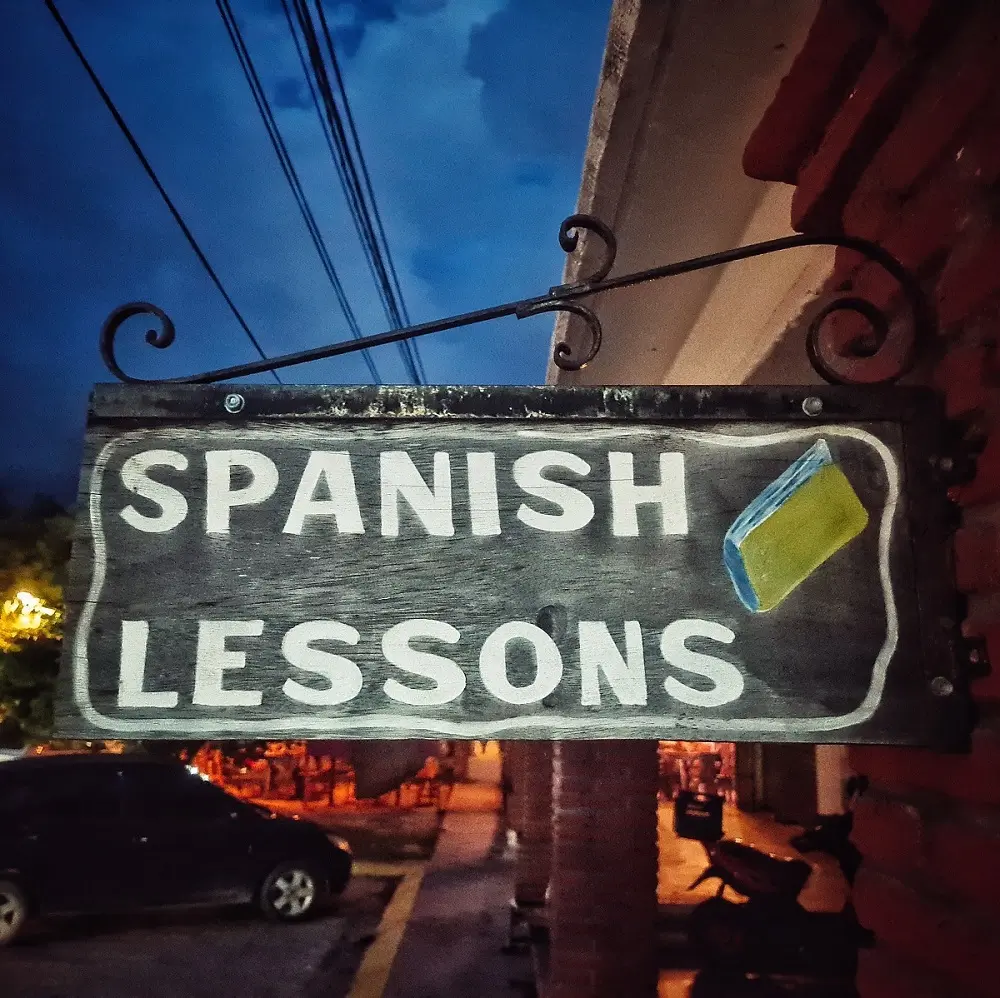
Spanish Schools | all over North, Central and South America are language schools that you can sign up for. There are hubs for cheap language courses all over the place, such as Antigua, Guatemala; Medellin, Colombia or Cusco, Peru.
These provide top-notch value for money and significant immersion to help you really get to grips with the language in a short period of time. Some offer accommodation are part of the package price. Ask around. An added bonus is the almost inevitable friends you will make during your course.
Get Some Lessons | consider having some lessons before you leave your home country, especially if you are travelling abroad for an extended length of time. A few private one-on-one lessons can go a really long way! If a group is more suited to your budget, this can be a great opportunity to meet new people who share your interests and practice your conversation skills.
Targeted Learning | if you are teaching yourself some Spanish – think about what will be most useful. Learning just the essentials before you leave is smart and you will be prepped for simple things, like buying tickets, ordering food, understanding numbers, checking the cost of items and arranging accommodation.
Don’t forget to learn all the useful polite words too – ‘please’, ‘thank you’, ‘I’m sorry’, ‘excuse me’ all go a long way.
Google Translate | Google Translate is not always correct but, honestly, it has been a godsend sometimes. It is completely free and individual languages can be downloaded to your phone so you never need internet in order to use it. Honestly, it’s actually pretty good for Spanish.
Talk to People | this one takes a bit of guts to begin with, but try having a basic conversation with someone. Once you know some basics, you realise how much you can communicate with some broken Spanish and how much you can understand in return.
Podcasts | there’s loads of ‘learn Spanish’ basic language type podcasts out there. These are pretty decent for if you’re sat on a bus or plane and you have time to burn. Exposure to the language is really useful. I found that just listening to songs in Spanish was helpful for me!
Final Thoughts – Spanish Language in Latin America
After travelling the world for the past four years, I’m still shit at languages. I’ll always be terrible at them, I think.
However, it’s essential to get the basics down in almost any country you visit, but in particular, Latin America. Spanish, specifically, is honestly such an easy language to learn if you already speak English and, as soon as I started seeing progress, it was really enjoyable too.
I hope you have a fantastic time wherever you go!
Hi, thanks for visiting our blog! If this post has been of help to you, or you’ve just enjoyed our random ramblings and musings, say thank you by buying us a coffee! It helps keep The Restless Beans blog up and running.
Thank you, Claire + Nick


Hello
Thank you for guidance
Although I have visited some Spanish countries before as a tourist but now I am visiting most of Central and South America all speaking Spanish language