

· SOUTHEAST ASIA · CAMBODIA ·
Renting a Scooter in Siem Reap: Around the Ruins and Beyond
Scribbled by Claire ⬩ 23 Aug 2025
Did you know you can now rent a scooter to get around Siem Reap? It’s the perfect way to experience the city and ruins of Angkor Wat, so read on for what licenses you need, what the roads are like, how tricky it is to ride, safety, biking around the ruins, and more.

Many years ago we spent a week in Siem Reap, using the various omnipresent tuktuks to travel around the city and adjacent sites. This was the customary means of transport for tourists, but honestly, we kind of hated it.
I’m not keen on taxis in any country (when there are alternative options) and I find it particularly irksome being on somebody else’s schedule. So, imagine being taken around the circuits of Angkor Wat and being told by your driver to meet him in 45 minutes, on the other side of a site. This took away all sorts of freedoms that I didn’t even know I needed, especially as a photography enthusiast.
Renting a driver is also kind of pricey if you want to visit the ruins at varying times of day. Imagine you want to catch a sunrise *and* a sunset on the same day – this could easily cost well in excess of 30 dollars.
However, before our most recent trip to Cambodia, we learnt that tourists are now allowed to rent a scooter in Siem Reap! This was not an option during our first trip (the laws changed in 2020, plus we had no idea how to ride a bike back then so it would have been a disaster). This news was a revelation, and renting a bike made our trip so much more enjoyable than our previous one!
I know this all sounds a bit dramatic, and maybe I’m being fussy. However, I really think that having your own method of transportation is the ultimate way to experience this epic little city and its world-famous surroundings, especially if you want the flexibility to visit on your terms. It is particularly important if you intend to do any kind of serious photography.
Note: we use motorbike and scooter interchangeably here, since they are considered the same thing in Cambodia by law.

IN THIS GUIDE //
Riding Around Siem Reap
Do we recommend Renting a Scooter in Siem Reap?
– What are the Roads and Traffic Like?
– Is Riding in Siem Reap Difficult?
– Is it Safe?
– Check Your Insurance
What Licenses Do You Need?
– Are You Allowed to Ride a Scooter in Siem Reap?
How Much Does it Cost to Rent a Scooter?
– Deposits
Simple Road Rules and Tips
Are You Allowed to Ride Around Angkor Wat?
– Roads and Parking
Alternatives to Scooters
Where to Next?
This post may contain affiliate links. If you book through these links we may make a small commission at zero cost to you. It helps us pay for the upkeep of this blog. Thank you!
Do we Recommend Renting a Scooter in Siem Reap?
Yes, we would highly recommend renting a scooter – zipping around the city was our favourite part of our visit! However, there are a few things to think about before renting one:
What are the Roads and Traffic Like?
The roads and traffic can be characteristically southeast-Asian-city hectic (IYKYK), and if you don’t know how to follow the flow of traffic, rather than rules, it might be stressful.
Around the city, the roads vary from well paved, maintained surfaces, to dirt and pot-holed tracks than can catch a bike rider unawares and cause an accident. It depends on exactly where you want to ride, but I’d recommend not flying down any backroad at a speed that is too fast to control if you hit a sneaky bump (honestly, there’s never a reason to speed around Siem Reap – it’s such a chill place).
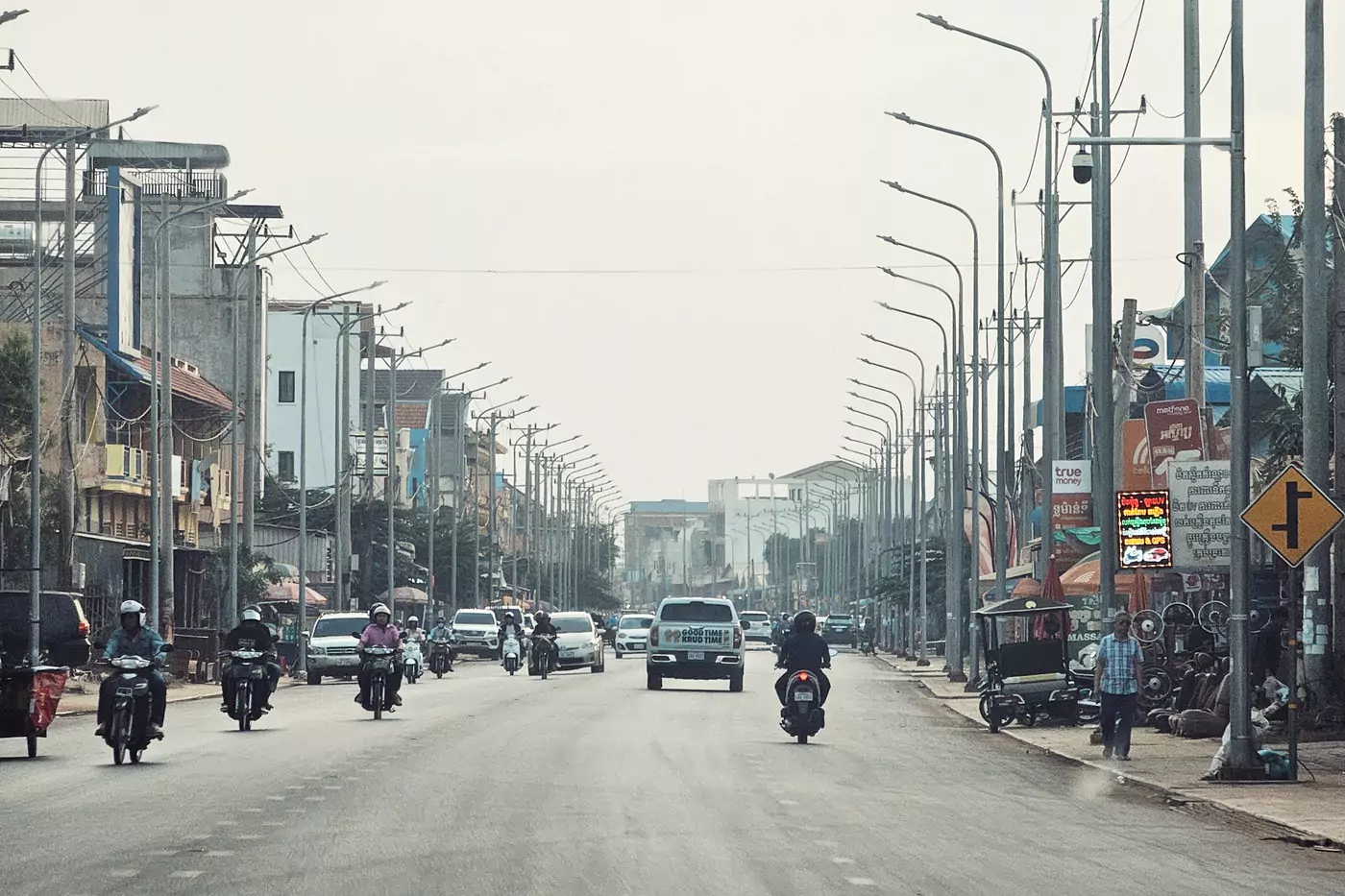
The traffic is quiet and peaceful early in the mornings but gets progressively busier as the day goes on. Motorbikes and scooters make up most of the traffic, but there are cyclists, cars and tuktuks mixed in, too. Even when the traffic was busy, we didn’t find it difficult to navigate, once used to the slightly chaotic traffic current. (In fact, I’d argue that it isn’t chaotic at all and there’s actually a smooth, sensible flow to it. You’ve got to be in it to see it!).
Is Riding in Siem Reap Difficult?
We found Siem Reap really easy to ride around, especially earlier in the mornings. It’s a city that has some very busy main streets running through it, but most of the smaller side roads are peaceful so you never feel so stressed out by the traffic that you can’t escape most of the time. Generally, the traffic is pretty slow moving anyway.
The city is also just not that large, so you end up riding the same roads over and over. It’s quite easy to learn the routes to the shops, markets, ruins, and your hotel without any GPS.
Driving at night is pretty chill, too, within Siem Reap itself. There are street lights and the roads aren’t busy – we drove around a lot between places in the mid/late evenings. Just be careful because seeing the pot holes at night is a bit tricky. My biggest concern, if I’m honest, was the drunk tourists coming home from Pub Street.
Is it Safe?
Yes, we’d say it is safe to ride a scooter in Siem Reap.
However, if you do not have experience riding a motorbike or scooter in southeast Asian city-style traffic, we’d suggest skipping the scooter rental here. It’s not a place to learn for the first time, that’s for sure!
Personally, we found the driving and riding in town to be actually quite cathartic and comfortable, but we ride our motorbike around Bangkok, and nothing is more exhausting than that! So, we’d urge you to consider your experience (and insurance) before deciding to ride.
Check Your Insurance
As we mentioned above, you should definitely consider your travel insurance before renting a scooter.
Not only do you need to be legal to ride, but you also need to make sure your travel insurance covers scooter rental with whatever license you currently hold. Many imply they do, but actually the small print can be a bit unclear – we’d suggesting reading your policy very carefully.
If you fall off or somebody hits you, you really need to be able to afford the treatment (and repatriation in extreme circumstances).
There is a way to ride completely insured even if you do not have the correct license through a reputable company called Genki. The policies are pricey, but they insure unlicensed riders, so it’s understandable! We’d highly recommend you get the correct licenses, but if you can’t for whatever reason, they will cover you.


What Licenses Do You Need?
To rent a scooter in Cambodia for short term-stays (under three months), you need to have your home driver’s license and a 1949 International Driving Permit (IDP).
⬩ If you rent a bike with an engine size of 125cc and under, you do not need to have a specific motorbike license.
⬩ For bikes above 125cc, you need to have a full motorbike license in your home country.
Most bikes we saw were 125cc exactly, so you’ll definitely be able to find a bike to ride if you don’t have a full bike license (although, as we said above, we’d recommend you have some previous experience and check your insurance).
You legally have to wear a helmet, too, while we’re talking about requirements!
Without all these fulfillments, you’ll almost certainly be riding uninsured. If that is the case, we’d recommend Genki for your travel insurance policy, so that if you get in an accident you’re covered.
Are You Allowed to Ride a Scooter in Siem Reap?
So, this is a weird one. Some online sources report that within Siem Reap itself, you are not allowed to ride a motorbike, because it was taking away work from the tuktuk drivers and tour guides. However, there are rental agencies everywhere and this doesn’t seem to be the case on the ground.
We’ve not managed to find any official corroborating evidence for this, but we thought we’d mention it, just so you know.
How Much Does it Cost to Rent a Scooter?
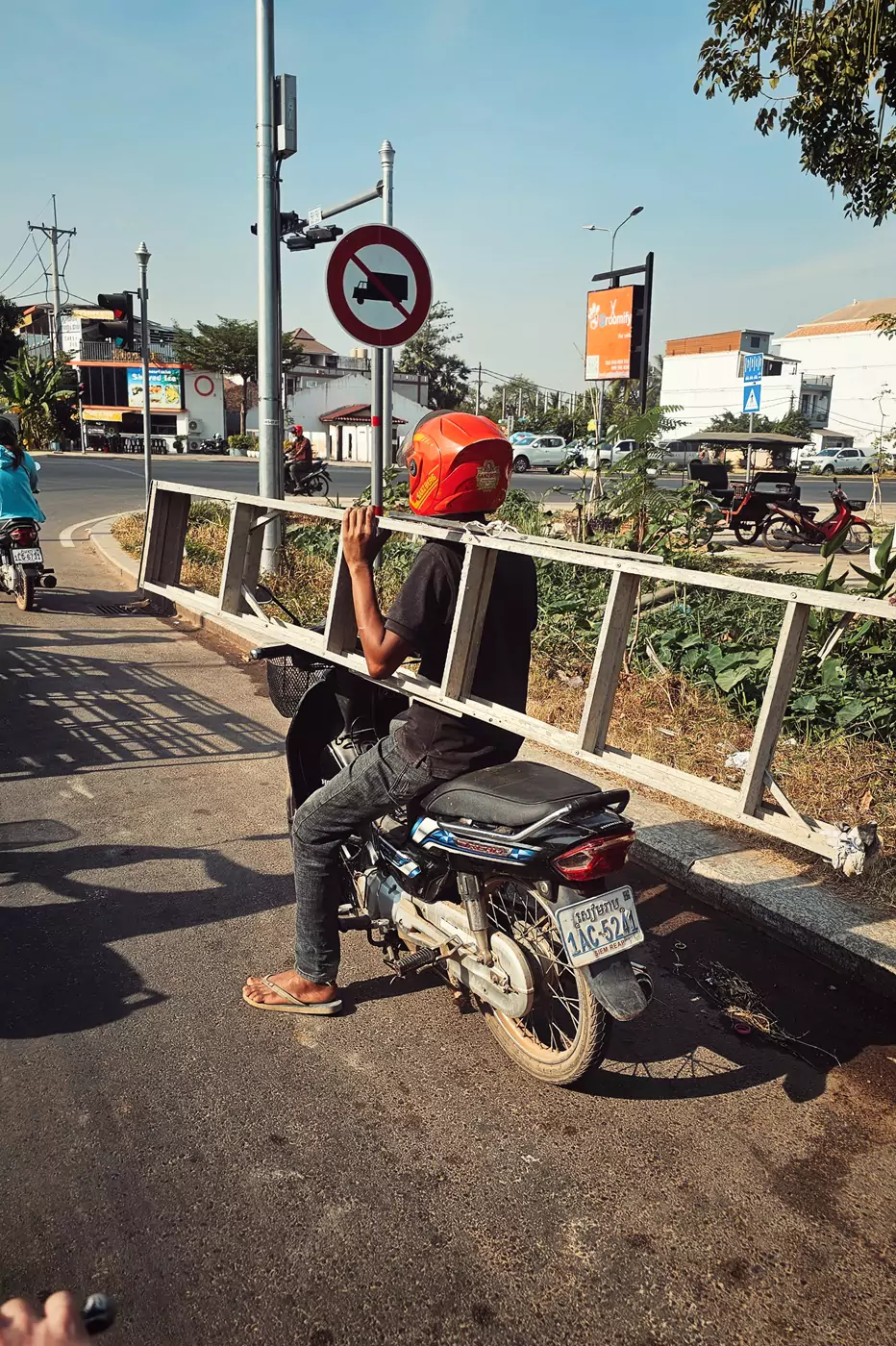
We wandered around many streets in Siem Reap, hunting for rental bargains. During our search, we were quoted from between 8-15 dollars a day for a scooter.
The first place we checked out was our hotel who wanted to charge 15 dollars a day – which is a bit on the high side! We then wandered around various shops and enquired anywhere with a row of bikes outside, who mostly quoted 8-10 dollars a day.
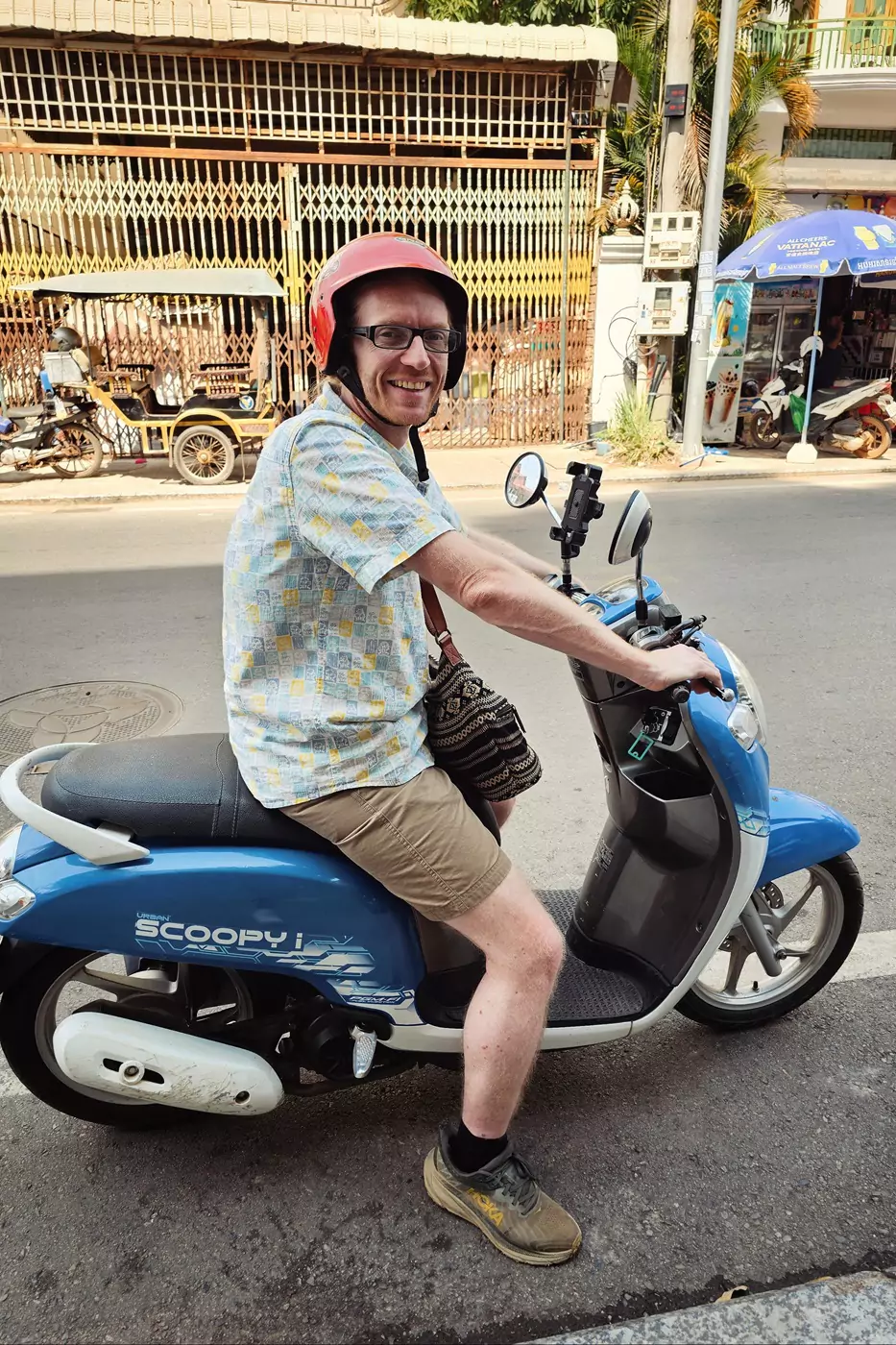
We settled with a blue 125cc Scoopy with two dodgy helmets from a nice lady down the road from our hotel for 8 dollars a day. Her shop was called Villa Niron (Hostel & Bikes Rental) and she was very flexible – like she didn’t really care when we brought it back (even though we kept it for longer than our initial rental agreement). She didn’t overcharge us or try to claim any damages.
Deposits
When hiring a scooter, it is usual to provide a deposit in case of damage to the vehicle – usually in the form of either identification or cash.
Never leave your passport as a deposit. It is not required (in fact I don’t even think it’s legal to do so). You should be able to leave a copy of your driving license or passport, instead. We often use an old driver’s license as a deposit.
For our recent bike hire in Siem Reap, we left a spare International Driving Permit as our deposit (we have more than one for these exact scenarios!).


Simple Road Rules and Tips
Below are a bunch of useful things to know about the roads before setting off on a scooter.
Also, in Cambodia, people drive on the right side of the road.
Speed Limits
Speed limits within Siem Reap are typically 40 kilometres per hour, although they are rarely signed on the roads through the town.
If you drive further afield, there are a few speed signs on the main roads between cities (for example, there was the occasional sign when we drove to Battambang).
Traffic Lights
We never saw people running red lights, or even getting impatient at other road users (which was a lovely surprise, to be honest). Having said that, there aren’t all that many lights in Siem Reap.
You can turn right on a red light as long as it is safe to do so and you come to a complete stop first. In practice, you’ll see motorists slow down before turning, without stopping.
Also, when there are lights at crossroads, there are no right-only or left-only lights (that we saw). This means it’s a battle to turn across the opposing traffic. So, motorbikes will wait at the front then dash off as fast as possible to beat the stream of oncoming cars just as the lights go green. It can be a bit of a hilarious, head-on mess if you are turning left!
One-Way Streets
There are quite a few one-way streets in town, which actually makes riding around easier (especially if you are used to driving on the left side of the road, like us).
However, Google Maps isn’t always aware of these one-way roads and might try to send you the wrong way – always follow the traffic flow or any road signs.
Indicators
Drivers and riders in Cambodia don’t tend to use their indicators all that much. However, people don’t use lanes that much either, so it’s not really that big a deal. We used ours anyway wherever it made sense to, though.
Horns
In Cambodia, people don’t use horns very much, at all. It’s definitely nothing like riding a scooter in Vietnam!
Generally, we found it very peaceful cruising around Siem Reap.
Crossroads
Crossroads in central parts of town are probably the most difficult part of driving around Siem Reap, because there’s no obvious way to know who has right of way.
I’d recommend being a little hesitant, but sometimes you simply have to throw yourself into the stream of opposing traffic and hope for the best. The thing is, this *always* works out because Cambodian traffic flow works just like a river, diverting around obstacles and taking the path of least resistance. Somehow, it’s always fine, even when it feels like it shouldn’t be.
Parking
We were told that:
⬩ When the curb is painted white, or black and white, then parking is allowed.
⬩ When the curb is painted yellow and white, parking is not allowed, but unloading/loading of goods and passengers is okay.
⬩ If the curb is painted red and white, then neither parking nor loading/unloading is permitted.
⬩ Mostly, the curbs are not painted at all, so you can park wherever (using some common sense).
However, we noticed that, unofficially, most of these parking rules don’t seem to apply to bikes!
Pedestrians
Sometimes, there are no paths, so pedestrians have to walk along the roads. Other times, there are paths, but pedestrians will walk along the roads anyway.
Just as the traffic flow will avoid you if you pull out in front of motorists, it will also meander past pedestrians in the road, too.
So, just keep an extra eye out, especially for kids.
Gas Stations
There are a fair few gas stations around Siem Reap and they show up on Google Maps.
They are manned by an attendant, so you don’t fill up the tank yourself. Just tell the employee ‘full’, or the number of litres you need. Currently a litre of petrol costs a little over a dollar. We always paid in cash (because it is so affordable to fill up a scooter tank!).
Average Speeds
Honestly, if you’re reading the above and it makes you feel a bit nervous, it’s worth noting that nobody drives very fast in Siem Reap. This means any unpredictable movement is so slow that it doesn’t feel disconcerting.
It would be very rare to go over 40 km/h in central Siem Reap, and usually you’ll be travelling less than 30 km/h.
WHERE TO STAY IN SIEM REAP
We’ve stayed multiple times in Siem Reap, each time trying out a few different hotels.
Our favourites have been:
Hari Residences and Spa ($$) | this hotel is simply outstanding value for money. It’s located in central Siem Reap by the river and old town, so everything is walkable. The staff take customer service *way* above and beyond, and the super clean and comfortable rooms are enormous, with large balconies furnished with swinging chairs. It’s such an arty, thoughtfully designed hotel, even down to the welcome drinks and cake (it was actually decent cake!).
The hotel has one of the best rooftop pool views in the city, too! Oh, honourable mention for their outstanding always-included breakfast, which was fresh, vegetarian friendly and massively varied.
———
Viroth’s Hotel ($$$+) | this hotel was an immaculate dream that I never wanted to wake from (sounds dramatic, but it’s true). It’s bit pricier than our usual choices, but also worth absolutely every penny (it had a exceptional reputation and I wanted to test that out). With a location near the river, it’s perfect for exploring Siem Reap on foot, although we didn’t really want to leave after arriving.
The staff are second to none (I actually mean that, probably the best customer service we’ve received anywhere), the aesthetic design is top notch and the hotel is pristinely maintained. I’m a plant person, so this hotel was particularly magical for me. The rooms are modern, with extremely comfortable beds, and are way brighter than any others we’ve had in Cambodia. Everything about this hotel was just so thoughtful. Also, the exceptional pool and restaurant are worth staying for, alone.
–


Are You Allowed to Ride Around Angkor Wat Without a Guide?
Yes, you can absolutely ride your scooter around Angkor Wat independently (in fact, we think it’s the best way to see the site).
You must have a ticket in advance before riding there, though, because there are checkpoints on the roads and you will definitely be flagged down and your ticket will be checked. There are standard spots where the staff wait, such as around the gates to Angkor Thom (Bayon). You’ll see them wave from the side of the road.
A ticket is necessary even if you ride past the ruins and don’t actually go into the sites. We would usually have our ticket checked on the roads a minimum of twice per day.
Other than that, you can ride around the area freely, stopping wherever you want. It’s super cool, because there are loads of small quirky stops that we didn’t get to visit during that first trip to Angkor Wat that we were able to explore on our own with a scooter (like small gates and random, overgrown roadside ruins).
Roads and Parking Around Angkor Wat
The roads aren’t particularly busy around the Angkor Wat ruins and are generally well paved, but it’s worth noting that people do tend to drive a little faster out here since there is so little traffic. We noticed the roads became quite busy around school time, with people dropping off their kids between 7-8am.
There are small parking spots for bikes and tuktuks outside all the major ruin areas, so you won’t struggle to find somewhere to park. Just look for loads of tuktuks, bikes, a set of shops, or a small stretch of dirt by the side of the road.
Be aware that there are monkeys all over Angkor Wat and they will steal anything you leave unsecured! Also, watch out for them crossing the roads, especially around Bayon, because they’re kind of an earthy brown and hard to see against the roads in low light. We had a whole troupe wander out in front of us several times.


An Alternative to Scooters
Maybe after reading all of this, you’re a little uncomfortable with riding on Siem Reap’s roads with your current biking skills (totally understandable). Or you’re travelling in a group and some of you can’t ride a motorbike.
Did you know there is an alternative to scooter rentals that still gives you the flexibility and freedom of a bike?
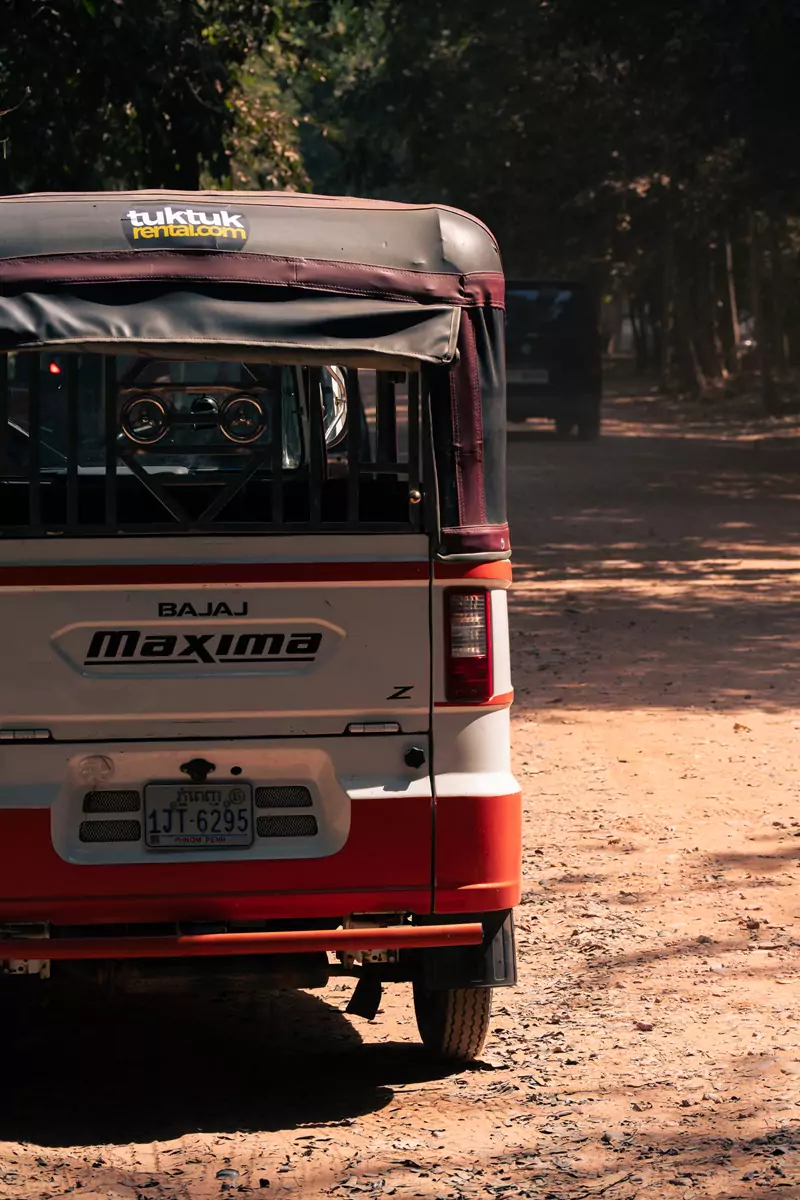
It is possible to rent your very own self-drive tuktuk, which comes complete with lessons and insurance. It’s a fantastic way to get around Siem Reap, especially if there’s a group of you, or you have kids (they can hold four people at a stretch).
We’ve rented tuktuks in Sri Lanka and Cambodia, and the Cambodian tuktuks are waaaaaay nicer – they’re practically luxury.
So, if this is something you’d consider, head on over to our guide to renting a tuktuk in Cambodia (spoiler: it’s hilarious, great value for money, and well worth it for the convenience).

Where to Next?
I really loved our time in Siem Reap. It’s actually one of my favourite cities in southeast Asia and I can’t wait to go back. It is one of those places that actually lowers my blood pressure a little – a kind of therapeutic, liberating place to exist in. This sensation is enhanced substantially by getting around with our own transport!
It’s a magnificent feeling whizzing around the Angkor ruins all alone at sunrise. It’ll be one of those core memories that stays with me forever. We highly recommend it (the same goes for whizzing around in a tuktuk, too!).
If you’re planning your trip to Siem Reap, have a peek at how we’d spend two days in the city – there’s so much to do beyond just the temples!
Hi, thanks for visiting our blog! If our free content has been of help to you, or you’ve just enjoyed our random ramblings and musings, say thank you by buying us a coffee! It helps keep The Restless Beans blog up and running.
Thank you, Claire + Nick


