

Street Photography at Thaipusam – Capturing an Unconventional Voyage to the Batu Caves
Scribbled by Claire ◊ 01 Mar 2025
Photographing the Tamil celebration of Thaipusam at the Batu Caves in Kuala Lumpur was the highlight of my travel-photograhy life. Here, we write about why the event was so incredible, what all the symbolism means, when to arrive, photography tips and more.

I first read about the Tamil festival of Thaipusam around two years ago. It was mentioned in a low-key article about festivals and events around Malaysia.
In that publication, Thaipusam was described as a Hindu religious celebration, with devotees bearing enormous encumbrances. They walk barefoot over long distances and, more dramatically, inflict mortifications of the skin, like piercings with skewers.
As a photographer, this depiction of Thaipusam piqued my curiosity. Street photography is always my preferred genre and bright, dynamic events are my favourite (aren’t they everyone’s?). Specific cultural celebrations are also a fantastic way to capture photos that tell a story, interact with participants, and learn about something totally distant from your own world. It’s also quite a challenge for me (compared with landscape and other, more stationary, photography!).
Anyway, this article contains my favourite Thaipusam street photography, with explanations of everything I learnt and what the photos exhibit (attendees were more than happy to enlighten me). It also notes where we took photos, what settings we used and any tips we have, plus thoughts on the ethics of photography at events such as this. It’s an interesting one!
For more logistical information on visiting Thaipusam, check out our how to visit guide.

IN THIS GUIDE //
Thaipusam Photography
WHAT IS THAIPUSAM?
A PILGRIMAGE
HOLY ASH AND BODY PAINT
MORTIFICATION OF THE FLESH
KAVADIS AND THEIR BEARERS
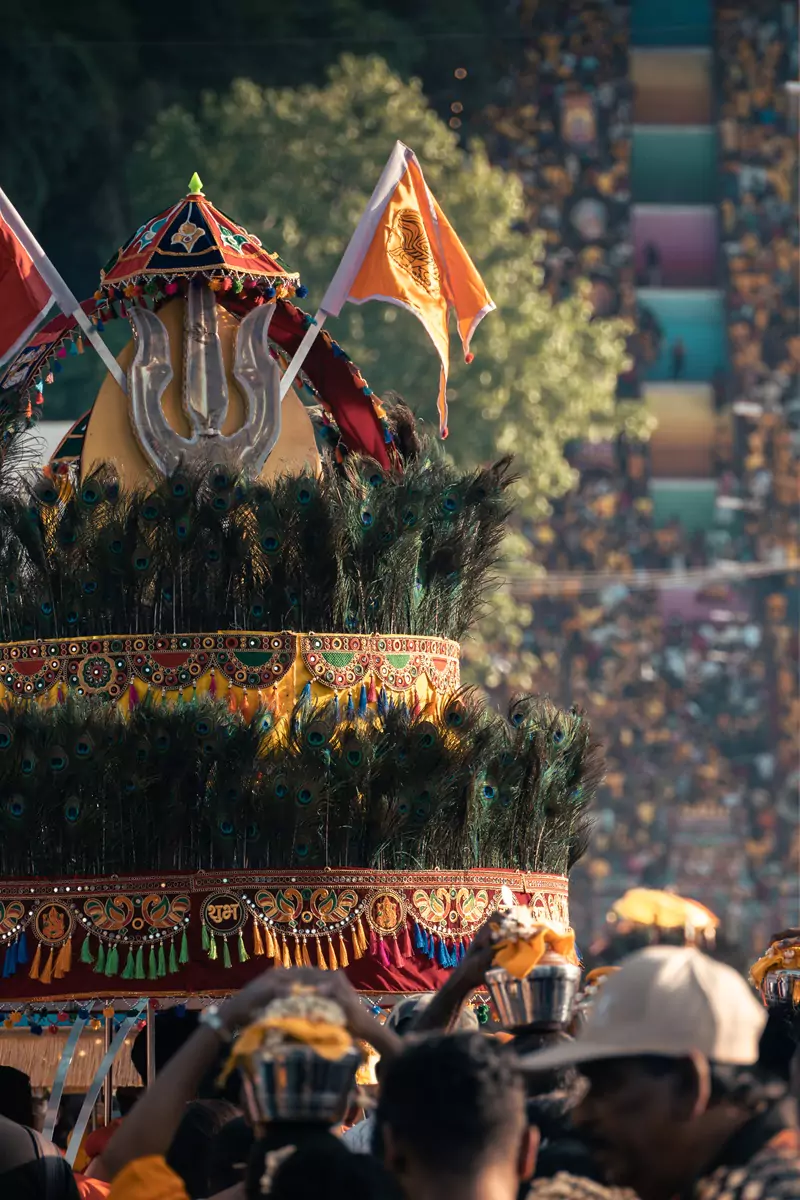
SIGNIFICANCE OF PEACOCK FEATHERS
IMPORTANCE OF COMRADERY
MOTIVATING MUSICIANS
DEVOTEE PREPARATION
THOUGHTS AND TIPS ON PHOTOGRAPHY AT THAIPUSAM
– HOW TO TAKE THE BEST PICTURES
– PHOTOGRAPHY SUGGESTIONS
ETHICS OF STREET PHOTOGRAPHY AT THAIPUSAM
– THINGS TO CONSIDER AS A PHOTOGRAPHER
PHOTOGRAPHERS WITH(OUT) EGOS
FINAL THOUGHTS – THAIPUSAM PHOTOGRAPHY
This post may contain affiliate links. If you book through these links we may make a small commission at zero cost to you. It helps us pay for the upkeep of this blog. Thank you!
LOGISITICS OF ATTENDING THAIPUSAM AT THE BATU CAVES
If you want to know how to visit Thaipusam in Kuala Lumpur, including transport options, where to stay, what our experience was like, how to dress, and more, have a look at our logistical guide to visiting the festival.
–
RELATED | 15 EPIC PENANG PHOTOGRAPHY SPOTS
What is Thaipusam?
I’ve written more in-depth about this within our Thaipusam guide but, in brief, it’s a celebration of the Tamil Hindu god of war, victory and wisdom – Lord Murugan.
Devotees show their dedication to Lord Murugan by undertaking a demanding pilgrimage to the Batu Caves, in northern Kuala Lumpur (and other temples across the world).
A PILGRIMAGE
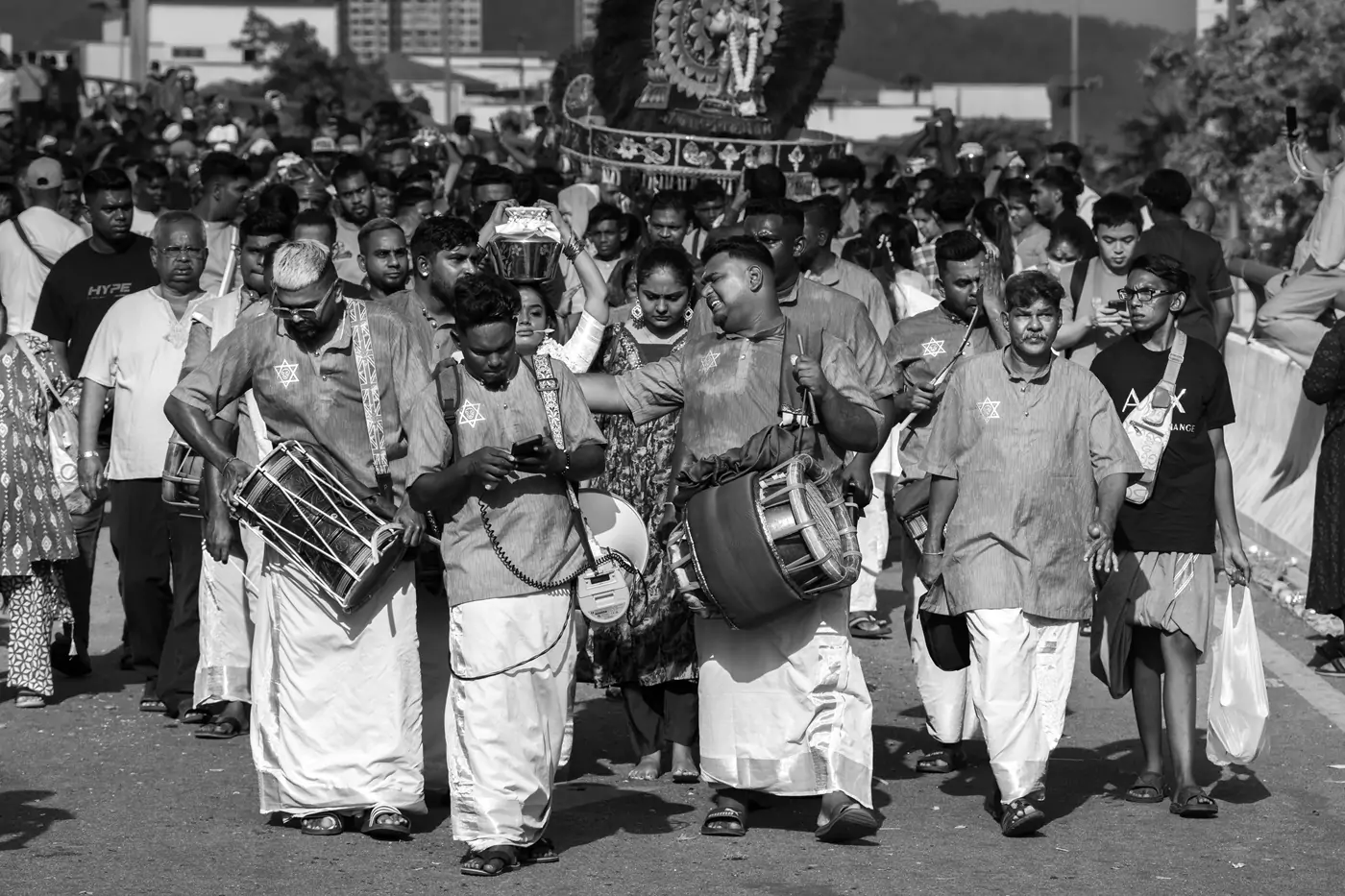
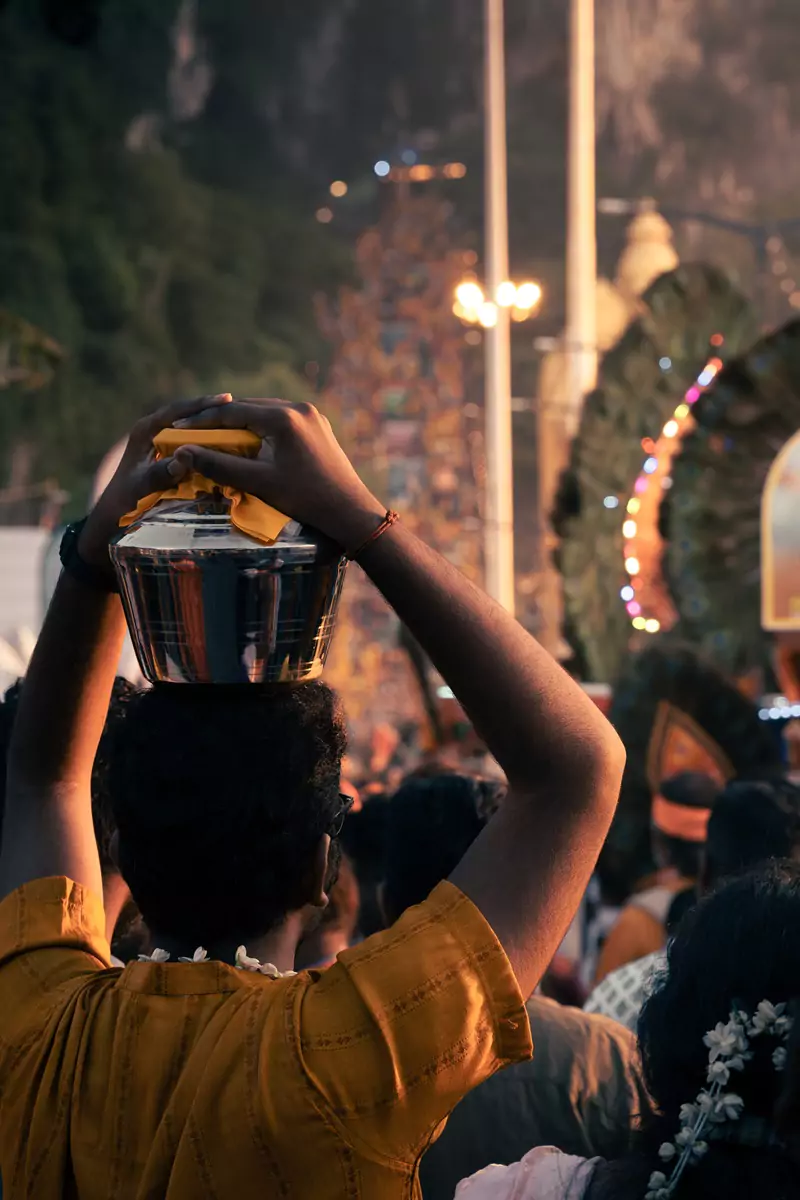
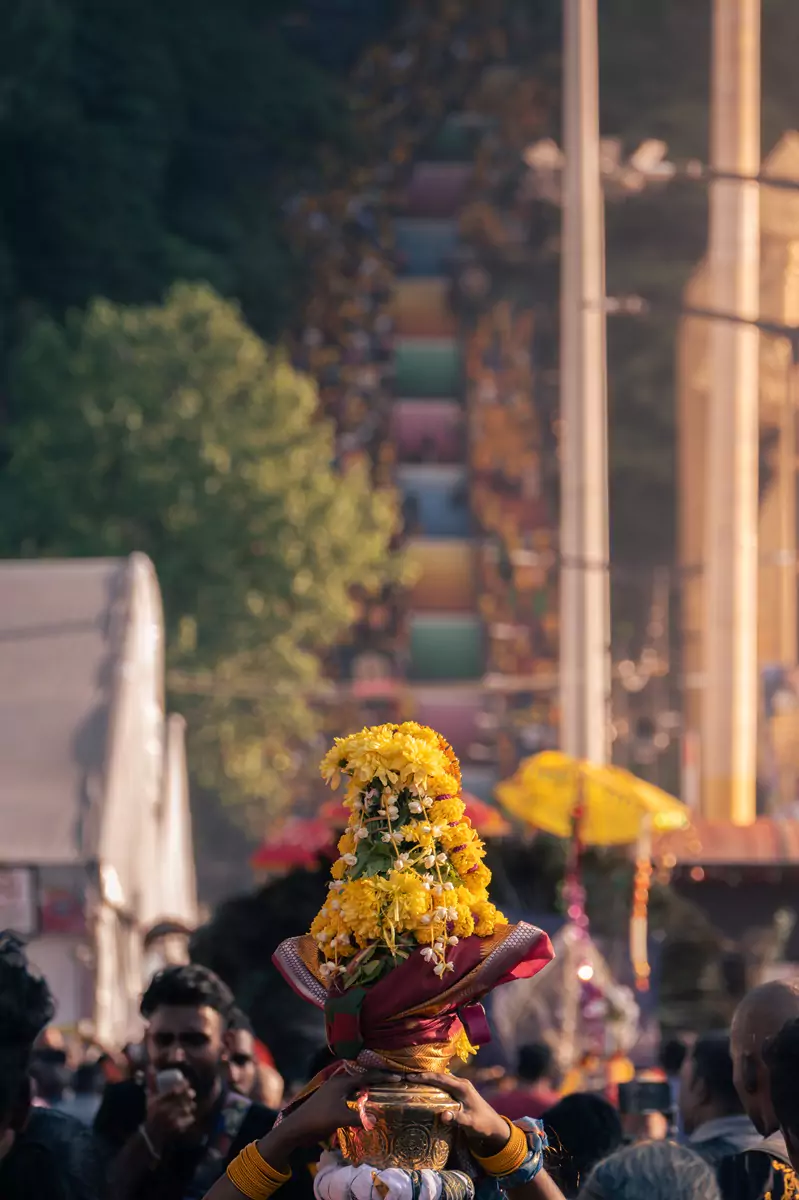
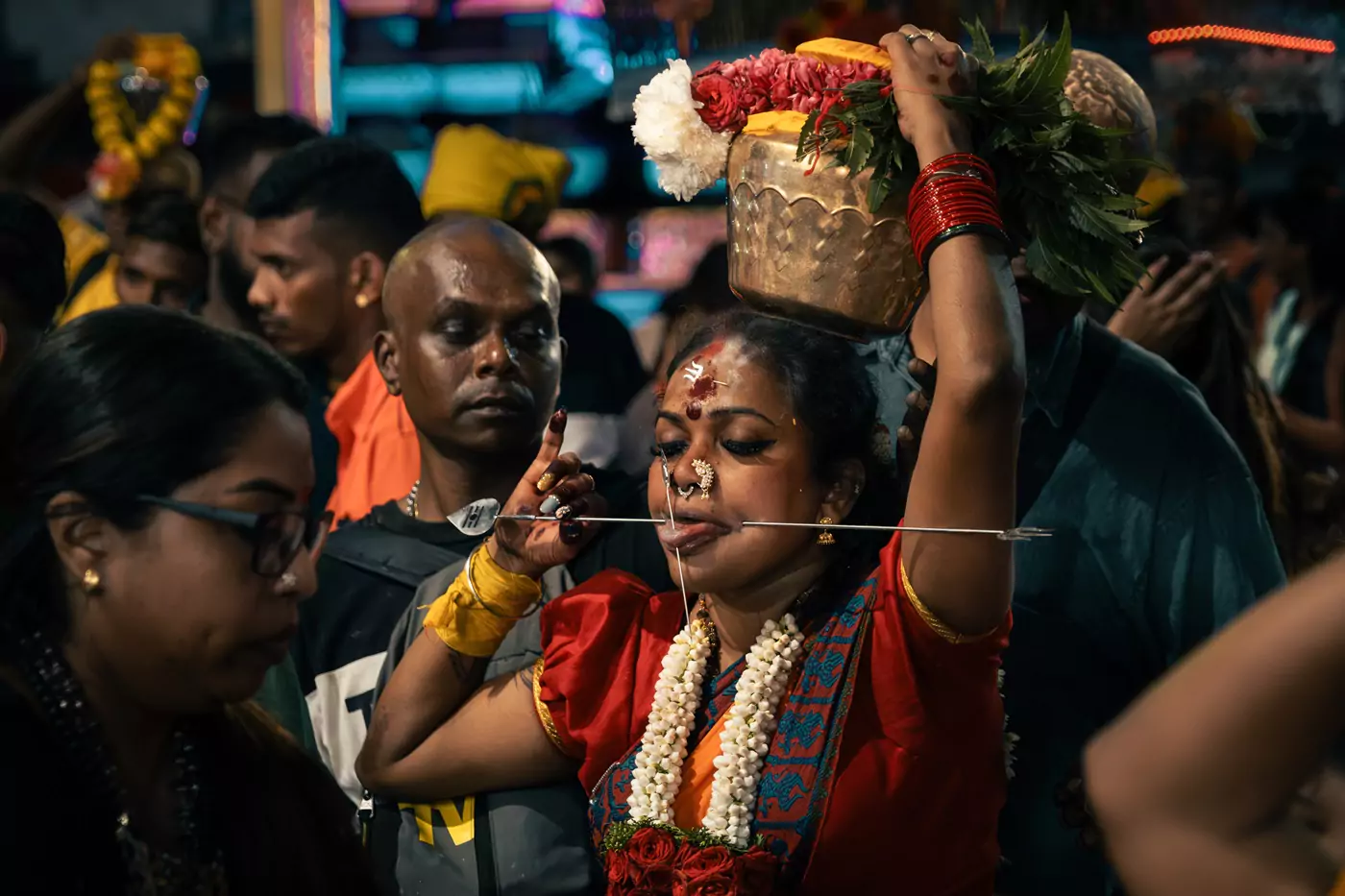
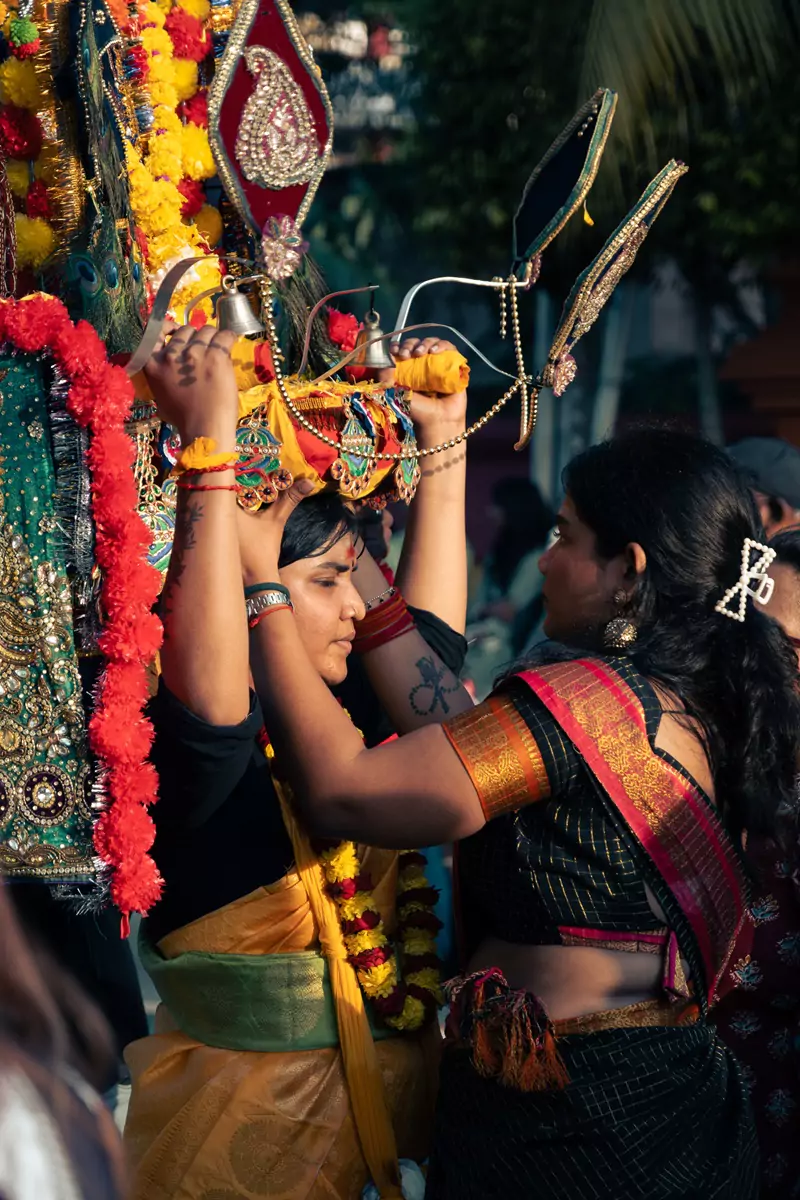
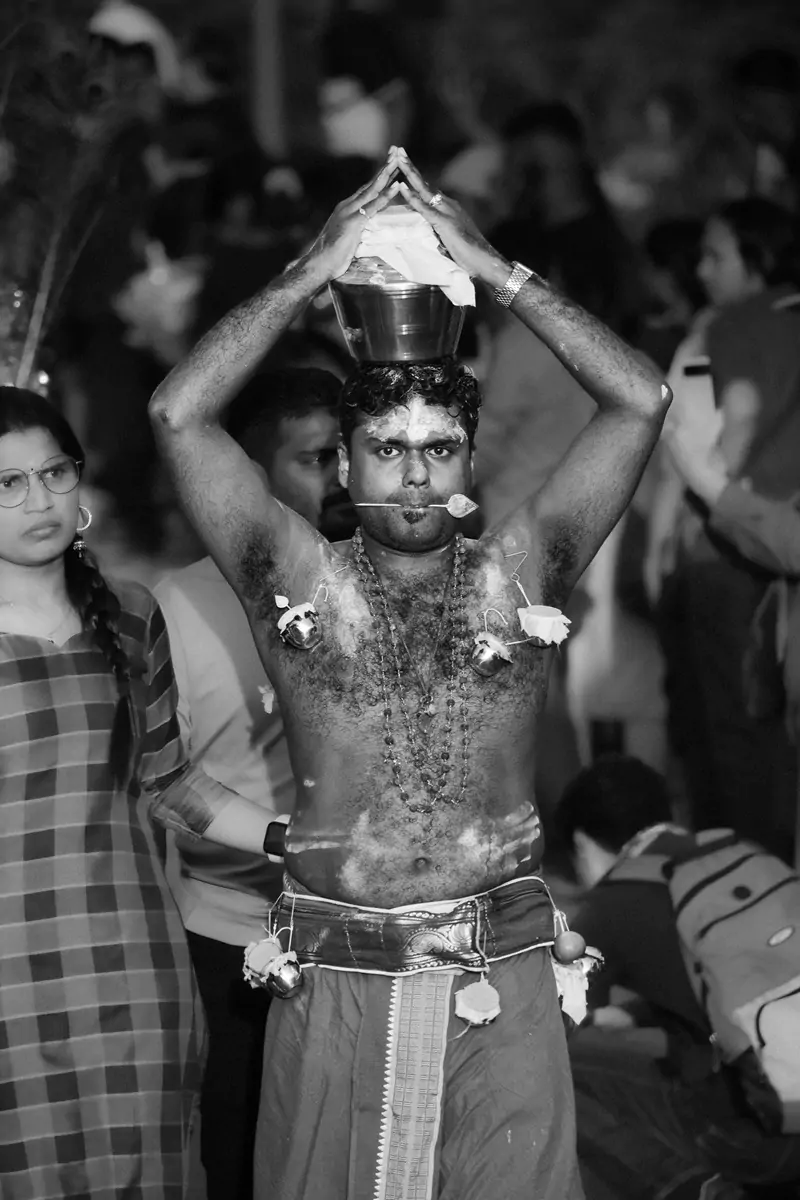
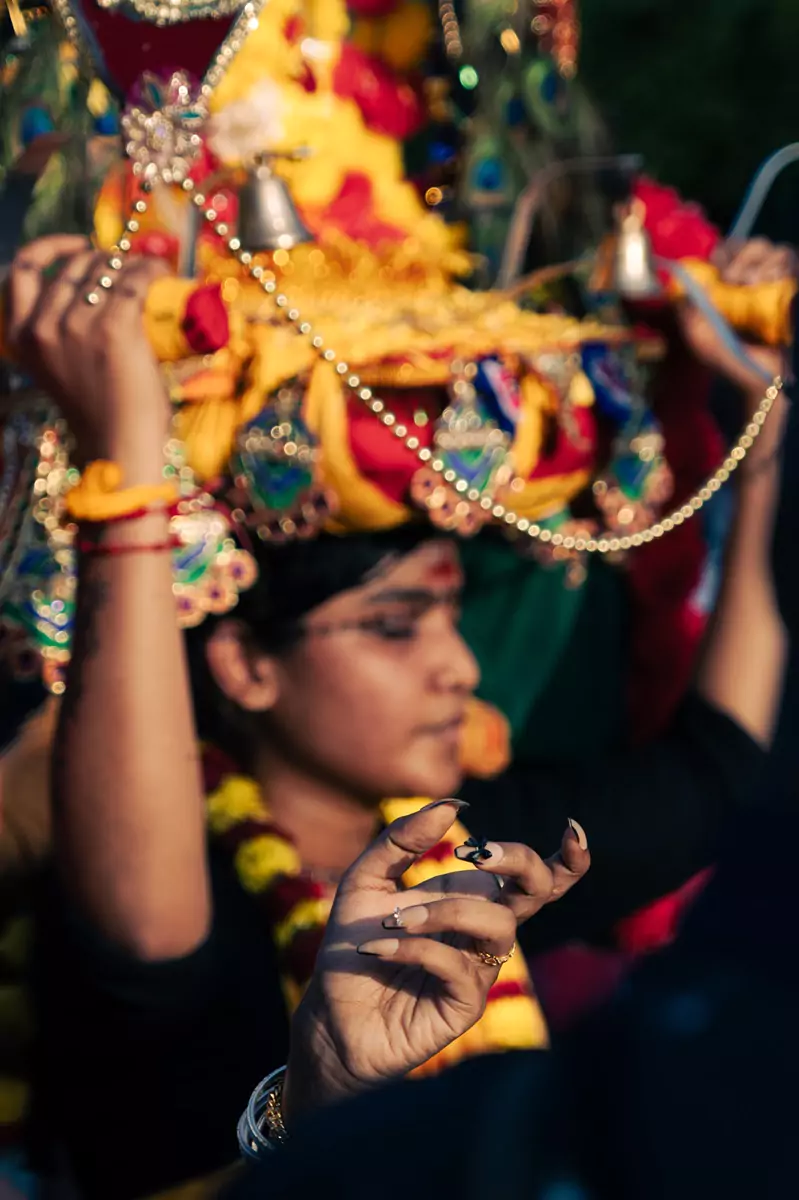
Tamil Hindu devotees attending Thaipusam in Kuala Lumpur undergo a pilgrimage to the shrine of Lord Murugan at the Batu Caves. Here, they perform a ‘Kavadi Aattam’ which is a ceremonial act of sacrifice with the concept of burden at its core. In practice, this typically involves carrying a physical burden such as a ‘Kadavi’, a structure worn on the shoulders or a ‘paal kudum’, a milk pot worn on the head.
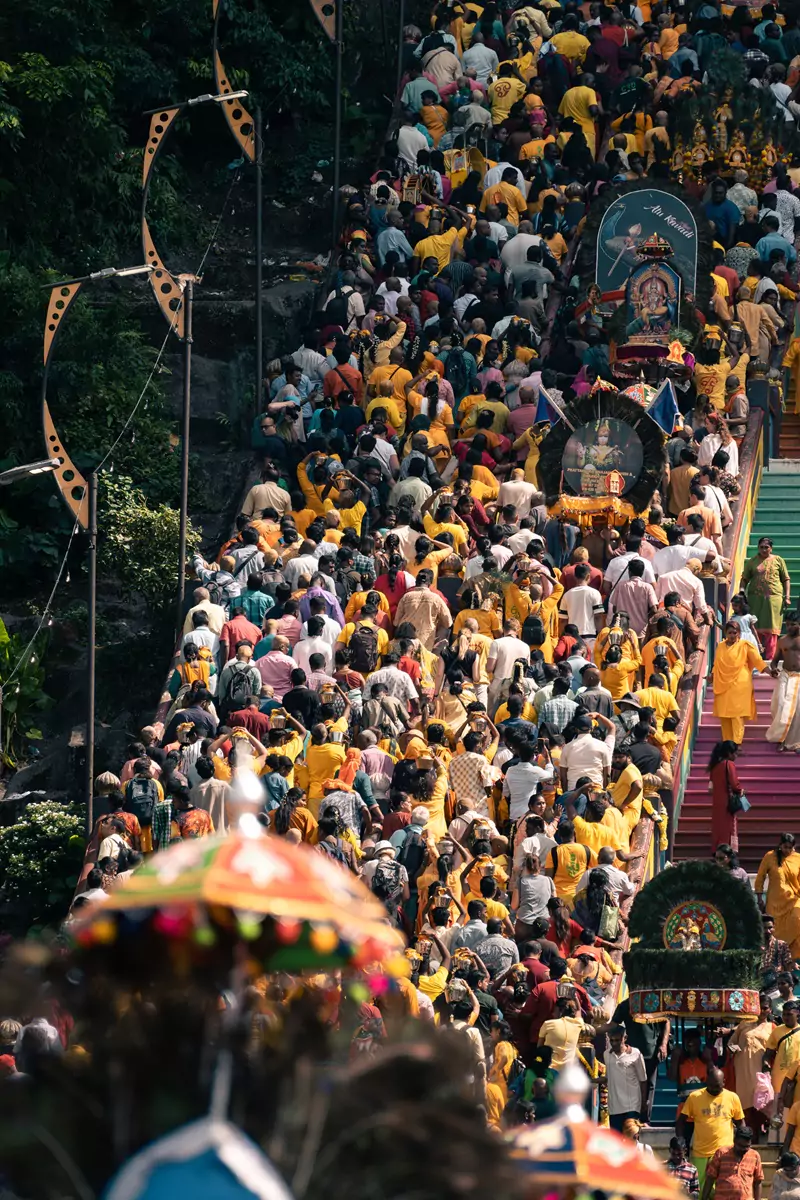
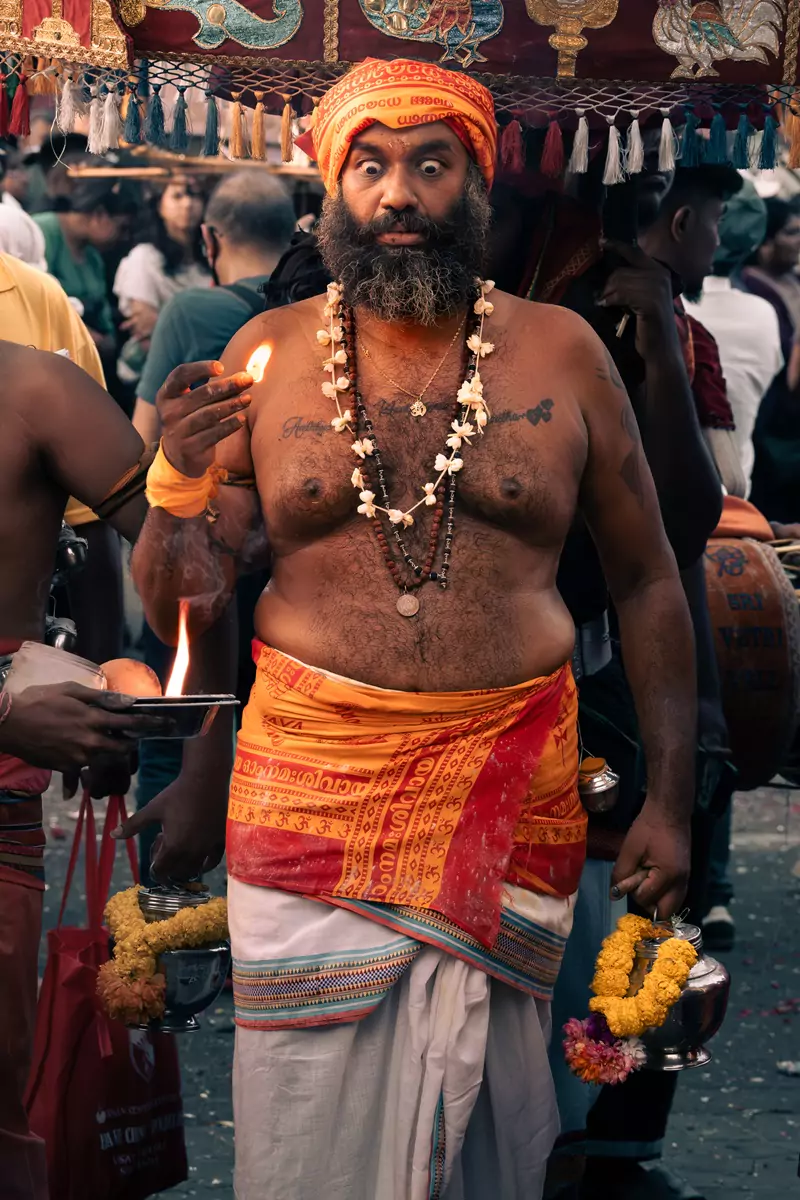
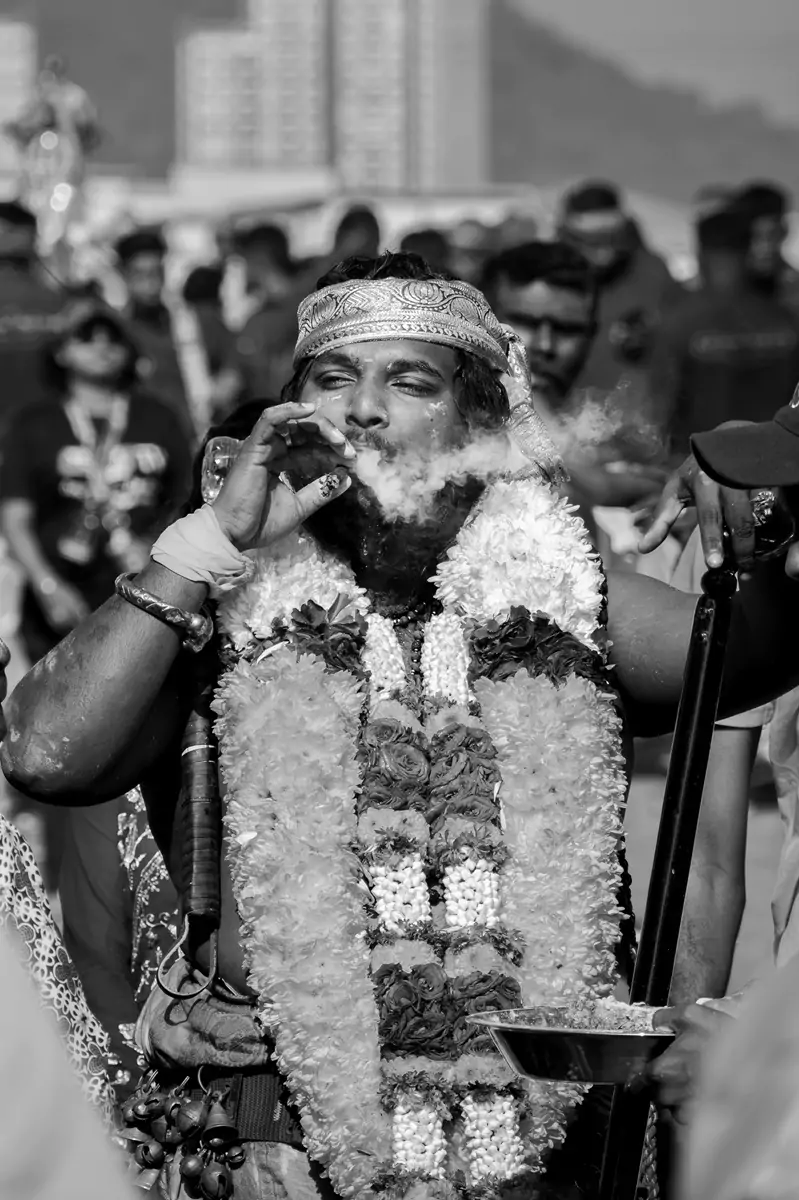
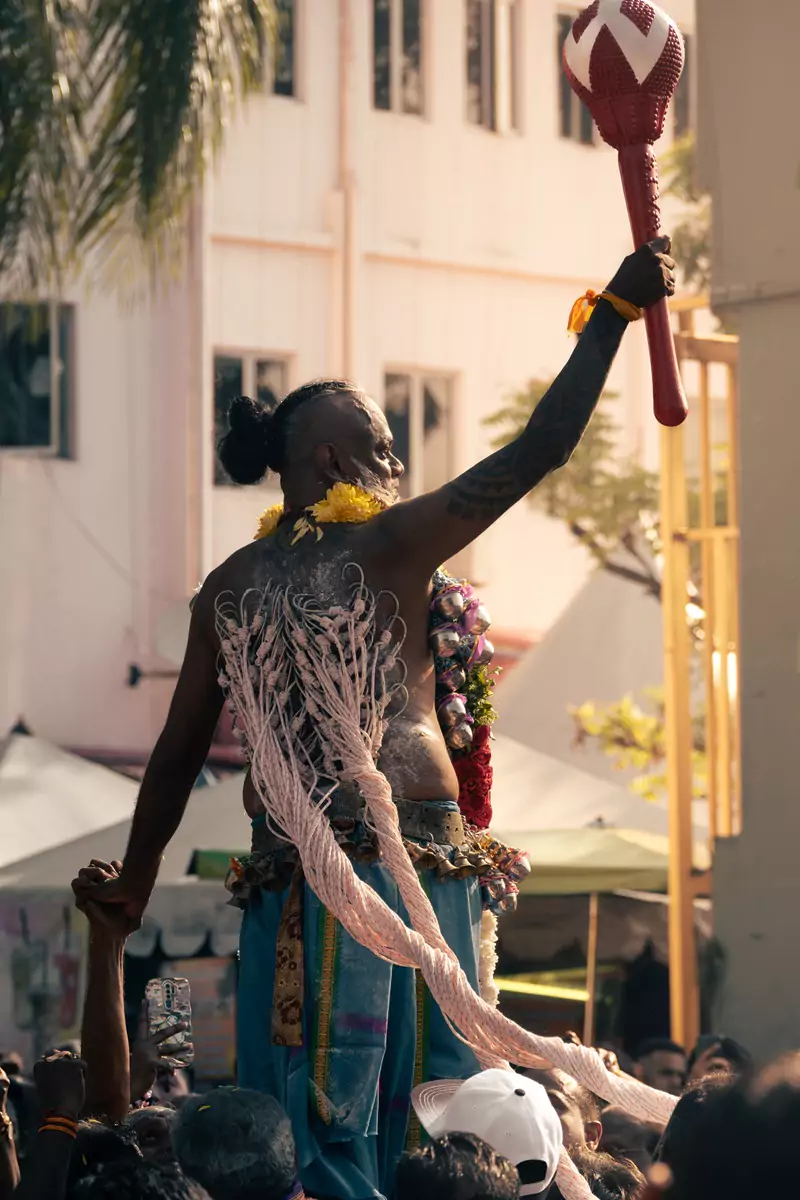
Participants wear clothing in shades of orange, yellow and red, as well as garlands of flowers. Some will adorn yellow face paint on freshly shaven heads, whilst others will walk in barefoot with skewers through their skin.
–

HOLY ASH AND BODY PAINT
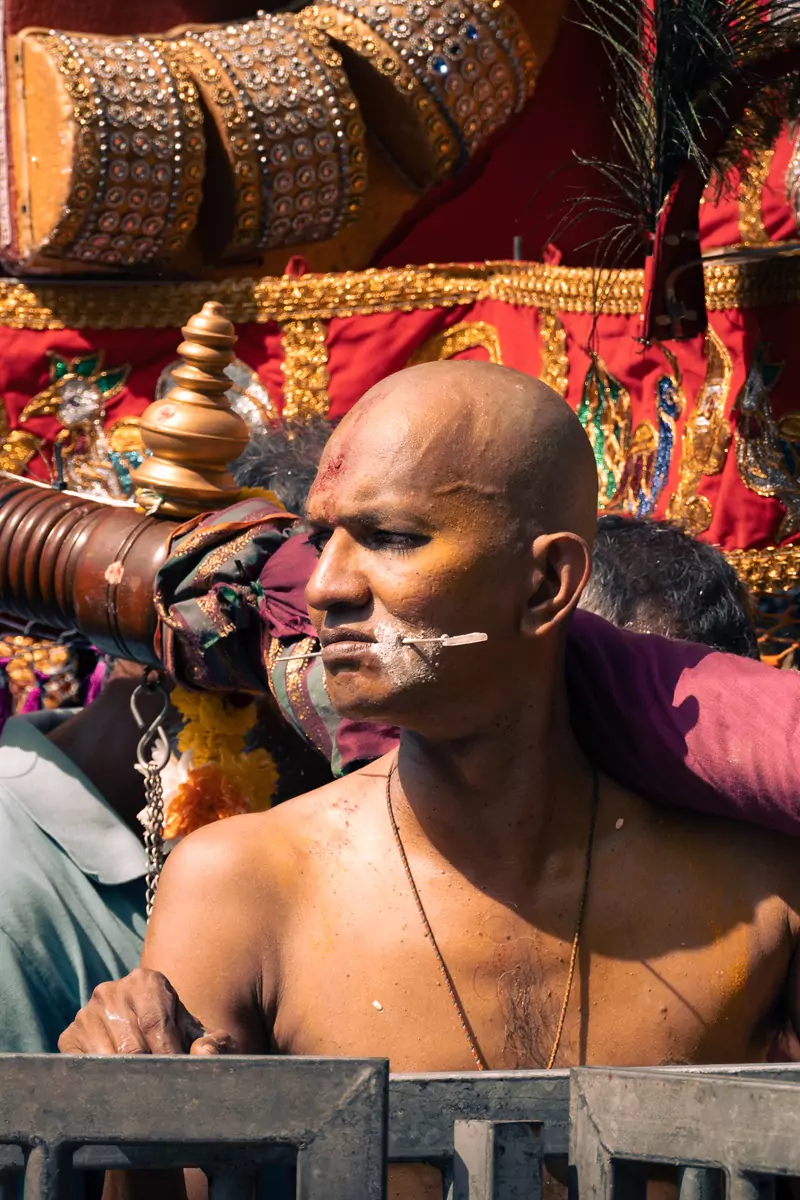
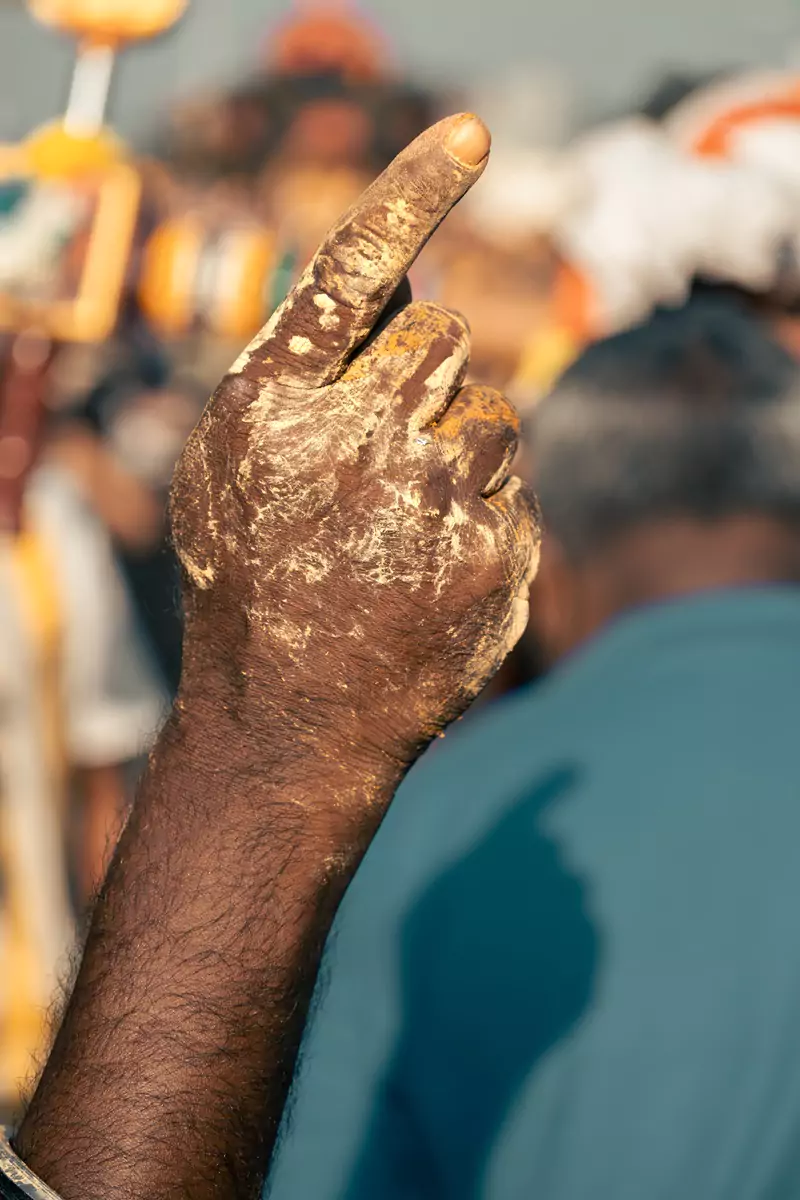
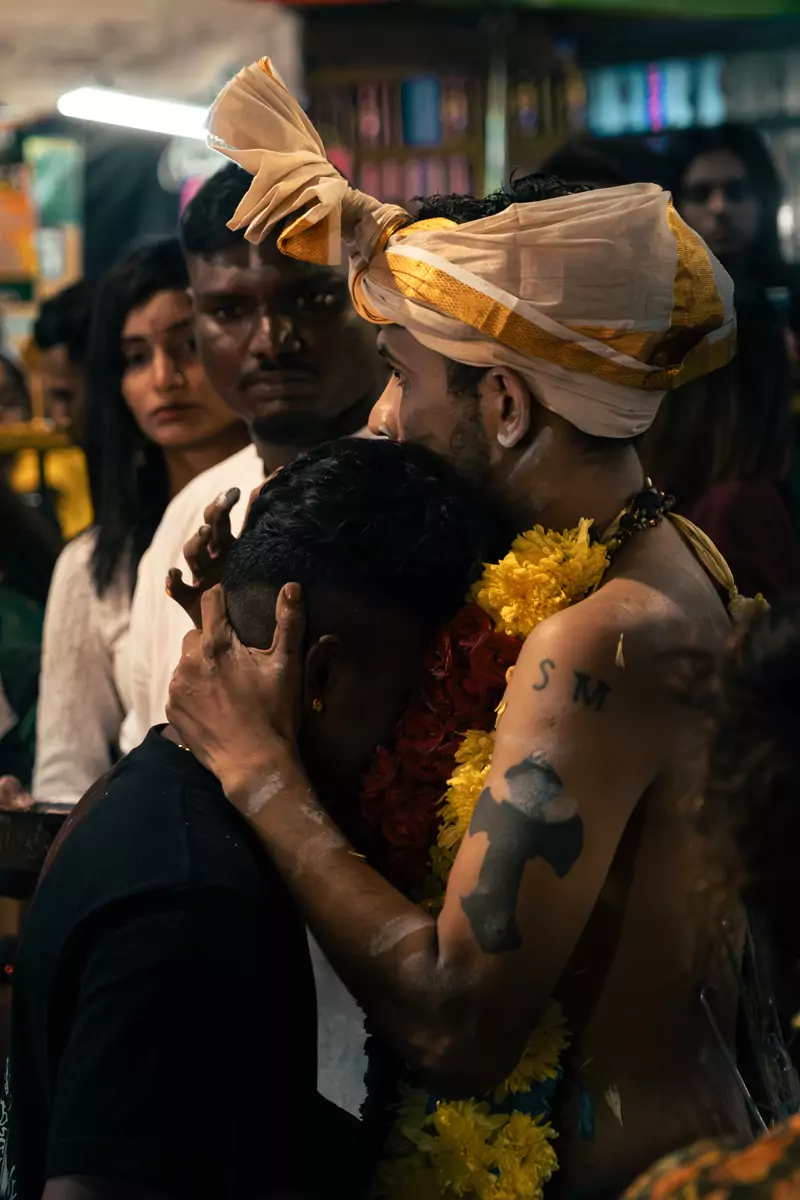
Known as ‘Vibhuti’, this holy ash comes from ceremonial fires and is made into a paste which is spread over devotees’ bodies, such as the face and pierced sites. Some wear it as a ‘Tilak’ – a symbol of their religious orientation which is often worn on the forehead. In the case of Shiva, this is represented as a ‘Tripundra’ or three horizontal lines on the forehead, sometimes accompanied with a red dot.
We were told by attendees at Thaipusum that applying the holy ash protects them and grants divine blessings. Another person said that it helps the wounds from piercings heal, too.
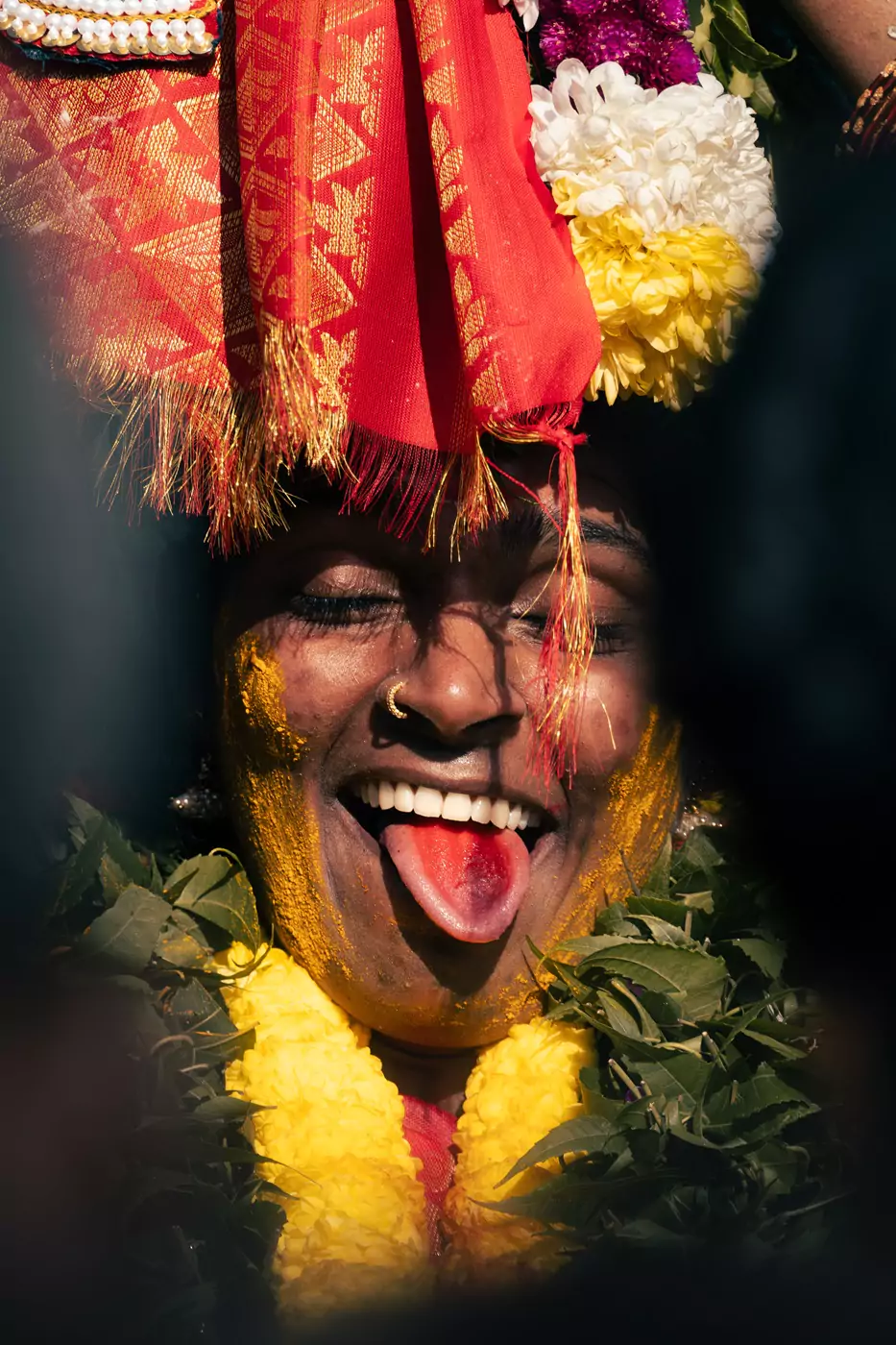
The yellow paint seen at Thaipusam is a paste made from a mixture of sandalwood and water. In addition to the rich yellow being a favoured colour of Lord Murugan, the paste has an added bonus of helping to cool the skin.
–

MORTIFICATION OF THE FLESH
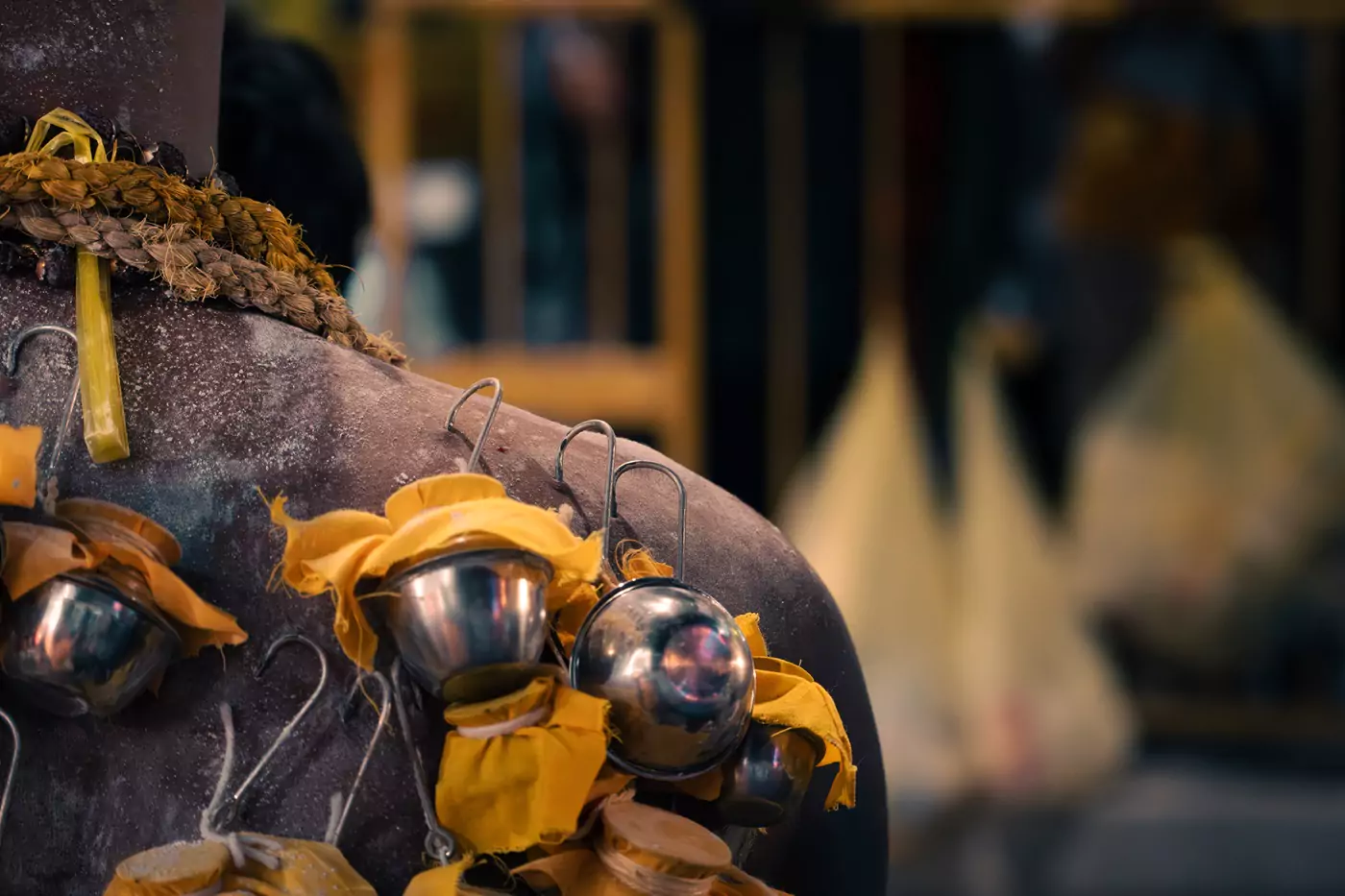
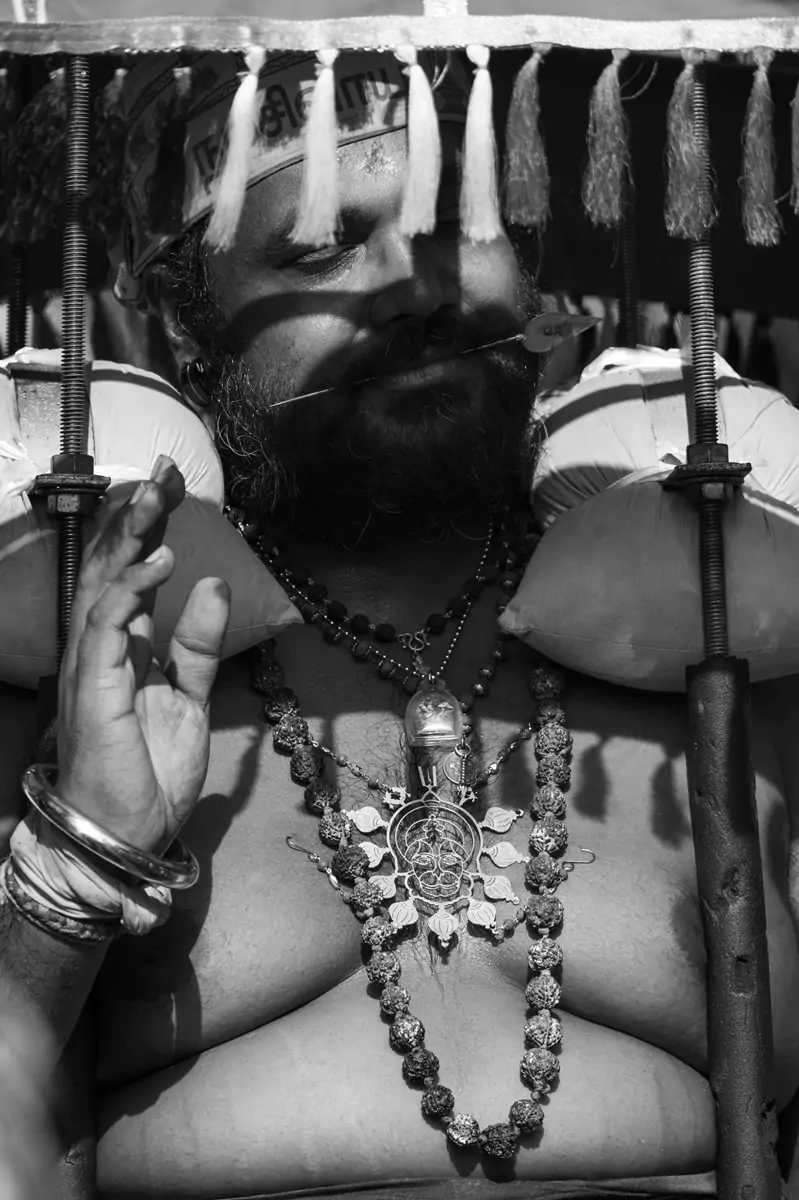
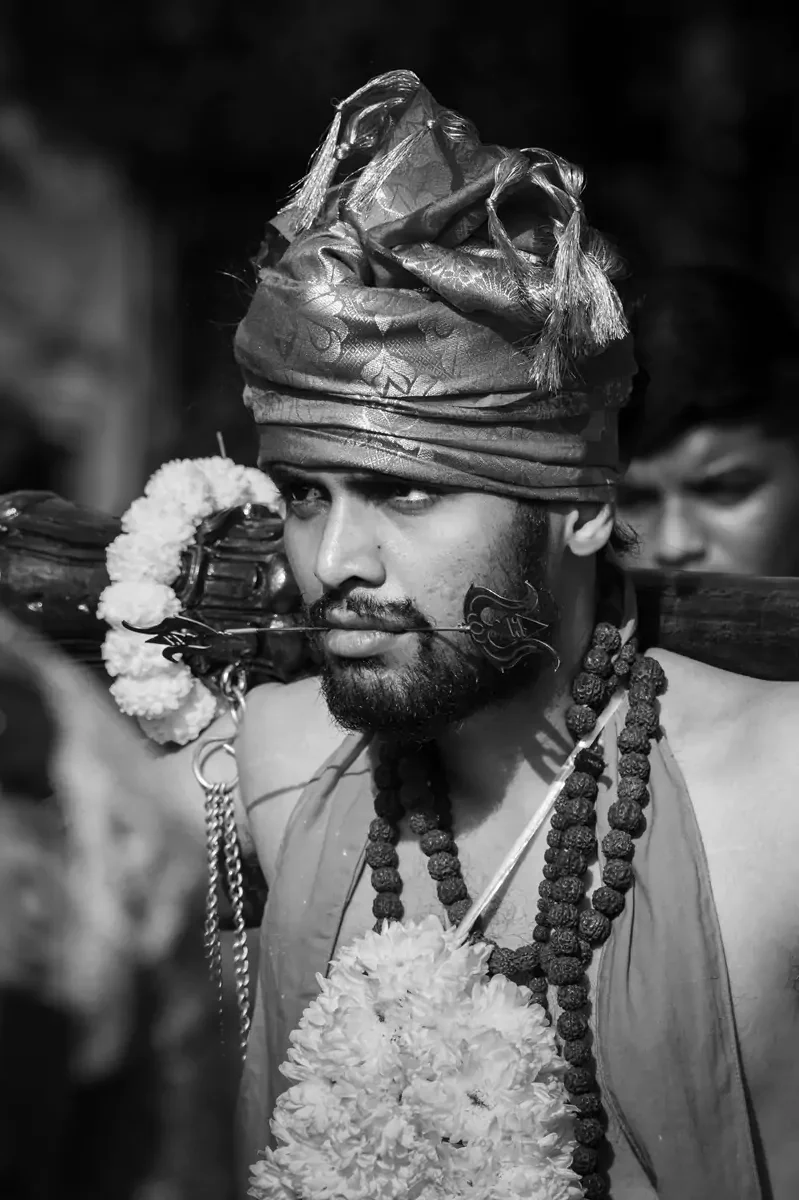
One of the most sensationalised aspects of Thaipusam at the Batu Caves are the piercings. Some of the devotees, men and women alike, choose to express their faith through the ceremonial spearing of their skin using skewers (small spears) or hooks.
The spear shape represents the ‘Vel’ which was Lord Murugan’s weapon in battle. Various body parts of the devotees are pierced, including the arms, shoulders, back, cheeks and, in some cases, tongues.
Although this practice is one of the most well-known, glamorised aspects of this festival, it’s certainly not the foremost reason to attend, as a photographer or just a visitor. Mortification of the skin is just one of many ways that the Tamil people express their faith and appreciation for Lord Murugan during Thaipusam.
For the squeamish, there wasn’t any blood on show, really. The skewers are inserted with precision into the skin to avoid unnecessary blood loss and it’s no different really than other piercings you see anywhere else in the world.
–


KAVADIS AND THEIR BEARERS
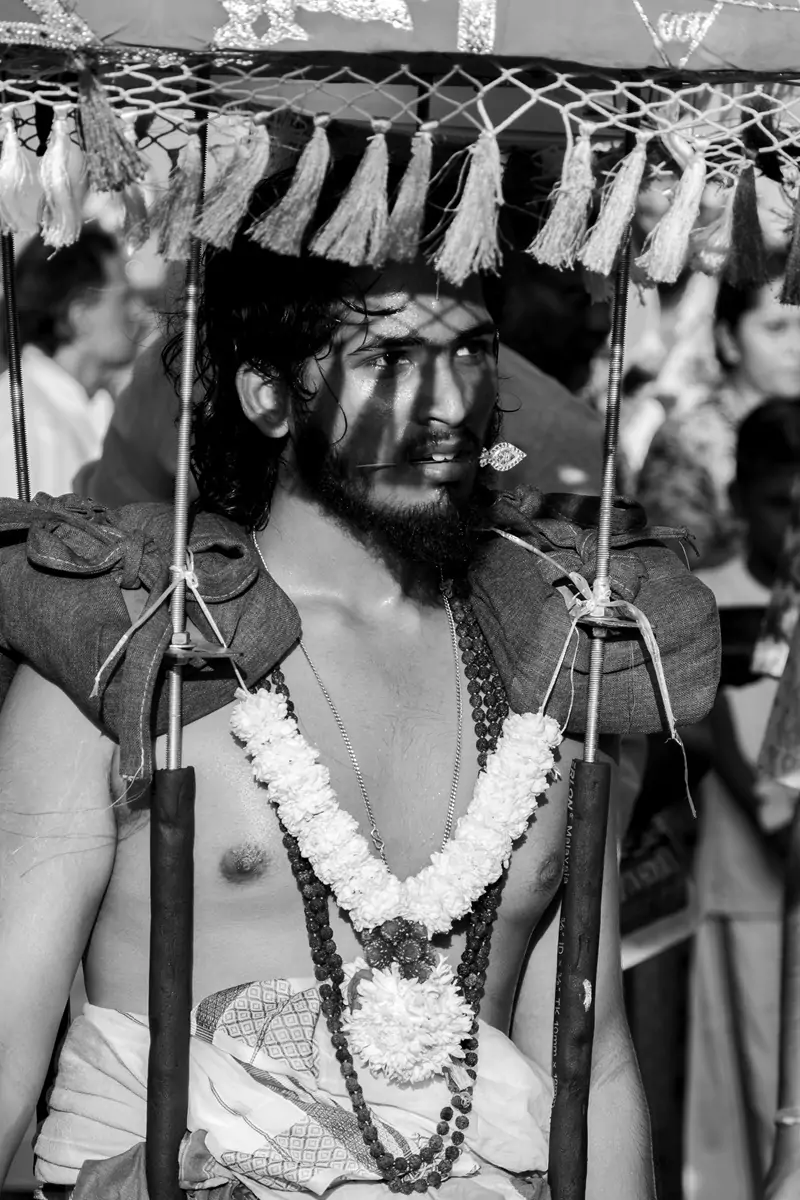
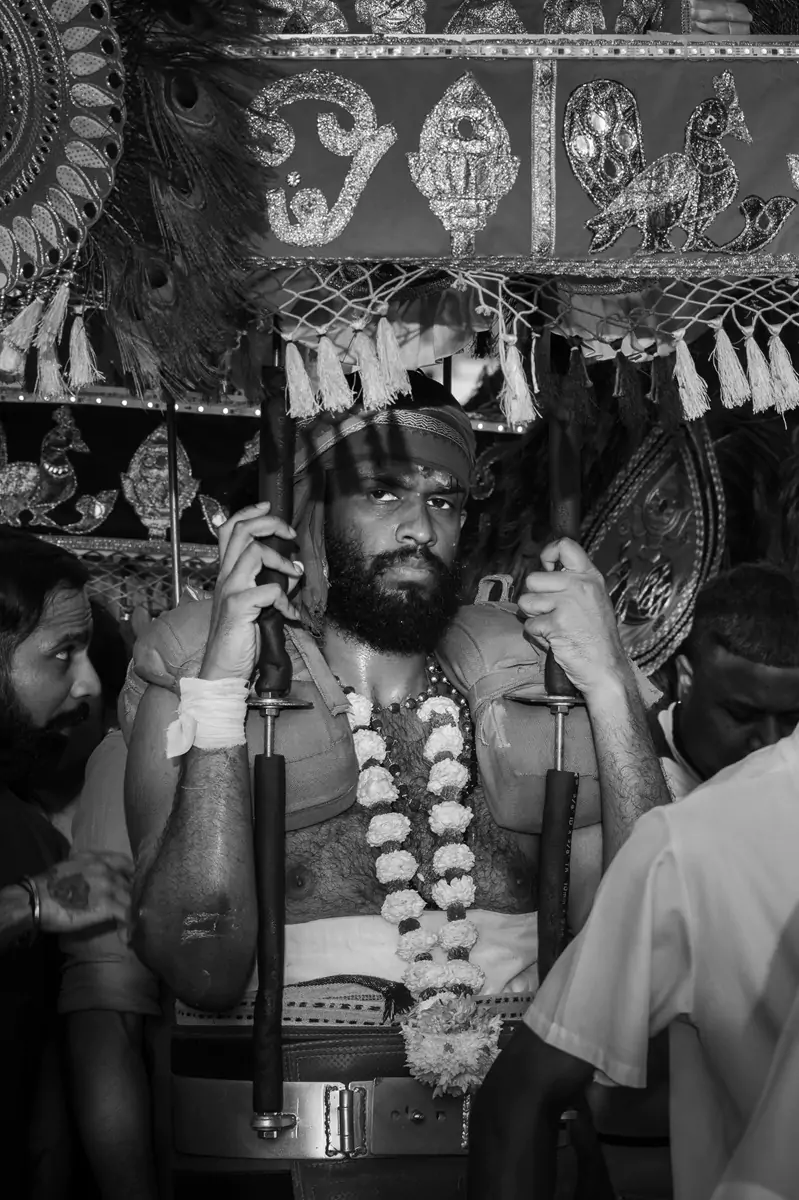
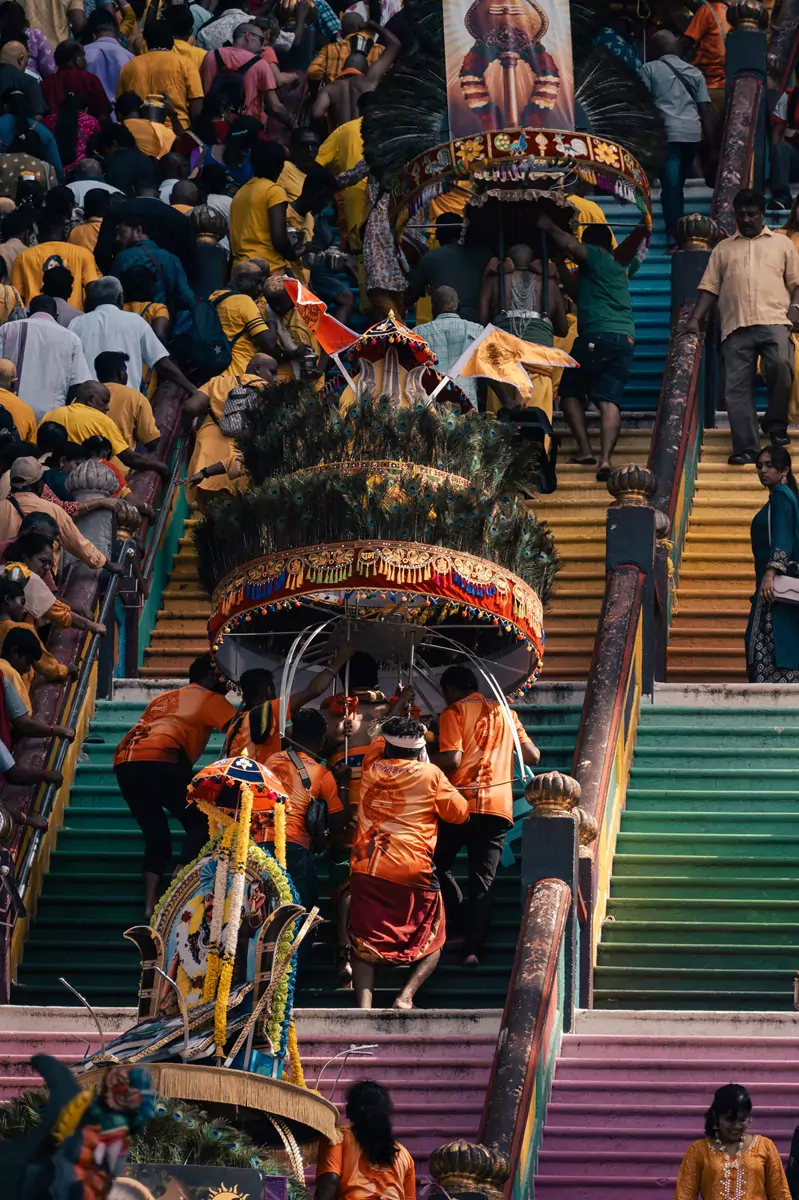
A kavadi is a heavy wood or metal structure worn by devotees during Thaipusam – the larger types look something akin to an elaborately designed parasol. These can be up to two metres tall and typically weigh around 30 kilograms but some, apparently, have been almost 100 kilograms!
They are worn on the shoulders, often secured around the waist with a belt or bolted metal sheets with thick padding to protect the bearer.
During Thaipusam at the Batu Caves, we saw kavadis embellished with figures and pictures of Lord Murugun and Lord Hanuman (a demi-god with monkey characteristics who represents strength and devotion), amongst others.
These were further adorned with peacock feathers, flowers and leaves, colourful tassels and, in some cases, flashing L.E.D. light displays. The burdens were attached to the devotees with hooks or metal skewers, which pierced their backs.
–


SIGNIFICANCE OF PEACOCK FEATHERS
In Hindu culture, the peacock is heavily associated with Lord Murugan – after defeating the demon Surapadma, he took a peacock as his mount.
The vibrant colours of the peacock feather are a symbolic representation of grace, beauty and devotion, a reflection of Lord Murugan’s qualities. Peacock emblems and peacock feathers are a way of devotees to show their commitment to the deity without mortification of the skin. Although, they will often be seen in conjunction with each other at Batu Caves’ Thaipusam celebrations.
–

IMPORTANCE OF COMRADERY
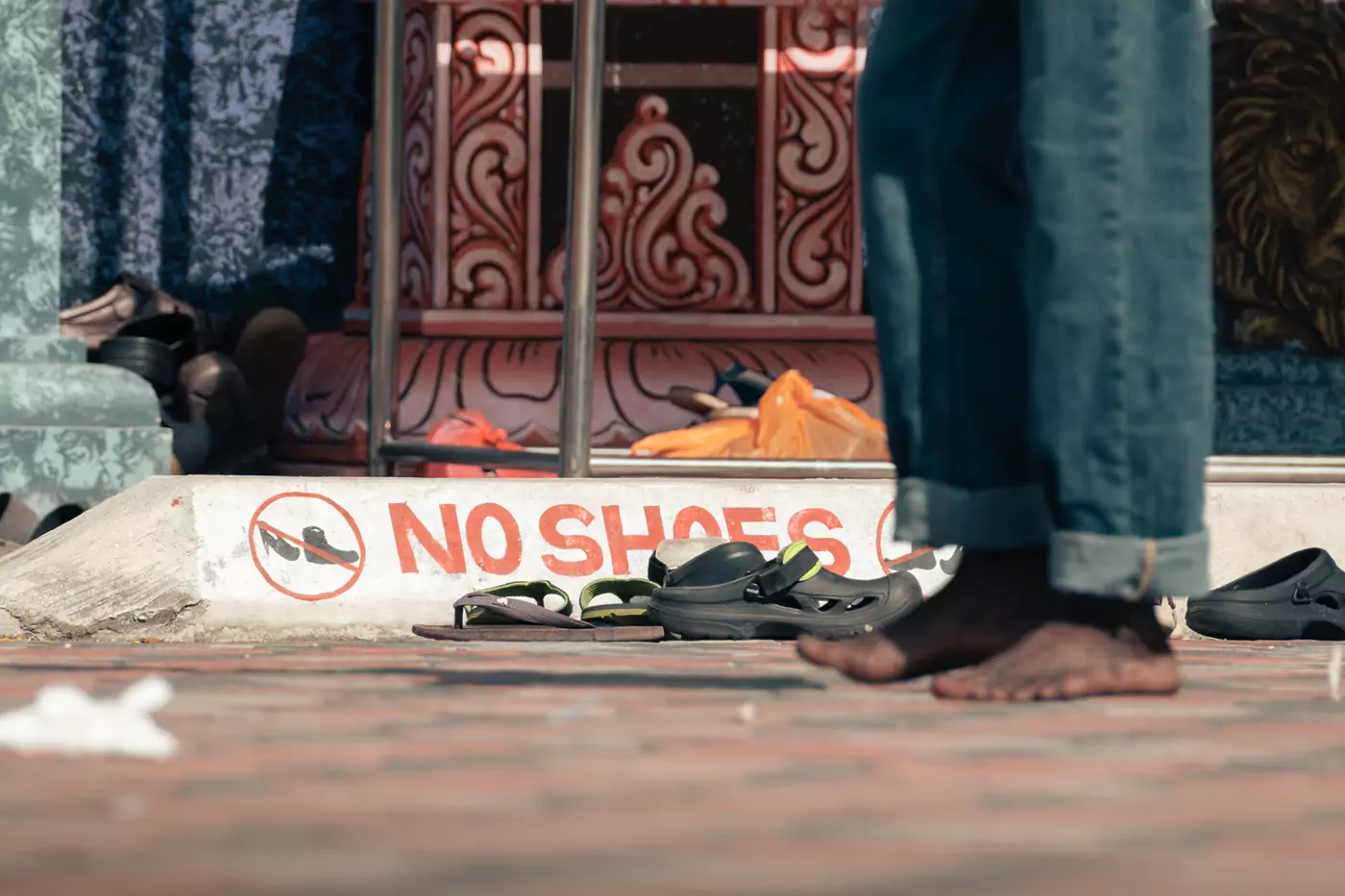
The pilgrimage for a kavadi bearer is a purposely arduous one. Pre-preparations for Thaipusam include eating a simple vegetarian meal once a day and completely fasting the day before Thaipusam. Many choose to complete the journey barefoot and, even at night, the temperatures at Kuala Lumpur’s Batu Caves rarely go below 20 C – it’s always hot.
To aid them in their ordeal, friends and family will accompany the kavadi wearer on their pilgrimage.
We saw the companions dabbing sweat, re-adjusting the kavadi, steering the devotee and keeping the route clear for them. They often carry a stool and water for the kavadi wearer and all work together when the group climbs the stairs, to keep the kavadi wearer upright for the final ascent.
It’s quite an impassioned group effort.
–

MOTIVATING MUSICIANS
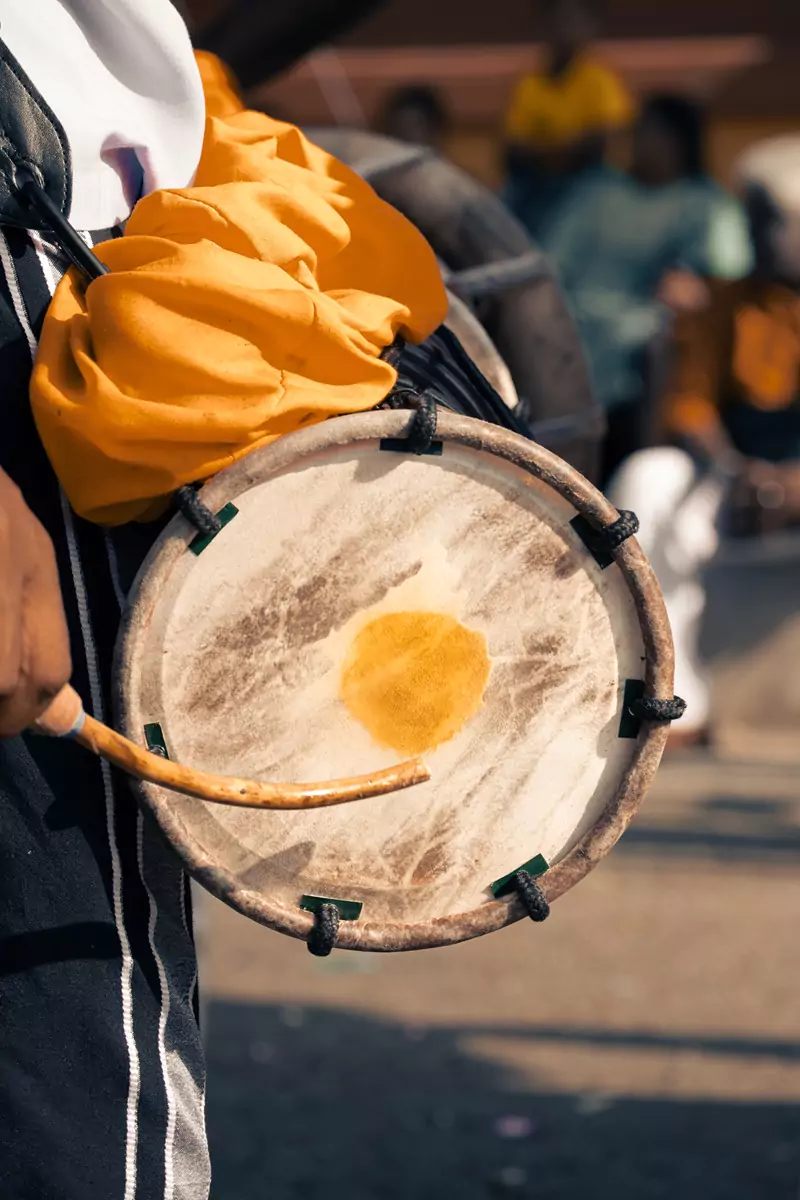
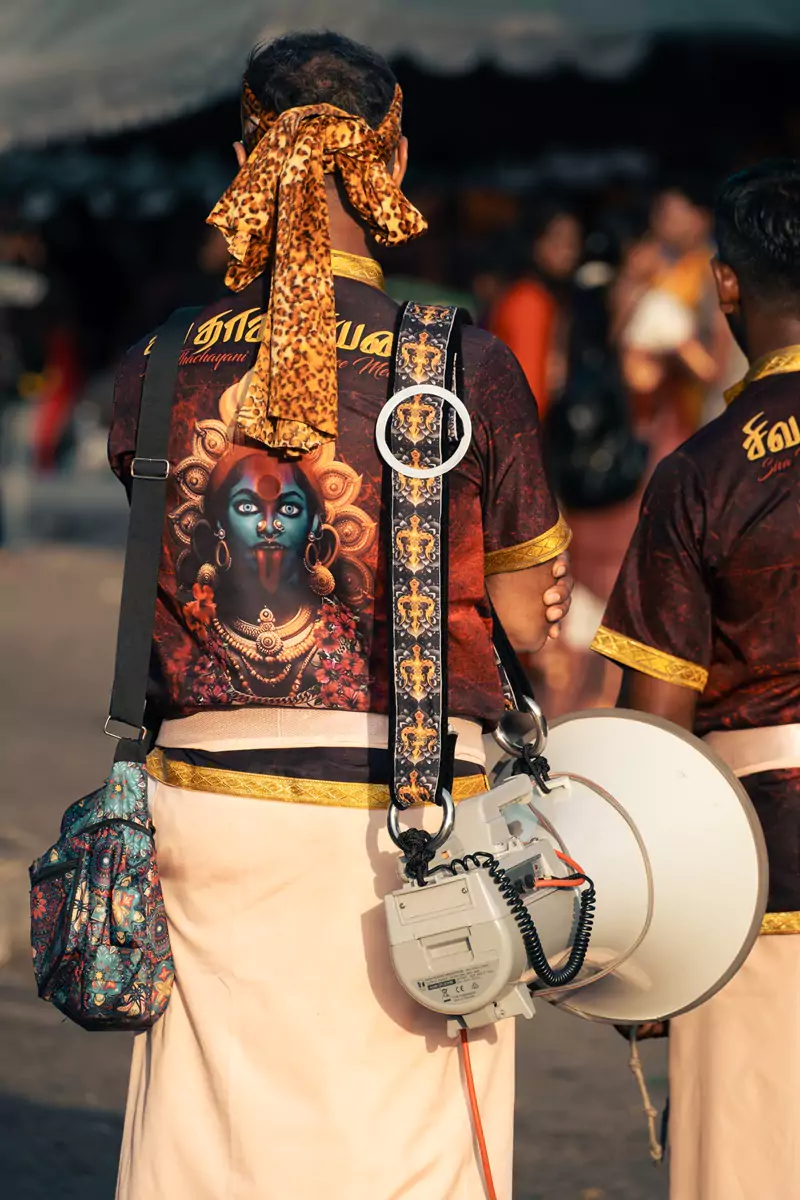
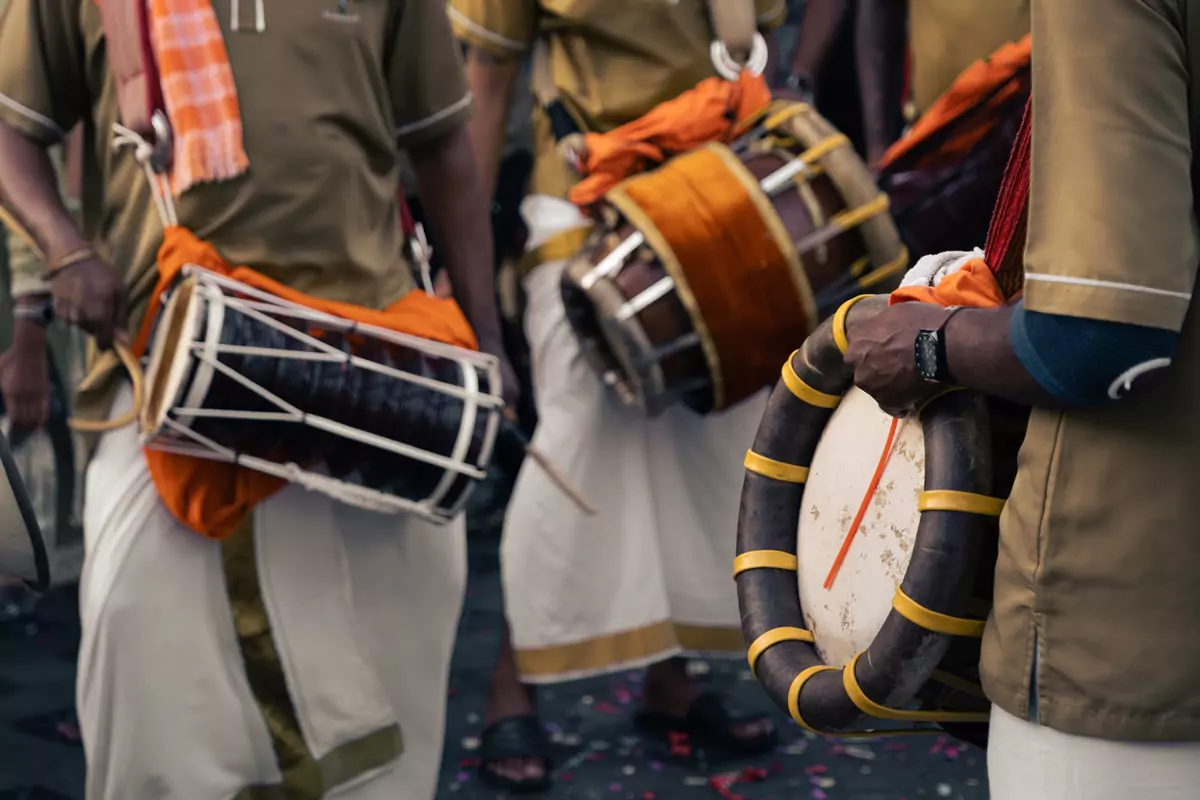
Part of the entourage surrounding the kavadi wearer is a (sometimes massive) musical troupe, consisting of multiple drum-bearers called an ‘Urumi Melam’. Leading the group is often a person with a bullhorn or megaphone who directs their high-speed chanting at the kavadi wearer.
We were told that the principal job of the musicians at Thaipusam is to keep the kavadi wearer motivated and in a trance-like state, which helps them endure the pain of the pilgrimage to the Batu Caves. High speed, rhythmic chants create a spiritual atmosphere, enabling the devotees to perform their Kavadi Aattam or ‘Burden Dance’.
This Burden Dance is a hardship undertaken by the kavadi wearer for their faith as an act of devotion, contrition, or asking for aid from Lord Murugan. It makes use of the kavadi as an extension of the body, with the wearer spinning, dipping and dancing as they walk to the Batu Caves.
–
DEVOTEE PREPARATION
Thaipusam is not just about the ritual itself, but also the ethos behind it. The practice of ceremonial burdens is an integral part, showing devotion by enduring pain as an act of submission to Lord Murugan.
Devotees for Thaipusam can start preparations up to 48 days in advance, seeking focus through acts of penance (although people we spoke to mostly spent a week preparing). These acts are performed through prayer, fasting and physical austerities. Some examples:
Diet and fasting | one simple, vegetarian meal a day
Routine | sleeping without a mattress, prayers
Physical austerities | not cutting hair, celibacy, no smoking or alcohol
We spoke to a man after he had finished his journey to the Batu Caves, who said that it wasn’t the piercings or the weight that he struggled with most, but the minimal vegetarian diet!
–

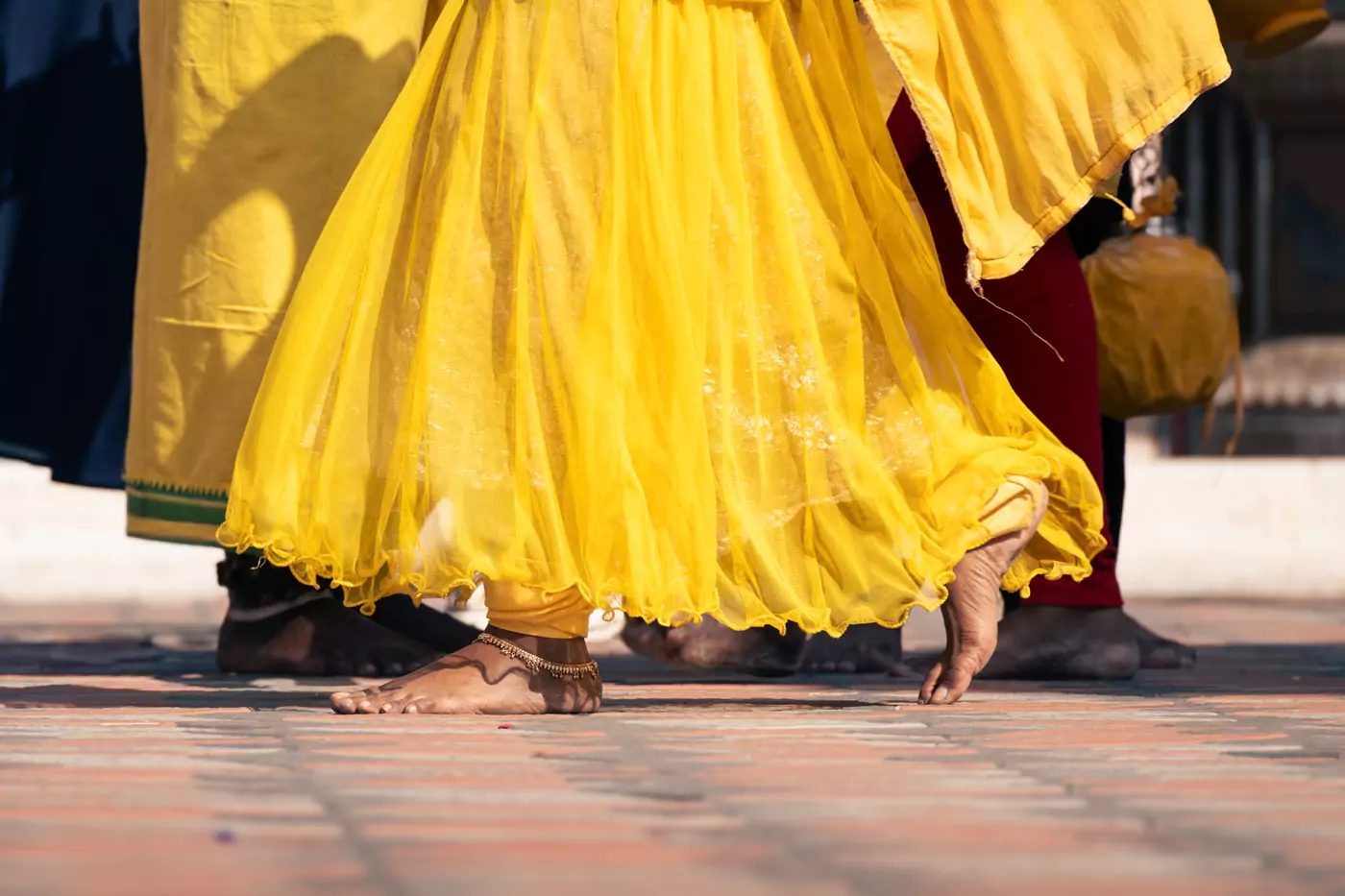
Thoughts and Tips on Photography at Thaipusam
Honestly, photography at Thaipusam is challenging!
Light | there’s a lot of low light to contend with, especially if you visit before sunrise (which we recommend).
Banding | sometimes, the artificial lights can cause interference called ‘banding’, a kind of ‘mismatch’ between the frequency of the light and the camera’s sensor. This is particularly common in dim conditions.
Movement | everyone is moving, all the time! Activity mixed with low light is a serious photography challenge.
Crowds | even during brighter daylight hours, there are still enormous crowds who often surround you.
Other photographers | at Thaipusam, they were surprisingly invasive, and I’ll write a little about my thoughts on it lower down. Needless to say, they love to stand directly in front of you!
For a few solutions to some of these issues, have a peek at our travel photography tips.
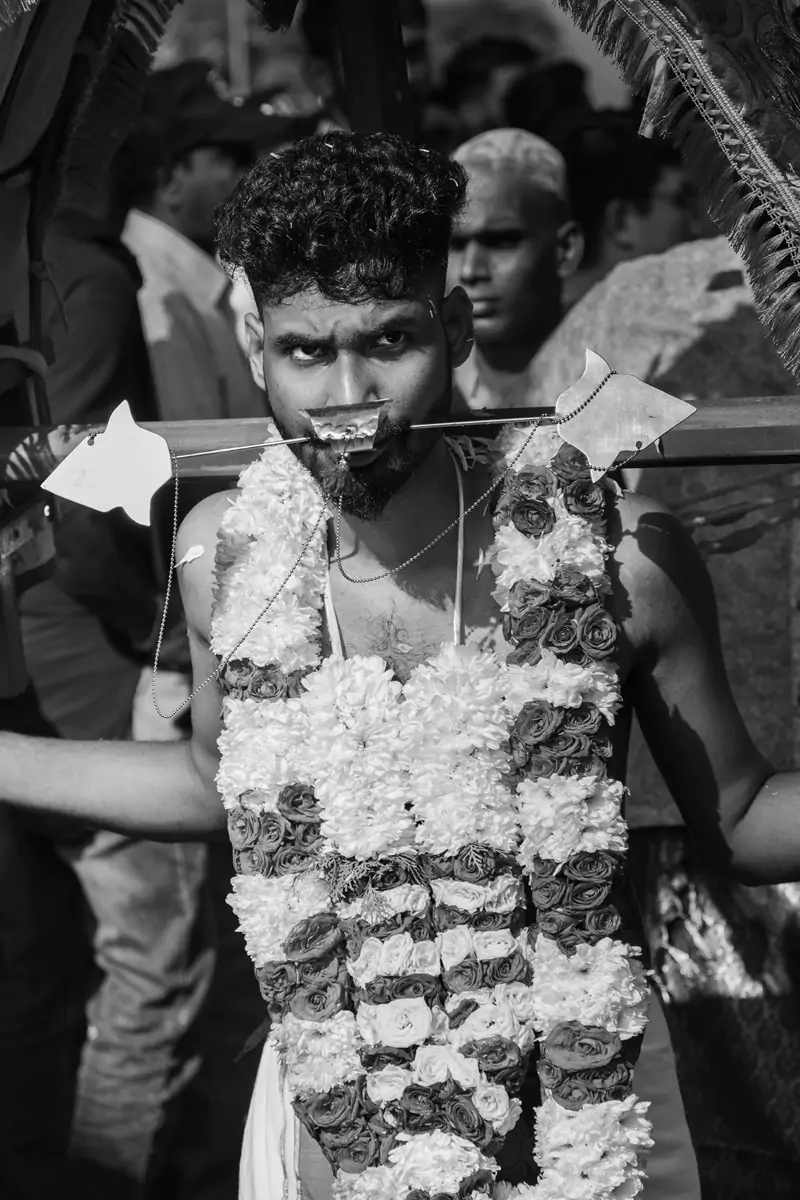

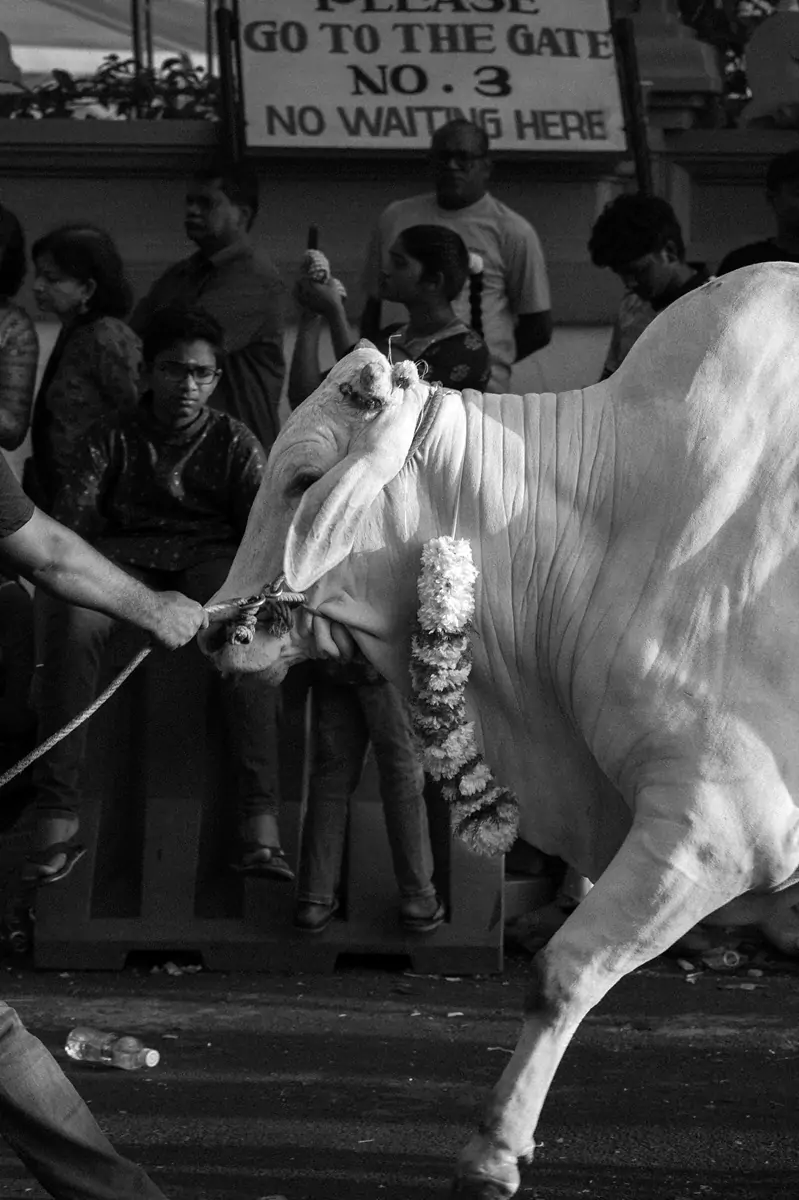
How to Take the Best Pictures at Thaipusam
Every photographer is different, but I love to take crisp, tidy, movement-free, artistic photography that captures individual subjects (most of the time). Others might embrace a longer shutter speed to display the action, vast crowded scenes, add lots of grain to their photos in post-processing or even over-expose to push the intensity of the event.
I’m boring, though, and try to avoid all those things (although a touch of grain on a monochrome shot can be classy), but each choice is cool. Here, I’ve written about how we captured the photography you see in this post and our tips for that.
Note | just under half the pictures were taken before sunrise or at night, the rest were after.
About us | for Thaipusam at the Batu Caves we shot entirely manual (with auto-focus), using crop-sensor Fujifilm XT5s combined with Fujinon XF 70-300mm f/4-5.6 and Fujinon XF 16-55mm f/2.8 lenses.
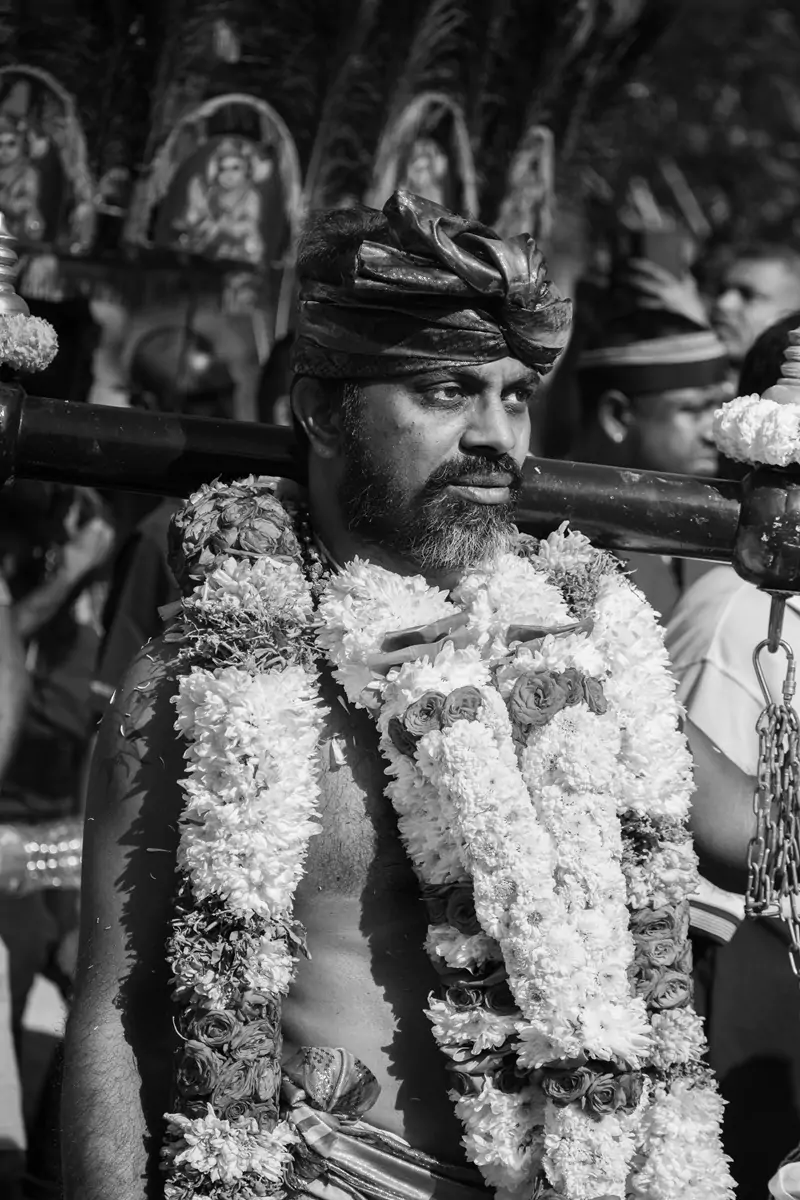
Photography Suggestions for Thaipusam
Manual | we would recommend using manual settings to provide full control (although loads of people will totally disagree with this!). The light and movement at this festival is *continuously changing* so even if you prefer to use priority settings, ensure you know the camera dials and buttons well.
Advanced focus settings | we’d recommend avoiding the eye or people detection settings because the crowds at Thaipusam are frenzied and the camera may choose the wrong person to focus on. I rarely use my eye and people focusing options anyway, but if you use it regularly, make sure it’s doing what it should!
ISO | don’t be afraid to whack up that ISO in low light. This is especially relevant if you have a newer camera, where the ISO really doesn’t degrade your image very much. It’s better to have a mildly grainy picture, than an unintentionally blurry, movement-affected shot.
Move around | there are loads of people everywhere, but just outside the main gate we found the crowds dispersed. There’s lots of space and you can take photos from other angles, like lower down, for example – the kavadis often partially obscure their carriers. It’s also a perfect spot for sunrise.
Don’t neglect the zoom | go for details! A zoom lens is a surprisingly good way to capture specifics of the elaborate kavadis, the striking Batu Cave stairs and any other aspects (think monkeys stealing food and pigeons being annoying). It also means you don’t get in the way of anyone.
Eye contact | always look at your subject and act graciously. This is a great way to show respect for what they are doing, and engaging with your subject is a much better way of taking photos in almost any scenario.
Slight elevation | even a curb will do! The crowds are often thick at the Batu Caves during Thaipusam and will block your shot – if you find a slightly elevated position, embrace it.
Light source position | capture your subjects with the sun behind you. This applies to floodlights, too. It’s common sense, but the light illuminates your subjects beautifully and there is no need to worry about blown out skies or sun glare (I may have forgotten to put the sun hood on my camera for the entire event).
Avoid clutter | this is a personal style, but I prefer to avoid clutter in my photographs, so big crowded places are nightmares for me! However, there are always small moments to be found where a subject can be the centre of attention – focus on those whenever possible.


WANT TO TAKE A BETTER PHOTO?
There are three parts to travel photography –
◊ Planning your trip
◊ Taking the photo
◊ Editing the end result
To get the highest quality, most sophisticated photos from your travels, you’ll need to perfect all three (plus a tiny bit of luck).
So, we’ve written a lot of country-specific guides about planning trips to various destinations, and also collated our absolute top tips for taking photos on location. We’ve also written a dedicated post on how to take the best black and white travel photography. Check them out if you’re interested!
We also write about typical editing mistakes to avoid. To complement that, we’ve collated a more intermediate user’s guide to editing travel photography. This covers more elegant, advanced and refined skills, ones that will promote your photos to the centerpiece of anybody’s wall.
–
RELATED | PHOTOGRAPHING MALAYSIA’S LARGEST BUDDHIST TEMPLE
Ethics of Street Photography at Thaipusam
This is a topic I spend a lot of time thinking about, not just about photography for Thaipusam, but in general.
Some street photographers can be quite blasé about the ethics of people photography (sometimes regardless of specific laws in a particular country). Additionally, they are often extremely covert with their camera to ensure the subject doesn’t notice – I’m not a big fan of this most of the time.
My perspective | Thaipusam at the Batu Caves is probably the most photographed and videoed event I’ve ever attended. Like, I’m serious – by daybreak there were hundreds of photographers getting right up in the face of the devotees. A few were professional media, but most others were private photographers. There were obviously newspapers filming reports here too – it’s hardly a typical street photography venue!
There were thousands of observers also videoing and photographing with their phones, too. Many kavadi-bearers even had their own teams of people videoing them. It was a circus of media.
None of this took away the immensity, intensity, or comradery of the event, at all. However, it’s worth noting if you’re planning to take photos during daylight at Thaipusam.
In my opinion, street photography for Thaipusam at the Batu Caves is totally okay, as long as you act considerately and are respectful with the photos you take (honestly, you’re unlikely to snap anything that somebody else hasn’t!).
For the photos in this post, we sought permission wherever possible (it’s a chaotic procession, so not always that easy). In fact, we often had supporting troupe members encourage us to take shots – in this case I feel like having a big camera and an even bigger smile was a small benefit here!

Things to consider as a Responsible Travel Photographer
⬩ Is what you’re capturing fairly representing a situation or person?
⬩ Did you have to invade somebody’s personal space to take it?
⬩ Does the subject know you’re taking the photo?
⬩ Are you being disruptive?
⬩ Is your subject comfortable with your presence?
⬩ Are your subjects children?
You shouldn’t put your camera within a foot of somebody’s face, no matter how welcoming they are – it’s just a bit gross when they are going through a process of physical burden for spiritual purposes. Also, don’t block their entourage – it’s just not cool.
It’s nobody’s ‘right’ to be in somebody’s face, ever, even if the law permits it. (Most of my close-up photos are taken on a 70-300mm lens).
Summary | I’m mainly writing this because of other photographers’ behaviour at Thaipusam. It was the only downside to an otherwise fascinating, community-centered event that was probably one of the best of my travelling life. I’m worried that over time, people will begin to resent anyone with a camera, just because a few photographers are self-entitled dicks.


Frequently Asked Questions
What camera settings are best for photography at Thaipusam?
This depends on the time of day and your subject’s movement. We’d recommend using close to wide-open aperture and high ISO at night to allow for a faster shutter speed. During the day, settings are much more straightforward, just ensure that you have a short enough shutter speed for the movement (try and go for 1/250 seconds or shorter, although other factors, such as zoom and IBIS, will affect it).
How can I attend Thaipusam at the Batu Caves?
You can just turn up! For more information, have a look at our Thaipusam guide.
Is taking photos at Thaipusam allowed?
Yes, taking photos at Malaysia’s Thaipusam festival is allowed.
When is best to arrive at Thaipusam for photography?
The easiest time to photograph Thaipusam is during daylight hours, so after 7.30am. It’s more interesting, but more challenging, taking photos at night.
Is there a dress code for Thaipusam?
There is no dress code for Thaipusam, but be respectful. It’s a religious celebration, so choose non-revealing clothing – cover your shoulders and knees. Also, avoid wearing inflammatory or crude slogans and images.
Photographers With(out) Egos
Travel photography should always be about the subject, not the creator. It should not be about getting credit, kudos, and compliments. Ideally, its purpose would be to demonstrate, teach, or provide value to an audience – one who hopefully wants to learn.
That’s why I love running this website! My goal is to show a tiny bit about who the people of Thaipusam are, and to expose a slither of the world to people who will have never heard of this moving and fascinating cultural celebration, much less had the opportunity to attend.
I’ve included loads of relevant information alongside each of the photos because much of the coverage from outside of the culture focuses on sensationalising the piercings at Thaipusam. This is only one small part of the celebration, and I’m aware that it would be easy for me to do the same.
Final Thoughts – Photography at Thaipusam
Photographing Thaipusam at the Batu Caves was one of the best photography moments of my life!
It was everything (and nothing) like I anticipated, which is honestly the best kind of day.
I hope you appreciate the photos, and that maybe you learnt something new. If you’re thinking of attending Thaipusam, have a little look at our visitors guide, which includes stuff like transport, timings, and more. For more photography content, check out out travel photography tips, or have a read of our typical editing mistakes or more advanced editing tips.
Hi, thanks for visiting our blog! If our free content has been of help to you, or you’ve just enjoyed our random ramblings and musings, say thank you by buying us a coffee! It helps keep The Restless Beans blog up and running.
Thank you, Claire + Nick


