

Driving Sri Lanka’s Elephant Road – an Adventure or a Mistake?
Scribbled by Claire ◊ 04 Aug 2024
Read on for our experience with Sri Lanka’s largest wildlife species on what has been dubbed ‘Elephant Road’, including how we felt about it, a little about the conflict between communities and elephants, our impact as tourists, and how to survive an interaction!
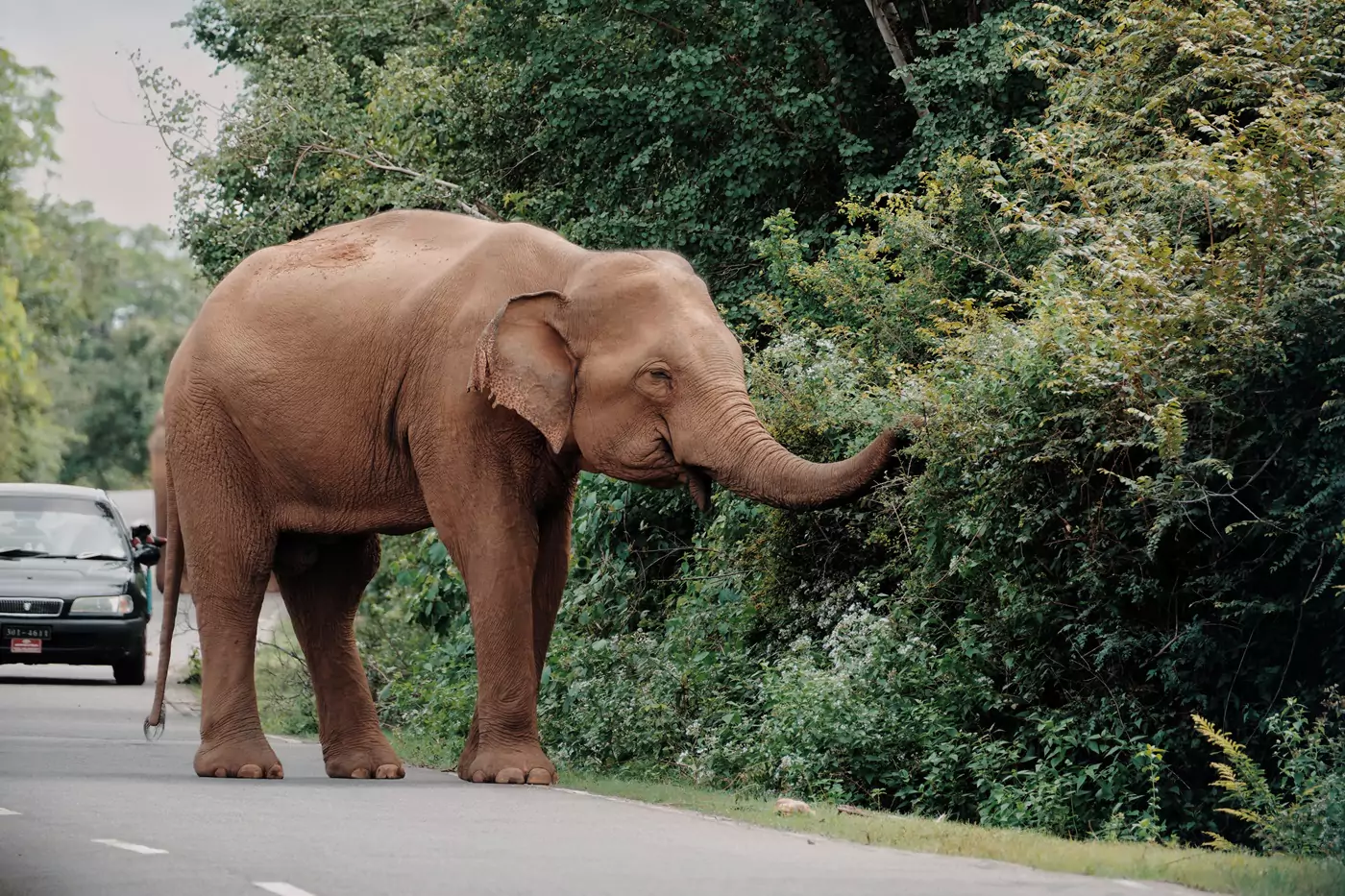
During my (admittedly minimal) Sri Lanka tuktuk road trip research, I saw photos of intrepid, self-driving tuktuk tourists posing near elephants that appeared to have just randomly wandered across the road in front of them. It seemed to be the dream way of seeing wild elephants; no forced interactions, using our own vehicle, and avoiding the hordes of jeeps that I’ve seen tightly circle the animals during safaris in the Sri Lanka national parks.
I didn’t appreciate how easy spotting elephants on the road in Sri Lanka would actually be. Initially, I thought that roadside elephant locations would be completely based on luck and their appearances mostly random. After all, there’s around 7000 wild Sri Lankan elephants according to the Ministry of Agriculture and they’re free roaming animals. However, it turns out that finding them isn’t random, at all – most of the tourists I saw had *deliberately* gone out to find the wild elephants. There are even places nicknamed ‘Elephant Road’!
I’m no storyteller, so strap yourself in for a speedy rundown of our experience, detailing where, how and why we ended up seeing wild elephants on the road in Sri Lanka. We’ve also discussed whether you should do it yourself and how I felt about it, both during and after.
If you are considering driving a tuktuk in Sri Lanka – check out our all-encompassing guide to renting one.

IN THIS GUIDE //
Driving Elephant Road in Sri Lanka
WILD ELEPHANTS IN SRI LANKA
SRI LANKA PROTECTED AREAS
SRI LANKA’S ELEPHANT ROAD
– OUR EXPERIENCE WITH WILD ELEPHANTS IN SRI LANKA
– WHY ARE THE ROADS SO NARROW?
– CAN FRUIT SAVE US?
– MORAL OF THE STORY
SHOULD YOU DRIVE ELEPHANT ROAD?
HUMAN ELEPHANT CONFLICT
IS DRIVING SRI LANKA’S ELEPHANT ROAD ETHICAL?
ARE ELEPHANTS DANGEROUS?
FINAL THOUGHTS – ELEPHANT ROAD SRI LANKA
This post may contain affiliate links. If you book through these links we may make a small commission at zero cost to you. It helps us pay for the upkeep of this blog. Thank you!
Wild Elephants in Sri Lanka
Most people visit Sri Lanka with the intention of doing some kind of safari (both Yala and Udawalawe National Parks are popular for elephant spotting in southern Sri Lanka, but alternative safari options are rife across the country). Others plan to visit an elephant sanctuary in Sri Lanka (please don’t – they’re rarely a real, ethical sanctuary).
We aren’t the biggest wildlife buffs, so toyed with the safari idea, but concluded that it would be wasted on us – we prefer plants to animals generally and safaris aren’t always ethical. Our journey across Sri Lanka had also shown us so much wildlife already, directly from our tuktuk, including peacocks, crocs, monitor lizards, water buffalo, deer, various species of monkeys, and even elephants from across a lake! It didn’t seem like we could gain that much from an expensive, overcrowded, ethically questionable safari.
However, we openly laughed about the idea of cruising past an elephant on the road in a tuktuk – it would be a novel experience, right? To be honest, I hadn’t given it that much thought and elephants weren’t exactly bucketlist. At any rate, we figured that if we randomly see a wild elephant on the road, then there’s nothing unethical about that, right?
So, when several people on Instagram messaged us saying that there was a public ‘elephant road’ running along the western edge of Yala National Park where Sri Lankan elephants can often be spotted, we slightly adjusted our route and headed down, on our way from the highlands to the beach.
SRI LANKA PROTECTED AREAS
Sri Lanka has lots of places (currently over 500 with more to be added), which are described as protected areas. These include National Parks and Reserves, Conservation Forests and other areas highlighted as important for biodiversity.
They often have public roads that run through them, meaning that you are more likely to come across wildlife, both large and small. Although this sounds like an amazing opportunity, it’s important to be aware that these roads are certainly not safe (or sometimes even legal) to stop on.
The road that was suggested to us was the B35, or the Buttala-Kataragama Road, starting south of Buttala. This route is colloquially known in Sri Lanka as the ‘Elephant Road’. On Google Maps, you can see it traverse the edge of the protected area of Yala National Park, passing one of the entrances. It’s just a normal, public B-road, so driving it should be fine, right?
–
BACKPACKING SRI LANKA – 29 TIPS | SIGIRIYA’S MOST CAPITIVATING VIEW
Sri Lanka’s Elephant Road
We arrived in Buttala, north of Yala National Park, around lunchtime and topped up our tuktuk, Blue Pebis, with petrol (always do this even if you have more than half a tank – we were grateful we did). It was a bit rainy and moody, with occasional, intermittent sunshine, typical of our trip to Sri Lanka.
Turning south towards the national park, the road looked the same as any other, with no obvious sign of elephants (not even enormous mounds of elephant crap that commonly litter the road). We continued, passing small houses and businesses, until we arrived at a kind of army checkpoint where (I think) the Yala National Park border is. The guard there just stared blankly at us, so off we went, trundling along at our tuktuk’s 40-kilometre max speed.
We drove for around 15 minutes through empty, flat, green landscapes, until we reached the official entrance to the park. There was a large gang of grey langurs nearby who were brash enough to try and get into our vehicle, a fully displaying male peacock and some roadside monitor lizards sunning themselves. No elephants though. I was feeling a little complacent, despondent, and a bit on edge because of the monkeys.
The brashness of the monkeys should have been a warning for what was to come, but it didn’t occur to me at the time.
We continued on. The two-lane B35 was mostly empty and reasonably narrow, lined with compact jungle the entire way. I pictured it as being some wide, sparse savannah with views for miles (like pictures you see of the Serengeti – totally naïve of me since we were in Sri Lanka). I then started to imagine what it would be like if an elephant suddenly lurched out on this narrow, surprisingly slightly claustrophobic road (pretty sure elephants don’t usually lurch, but what do I know?).

Our Experience with Sri Lanka’s Wild Elephants
Without making too much of a drama about it, about five minutes after passing the entrance, we inevitably bumped into an elephant (not literally). I was startled and in a bit of disbelief, but there it was, maybe 200 metres in front of us.
Even from far away, this stationary beast was gigantic. Its trunk was whipping about and gripping a branch like a weapon in an extremely alarming manner. The elephant’s body was perpendicular to us, blocking the entirety of the two-lane road. In my mind, I had pictured seeing an elephant’s butt sticking out of some shrubs, if we were lucky enough to see one at all. Not this – a house-sized monster, just hanging out in the middle of the road, swinging its oversized appendage around wildly.
Why Are the Roads so Narrow?
Thing is, I was suddenly all excited but also kind of terrified. I didn’t expect to be so disturbed by my first encounter with a wild elephant in Sri Lanka.
I know this is obvious, but elephants are colossal. My thoughts started to swirl around – surely this road is unreasonably narrow? Clearly it wasn’t smart to design a road that was only the exact length of an elephant.
It’s a bit sketchy in a tuktuk when there’s little space on the road, in all honesty. A tuktuk does not have the luxury of being able to drive onto the grassy verge of an ‘elephant road’, whereas other motor vehicles can do so with relative ease (see pictures). These tiny metal rust-buckets aren’t exactly known for their acceleration or resistance from immense elephant impact either.
Some residents even stopped to warn us that the elephants were very dangerous (like I didn’t already know), which just left me more on edge and wishing I only had a gang of monkeys to deal with.

Can Fruit Save Us?
A bunch of local guys in an open-backed truck stopped and gave us a bunch of mangos. I initially thought they were stopping to give us a snack (this actually happened previously in Polonnaruwa!), but then they motioned for us to throw our newly acquired lunch at the elephants to distract them so we could pass. The thing is, we sat and watched them drive past the elephant, doing this exact thing, but the elephants weren’t all that fussed for the fruit.
So, now, I’m wholeheartedly shitting myself because this enormous, swaying, thrashing creature with a big stick still gripped in its trunk is completely blocking the way to the next petrol station. Plus, there is no way we could remain out here towards sunset because it just wouldn’t be safe.
Eventually, a truck driver stops and tells us to follow them, so we took a deep breath and revved our little tuktuk to its max speed capability (spoiler – it’s not great). Engine squealing like an old lawnmower, we pass less than a foot from the elephant’s trunk. I videoed it (obviously) and said something along the lines of, ‘if I’m going to die, I may as well film it’.
Halfway through a stereotype sigh of relief, we immediately see another goddamn elephant, the same size as the first, also stood in the road, about 150 metres in front. Now we’re sandwiched between two immense, animated, trunk-whipping nightmares. Existing in a tuktuk, in that moment, felt very visceral, exposed and vulnerable – it was all pretty concerning.
Anyway, this happened four more times as we passed what felt like an entire herd of full-sized elephants, all equally as terrifying as the first, with the last one charging straight at us (it was probably just a brisk walk, to be fair). I threw my mangos at the road in a blind panic, but it ignored them as we zipped by, a few feet from its flailing trunk.

Moral of the Story
Moral of the story? Don’t bother taking fruit down Elephant Road (thinking about it, fruit may even attract them).
Feeding elephants in a national park is not the most ethical of behaviours anyway, (it’s actually illegal!). I know that feeding any wild animal is bad (in general), so it’s not something I’d ever usually do. However, the residents do it and I thought, in the moment at least, that I was going to get mauled by an hungry, rampaging elephant.
Also, do not stop your engine if you are waiting to pass an elephant in a tuktuk, unless you are certain you can start it again first time (tuktuks are notoriously bad for stalling). Our tuktuk was extra temperamental and I’m absolutely sure he’d have been a bit of a dick if he knew that a hoard of raging, hungry, house-sized animals had him in their sights.

PLANNING A SRI LANKA TRIP?
Have a quick peek to see if any of our other Sri Lanka posts might be helpful:
How to explore Mihintale – Sri Lanka’s most sacred Buddhist site
Is the Pidurangala Rock hike worth it?
Everything you need to know about backpacking in Sri Lanka
The monster three week Sri Lanka itinerary
How to rent a tuktuk in Sri Lanka – realities of driving a cranky rust bucket
How to visit Sri Lanka’s exquisite ancient capital of Polonnaruwa
–
Should You Drive Elephant Road?
Reflecting on our experience after, I may have been being a smidge melodramatic (although if our tuktuk had been flipped like a fried egg, I wouldn’t be saying that, would I?). However, I just want to impress on anyone wanting to drive their tuktuk down the B35 (or any other elephant road) that it might be scarier than you think and certainly not without danger.
Fundamentally, these are public roads and anyone can drive down them at any time. That does not mean you should though.
Having researched it since, there are also some serious ethical considerations with wild elephants in Sri Lanka that we’ll elaborate on below.
This entire shitshow happened because I did very little research. I didn’t believe we’d actually see an elephant, and I thought it would just be a normal road with cars and houses on it, like everywhere else in Sri Lanka. I kinda messed up.
HUMAN-ELEPHANT CONFLICT (HEC)
The relationship between rural Sri Lankan communities and elephants is a complex issue, and not one I will pretend to understand.
The issues are referred to as the human-elephant conflict (HEC), which is something that all elephant occupying countries experience anywhere that humans and elephants coexist, including Sri Lanka. These conflicts arise due to the inherent issues of human and elephant interactions and competition for resources. This is especially prevalent in enclosed regions, like Sri Lanka.
Rapid human population growth causes acute difficulties in confined elephant-human areas. Sri Lanka’s rural population has more than doubled between 1960-2020, while the forest cover in Sri Lanka is reported to have reduced from 24.8% to 21% between 1992 and 2019. Combining elephant habitat loss with reducing resources, and competition is fierce.
The clearing of forests for human infrastructure, such as the 2000-hectares needed to build the Mattala International Airport near Yala National Park, has reduced Sri Lankan elephant habitats and fragmented the land they live on. Road construction across the country changes elephant roaming routes. Also, a road is far easier to walk down than dense forest, which further increases human-elephant interaction.
The results of human population growth and reduced wildlife habitats often leaves elephants with no choice but to stray into human inhabited areas. This commonly results in damage to property, crop raiding or even death.
There is an enormous amount of literature on the HEC in Sri Lanka, far too much for this post. As visitors though, the one, single thing we should do is to actively not make things worse. Avoiding interactions with elephants of any kind, as a tourist, is our responsibility.
–
COMPREHENSIVE SRI LANKA ITINERARY | MIHINTALE – SRI LANKA’S SACRED SITE

Is Driving Sri Lanka’s Elephant Road Ethical?
So, should you intentionally search out and take a detour to see wild elephants in Sri Lanka? The answer is an unequivocal no. In the end, it’s just another wild animal interaction, like any other. Here are some specific reasons why:
Wild | wild elephants are meant to be wild. They become less wild with each and every interaction with humans. Elephants fed by humans eventually lose their fear of them and can become aggressive in pursuit of food both from vehicles and pedestrians (below are some links to examples). Sadly, the only recourse is euthanising the animal as relocation isn’t an option for an aggressive elephant.
Behaviour | elephants are modifying their natural behaviour due to human interaction. For example, Asian elephants are forest dwelling and would normally only come out into the open at night. This suggests that hanging out on open roads during the middle of the day is not something they’d usually do.
Accidents | incidents between elephants and vehicles is more likely along roads where they are fed as they tend to frequent these areas more often.
Roaming | Sri Lankan elephants tend to roam less (they normally roam around 50 kilometres a day) when they can hang out on roads and get fed, leading to associated health complications from lack of exercise and spreading of cross-species diseases.
Dependency | according to reports, there are four bull elephants on the B35 ‘elephant road’ that now depend on the food provided by travellers on this route.
Law | feeding wild elephants (or any wildlife) is illegal in Sri Lanka, as per the Sri Lanka Flora and Fauna Protection Ordinance. The government is planning to increase mobile patrols along the B35 to take action, including arrests and fines, for people feeding elephants.
Diet | excessive amounts of high sugar fruit is bad for elephants, as is feeding them bread, which their digestive systems are not designed to process. In the UK, modern zoo practice is to avoid or severely limit anything high in sugar content for elephants.
HEC | the balance between humans and elephants is extremely delicate. Encouraging any imbalance with your presence makes managing the human-elephant conflict so much harder.
Impressions | feeding elephants by hand from a car or bus propagates the impression that elephants are tame and friendly. An elephant being habituated to human traffic or interaction is not the same as ‘tame’.


ARE ELEPHANTS DANGEROUS?
Wild elephants in Sri Lanka are dangerous. I think many people have been exposed to those gross Thailand ‘bathing with elephant’ videos that are all over the place on social media. These make elephants out to be friendly, cuddly and almost like pet dogs, however, this could not be farther from the truth.
Sri Lankan elephants (elephas maximus maximus) can reach 6.5 metres in length, over four times the average width of a car. At full size, they weigh 2000-5000 kilograms, which is not something I want to mess with, even if they were mostly friendly (which they’re not). Their top running speed of 40 kilometres per hour means they can absolutely keep up with a little tuktuk.
Several Sri Lankan residents stopped to tell us that the elephants were dangerous. People here know. We even saw enormous holes in walls where an elephant has just charged its way through (the residents pointed it out).
Every year, 125 people on average are killed by elephants (and 370 elephants are killed by humans). Sri Lanka actually reports some of the highest human and elephant related deaths in the world.
There are also numerous incidents of tuktuks being flipped over by aggressive elephants searching for food. Here are a few examples demonstrating why you shouldn’t ever hand feed an elephant or get too close:
Elephant flips a tuktuk
This one is particularly bad – the tourists seemed entertained by the aggravated elephant
Wild elephant attacks tuktuk
–
POLONNARUWA GUIDE | SRI LANKA TUKTUK RENTAL
A QUICK NOTE ABOUT THE BBC
Recently, the BBC released their newest nature extravaganza, called ‘Asia’. As always, it is an exquisite work of art and definitely worth a watch.
However, in a later episode, they actually cover the B35 ‘Elephant Road’ in Sri Lanka. I found that it slightly glamourised and made light of the issues I’ve written about here.
They mentioned the human-elephant conflict in Sri Lanka but, to me, it still felt like their footage would encourage people to visit, rather than the opposite.
It’s left me feeling conflicted about it all!
–

GETTING AROUND SRI LANKA
If you fancy self-driving around Sri Lanka (and avoiding elephants in the process!), consider booking a rental car through our favourite company, Discover Cars (they’ve got great insurance), or check out our post about tuktuk rentals.
Booking through our links helps us fund this blog at no cost to you. Thank you!
◊
Final Thoughts – Elephant Road Sri Lanka
In the end, you may not be able to avoid seeing a wild elephant on the road, even if you try. With 7000 of them roaming the smallish island of Sri Lanka, it’s possible you’ll get a sighting, no matter what. There are reports of elephants on or nearby roads all over Sri Lanka, especially in the Cultural Triangle area where many tourists visit (think: Dambulla, Sigiriya, Anuradhapura, Polonnaruwa).
I know it’s a novelty to see a wild elephant on the road, but it’s just not worth the safety risks or the long-term impacts on the Sri Lankan elephant (and human) population.
If I had the choice, I definitely would not drive any road intentionally just to see an elephant again – I just feel kind of icky about it now, even though I know the ‘Elephant Road’ is just a public thoroughfare. It was an avoidable wildlife encounter – taking a specific detour to see elephants, however wild, then being told to give them fruit, is a hard pass from me.
You could make the argument that tourists do no harm in these situations. After all, the road is mostly frequented by local people, who we saw feeding the elephants (we didn’t see any tourists doing this). However, I don’t want to be part of a problem, nor propagate it, no matter how small my contribution. It may seem like nothing, but authorities are even considering shutting the B35 road due to risks posed by people feeding elephants.
Some people may claim that by writing this post, other people will go searching for wild elephants in the protected areas of Sri Lanka. While that is true (although absolutely over-overstating our influence), I’m hoping that it might actually persuade some *not* to. If you don’t know something is bad, like I didn’t, you may just go drive down a road that someone recommends, despite it being a questionable choice.
Anyway, whatever you choose to do, I hope you don’t get your tuktuk flipped over by a rampaging elephant (and also have an amazing time in Sri Lanka!).
Hi, thanks for visiting our blog! If this post has been of help to you, or you’ve just enjoyed our random ramblings and musings, say thank you by buying us a coffee! It helps keep The Restless Beans blog up and running.
Thank you, Claire + Nick


Hey! We are renting a tuktuk as well and we are thinking to cross the B35 road. Did they charge you for crossing that road? Loved your blog, sounds like a real adventure and it’s funny too 🙂
Hi Zénó,
I’m glad you enjoyed our post 😊. We drove the B35 south from Battala Town to Tissamaharama and there was no charge for taking it.
Hope you have an awesome trip around Sri Lanka!
Just wanted to thank you for this well written and researched post!
We are not self driving and just going by train and bus, but learned a lot from it and would definitely not drive the road after learning about the possible implications for the elephants.
Thank you
Hi Carolina,
Thank you for your comment, we’re glad you found it useful.
Thank you for this article! It really helps me with planning a trip to Sril Lanka and on what not to include in it! Thanks for sharing your experience! I’ll be reading your other posts as well! 🙂