

The Best Maldives Local Islands for an Island-Hopping Trip
Scribbled by Claire ⬩ 19 May 2025
Are you overwhelmed by the number of Maldives local islands to choose from? Here, we list our favourite Maldives local islands, giving loads of pros and cons, to help any prospective traveller make the tricky decision of which ones to pick for their island-hopping trip – whether you’re a family, solo or budget traveller!

The Maldives may be synonymous with private resorts and luxurious over-water villas, but since 2009, it has been possible to visit on a budget and stay on the local, inhabited islands.
This provides a fantastic opportunity to visit a geographically distinctive country that has, until recently, been off-limits to the world. It also provides the appealing benefit of saving some money while experiencing this paradisaic island nation.
We recently hopped between six of these Maldives local islands across four different atolls and it took us forever to choose which ones to visit! We were worried they might be all the same, but that is not the case, at all.
So, to make things simpler for you, below is a list of the islands we visited, detailing what we loved about each (and everything we didn’t), plus which islands would be best for different travellers and why.
We also mention some other local islands that were recommended to us for specific reasons while out in the Maldives. The diversity between the islands was huge – it is worth doing your research!
IN THIS GUIDE //
Choosing Your Ideal Maldives Island
What is a Maldives Local Island?
Maldives Local Island vs Private Resort
– Laws
– Resorts
– Local islands
– Budget
1. Hulhumale
2. Fulidhoo
3. Maafushi
4. Thulusdhoo
5. Ukulhas
6. Thoddoo
Other Local Island Recommendations
Maldives Local Island Google Map
Final Thoughts
This post may contain affiliate links. If you book through these links we may make a small commission at zero cost to you. It helps us pay for the upkeep of this blog. Thank you!
What is a Maldives Local Island?
The Maldives is made up of nearly 1200 islands, around 200 of which have people inhabiting them.
Since the 1970s, many of the uninhabited Maldivian islands have been gradually developed as tourist resorts, mostly by international companies. These are called the private ‘resort’ islands and are what you’ll see on the front of most magazines.
For far longer though, native Maldivians have resided on this land, with small villages dotted across the archipelago nation, relying primarily on fishing for a living.
Until a government initiative in 2009, there was no easy way to stay on these local islands as a tourist – it was prohibited to do so. The new regulations encourage local island tourism as a way of improving resident quality of life through increased employment. This means that it is now possible to stay amongst the communities of people living across the Maldives, rather than in a private island resort.
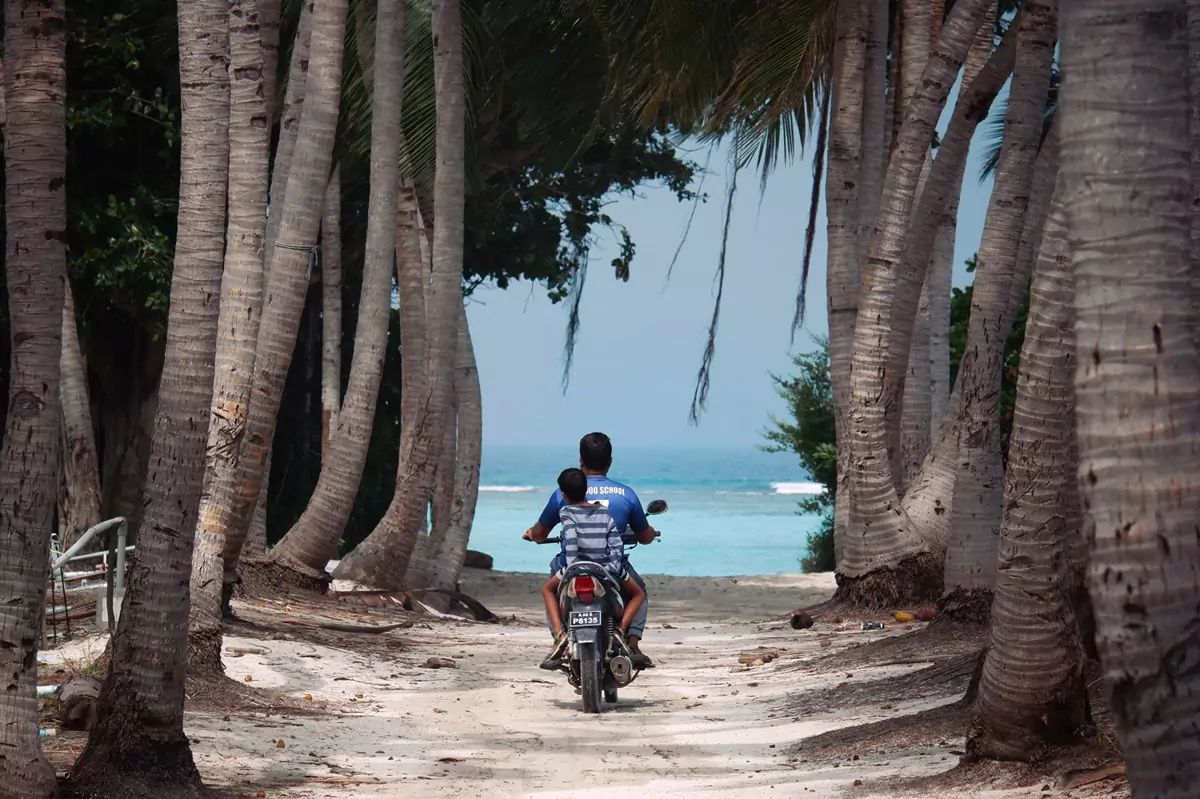
Differences Between a Maldives Local Island and Resort Island
There are startlingly significant differences between the Maldives local islands and the private resort islands, considering they all exist within one country and are so close that you can often see one from the other.
Laws
Firstly, the laws are completely different on public/local islands versus private ones.
On all Maldives local islands, alcohol is prohibited and there are strict, conservative dress codes (apart from a few designated areas called ‘bikini beaches’).
Many of these rules on private resorts are far less stringent or even non-existent – most things are permitted, apart from nudity and dogs.
Resorts
The resort islands are exactly what they sound like – big, posh resorts for foreign visitors.
These have no actual residences for local people on the island and each one is managed by an individual hotel company. They have complete control over the island and, as such, the islands are often perfectly groomed and completely designed with the tourist in mind.
Many of them even have ways of specifically removing mosquitos!
These are what you’ll have seen in brochures and on adverts.
Local Islands
In contrast, a local Maldives island is a village or small town, situated on a little sandy strip in the ocean.
They still have beautiful beaches, restaurants and guesthouses for visitors to stay in, but with the added benefit of a community existing alongside. There are the same excursions and diving opportunities, but offered at a fraction of the cost. Each local island is inhabited by up to a few thousand people, so (obviously) has schools, mosques, football pitches, healthcare centres, and waste disposal.
You know, just normal stuff that makes visiting somewhere new more interesting.
Budget
One of the biggest distinctions between the type of islands is budget.
Resorts can cost thousands of dollars a night, which would pay for (way more than) a week on a local island. The local islands have more affordable accommodation, food and transport (the public ferry routes do not service private islands, so for more distant resorts, you might be stuck paying for a crazy-expensive seaplane!).

1. Hulhumalé
Hulhumalé is the best island to stay on after landing at Velana International Airport if you can’t get a local ferry immediately after landing.
The island is connected to the airport (and Malé) by road and is completely artificial. Construction started in 1997 using sand pumped from the seabed and further expansion projects are ongoing. It is fascinating to see how big it is and how difficult it is to notice that the island is man-made. It’s huge compared with other Maldives local islands.
Our Experience of Hulhumalé
We really liked Hulhumalé, after reading some less than positive reviews. It has a lovely little swimmable beach with gleaming azure waters along the eastern edge, some nice restaurants, cafes, parks, a cinema, plus really welcoming residents. We only spent one day roaming around but gathered so much useful information just from talking to people.
Food: there is a plethora of food options here, which is conspicuous in its absence on other islands. We had a pizza from Pizza Buono which was surprisingly good – would thoroughly recommend.
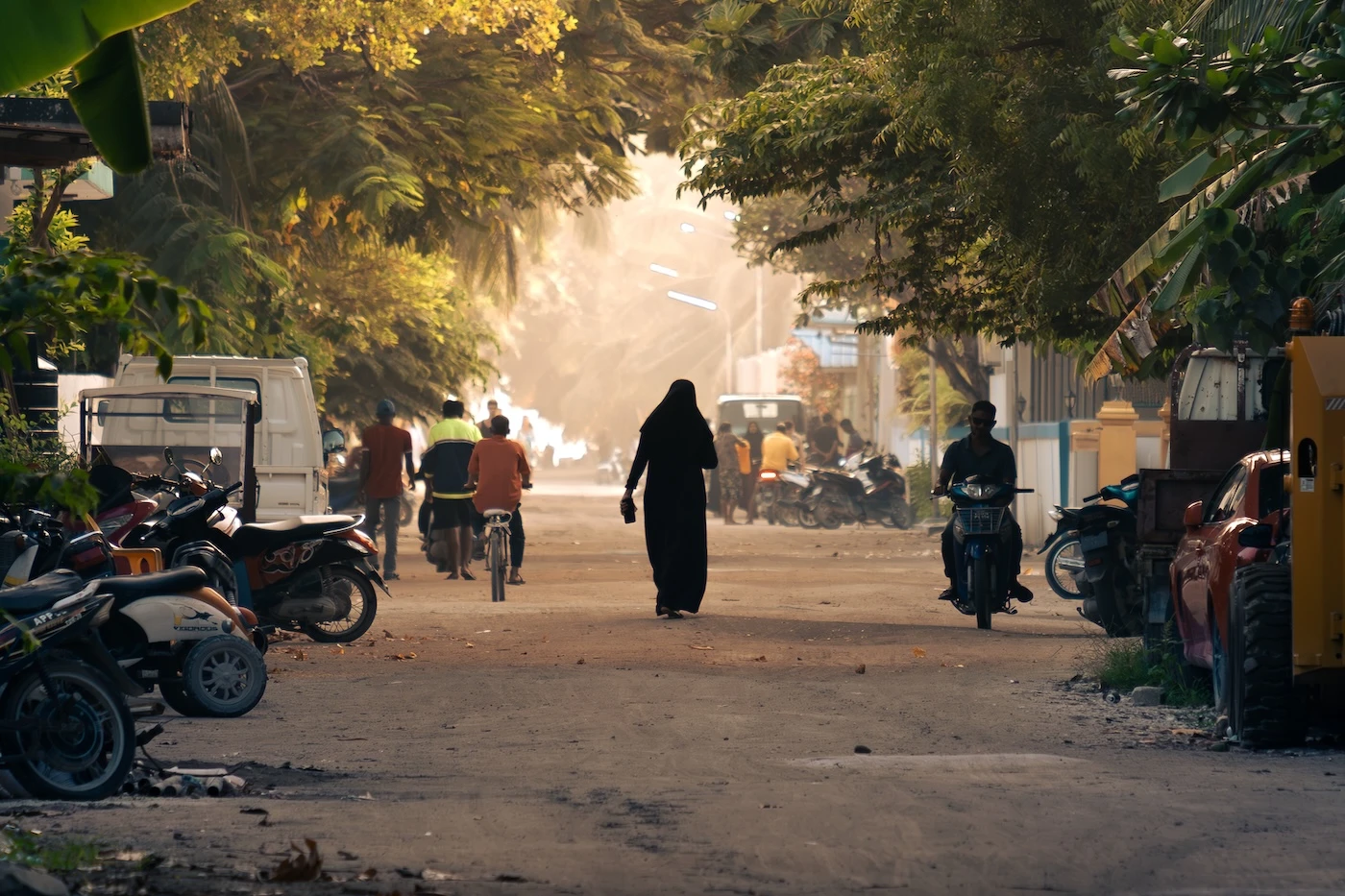
Vibes: it’s not really your idyllic Maldives local island getaway though, so is best used as a hub after arriving or departing the airport. There is no bikini beach and it’s just a normal community, which we preferred – it feels a little less artificial (the irony of that on a reclaimed island is not lost on me). First thing in the morning, you’ll see residents exercising on the beach and fixing bikes by the side of the road.
Hulhumalé – THINGS TO KNOW
Distance from Malé: 7.5 kilometres
Size: 4 km²
Population: 53,000
Best for: airport transits, restaurant options, people
Bikini Beach: no
Atoll: North Malé Atoll
ATMs: many
–
WHERE TO STAY ON Hulhumalé
In Hulhumalé, we stayed in the Amber Beach Hotel.
This hotel was amazing, located right on a pretty bit of beachfront, with a modern cafe on the bottom floor. The room was comfortable, bright, modern, with great TV channels, plus lots of the rooms have amazing views of the ocean too.
The breakfast was the best we had across the Maldives, with so many incredible choices.
The staff were lovely and taught us some Dhivehi too!
Fully recommend this one if you’re transferring through Malé.
–

2. Fulidhoo
This was the smallest and most isolated of the Maldives local islands on our itinerary.
Despite Fulidhoo’s relative isolation and tiny size (around 700 metres long), a lot of people seemed to have heard of it! When we spoke to people at the port in Malé, many had either been or were intending to visit there. Despite this, when we stayed, it seemed empty. I mean, completely, eerily empty; almost desolate.
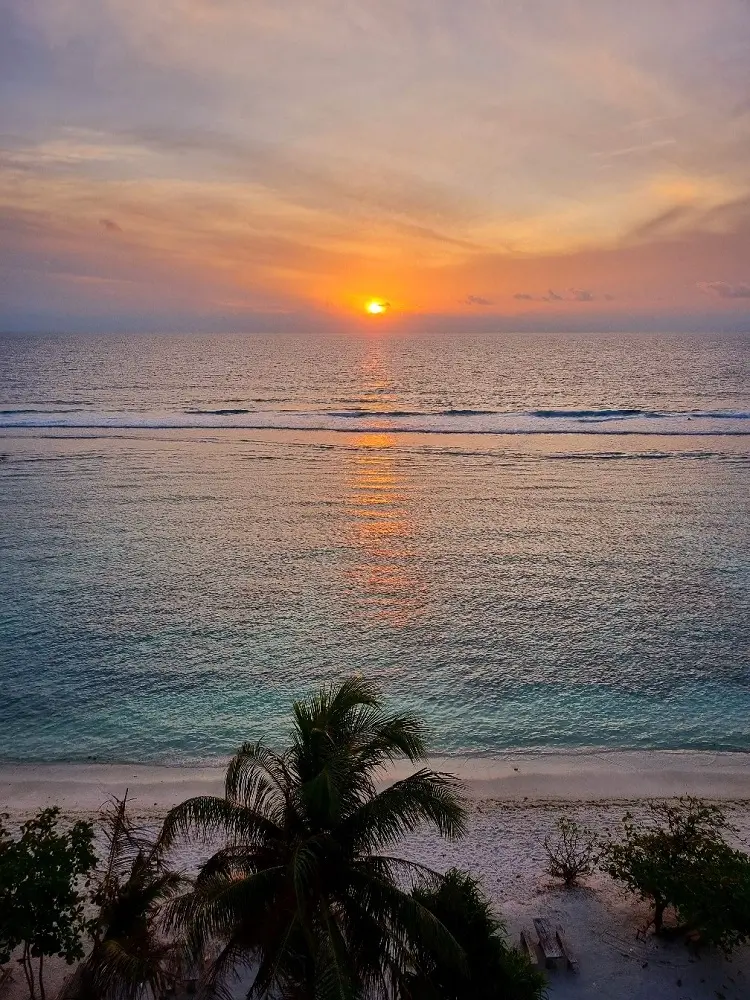
The island has two bikini beaches. The western bikini beach is prettier, emptier and lined with swaying palms, perfect for sunset. On the eastern end, the sugar-white bikini beach seemed larger, good for snorkelling, with a few more people (there are more guesthouses along the east and northeast).
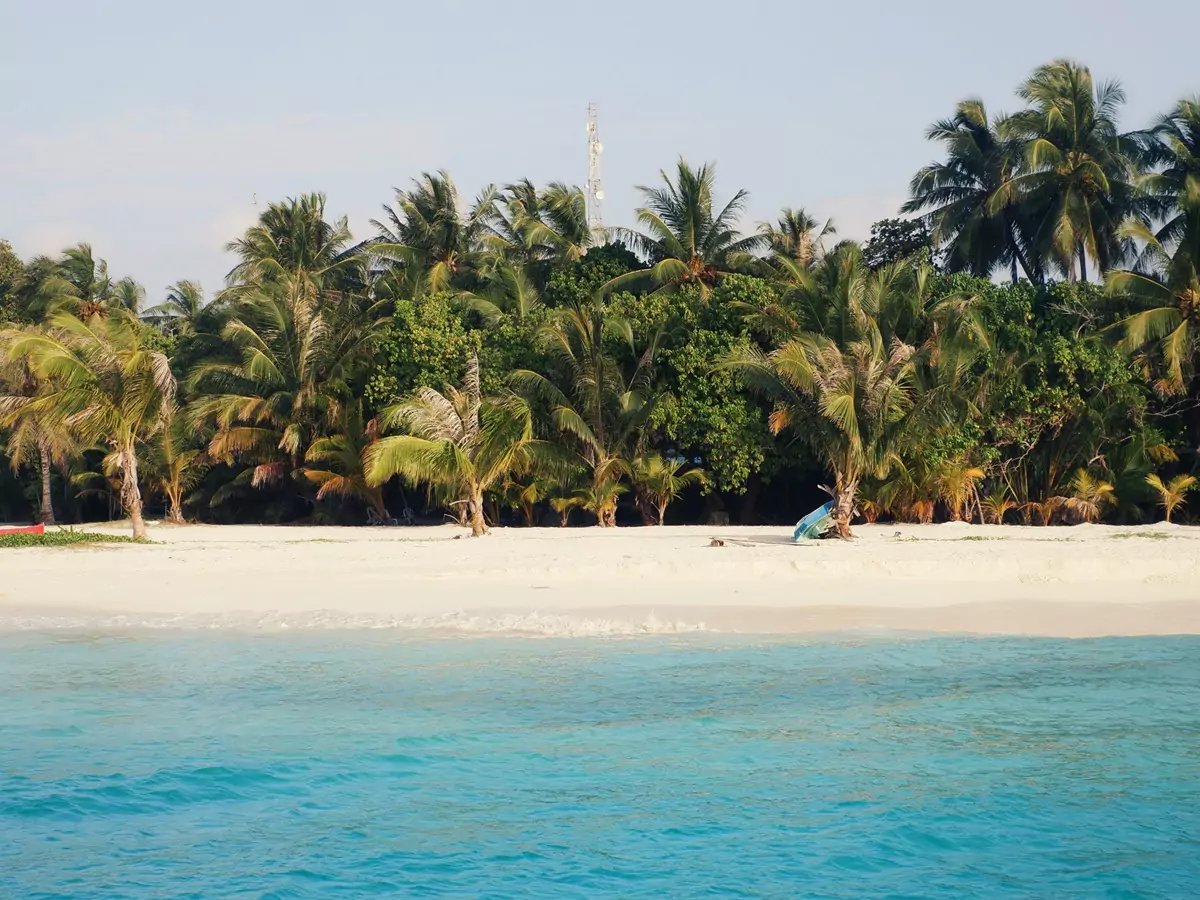
There are very few restaurants, no proper beach bars and several shops. The island has around fifteen-ish guesthouses, a magistrate, a football pitch (there’s at least one on every island!), a little main street with shops and a pretty green mosque. The one actual road that exists on the island is just sand. At the western end, there is a small power plant and a phone pylon.
Our Experience of Fulidhoo
For some people, I’m guessing this would be pure paradise. I mean, an empty tropical island all to yourself, surely that’s a utopia? However, for us, it was our least favourite island purely due to this. It’s absolute bliss for people who want to do nothing; the problem is, we hate doing nothing.
Vibes: the island lacked a sense of community buzz (although there does exist a population of more than 500 people). It is not, in fact, empty at all, it just feels empty. We did see a group of local women exercising at the football pitch, a man cleaning the mosque and a few fishermen. So, if you are looking for the perfect Maldives local island to chill out on and read a book for a few days, it may be ideal for you. Also, if eating at your guesthouse most nights doesn’t bother you, check it out!
The island was also the only one that doesn’t have any diet coke (my vice).
I definitely don’t want to imply that there was anything bad about the island or the people there, I think we were just bored. It’s tricky to review something when you know deep-down it just doesn’t suit you.
We did enjoy seeing the rays right off the peer, however the ethics of the fishermen feeding them to tempt them inland is sketchy. I asked our host about it, and he said that usually the rays would live further out but only come in because they were fed.
FULIDHOO: THINGS TO KNOW
Distance from Malé: 56 kilometres
Size: 700 by 200 metres
Population: 504
Best for: absolute silence, spotting rays from the shore, isolation, silky white sand
Bikini Beach: two
Atoll: Vaavu Atoll
ATMs: none
–

MALDIVES LOCAL ISLANDS: SOME REALITY
Some Maldives local islands are in the midst of a serious construction boom. Since tourism is a relatively recent thing, this is unsurprising, but well-worth noting when setting your expectations. Some islands have half-built buildings on every street, with construction noise and materials everywhere. Upgrading and expanding infrastructure is necessary for the residents of the Maldives, but not exactly idyllic, and I like to keep shit real on this blog.
From our experience, Fulidhoo and Maafushi were the worst for this. They had so much in the way of construction that it never felt very peaceful to me. The best islands were Thulusdhoo and Ukulhas, where I can remember very little comparably (although Ukulhas is apparently ramping up development on its northern end).
This development can be considered sad from a touristic point of view – one that feels like infrastructure is overtaking these paradise islands, however it can be argued that expansion and modernisation is very much in the interest of the citizens of the Maldives.
We shouldn’t begrudge any culture from modernising if that is what they choose. Having said that, get to the Maldives local islands soon because islands like Fulidhoo may not remain as sleepy as they are right now!
–
3. Maafushi
If you have only come across one Maldives local island during your research, it is almost certain to be Maafushi. This sizable island is very close to Malé and was one of first to develop as a leisure hub for non-resort tourists.
It has more than 70 guesthouses and hotels, some of which are proper high rise, up to ten floors up The vast majority of residents have switched from working in the fishing industry to the tourism industry and the island has water sports galore, high-end restaurants and even offshore ‘booze boats’.
Despite the emphasis on tourism, the island is a real, working town. This means it has all the usual facilities, including one of two prisons on the Maldives, a cemetery, post office, football pitch, mosques, a bank and a bunch of convenient stores.
Our Experience of Maafushi
We stayed near the north end (loved our little hotel), where the beaches and most tourist facilities are, including one bikini beach. Getting off the ferry at the port, we immediately noticed commotion, music and building sites. You know the incessant hum of drilling? That, from all sides. The island appears to be in a constant state of development, from all directions. (The drilling is not so prevalent in the tourist areas further to the north).
However, despite this, I think we are in the minority of people who preferred Maafushi to Fulidhoo, because at least it felt alive and busy with residents. It was nice to see life in the Maldives, which is the one thing we were looking for when booking our trip (we are not super beachy).
Space: it is pleasant to walk all the way down to the southern end, where the prison is (we spotted sharks along the shore). Here, you’ll see a whole bunch of ordinary infrastructure and life. So, if you want to experience a bit of the Maldives community, it’s a decent destination for a few days. We watched people windsurf, played around in the outdoor gym, wandered the long dusty streets and checked out the small stores.
Facilities: we think Maafushi would be a good local island if you require a lot of tourist infrastructure. Hiring a jet ski or visit a ‘booze boat’ is not really our cup of tea, but this is the kind of place that offers these services.
Time: Maafushi is great for shorter stays due to its proximity to Malé, situated around 25 kilometres to the south of the capital.
Beaches: the beaches on Maafushi were below average, in our opinion, compared to the other islands we visited. Although the water is an unconscionable blue and the sand is soft, it is small and busy.
Food: the food options were decent on Maafushi and not as overpriced as we expected, considering how touristy the island is.
MAAFUSHI – THINGS TO KNOW
Distance from Malé: 26 kilometres
Size: 1.3 by 0.3 kilometres
Population: 2700
Best for: proximity to Malé, water sports, bustle, booze boats, local activity
Bikini Beach: one
Atoll: South Malé Atoll
ATMs: one
–
WHERE TO STAY ON MAAFUSHI
In Maafushi, we chose a guesthouse called Island Ambiance, not far from the northern tip.
This little hotel was really, really lovely; set several streets from the east side, down a small sandy road. The rooms were huge, bright and so, so clean. The air conditioning was effective and the bed extremely comfortable. We always had hot water in the shower too. For the inclusive breakfast, there was traditional mashuni (tuna, coconut and chilli) or pancakes – all freshly made by the welcoming staff. We loved it!
The staff were really responsive, helpful and approachable and we would thoroughly recommend this place – the quality for the price was outstanding.
–


EXPLORE MORE OF THE MALDIVES
Go island-hopping:
Ukulhas: are these the prettiest beaches in the Maldives?
Thoddoo: why you should explore this magnificent agricultural island
Maafushi: a guide to the Maldives’ most popular spot
Thulusdhoo: experience the surfer paradise of the Maldives
more tips for your trip:
How strict is the dress code in the Maldives?
Remove the complexity of planning an island hopping itinerary around the Maldives
Learn how to navigate the Maldives public ferries
Quirky things to know for Maldives budget travellers
How much does a two week trip to the Maldives cost?
–
4. Thulusdhoo
Thulusdhoo is an intermediate-sized Maldives local island, northwest of Malé, with a reputation as a bit of a surfer’s paradise. It’s nearby two of the best surf breaks in the Maldives, Cokes and Chickens.
Although it is a larger island, a bit like Maafushi, it has far more space and less people (at least it feels that way). The ferry port is at the far end of the island, so you are collected by your guesthouse in a golf cart which winds its way through rough dirt tracks surrounded by wild-looking plains.
There are lots of high-quality accommodation options on the island; some with the most incredible sea views despite rarely going over two stories high. Small restaurants line the shore with epic beachfront locations and great food (still with the same super-slow island-time service, though!).
There is one pristine bikini beach at the eastern end of the island with swings in the sea and idyllic swooping palms. Most of the guesthouses bunch up around that end of the island.
Our Experience of Thulusdhoo
We really enjoyed snorkelling the house reef on this local island. There was great visibility and the water was really calm – it seemed well-suited to anyone who is a weaker swimmer.
Food: the food on Thulusdhoo was generally outstanding, and we even found real-life vegan food (although it was the most expensive meal of our trip!).
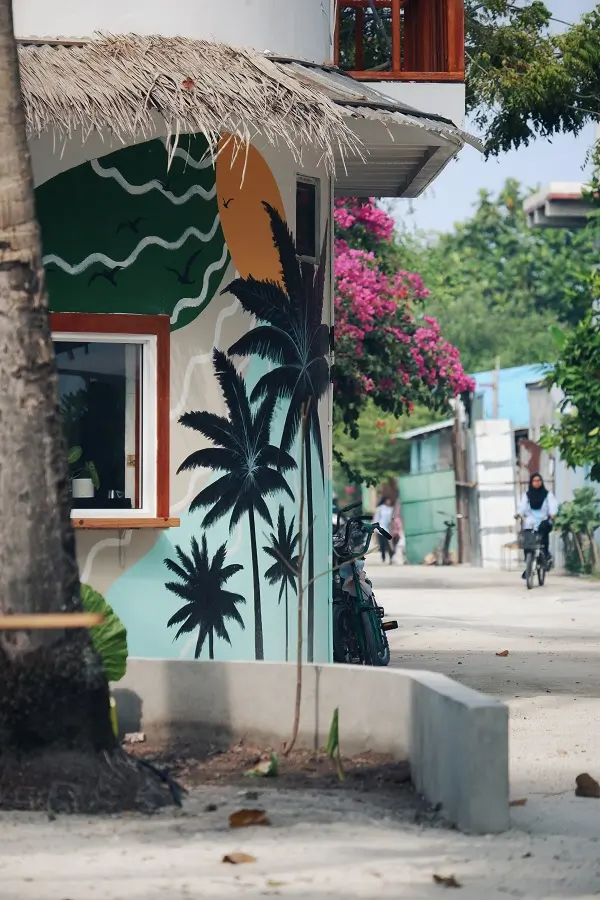
Beach: the beach was close to almost every hotel and guesthouse. This was lovely since it meant that the restaurants and facilities bunched up together, creating pretty streets and community vibes, all covered in beautiful flowers and art. The island was also big enough that we could wander far from the ‘tourist zone’ with ease. It’s not a particularly jungly island though, if that is what you are after.
Thulusdhoo was not what I expected at all. There was a bustle of people; walking, riding bicycles or motorbikes and the vibe just felt energetic (although still sleepy by the standards of almost anywhere else in the world).
This was probably our second favourite island and definitely our favourite accommodation; we loved it here.
THULUSDHOO: THINGS TO KNOW
Distance from Malé: 27 kilometres
Size: 1.58 by 0.68 kilometres
Population: 1483
Best for: surfing, vibes, food, picturesque beach, swimming
Bikini Beach: one
Atoll: North Malé Atoll
ATMs: one
–
WHERE TO STAY ON THULUSDHOO
In Thulusdhoo, we stayed at Reef Edge Thulusdhoo.
This was our absolute favourite accommodation across all the Maldives islands we visited. It was modern, well-equipped and every room had a beautiful view and balcony. The hotel also had bicycles you could use for free and even a complimentary washing machine (which was *the* most exciting thing that had happened to us in months).
The ground floor was surrounded by a meticulously cared-for, flower-filled garden, stretching away towards the ocean.
The inclusive breakfast was great, the staff spoke fantastic English and the guesthouse also pick you up for free from the ferry port in their little golf buggy. Everything was perfect and we’d definitely stay again given the opportunity.
–
QUICK TIPS FOR CHOOSING YOUR MALDIVES LOCAL ISLAND
1 – Always have a look at your islands of choice on Google Satellite to get a feel for where and how large the beaches are.
2 – Be aware that seasonal differences will affect the tides, which change the width/access to the beaches and the potential debris left on them. Our experiences are all based on travelled in January.
3 – Stick to one atoll ferry route for your island hopping itinerary if you are low on time, stopping at several adjacent local islands in a row.
–
FOR MORE LIKE THIS → 25 IMPORTANT TIPS FOR MALDIVES ISLAND-HOPPERS
5. Ukulhas
Ukulhas is definitely a Maldives local island that has tuned in with its tourism potential – it seems to know exactly what it’s doing.
Not only that, but it’s one of the first islands in the Maldives to be environmentally friendly, utilising a proper waste management system. The island is well-known for being spotless, with regular beach clean-ups. The one-kilometre beach, as well as being immaculate, is world class, with little bars dotted along the huge bikini beach. The island has quality accommodation and food options along with all the other usual facilities you’d expect.
Our Experience of Ukulhas
Facilities: the infrastructure surprised us when we arrived – there are colourful, friendly beach bars selling cocktails (non-alcoholic) with rustic beach chairs, hammocks, umbrellas and loungers. It felt closer to a place like Thailand 20 years ago than anywhere else we had been (whether that is good or bad is up to you!).
Cleanliness: as expected, cleanliness was top-notch. The shorelines were flawless, and we didn’t see much in the way of trash around the island apart from one end where it was being collected (towards the north eastern end). Something we absolutely loved was that the white, sandy beach was surrounded by massive fruit trees, jungle and tiny white picket fences. In my opinion, it was an absolute stereotype of island perfection (and I’m pretty difficult to please).
Cost: these additional facilities and benefits cost though – this was by far our most expensive Maldives local island. Accommodation and meals here were pricey and you largely get a lower standard for your money (there is high quality stuff available, we just didn’t pay for it).
Motorbikes: there are a remarkable number of motorbikes on Ukulhas. Even though the island is a kilometre long, people still motorbike everywhere. We’d see people picking their kids up from school and motoring 300 metres home.
Weather: we arrived on the ferry and there had been a *torrential* thunderstorm. This left the island completely flooded – I can’t confirm if other local islands also flood like this but be aware that it brings out the mosquitos (for some reason they didn’t bite us). It also makes traversing certain streets difficult. The island did not lose power or struggle in any way to provide services, though.
Reef: the house reef snorkelling on Ukulhas was the best we found on our trip. The water was so still and clear, you didn’t even have to put your head underwater to see all the fish.
Tourists: weirdly, most tourists on this island were Italian. This isn’t a bad thing, just something we noticed (would only be a bad thing if there were cars – which luckily there isn’t*).
Ukulhas felt like the most fashionable, vibrant Maldives local island of our trip. I wouldn’t say that any of the islands are particularly ‘trendy’, but it was the closest to cosmopolitan that I think you’ll get.
*Italian drivers are nightmares
UKULHAS: THINGS TO KNOW
Distance from Malé: 72 kilometres
Size: 1 by 0.2 kilometres
Population: 1065
Best for: world-class beaches, tourist services, eco-friendly, small, best house reef
Bikini Beach: one
Atoll: Northern Ari Atoll
ATMs: one
–
WHERE TO STAY ON UKULHAS
The accommodation we chose was called Island Home Inn.
It’s only a few metres away from the empty south-eastern beach. Truthfully, it was probably our least favourite accommodation across the islands, although we still liked our room a lot (all of our Maldives guesthouses were lovely for different reasons).
The rooms were large, modern and comfortable with reliable hot water and aircon. The Wi-Fi worked better than on some other islands.
The inclusive breakfast was obviously tuna-based, as expected, but good. You even ordered through an app!
Despite being our least favourite, we would still recommend our hotel, but also the SeaLaVie Inn. This five-room accommodation was popular with the people we spoke to on the island and was right next door to our hotel. It looked so cute!
–


6. Thoddoo
Thoddoo is the only Maldives local island on this list that is not part of an atoll, or ring of islands. It’s a large, nearly circular disk, just floating on its own in the middle of some crazy blue ocean. The place seemed pretty unique, which is why we decided to check it out.
Known as the ‘Island of Watermelons’, Thoddoo is famous for agriculture, specifically watermelons and papayas. It feels spread out, with most of the dwellings in the centre of the island, surrounded by fruit fields that eventually lead to beaches. About a third of the island is apparently farmland, which is in huge contrast to anywhere else that we went in the Maldives. Although it’s all about fruit here, there are two tourist bikini beaches on opposite ends of the island (the area of the two together is less than the single one on Ukulhas).
The island itself was an agricultural community far before tourism came around, so the community has all the usual facilities, including several football pitches and mosques, a hospital, kindergarten, gym, restaurants and more.
Our Experience of Thoddoo
We loved Thoddoo. It was by far our favourite of the Maldives local islands.
Space: we enjoyed being able to walk for miles through the plantations and not run out of space; we also loved the fruit trees with giant fruit bats swooping between them. It is large enough that hiring a bike is a sensible option, and most hotels will offer them for free. We were given a little golf-buggy tour of the island by our host who answered all my probing questions about the agriculture, resort and local tourism industries on the island!
Beaches: the beaches were as beautiful and spotless as on Ukulhas in our experience, stretching for as far as the eye can see. If you are exclusively looking for a bikini beach though, the ones on Thoddoo can get crowded, so it depends on what you want to wear when you hang out.
Food: this was the one island that actually served dinner within a reasonable time frame (so less than an hour). We loved the food and were even given free coconuts with paper straws.
Tourists: unlike Ukulhas, this island was jammed full of Russian tourists. Our hotel host even mentioned that it was rare to see other nationalities. The tourists were rude and were the worst for obeying the dress code laws, our host even mentioned that it was sad. Despite this, we found the residents to be, by a mile, the most welcoming and friendly (despite the Russians all being horrible to us!).
It’s interesting. According to our host, this island never really sent many family members away to work on the resort islands as it is primarily agricultural. This means that less people would have encountered tourists before 2009. Maybe this is why people are so wonderfully welcoming on this island?
THODDOO – THINGS TO KNOW
Distance from Malé: 67 kilometres
Size: 2 by 1 kilometres
Population: 2058
Best for: world-class beaches, tourist services, eco-friendly, small, best house reef
Bikini Beach: two
Atoll: considered part of the northern Ari Atoll
ATMs: one
–
WHERE TO STAY ON THODDOO
On Thoddoo, we stayed at Jeym Lodge.
It was centrally located on the island, near the large football pitch in the centre. The beach on the sunset side (western) is less than a 10-minute walk.
We liked this hotel a lot. The rooms were really comfortable, new and modern. The hot water and aircon were perfect, every room had a beautiful terrace surrounded by plants and flowers, plus we were given a tour of the island by the host.
The breakfast was buffet style on the roof, with tuna (obviously) and lots of other great options. Bike hire was free and the front desk could sort out any excursions, including diving.
We don’t really have anything bad to say about this accommodation – fully recommend.
–

Other Maldives Local Island Recommendations
While chatting with tourists and residents across the Maldives, we tried to gather as much information and recommendations as possible for other Maldives local islands that might have something extra special for our next trip itinerary. Here are some of the ones that stood out to us.
⬩Feridhoo: remote with amazing beaches, loads of nature and only a few guesthouses. Really off the beaten path and quiet. ‘Unspoilt’ was another word used to describe this island.
⬩Rasdhoo: beautiful nearby sand bank, reasonably near Malé (good for combining with Ukulhas and Thoddoo). Great value diving excursions.
⬩Omadhoo: fantastic (apparently the best) snorkelling on the house reefs, stingrays and sharks by the beach. Small, remote and apparently has a sand bank.
⬩Himmafushi: best for surfing (I was told it is better than Thulusdhoo), laid back surfer vibes, very close to Malé.
⬩Kaashidhoo: super remote, jungle hiking, larger population, agricultural, off-the-beaten-track.
⬩Dhangethi: great value for diving excursions, fantastic house reef and beach, good tourist infrastructure.
⬩Guraidhoo and Gulhi: close to Malé, friendly, great quiet alternatives to Maafushi.
Be aware that accommodation books out on these tiny islands: there’s just not that much of it, plus prices do go up last minute. We’d recommend securing something as soon as you can:
⬩Check out Thoddoo’s decent hotel selection
⬩Have a look at Ukulhas’ cute beachside guesthouses
⬩Take a peek at Maafushi’s upscale hotel options
⬩Choose your perfect Thulusdhoo beach hotel
⬩Reserve your idyllic stay on tiny Fulidhoo
⬩Book your airport hotel in Hulhumale
We reserve all our accommodation on Booking.com, because it generally has the best cancellation options, decent prices and the most useful review.
Maldives Local Islands Map
Below is a map showing all the islands that we mention in this post. The purple markers are islands we visited, the orange are ones we were recommended.
Viewing your Maldives map on Google satellite shows clearly the individual atolls that the islands are on. Use these atolls to plan your route – ferries and speedboats tend to move along strings of islands.
To save the map, select the star next to the title.
Final Thoughts: Best Local Maldives Islands
There are nearly 1,200 islands in the Maldives, several hundred of which are inhabited. Visiting these Maldives local islands is a fantastic window into a country that has previously been difficult to access.
We have only visited six islands so far, however the variety across them was startling. Your island itinerary will really make a difference to the type of beach/diving/cultural holiday you’ll experience.
Our travels through the Maldives local islands were astonishing; it was one of the most unique and beautiful places we have ever travelled. We hope you enjoy your trip as much as we did!
Hi, thanks for visiting our blog! If our free content has been of help to you, or you’ve just enjoyed our random ramblings and musings, say thank you by buying us a coffee! It helps keep The Restless Beans blog up and running.
Thank you, Claire + Nick


Thank you for letting us know about this blog post about Reethi far. We also work for the deluxe beach villa in maldives you should visit reethi faru
Hello, great post. I was wondering how you were travelling between islands ? Local Ferry or fast boats ?
have a great day
Hi Francois, we travelled almost completely by public ferry between the Maldives islands. We only got a speedboat when we messed up the schedule timings! We’ve written more about the ferries routes on our Maldives itinerary page here and about catching public transport in the Maldives here.
Let me know if I can be of more help 🙂
Hola, tengo 4 días para disfrutar. He pensado en maafushi por tema tours. Esta bien o recomienda otras isla?
Gracias
Thank you very much for the detailed report provided. It was nice reading about your experience in the Maldives. Iam heading there next week, however, iam still undecided about where shall I go? Initially I was planning to stay in Mafushi and go to another island from there , but after reading your post about the construction and noises there i became more confused now, haha.
My question is, what would you recommend for someone like me who will visit Maldives for the first time? I have only 7 nights and travelling on budget.
Hi Bmoosavi,
Thanks for your comment.
I wouldn’t worry too much about the construction noises on Maafushi, or other islands in the Maldives – you can always check recent reviews for your accommodation to see if noise is mentioned.
With a week, we’d recommend sticking to one atoll ferry route. Some choices for your trip are a combination of:
1) Ukulhas, Rasdhoo and Thoddoo
2) Maafushi, Gulhi, Guraidhoo and Fulidhoo
3) Himmafushi, Huraa, Thulushoo and Dhiffushi
We’ve written more detail about these three options on our Maldives Itineraries post.
I hope this helps you choose where to visit 🙂