

◊
Visitors to England are often enticed by the cultural and historical attractions on offer, including a plethora of pretty churches, crumbling abbeys and grand cathedrals spread all over the country. If these attractions are your sort of jam, then look no further than the abbeys in Yorkshire. It has no shortage of religious ruins, some of which are the best preserved and biggest in the country.
This article gives you a run-down of our four favourite abbeys in Yorkshire that we think most deserve your time and money.
◊
This post may contain affiliate links. If you book through these links we may make a small commission at zero cost to you. It helps us pay for the upkeep of this blog. Thank you!
WHY WERE THESE ABBEYS IN YORKSHIRE DESTROYED?
After the Norman conquest in 1066, monks started travelling to England from Europe and set up abbeys and priories all over the country, many of which were in Yorkshire. These buildings were the centre of religious learning until the rule of King Henry VIII in the 16th century. Between 1536 and 1540, he destroyed many of the monasteries after creating the Church of England.
This was done to enable Henry VIII to be allowed a divorce, as the pope refused permission. The Dissolution of the Monasteries, as it is now known, is argued to be one of the most revolutionary events in English history.
FOUNTAINS ABBEY
Abbeys in Yorkshire are some of the most beautiful ruins in England and if you only have time to visit one, make it Fountains Abbey.
History | the Abbey was founded in 1132 by 13 Benedictine monks from York and was named for the springs of water on the lands. They converted to Cistercian monks the following year and initially the Abbey flourished. The Black Death in 1348, along with raiding from the Scots throughout the 14th century, led to economic collapse of the Abbey and its holdings.
In 1537 the last abbot of Fountains Abbey, William Thirsk, was executed for treason by King Henry VIII. The Dissolution of the Monasteries in 1539 led to the land being sold to a merchant named Sir Richard Gresham. Fountains Abbey stayed as private land until the 1960s when it was transferred to West Riding County Council. It subsequently purchased by the National Trust in 1983.
WHY VISIT AND LOGISTICS
Why visit | located on the edge of Nidderdale Area of Outstanding National Beauty, these 12th century Cistercian monastic ruins are truly special. Set in the extensive, manicured Studley Water Gardens, complete with unique statues, temples and a river.
Logistics | there is a fee of £15 per adult by the National Trust (free with a National Trust membership). Bookings are now unnecessary. The fee is (for once!) reasonable since you can comfortably spend most of a day if you bring a picnic. Private transport is the easiest way to reach our top Abbey in Yorkshire.


WHITBY ABBEY
This iconic abbey in Yorkshire is a Benedictine ruin. Situated on a cliff overlooking Whitby and the ocean, it was even used as inspiration for Dracula!
The History | the Abbey was formed in 657 AD and became one of the biggest religious centres of the Anglo-Saxon world. In 664 AD a synod at Whitby (a high ranking meeting of the Church) was held which determined that Easter would always be on a Sunday. During the 9th century, the Abbey was abandoned, likely due to Viking raids. However, after the Norman conquest in 1066, a new monastic community was formed.
Following the Dissolution of the Monasteries, Sir Richard Cholmley bought the Abbey’s buildings and core of the estate. This then passed down through his family for centuries. In 1914, the German high seas fleet shelled Whitby and major damage was done to the Abbey. The ruins were later designated as Grade I listed (the highest protection) and placed in the care of the English Heritage.
WHY VISIT AND LOGISTICS
Why visit | this excursion is a great choice to combine with a trip to Yorkshire’s east coast. Take a picnic lunch; the views are astonishing. If quality beer is your thing, there is a small brewery pub with outside seating adjacent to the abbey with great craft ales. Do not miss the church and graveyard overlooking Whitby town just behind the Abbey – the scenery is beautiful.
Logistics | the site is managed by English Heritage and entry is £10, with an extra charge to park. Bookings are no longer necessary in 2022 however you save money by purchasing in advance. This Yorkshire abbey can be easily reached without a car. Travel by train to Whitby and then walk up the many steps or catch a local bus.


KIRKSTALL ABBEY
If you come to Leeds on your trip to Yorkshire then ensure to visit Kirkstall Abbey. It is around a ten-minute stroll from our house so we visit often, just for a walk or picnic.
History | Henry De Lacy, the Earl of Lincoln, made a promise to dedicate an abbey to the Virgin Mary if he survived from serious illness in 1147. He recovered, so gave the Abbot at Fountains Abbey land to establish another abbey in what is now known as Lancashire. The area proved inhospitable and an alternative in the Aire Valley was purchased instead. The Abbot Alexander and 12 other Cistercian monks built Kirkstall Abbey and associated buildings between 1152 and 1182.
After the Dissolution of the Monastery, the lands were awarded to Thomas Cranmer in 1542. The abbey reverted to the Crown upon his execution in 1556. Subsequently purchased in 1584 by Sir Robert Savile, Kirkstall Abbey remained in his family’s hands until 1671, when it passed to the Brudenell family. In 1889 the Abbey was sold to Colonel John North who presented it to Leeds City Council. After a period of substantial restoration, it was opened to the public in 1895.
WHY VISIT AND LOGISTICS
Why visit | it is beautifully preserved, adjacent to the river Aire and woodland. There is a market once a month selling handcrafted gifts and local artisan foods. Once a year in July there is also a regional festival celebrating all things Yorkshire.
Logistics | a huge bonus for this Yorkshire abbey is that there is no entry fee, no parking costs and no need to book! On public transport, a short train journey to Headingley station from Leeds will bring you within easy walking distance. Alternatively, many buses pass right by outside. One of our favourite pubs, The Kirkstall Bridge Inn, is a 13-minute walk away which we recommend on a sunny day for their excellent craft beers and riverside garden.


BOLTON ABBEY
This 12th Century Augustinian Priory is set by the banks of the River Wharfe and has beautiful walks along the river and the surrounding forest.
History | despite the name Bolton Abbey, this is technically a priory. The monastery itself was founded in 1120, but the actual Abbey was founded in 1154 by the Augustinian order. The Abbey passed through various lords and in the earlier parts of the 14th Century Scottish raiders caused the temporary abandonment of the site and serious structural damage to the priory.
When the Dissolution of the Monasteries occurred during the 16th century, construction works were still ongoing and buildings were left unfinished as a result. In 1540, Bolton Abbey was dissolved and the majority of the estate was sold to the Clifford family. The Abbey stayed in the family until a charitable trust was set up that turned it over to Chatsworth Settlement Trustees in 1946.
WHY VISIT AND LOGISTICS
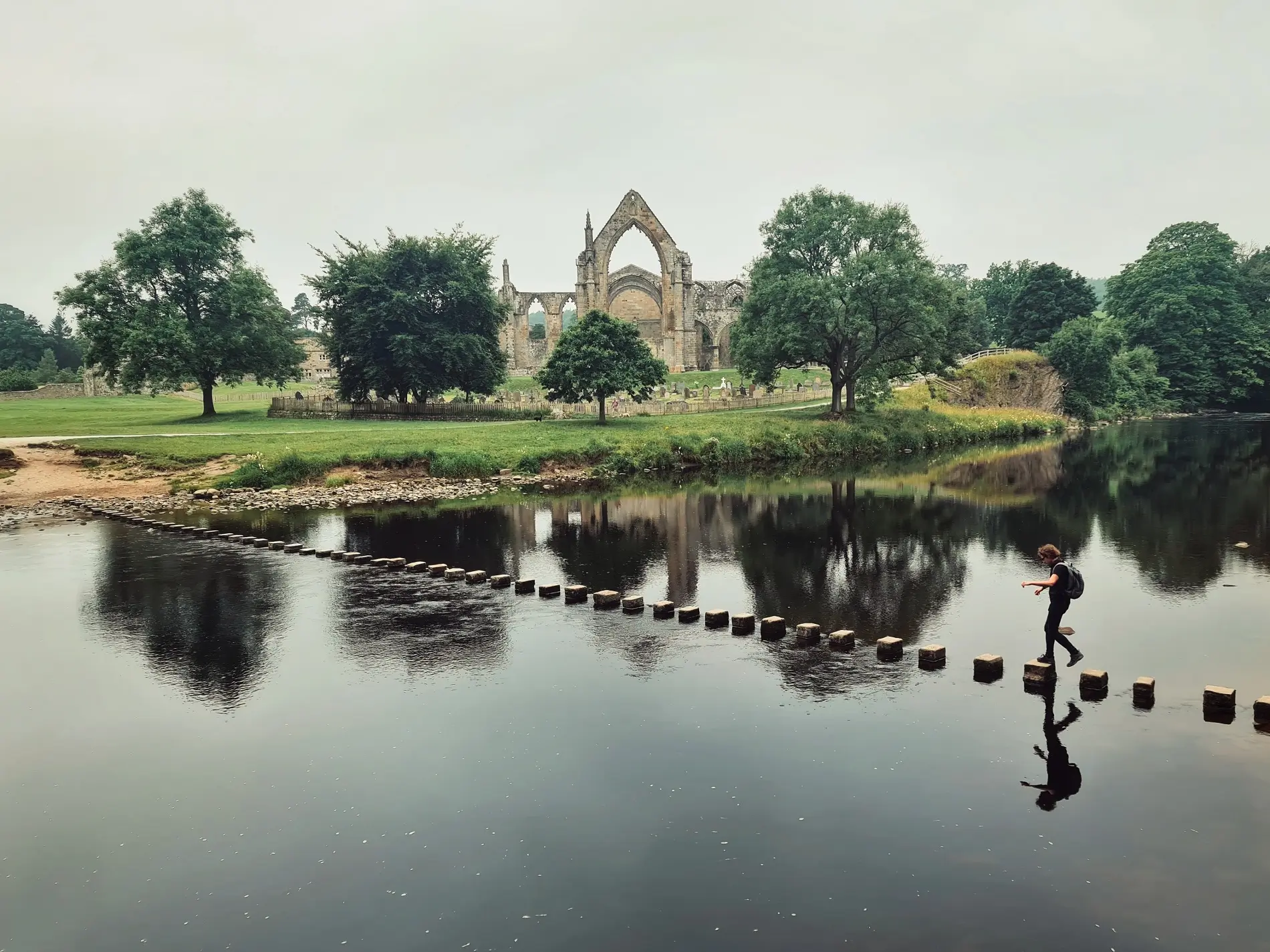
Why visit | the Abbey building itself is worth a short visit but the Strid – a series of narrow, rocky gorges further along the river Wharfe is an even bigger attraction. If the water level is low, consider crossing the stepping stones directly across the river from the Abbey, just to add a little extra jeopardy to your visit! You can also walk through the Valley of Desolation to Simon’s Seat if you want to get in some Yorkshire hiking. Just up the road from Bolton Abbey is Grassington, an excellent introduction to the Yorkshire Dales towns.
Logistics | opening times are 9am to 7pm, last admission 5:30pm (including Bolton Abbey, Riverside and Strid car parks). Advance tickets are £10 for one vehicle, £12.50 on the day. One ticket admits one vehicle (with up to seven people). Located between Skipton and Harrogate off the A59, the best way to get to Bolton Abbey is via private transport. It is possible to take public transport but this is tricky and will involve some walking near the end.

FINAL THOUGHTS – ABBEYS IN YORKSHIRE
The Abbeys in Yorkshire rank among some of the best across the entire country. With 1000 year old history, beautiful architecture all set in stunning Yorkshire scenery, it is worth including some or all of these Abbeys on your Yorkshire itinerary.
If you are currently only considering visiting London, we hope this sways you to visit us up here in Yorkshire!
Have a great day!
Hi, thanks for visiting our blog! If this post has been of help to you, or you’ve just enjoyed our random ramblings and musings, say thank you by buying us a coffee! It helps keep The Restless Beans blog up and running.
Thank you, Claire + Nick


