

The Best Grand Canyon South Rim Day Hikes
Scribbled by Claire ◊ 19 Aug 2024
We recently tested ourselves by hiking all of the main South Rim day-hikes below-the-rim! These are our trail thoughts, listed from favourite to least, including hints, timings, scenery, difficulty, and pros and cons, to help you choose your ideal hike!

You can’t visit the Grand Canyon and not want to hike into it, at least a little bit.
Spotting the narrow passages that carve their way around the curves of the canyon; imagining what it would feel like to be the tiny specks moving through the immense landscape. It’s undeniable; the best South Rim Grand Canyon hikes all lead down below the rim towards the Colorado River – piquing the imagination of every spectator at the top.
Each of the trails listed below have various length routes which we’ve named, and included the rough time required. Choose the appropriate length for your day hike based on your fitness (and ambition!).
For more in-depth Grand Canyon information, including lodging, where to eat, and other activities, check out our detailed South Rim itinerary and guide.

IN THIS GUIDE //
The Best South Rim Grand Canyon Day Hikes
BEST TIME TO HIKE THE GRAND CANYON
GRANDVIEW TRAIL
SOUTH KAIBAB TRAIL
WHERE TO STAY IN THE GRAND CANYON
HERMIT TRAIL
WHAT TO PACK ON A DAY HIKE
BRIGHT ANGEL TRAIL
THE RIM TRAIL
FINAL THOUGHTS
This post may contain affiliate links. If you book through these links we may make a small commission at zero cost to you. It helps us pay for the upkeep of this blog. Thank you!
BEST TIME OF YEAR TO HIKE THE GRAND CANYON
The weather in the Grand Canyon can be extreme, especially as you hike within the canyon towards the river.
We do not recommend hiking below the rim during summer – the temperatures significantly increase as you head down, there’s little shade and everything in the canyon is strenuous. Temperatures at the river are well in excess of 100F degrees and people do die, avoidably, every year.
The visitor centre and backcountry office displays temperatures at the Canyon rim and at Phantom Ranch (on the Colorado River). Check both before heading down. The National Park Service use the NOAA for weather forecasts if you’d like to check yourself.
We personally would not hike below the rim after the beginning of May and before October, ever. Our most recent backpacking trip was right at the end of April and it was roasting down by the Colorado River. We drank two gallons of water each per day and there was no breeze. It was tough. Previously, we backpacked at the end of October and the weather was lovely.
The best times to day hike the Grand Canyon are October into November and March to May.
Winter hiking is possible, but microspikes are an absolute necessity because the upper trails are icy and dangerous. Always check the weather before hiking – we’ve woken up under a decent blanket of snow in May in the Grand Canyon before!
–
HOW TO HIKE KANARRA FALLS, UTAH | 16 EPIC SLOT CANYONS IN UTAH

1. Grandview Trail
HORSESHOE MESA (ROUND TRIP 6.4 MILES, 6-9 HOURS)
COCONINO SADDLE (ROUND TRIP 2.2 MILES, 2-4 HOURS)
This is by far and away the best South Rim Grand Canyon hike. It is peaceful (we saw very few people during our trip), has amazing views at sunrise and is beautifully rugged. Built in 1898, it was originally a copper mining route (you can see these mines down on Horseshoe Mesa) but has since been left to deteriorate over time.
The trail is a little more challenging than the others in this list, but I think the serenity and views make up for it. It is classified as ‘unmaintained’, which means the route is not used by the pack mules so is narrow and rough in places.
The trail | I would absolutely recommend having hiking boots or good trailrunners, plus poles for this trail – it is exposed and there are a lot of loose rocks and uneven tracks. The hike is also extremely steep in places, although not consistently, so there were flattish areas to catch your breath. The steepest part is at the beginning down to the Coconino Saddle, which is something to be mindful of for the hike out! Other tricky bits on the Grandview Trail are the occasionally very tall steps. They are hard work on the knees (and particularly awkward if you have shorter legs).
There have been some washouts along the trail recently, making parts of it hard to pass. Routes through these mini landslides may have been marked by cairns by now, however after very wet summers, these trails can, and do, change slightly and often require a little bit of route finding. These portions of the path can be slow and tricky.
Backpacking options | this hike is commonly done as an overnight trip to Horseshoe Mesa or Cottonwood Creek, though you will need to apply for permits.
Trailhead | Grandview Point, off Desert View Road, east from Grand Canyon Village.
PROS AND CONS
Very traquil, hardly any people
Fascinating construction – check out the log steps
Very pretty trail
No mules
Basic bathroom facilities at Horseshoe Mesa
Quiet trailhead with easy parking
No drinking water
Very steep, especially at the beginning
Super tall steps – tough on the knees
The most rugged of the day hikes listed here
Quite exposed – could be nerve wracking
Washouts make route finding difficult
INCREDIBLE THINGS TO DO IN PAGE, AZ | ONE PERFECT DAY IN CAPITOL REEF


CAR HIRE FOR YOUR GRAND CANYON TRIP
We always rent our vehicles all over the world, including our recent trip in the United States, with Discover Cars. They’re often the most affordable, plus they paid out immediately on an insurance claim we made when our car took some heavy damage in Sicily.
Find out more about why we fully recommend them.
–
TAKE A LOOK BELOW OR CHECK CAR RENTAL
2. South Kaibab Trail
OOH-AAH POINT (1.8 MILES ROUND TRIP, 1-2 HOURS)
CEDAR RIDGE (3 MILES ROUND TRIP, 2-4 HOURS)
SKELETON POINT (6 MILES ROUND TRIP, 4-6 HOURS)
The South Kaibab trail is one of the two main ‘corridor’ routes which connect the North Rim with the South Rim at Phantom Ranch. It is a well-maintained, wide dirt path that provides some of the finest views in the Grand Canyon very early on along the trail. The distance-travelled to vista-quality ratio is at a maximum here.
The trail | South Kaibab is steep, but smooth-ish, and easy to hike compared with the unmaintained routes. There is minimal ice, even in winter due to the amount of sun exposure. However, this lack of shade makes the trail very uncomfortable in summer. Always hike early, before the sun rises. Many people set off as early as 2-3am.
Crowds | this route is also the fastest and shortest way to reach the Colorado River, so it can be busy with rim-to-rim hikers and backpackers heading to Phantom Ranch. Due to all these things, it is extremely popular and gets super, super busy. There are also mules, resulting in mule crap all over the paths. You will also inevitably have to stop the let them pass.
Facilities | there are bathrooms at Cedar Ridge and water at the trailhead in summer. There is also a sheltered rest area at the Tip-Off (which is further than the average day hike). At the bottom, Phantom Ranch usually has running water.
I personally never found peace on the upper portion of this trail, even after starting out on the first shuttle of the day. It really does get very, very crowded at times. Instead, it was the expansive views that really provided me with the motivation! It is spectacular, so despite my lack of quiet, I was very much able to appreciate the journey.
Backpacking options | Phantom Ranch/Bright Angel Campground on the Colorado River are the most common choices from the South Kaibab trail. Havasupai Gardens is the other choice by cutting across the Tonto from the Tip-Off.
Trailhead | Yaki Point, east of the Grand Canyon Village (you need to get the orange shuttle all year round for access – no private vehicles).
PROS AND CONS
Best effort to view ratio in the Grand Canyon
Bathrooms at Cedar Ridge
Wide, maintained, comfortable trail
Water at trailhead
Less ice than other trails
Quickest route to the river
Shaded rest area at the Tip-Off
Very busy trail – the second most popular in the park
Have to get a shuttle to the trailhead – no private vehicles
Mules on the trail
Very little shade which is problematic in the summer
No water along the trail

WHERE TO STAY IN THE GRAND CANYON
There are several lodges within the South Rim Grand Canyon boundary:
Maswik (5 minutes from the rim, more affordable – my favourite)
Kachina & Thunderbird (on the rim, amazing views and location next to Bright Angel)
El Tovar (posh, high-end, historic, books out fast)
Yavapai (cheapest, most basic, away from rim, near the village market and campground)
We’ve not stayed in El Tovar because $$$, but the others are all okay.
—
7 miles outside the Grand Canyon boundary is Tusayan, a small town/village with lots of nice (but expensive) hotels. We’ve stayed in most of them (unfortunately for our wallet) and Red Feather Lodge is the best value for your money.
Further out, around a one hour drive, is a Route 66 town called Williams with some slightly cheaper lodging.
—
There are two, developed, above-rim campgrounds in the South Rim Grand Canyon National Park – Mather and Desert View. The former can be booked in advance on recreation.gov (no permits needed). The latter is first-come, first-serve.
Both these campgrounds get crazy cold in winter (and often in autumn and spring too).
The North Rim also has a lovely campground, which is open May 15th to October 15th every year (reservations generally required).
I’ve camped in all three and they’re a pleasant and affordable way to stay in the Grand Canyon National Park.
–
MONUMENT VALLEY VS VALLEY OF THE GODS | GOING OFFROAD IN CAPITOL REEF


3. Hermit Trail
DRIPPING SPRINGS (ROUND TRIP 7 MILES, 5-7 HOURS)
SANTA MARIA SPRING (ROUND TRIP 5 MILES, 4-6 HOURS)
This route is an interesting one. It was built in 1911 and used as the original tourist trail into the Grand Canyon. It predates Phantom Ranch by around 10 years and the remains of a luxury tourist camp can still be seen near Hermit Creek. Around 1930, after the South Kaibab and Bright Angel trails were acquired by the National Park Service, the path was left to decline.
Present day, it is designated an ‘unmaintained’ trail, indicating it is more rugged than the corridor trails of Bright Angel and South Kaibab. Hiking boots and poles are highly recommended for this route. It killed my knees going down!
The Trail | Hermit is steep, dropping 2000 feet in the first couple of miles (remember this for the hike out). The original cobbled/paved paths are unique on this route – keep an eye out for the occasional remaining section. There are also a few animal track fossils (the rangers can mark them on a map for you if you ask).
This trail is a great one if you are a thirsty hiker like me (I drink my weight in water even on a cold day) – both Dripping Springs and Santa Maria Spring have water available. Always ensure you take something to filter or purify it.
Hermit is one of the best Grand Canyon South Rim routes, however in our opinion it gets really stunning after Santa Maria Spring. Therefore, we only put it at number three on our list for day hikes. Just a little further on from Santa Maria Spring is Lookout Point, which is suggested as a day trip option during the cooler months (8-mile round trip). It is spectacular as the narrow side canyon opens up with views of the Tonto Platform.
Note | we hiked to the river on this trail then camped at Hermit Rapids and did not return via the same route (which would have been horrendous – going up Hermit is not something I ever fancy doing!).
Backpacking options | the best place to camp is Hermit Creek, which is a lovely day hike down to the Tonto platform. Hermit Rapids is further down a rough canyon to the Colorado River (we did this and it was a *long* day. Monument is another popular campground on the Tonto (we got lost finding our way out of here though!).
Trailhead | Hermit’s Rest, along Hermit Road (closed to private vehicles seasonally – 1st March to November 30th. Take the red shuttle route during these months).
PROS AND CONS
Quiet – mostly overnight backpackers on this trail
Easy and reliable water sources
No mules
Not much exposure early on
Less ice in colder months
Some of the best views in the entire canyon further along the trail
Views are better further along the trail
Quite rugged – far more difficult than the corridor trails
Steep, especially near the top
Must get a shuttle to the trailhead for most of the year
A few washouts – only after Santa Maria Spring though when we were there
HOW TO DRIVE THE WHITE RIM ROAD | TIPS FOR CAMPING IN THE NATIONAL PARKS

GEAR FOR DAY HIKING THE GRAND CANYON
Below are a few of the things I’ll never hike in the Grand Canyon without. Obviously, if you are only hiking a mile down, some of these things might be a bit overkill. However, it’s better to be safe than sorry!
Ratsack (to protect your food from critters on off-corridor trails if you intend to leave your bag anywhere)
Sunblock
Sensible, comfortable shoes
Hat
Plasters – I like Moleskin
Permit (if overnight backpacking)
Hiking poles (these help with the knees)
Water
Platypus water thingies (for extra water)
Water filter (my new fave is Katadyn BeFree)
Back up water sterilising tabs
Electrolytes
Headtorch
Layers (it can be freezing in the morning)
All the salty calories
Knee supports (if you have any knee risk)
Painkillers (totally necessary if you have my knees)
Extra socks, preferably merino (I love Injinji socks)
Hand sanitiser
Toilet roll
Bowel trowel (off-corridor)
Tissues to wipe up your tears
–
13 AMAZING NATIVE AMERICAN RUINS | 10 OFFBEAT THINGS TO DO IN MONUMENT VALLEY

4. Bright Angel Trail
1.5 MILE RESTHOUSE (3-MILE ROUND TRIP, 2-4 HOURS)
3 MILE RESTHOUSE (6-MILE ROUND TRIP, 4-6 HOURS)
HAVASUPAI GARDENS (9-MILE ROUND TRIP, 6-9 HOURS)
PLATEAU POINT (12-MILE ROUND TRIP, 9-12 HOURS)
This is the easiest and most popular way to see the canyon below the rim and, in many people’s opinion, one of the best Grand Canyon South Rim hikes! The views are decent considering the hike is set back in a side canyon. If you make it as far as Plateau Point (not a good idea in summer), the landscape goes from ‘decent’ to spectacular, exceptionally quickly.
The trail | Bright Angel is wide and smooth, making any exposure feel minimal. It is steep until it levels off towards Havasupai Gardens and from there to Plateau Point it undulates without any significant elevation change.
To me, the route feels relentless and never-ending, with the views not really varying after the first half an hour until Havasupai Gardens. It was also incredibly busy and covered in fresh mule crap, which was not so pleasant. We’ve hiked up this trail several times now, always at the end of a backpacking trip, so I am never as enamoured with it, possibly because I’m always absolutely shattered by that point.
We hiked up the Bright Angel Trail after a particularly gruelling 33-mile trip and positively marched up it – we didn’t think it was particularly tough, just not that exciting. (We are not very fit – just really craved pizza after four days of camp food).
Facilities | the route has regular toilets, water points in the summer (pipelines allowing – always carry water anyway), rest houses and lots of shade during the earlier parts of the day. At the bottom, Havasupai Gardens has running water, picnic areas, bathrooms and a fully equipped campground.
I would recommend the Bright Angel Trail for nervous hikers who are concerned about route conditions, fitness, or water supplies. Although it is at the bottom of our best South Rim Grand Canyon hikes, this trail is a perfect, beautiful introduction. The Grand Canyon is *hard* to hike no matter which route you choose, and this is still a significant challenge. It’s just a little safer due to the water points and shade.
Backpacking options | the easiest backpacking route in the Grand Canyon is at Bright Angel to Havasupai Gardens, 4.5 miles in. This is a competitive permit to get though.
Trailhead: Bright Angel Trailhead, in the Village near various parking lots and hotels.
PROS AND CONS
Easy, wide, maintained dirt paths
Seasonal water points 1.5 and 3 miles in
Year-round water at Havasupai Gardens
Ranger station and other permanent facilities at Havasupai Gardens
In shade for large portions of the day
Regular bathrooms
Conveniently located next to hotels and facilities
Parking nearby to trailhead
So many mules
Huge crowds, feels like Disneyland
Views can get repetitive
Still quite steep, especially right at the exit when you least need it


A SOUTH RIM ALTERNATIVE – THE RIM TRAIL
If all this talk about horrendous, exhausting hiking below the Grand Canyon rim already has you sweating – there is an easier way, which is perfect for a summer time day hike.
The Rim Trail is a 13-mile route that runs from Hermits Rest to South Kaibab, following the canyon rim for the duration.
The route has no noticeable elevation change, and the best bit is that the shuttle buses run along the entire length, so you can hop-on and hop-off whenever you want. Plus, you never have to backtrack (my personal pet hate when hiking).
This route can be icy in colder months, so use microspikes. Also, watch out for lightning at any time of year (especially the monsoon months of summer).
Large chunks of the trail are wheelchair accessible, too.
–
HOW TO GET LOST ON ARCHES’ BEST HIKE | THINGS TO DO IN ESCALANTE, UTAH


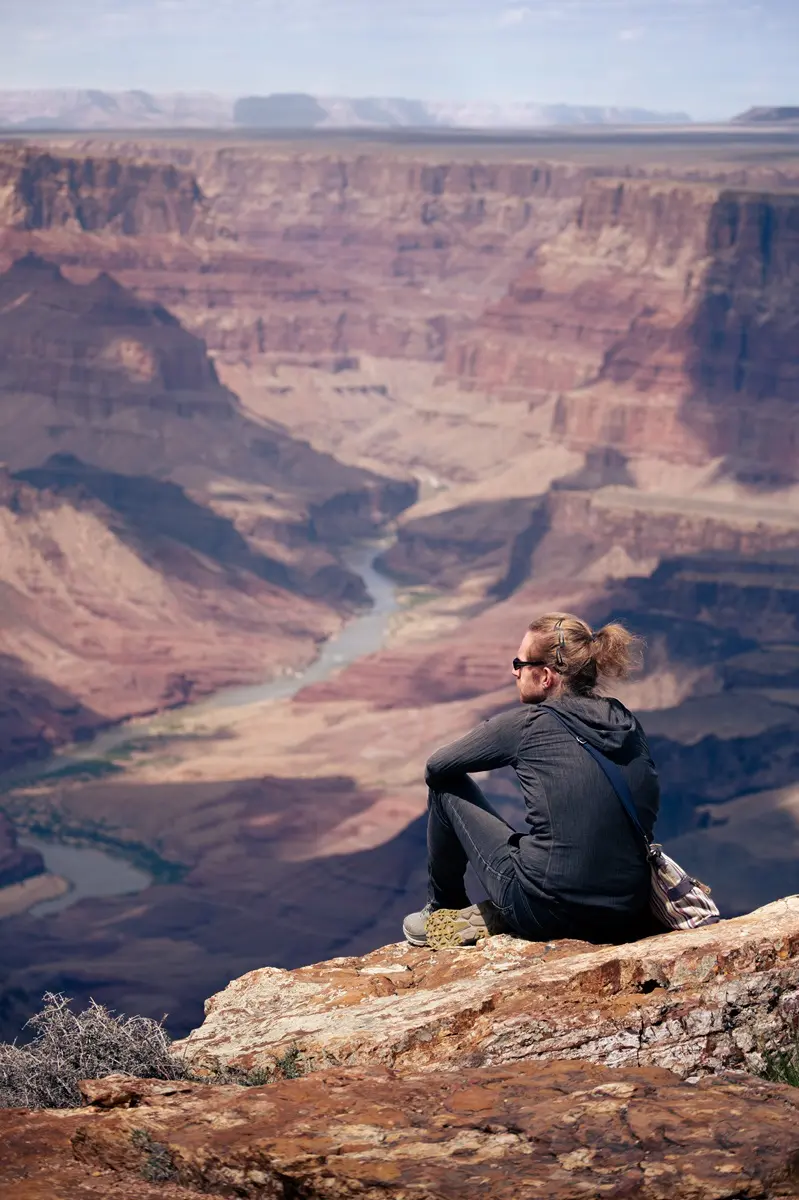
Final Thoughts – The Best South Rim Hikes
This list of the best South Rim Grand Canyon hikes is from our personal perspective and experience.
Note that we haven’t included any safety information here, but it should go without saying: do not hike midday in summer, wear traction devices in winter, take appropriate water and food supplies. We are not overly fit and could only really manage all these hikes because we had the correct gear and preparation. The National Park Service has all the safety information you need – hike smart and know your limits, people do die here every year.
If you’re interested, check out our detailed Grand Canyon South Rim guide and itinerary, with lots of recommendations for things to do (other than hiking!), places to eat and places to sleep.
We hope this was a helpful introduction to your below-the-rim options at the South Rim. Have a wonderful day!
Hi, thanks for visiting our blog! If this post has been of help to you, or you’ve just enjoyed our random ramblings and musings, say thank you by buying us a coffee! It helps keep The Restless Beans blog up and running.
Thank you, Claire + Nick


