

· AFRICA ·
9 Cool Things to do in Harar, Ethiopia
Scribbled by Claire ◊ 01 Nov 2024
Are you planning a trip to the legenedary walled city of Harar, in Ethiopia? We spent three days exploring the city, and these are the best things to do in the area!
Harar, designated a UNESCO World Heritage site in 2006, is a 1000-year-old walled city in eastern Ethiopia said to be Islam’s fourth most holy city.
If you are planning a trip around Ethiopia, it might be an easy choice to miss Harar (more accurately Harar Jugol when referring to the old town). The city is off in eastern Ethiopia towards the borders with Djibouti and Somaliland with no other major sites nearby. It does not have an airport. So why would you make the effort to visit?
To start with, this sacred fortified city is a rare place. It has 82 mosques, some of which date back to the 10th century. The cultural heritage within the city is surprisingly well preserved – it is an enclave of Islam in an otherwise deeply orthodox Christian country. The walled city is a maze of narrow alleys showing off the traditional architecture of typical Harari homes. Perhaps most renown is the relationship the city has established with spotted hyenas who roam at night through these back streets.
If that is not enough, here is our list of suggestions to persuade you that Harar is worth some space in your Ethiopia itinerary!
This post may contain affiliate links. If you book through these links we may make a small commission at zero cost to you. It helps us pay for the upkeep of this blog. Thank you!
1. Wander the Alleys of Harar
This entry is my number one activity and I know I’m not alone in recommending it.
It may not sound very specific, but with more than 350 narrow lanes fitting into just one square mile, the old town will fascinate you at every turn. It’s an amazing experience, getting lost in the winding, colourful backstreets. You’ll come across traditional homes, vibrant streets hiding tiny mosques, small markets and many farm animals and cats. It truly is the best way to understand the city.
Don’t worry, you can never be lost for long. Either you’ll hit the city walls or the main street running through the middle!
This can be done with a guide. There are endless young men on the main streets who will offer to take you around and show you the sights. Some might say too many – I hit my courtesy quota pretty early on when walking around. It can get a bit overwhelming after a while. I always enjoy walking around alone, at least for a while – it helps me get the sense of a place.
The best advice I can give is to get off the main streets if you want some peace and quiet. The back alleys are full of fascinating people who are sincerely interested in showing you their homes and animals. We met a lady who just wanted us to photograph her dancing with her cat!


2. Feed the Hyenas
This bizarre activity has only been around since the 1960s, but the presence of hyenas within the city walls has been documented over the past 500 years. You may have even seen the hyena men on Planet Earth II with David Attenborough.
You can either feed the hyenas outside of either the north or east gate of the city. You pay 100 birr to the hyena man and a Bajaj costs 100ish birr depending on which gate you chose and where you are coming from. The event happens daily around 6pm. The hyenas, although wild, are docile around humans which allows you to feed them meat on sticks.
Be careful, sometimes the hyena men will try to rip you off. We saw them charge a young girl double that of her friend and they tried to charge us just for taking photos.


3. Feed the Harar Black Kites
The black kites in old town Harar know what they’re doing!
The birds hang around the meat market, waiting for scraps. Here you can pay the men for the meat to feed these chunky birds by hand for about 50-100 birr. Be aware that the kites can hurt your hand! My friend had scratches for a few days after.
You get given some raw meat which you put in your hand which you hold out very flat. The birds then swoop down and grab it with their talons, which are very sharp!

4. Drink the Coffee in Harar
Ethiopia is said to be the birthplace of coffee, so a pilgrimage to Harar in pursuit of the perfect cup is vital for any coffee lover! It is said that Arabian traders planted the first ever commercial coffee plantations here a thousand years ago and the coffee is still processed using traditional methods.
Although a smaller coffee producing region (only around 7-10 percent of the country’s production), Harari coffee has a distinctive wine-like, acidic flavour and is a rare example of superb naturally processed, sun-dried coffee. It packs a punch!
There are plenty of choices for your coffee needs in Harar from small stalls, markets and coffee shops. We had the best coffee from a lovely lady who we bumped into on the street. We had given her some water several hours earlier and she wanted to say thank you.
Don’t forget to buy some to take home with you from Nure, just off the main street running through the old town. Also remember, coffee ceremonies are a common occurrence just as in other areas of Ethiopia – always drink three cups!

5. Visit the Museums in Harar
The Arthur Rimbaud Cultural Center is one of the most well-known buildings in Harar, built on the site of the French poet’s home in the 1880s. The center, opened in 2000, comprises a small exhibit containing photographs taken by the poet, likely the first photographs ever taken of Harar. The entry fee is 50 birr and is a fascinating window into the renown poet’s life.
The Sherif Harar City Museum has a small selection of cultural objects from region Ethiopian groups including Harari, Oromo, Somali and more. The exhibits include coins, books, cloths, jewellery, garments and weapons. Guides are available and excellent. Entry is 50 birr and don’t forget to tip your guide.


6. Eat Some Fatira
These are fantastic local pancake/flatbread things that are filled with your choice of peppers, onions, tomatoes, chillies and egg. They’re great for vegetarians (in a country that really likes red meat!), taste lovely and are so cheap!
You can find them obscured behind just ajar wooden doors, often straight off the main street running through the old town. They’re easy to find! Just watching them be prepared over hot flames is an entertaining experience.


7. Walk Around the Old Harar City Walls
One of the most notable features of Harar is the 16th century wall surrounding the old town.
It is five metres high, 3.5 kilometres long and was erected as a medieval defence to protect the inhabitants of the town. The wall has five original entrances or gates named Buda, Sanga, Erer, Showa and Fallana (in Amhari) which symbolise the five pillars of Islam. The Erer Gate is sometimes dubbed the Richard Burton gate as this was the entrance he arrived through as the first ever non-Muslim in Harar, masquerading as an Arab trader.
Two more recent gate additions have been added since, one of which is the traffic friendly Harar gate, often seen in photographs.
Wandering around the perimeter of the old town was one of my most enjoyable experiences. There are instants bursting with chaotic, frantic, frenzied activity while other moments are peaceful and interactions with individual community residents are laidback and authentic.


8. Spot the Mosques
You would think that with 82 mosques, you’d be continually passing them throughout the old town!
With miles of twisting alleyways though, the smaller mosques can be hard to find, and are a treat when you do. The larger mosques, such as the Grand Jami Mosque, are easy to locate just off the main street running through the walled town. The smaller ones were more interesting to me though, hidden between traditional homes in the back streets. Remember that foreigners are not allowed to enter the mosques, so just observe from the outside.
There are also several other religious buildings that are worth visiting, including a Catholic church and orthodox Ethiopian church.


9. Try Some Harar Khat
Apart from coffee, nothing is as important as the Khat plant in Harar.
As a stimulant, it is consumed at an alarmingly high rate and gives the user a euphoric sensation. Chewing the bitter leaves is a social activity in Harar – you won’t find it hard to find someone willing to share with you! Harar is even said to be the birthplace of the plant according to explorer Richard Burton.

Top Harar Tip – Catch a Sunrise
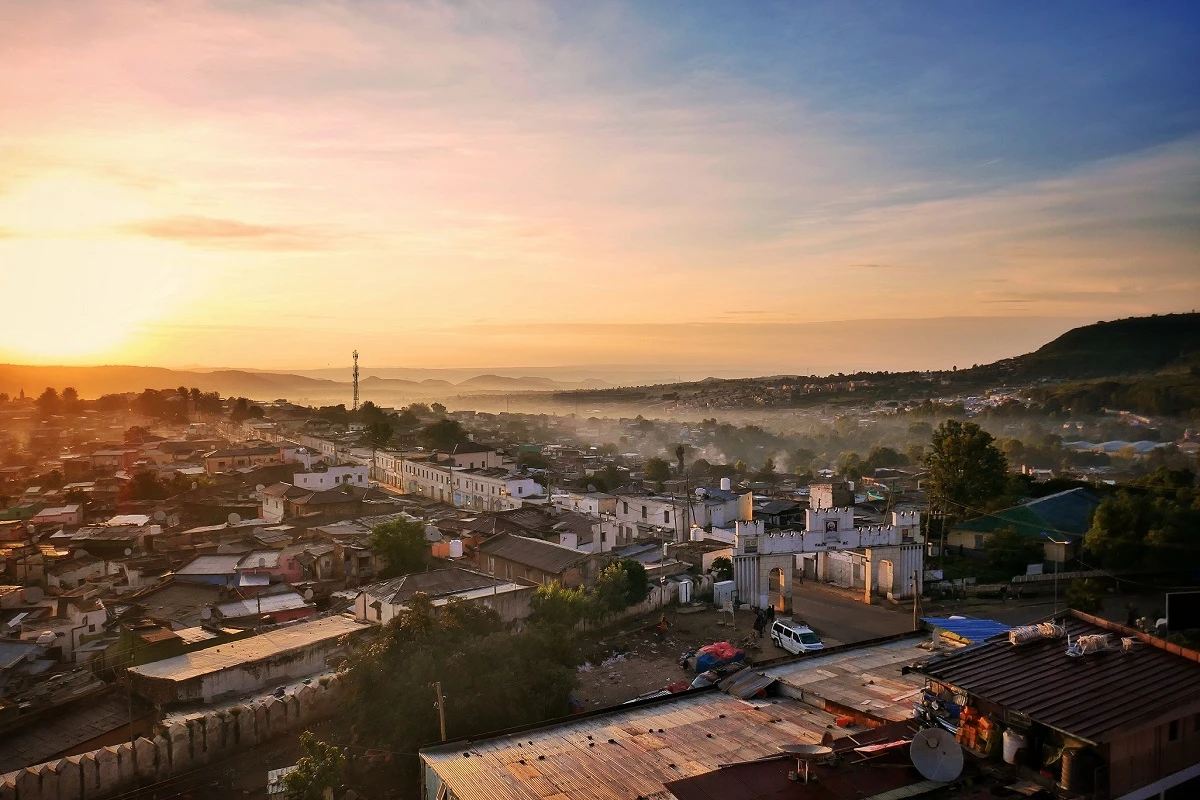
If you want to watch the sunrise or grab some photos like the top photo on this page or the one below – go to the top of Wonderland Hotel, right by the main entrance to the old town.
You can find the hotel on Google Maps. From the roof, you can see the entire old town, the main street running through the middle and the walls. The sun rises just behind it all! I think it may be the best sunrise I have ever witnessed (and I’ve seen a few).

Final Thoughts – Things to do in Harar
Harar is one of the most unique places we have ever visited. It was eye-opening, manic and exciting! The mix of friendly faces and slightly frantic, khat-influenced residents made for an experience that is very difficult to compare to anywhere else.
Walking around the narrow back streets felt like a world away, which is something I always look for when travelling. We still have very strong, lingering memories of it.
Have a fabulous day!
Hi, thanks for visiting our blog! If this post has been of help to you, or you’ve just enjoyed our random ramblings and musings, say thank you by buying us a coffee! It helps keep The Restless Beans blog up and running.
Thank you, Claire + Nick


