

How to Backpack Around in Tunisia – A Complete Travel Guide
Scribbled by Claire ◊ 26 Aug 2024
Are you looking to take an alternative backpacking adventure through Tunisia? This post contains everything you need to plan a trip, including transport, safety, what to wear, staying connected, whether we think it’s a good location for backpackers, and more!

Tunisia, the northernmost country in Africa, was not a destination that immediately popped up on our radar.
It appears that backpacking in Tunisia is not such a popular activity!
The country is well-known to some, mostly due to the Star Wars saga – many original filming locations were in Tunisia (and are instantly recognisable!). With this fame came a load of film buffs, but not your average budget-backpacking adventurer.
However, even if you are not a massive Star Wars fan, this country offers up plenty for a keen independent traveller, whether moving by bus, train or rental car. There are ancient fortified villages, expansive Roman ruins, sandy Mediterranean beaches and bustling medinas – all without the mass tourism found in countries like Morocco.
This lack in popularity was what initially attracted us to Tunisia. We spent a month travelling around the country, checking out the cities, ruins, islands and deserts; it was a pretty epic adventure.

IN THIS GUIDE //
How to Backpack Around Tunisia
WHY VISIT TUNISIA?
IS TUNISIA GOOD FOR BACKPACKERS?
IS BACKPACKING IN TUNISIA SAFE?
THE BEST TIME TO VISIT TUNISIA
MONEY IN TUNISIA
PUBLIC TRANSPORT IN TUNISIA
DRIVING IN TUNISIA
RAMADAN IN TUNISIA
VISAS FOR BACKPACKING IN TUNISIA
LANGUAGE IN TUNISIA
WHAT TO WEAR IN TUNISIA
WIFI AND SIM CARDS
FLIGHT ALTERNATIVES TO TUNISIA
BACKPACKER ACCOMMODATION
IS ALCOHOL ALLOWED?
FINAL THOUGHTS
This post may contain affiliate links. If you book through these links we may make a small commission at zero cost to you. It helps us pay for the upkeep of this blog. Thank you!
Where is Tunisia and Why Should You Visit?
Tunisia is a relatively small nation, sandwiched between Algeria and Libya, just across the Mediterranean Sea from Sicily and Sardinia. Near the northern tip of the country is Tunis, the bustling capital and largest city. Tunisia is a very easy country to reach, either by air or sea.
This country is diverse – scattered with some of the best preserved Punic and Roman settlements in the world, alongside traditional Islamic heritage in locations like the UNESCO designated Kairouan, Islam’s fourth holiest city.
The towns in Tunisia have vibrant medinas, exquisite mosques and buzzing markets scented with shisha and echoing with calls to prayer. It’s a sensory dream to explore here.
Heading south, approaching the gateway to the rolling dunes of the Sahara Desert, Tunisia becomes more arid. The south is covered with glistening salt flats, canyons, date palm plantations, traditional towns and crumbling villages. It’s a world away from the fertile, green lands to the north. There is also the chilled-out island of Djerba, a popular spot for tourists wanting an affordable getaway.
For such a small country, there really is so much to explore. We spent nearly a month backpacking in Tunisia and didn’t even see everything we intended to!
BACKPACKING IN TUNISIA – QUICK THINGS TO KNOW
Capital – Tunis
Country population – 12.26 million people
Currency – Tunisia dinar
National tree – Olive
Time in Tunisia – Central Eastern Time (CET)
Power outlets – Type C and E
Daylight saving time – No
Famous for – Star Wars
Number of UNESCO sites – 8
–
Is Tunisia Good For Backpacking?
Tunisia is not a traditional backpacker haunt. There are no super-social hostels or beach parties. It’s not particularly easy to meet large groups of travellers as you travel around, either. So, in that respect, it’s potentially not an ideal location for solo, sociable backpackers looking to make friends like they would on a beach in Thailand.
However, on the other side of the coin, backpacking in Tunisia is a joy:
◊ There are few tourists and affordable prices for all the major backpacking costs (sleeping, eating, moving).
◊ It is a wonderful country for experiencing as close to authentic an experience as possible, without the need for pricey guides and tours.
◊ Tunisia is rammed full of epic outdoor, cultural and historical adventures.
◊ If you’ve never been to the African continent before, Tunisia is an easy country to dip your toes into for a first visit.
In a few years, it will undoubtedly be lauded by all the backpackers that were frustrated with how busy Morocco was!
So, the answer is yes, Tunisia is great for backpackers. We wholeheartedly recommend Tunisia for an adventurous, affordable, alternative backpacking trip.

Is Backpacking in Tunisia Safe?
Yes, backpacking in Tunisia is safe, even for solo female travellers. This statement is partly subjective, of course, but it is based on our recent experiences plus government advisories.
Personally, we found the people of Tunisia to be exceptionally helpful, curious and approachable. This was more so than in many other countries we have visited. We experienced no scams, nobody trying to get money out of us, and some genuine hospitality which is so scarce in many other destinations.
For complete clarity, anything related to Star Wars is a shitshow and pure touts, scams, hassle and misery – but not unsafe.
Is Tunisia Safe for Women?
We had previously read that women can experience significant unwanted attention in Tunisia.
This was not something I experienced, even alone without Nick. My friend, who solo budget backpacked around Tunisia recently, used only public transport and stayed in low cost accommodation. She had no negative experiences with men, either.
Although my experience in Tunisia was only positive, it is also only anecdotal, and I’d recommend always being aware of your surroundings.
Turmoil in Tunisia
If you follow government advisories, there are several areas of Tunisia that are not recommended for travel (we use the U.K. FCO website which, I assume, is comparable to other countries?).
We did stray into these regions several times (towards Algeria’s border and near Sbeitla) and obviously didn’t have anything bad happen, however that isn’t necessarily representative of the real (or less real) risk.
Tunisia also had some high-profile terrorist attacks in 2015 and 2019. These incidents have definitely frightened tourists away from visiting and residents we spoke with have expressed much regret and sadness to us about it.
As with any region where there has been attacks at some point, I wouldn’t judge the current situation based on the past. Also, if the excessively paranoid U.K. government says it’s okay to visit, then it is definitely fine!

1. The Best Time to Visit Tunisia
The best time to visit Tunisia is between April-June and September to November. Temperatures during this time are pleasant and perfect for sightseeing.
Summer | the summer months in Tunisia are very warm, in at least the mid-30s (above 90 F), which might be okay for beachy people, but it’s pretty warm for anyone carrying a backpack! The sparkling coastal resort areas can be very busy with package tourists during these months, too.
Tunisian winters | these can be very cool, especially in the north around Tunis. The city has a Mediterranean climate, so if you are comfortable with Italy during winter, you’ll be fine in Tunis!
Our experience | we visited for the month of April. Our experience in the north west of Tunisia was a lot of rain and we found it very cold in the hills. In the south, in places like Djerba, temperatures warmed up a little but at no point would I have wanted to lay out in the sun for long! It was, however, perfect weather for walking, hiking and exploring. We had a few grey and cloudy days, but mostly it was sunny and warmed up a lot by the end of the month.
BACKPACKING TUNISIA ITINERARY INSPIRATION
Beach and Coastal Destinations:
Hammamet, Sousse, Monastir, Bizerte and Djerba
Medinas:
Tunis, Sousse, Sfax, Kairouan
Roman/Punic Ruins:
Dougga, Carthage, Thurburbo Majus, El Jem, Uthina, Utique, Bulla Regia, Sbeitla
Desert dreams:
Tozeur, Tataouine, Chott el Jerid, Douz
Nature:
Tozeur, Ayn Darahim, Zaghouan
–
We visited every place above apart from Bulla Regia and Sbeitla, because we ran out of time due to bad weather. Have a look at our Tunisia itinerary for more information.
–
2. Money in Tunisia
For all things money related in Tunisia, check out our itemised budget that includes ATM information, all our trip costs, and lots more.
Currency in Tunisia
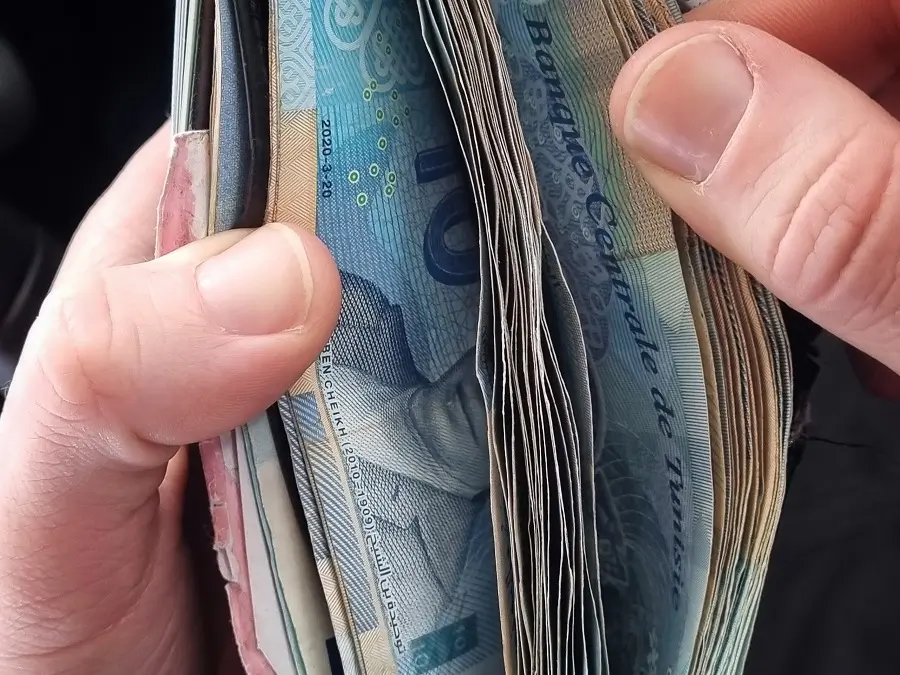
The currency in Tunisia is the dinar (TND), broken down into one thousand millimes. Sometimes values are written in millimes, for example: 1.4 dinar might be written as 1,400. If a price seems crazy high, it’s probably because of that!
The Tunisian dinar is a closed currency, so it is only possible to obtain it within the country. There are strict rules against exporting it too, down to this being checked at departures in the airport.
Cash or Card?
We found many places in the major cities in Tunisia accepted credit cards. This means that you can save money on ATM withdrawal fees, if you have a card that doesn’t charge for foreign transactions. We’d highly recommend carrying a whole bunch of local currency though, as it’s needed at many of the smaller establishments, including some hotels.
For our trip, we used cash the majority of the time for accommodation, gas, road tolls and small food stores. Our journey was entirely during Ramadan, so we frequented relatively few restaurants (nothing is open during the day!). This means we ate from a lot of supermarkets and the larger ones (Carrefour, Geant and Monoprix) take credit card.
Occasionally, when reserving accommodation on Booking.com, we paid by card.
ATMS
ATMs were easy to find in any main town – just locate them on Google Maps.
We took all cash out from ATMs, although we carried a few spare euros on us just in case. ATMs typically charged around 12 TND (about £3) per transaction and withdrawals were limited to 300 TND with the ATM we used. Other banks have different maximum limits.
Money exchanges in Tunisia are readily available across the country in main towns and cities if you would prefer to only bring cash for your visit.
3. Public Transport in Tunisia
Tunisia operates on trains, minibuses and hitchhiking. Without a car, these are the three obvious ways for a backpacker in Tunisia to get around the country.
Trains in Tunisia
We didn’t take any trains outside of Tunis, but have been told by tourists within Tunisia that they are slow and unreliable. The trains have a sizable reach though, traversing the northern half of Tunisia. They go as far south as Gabes on the coast, to Tozeur which lies inland towards Algeria.
One Tunisian train route worth utilising is the Tunis – Carthage – Sidi Bou Said – La Marsa line. It’s a fun, inexpensive and easy way to travel around the outskirts of Tunis and check out the ruins of Carthage, the blue-hued Sidi Bou Said, and beyond.
Tunisian Louages
Another public transport option within Tunisia is the long-distance shared minibuses, called louages.
These are the best and most economical option for a backpacking trip around Tunisia (apart from hitchhiking). In each town, there is typically an area where these minibuses congregate, normally named ‘station de louages’. This is the place to grab one. It’s worth asking your accommodation where the best place is to catch a louage.
Louages in Tunisia are exceptionally affordable, fast and mostly don’t get overpacked. The minibuses have colour codes, some with red stripes, others with yellow stripes, depending on if they are local or travelling further away. With enough time, you can efficiently backpack across the entire of Tunisia with these little vans!
Hitchhiking in Tunisia
Hitchhiking is incredibly widespread and is the best way to get around when budget backpacking in Tunisia.
There were people on almost every road trying to hitch a ride. Personally, I am absolutely comfortable hitchhiking in Tunisia and consider it safe, especially judging by the number of people who utilise it as a regular method of transport!
We found nobody in Tunisia in any way threatening or inappropriate, and would recommend hitchhiking if you are comfortable with it. Bear in mind that it’s polite to offer the driver some money for petrol for your journey, though. Generally, we are fans of hitchhiking in most countries if we don’t have a car.

4. Driving in Tunisia
Renting a car in Tunisia is recommended if you want to see a lot of the country with a bit of extra freedom. We had a car for nearly four weeks, covering nearly 4000 kilometres, and absolutely loved it.
Gas | (in mid-2024) is reasonably priced at around 2.50 TND per litre, people drive on the right and manual cars are standard.
Automatic transmissions | these are available from rental agencies but often cost far more. Our car was a tiny Kia Picanto, which functioned fine for the roads we drove.
Drivers | Tunisian drivers are not bad, despite what you may have read elsewhere. From our experience, only taxis were aggressive (they love to use their horns and, if you swear at them, they will swear back). All other drivers were polite.
Speed limits | we spent a lot of time being confused about the speed limits as roads are not well marked in this respect. Often, a reduced speed sign does not get ‘cancelled’, so knowing when and what speeds the increased limits were was occasionally challenging. This was never an issue though; the only two times we were pulled over were routines stops, the police checked our paperwork and we were politely sent on our way.
Police | there are a lot of police checkpoints, all over the country. They are not anything to be concerned about; have your license and rental paperwork to hand.
For more detailed information, check out our driving in Tunisia guide.
CAR HIRE FOR YOUR TUNISIA TRIP
We always rent our vehicles all over the world, including our recent trips in Oman, Saudi Arabia, Tunisia, Jordan and Morocco, with Discover Cars. They’re often the most affordable, plus they paid out immediately on an insurance claim we made when our car took some heavy damage in Sicily. We fully recommend them.
–
TAKE A LOOK BELOW OR CHECK CAR RENTAL
5. Travelling in Tunisia During Ramadan
Okay, so skip this entry if you’re not travelling during Ramadan!
Ramadan is the month-long celebration in the Muslim faith where participants abstain from eating, drinking, smoking and more during daylight hours. This can often mean interruptions to typical daily routines and changes in opening hours.
Our backpacking in Tunisia trip was entirely during Ramadan; this is what we noticed:
◊ Almost no food-related places are open during sunlight hours at all, even in tourist areas. In a few extremely touristy places, like Sidi Bou Said (Tunisia’s answer to Santorini), a few restaurants were open. This was a rarity in the destinations we visited, from our experience. During iftar (the evening meal which breaks the fast), we struggled to find places open that served anything other than large iftar style menus. This means that if you usually eat minimally or earlier in the evening, it might be problematic. A positive is that you might be invited to a traditional iftar feast!
◊ Supermarkets are open during Ramadan (but had less fresh food) and small bakeries still make cakes, croissants and bread all day long (they shut an hour or two before sundown). During the daytime, even during Ramadan in Tunisia, you’ll have to queue for your fresh baked baguettes!
◊ Delivery food apps do not work until around 21:00 every day.
◊ In resorts, it is possible to get full meals and alcohol during Ramadan, if this is something you want. Outside of resorts, most hotels and guesthouses include a full breakfast. We found that these were not reduced during Ramadan and operated during the usual morning hours. The airport in Tunis also serves food all day.
◊ Outside of food and meals, most of Tunisia seemed to function as usual during Ramadan (we didn’t notice any significantly reduced opening hours). The trains and buses ran as expected and all the historic sites we visited in Tunisia were open. Apparently, during the first day of Eid, it can be difficult to find transport, so keep this in mind if you are choosing to travel then. Apart from purchasing food, everything else operated as usual in Tunisia.
Our Experience – Should You Travel Tunisia during Ramadan?
Our trip to Tunisia was entirely during Ramadan! This means that technically, we cannot comment on what backpacking in Tunisia is like outside of this time.
If we are being honest, Tunisia was the most difficult Muslim country we have travelled to during Ramadan so far (we have also experienced Oman, Saudi Arabia and Jordan previously during Ramadan).
Although it was sometimes tricky, we didn’t have much of an issue with Ramadan in Tunisia. We travel on a budget and, as vegetarians, eat from supermarkets quite often anyway in meat-heavy countries. If eating luxuriously in a wide variety of restaurants twice a day is a necessity for your backpacking trip, maybe avoid Ramadan!
Personally, if you are visiting Tunisia during Ramadan and do not want to fast, we’d recommend getting a rental car. This means you can do a decent supermarket shop and rent apartments where you can cook. Eating in your car where people cannot see you is also far more sensitive to residents who are fasting.

6. Visas for Tunisia
As a U.K. citizen, we did not need a visa for any tourist stay in Tunisia under 90 days. This is the case for around 94 other countries, too.
Because we arrived at a ferry port, not the airport, entry requirements were a little stricter. In order to enter, we had to show proof of exit, proof of every hotel night reservation and tell the immigration officer our job titles and purpose of travel. Apparently, arriving at the airport is far less strict!
Depending on your nationality, this may not be the case for you. Check your local government website to check for your specific entry requirements for Tunisia.

7. Language in Tunisia
The official language of Tunisia is Arabic.
Although most Tunisians speak Arabic as their primary language, within the tourist or hospitality trade, you’ll very likely hear French. This is a relic of the French occupation between 1881 and 1956, which has left its mark with the language and food, amongst other things.
In supermarkets, gas stations and on many road signs, there were French language labels and instructions. In general, it wasn’t too difficult to get by.
We found that residents assumed we would speak French as many tourists there seemed to be from France. Not so many spoke English and most used an interesting combination of French and Arabic. I started our trip saying ‘thank you’ in Arabic but ended our trip saying ‘thank you’ in French. Honestly, it was confusing.
We also spoke to a Berber man around Tataouine who said that he only spoke French at home with his family. Our Airbnb host in Ayn Darahim didn’t know any French or English and only spoke Arabic! It’s unpredictable.
8. What to Wear in Tunisia
Tunisia is a majority-Muslim country, so it is important to dress modestly out of respect for the local population. However, we did not find it to be as strict as Oman or Saudi Arabia for example, especially in Tunis.
Women are not expected to cover their heads or dress in an abaya in Tunisia. It is recommended to always cover your shoulders and wear clothes that go below the knees. This rule applies to men as well, in general.
We visited during mild weather and local women generally dressed in abayas and head coverings, men wore trousers and long sleeves. In warmer weather, it is possible that this might change, however I would be surprised if it did.

9. Wi-Fi and Sim Cards
In Tunisia, you can pick up a local Tunisia sim card at a shop or the airport, get an e-sim with a company like Airalo, or just hope for the best with Wi-Fi.
We used an Airalo e-sim when arriving in Tunisia as our immigration was at the ferry port around 2 am (which had no Wi-Fi). This worked super efficiently and allowed us to get a Bolt taxi to our accommodation with no difficulty. The e-sim with Airalo cost about 29 TND for 1 GB of data. We recommend this option if you need data as you arrive in the country. Check out these Airalo sims if you are interested.
We also purchased several sim cards at the airport when we picked up our rental car. Our chosen network was Ooredoo, which worked well and cost 15 TND for 5 GB and 30 TND for 25 GB.
Wi-Fi, in our experience, worked moderately in Tunisian hotels and guesthouses. We could connect most of the time, but it wasn’t always quick enough to back up photos or stream TV, for example. One of our Airbnbs didn’t have Wi-Fi at all. I mostly used my sim data more often than I used Wi-Fi in hotels.
We did not see any places offering free Wi-Fi (we weren’t looking or asking for it either, though) outside of the airport.
In June 2025, Bolt has been suspended in Tunisia due to money laundering allegations. I’m not sure if Bolt will return, but have a check for other Taxi apps in Tunisia before you arrive – otherwise you’ll be stuck with the scammy, relatively expensive taxi drivers instead.
10. Flight Alternatives to Tunisia
Most international tourists into Tunisia will arrive at the capital city of Tunis by plane. However, if you are in (or passing through) southern Europe, consider taking a ferry. We arrived at the port in Tunis via a ferry from Palermo, which was very affordable, comfortable and far more environmentally friendly than a short-haul flight.
There are also ferry routes to Tunis from Civitavecchia (Rome), Genoa (Italy) and Marseille (France). We always check routes and book tickets on Direct Ferries.
If the ferry routes don’t work for you, check out your flight options with Skyscanner, which compares all the airlines and routes.

11. Backpacker Accommodation in Tunisia
Tunisia has a broad range of accommodation options that can suit pretty much any backpacker budget. These vary from locally run guesthouses all the way up to international standard, western hotels. However, it does not really have typical hostel or dorm accommodation that you may be accustomed to in other, more popular, countries.
A typical overnight stay in Tunisia is in a dar. The Tunisian dar is similar to a riad in Morocco – traditional and, sometimes but not always, boutique accommodation with local character. Depending on the price-point, these stays can be incredibly aesthetic while maintaining the local character of a place, or be a very simple, homestay-style accommodation with a local family.
We stayed in a wide range of properties in Tunisia. From slightly sketchy, fire warmed Airbnbs to luxury dars – we gave pretty much everything a go! The country has a fantastic range of accommodation for every type of traveller. Outside of the major towns, lodgings are more basic, but the price point tends to make up for this.
One thing we noticed was that no matter how expensive our accommodation was, where there was aircon, the cooling function worked perfectly, but the heating aspect often did not. Be aware that Tunisia does get cold overnight in the cooler months.
We never reserved a room more than one day in advance and often found accommodation on the day. This is one of the benefits of having a car – super high flexibility. There were never days where we worried about rooms filling up.
12. Is Alcohol Allowed in Tunisia?
Yes, Alcohol is available in Tunisia.
It’s reasonable easy to get, although not widespread since Tunisia is predominantly a Muslim country.
It’s generally sold in bars, hotels, and larger supermarkets. If you want any alcohol in your hotel, check beforehand with the accommodation if it’s not explicitly noted that they sell it. All larger, international hotels will have a bar.
During Ramadan, alcohol is not sold in shops, but is still available in larger, more international hotel bars.
For some representative prices, check out our Tunisia budget.
Final Thoughts – How to Backpack Tunisia
After a month and 4000 kilometres of driving in our tiny Kia Picanto, we can definitively say that we loved our Tunisia trip. As always, our plans were a last-minute thing, so we had absolutely no idea what to expect from this northern African nation. It exceeded all our expectations, even during Ramadan.
As mentioned in the previous section, we think it’s an amazing place if you are travelling on a budget, want to avoid mass tourism and see some seriously underrated sites.
We hope you have an amazing time backpacking in Tunisia!
Hi, thanks for visiting our blog! If this post has been of help to you, or you’ve just enjoyed our random ramblings and musings, say thank you by buying us a coffee! It helps keep The Restless Beans blog up and running.
Thank you, Claire + Nick


hello. as i read in your article you have used louages . i would like some more information about those. for example is there a louage going directly from tunis to tozeur ? or from douz to hammamet ? any info would be helpful.
thank you in advance
greetings from greece
Hi Konstantina, thanks for your message. We did not take louages on either of those specific routes, however from my understanding, it will be unlikely you’ll be able to get direct routes for the journeys you mention, you’d need to change louages. This will probably be at Gafsa for Tozeur and possibly Gabes for Douz. The best option is to choose an accommodation you might stay with, then message and ask them – we have found this method really useful for confirming transport methods and times, not just in Tunisia but all over!