

· AMERICAN SOUTHWEST · CALIFORNIA ·
A Death Valley Summer and the Dangers of Flash Flooding
Scribbled by Claire ◊ 19 Aug 2024
This is an unorthodox account of what Death Valley National Park is like during summer, and what can happen if you’re just a bit blasé about the risks of flash flooding.
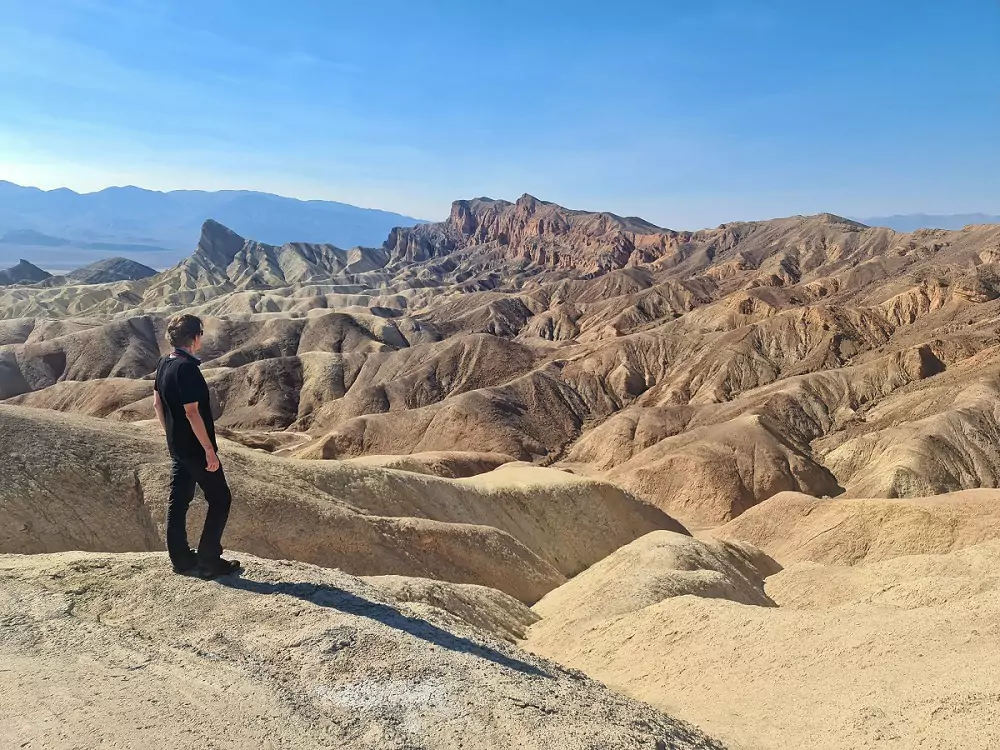
Death Valley has a reputation, and a rather notorious one at that.
The largest National Park in California holds a bunch of records, none of which are particularly effective at persuading people to spend some of their hard-earned vacation days there. It has the hottest temperature ever recorded on Earth and is both the driest and lowest place in the United States. Spending a summer day in Death Valley is not an easy sell.
Yet, despite this, people visit this fascinating, inhospitable park in droves – nearly a million people per year pre-pandemic decided that this remote, unforgiving desert was worth their time.
We are included in this statistic, the only distinction being that we always visit in summer. I cannot tell you what Death Valley is like during the temperate months of winter; I imagine it would be amazing for camping, hiking, and general recreation. I’m sure there are hundreds of other blogs and guides out there to show you what that is like.
However, this is our account of an unusual visit to Death Valley during the height of summer.
Instead of being a traditional tale of intense, barren wildernesses, it is about the bizarre moments during, before, and after our experience in the centre of an extreme flash flood. Most of all, it is about what we learnt about flash flood safety and why you should still visit Death Valley, even in summer (while being far cleverer than we were).

Disclaimer //
Unusual Death Valley Summer Dangers
It’s dangerous, travelling in well above 100-degree heat; things happen.
Do not get caught without way more water than you might need, plus food supplies. The desert is empty at that time of year; someone will find you eventually if your car breaks down, but it could take hours or even days if you are unlucky. We were stuck for a quite a few hours, and it was rough.
This story is mostly about our failings\, so don’t be us. Be way better!
This post may contain affiliate links. If you book through these links we may make a small commission at zero cost to you. It helps us pay for the upkeep of this blog. Thank you!
A (Dangerous) Summer Day in Death Valley
‘It’ll be fine’ I said. ‘Just keep going’.
I was mistaken.
Before we get to that, though, I should mention that this was not our first rodeo – we’ve experienced the peak summer conditions of Death Valley before; we were not untested in this terrain and climate. It was however our first, and hopefully only, experience of being in a flash flood.
It did not occur to me that the storm clouds might actually reach us, or that there was even the possibility of rain. Looking back, it was naïve and dangerous, but hindsight is a wonderful thing, isn’t it?
It was midday at the end of July and the sun was blazing. We had driven from Las Vegas with the aim of some free camping (Death Valley doesn’t charge for certain sites in summer and we’re suckers for a fee-free night with bathrooms). The knowledge that it would be ‘a little warm’ and far from ideal conditions was not lost on us, but it felt okay – we were prepared for it.
Our vehicle was a recently acquired hire car. American rentals are always so luxurious; this time it was a brand new, sleek, grey Nissan Altima. With a shiny, unblemished exterior and immaculate interior, it wasn’t the type of car we are used to renting elsewhere. It makes you hyperaware of any scrapes, gravel, and dirt.
The car was loaded up with water, the ubiquitous ramen noodles, and camping gear. We set off, kind of jokingly excited about the 48 C (118 F) temperatures awaiting us.
STAYING SAFE DURING A DEATH VALLEY SUMMER
–
RESEARCH – weather, rainfall, heat risks
AVOID – remote areas like Eureka Dunes and the Racetrack if travelling alone
STOCK UP – food, water and gas
DO NOT HIKE – particularly between 9am-5pm
SUNSCREEN – it’s actually better to just always be in the shade
PHONE – have a backup (mine overheated) and bring a map
CAR – ensure it is fully functional
–
RELATED POST | THE ULTIMATE CALIFORNIA ROAD TRIP
Trying to be smart never works if you are, in fact, not smart
The park was, as anticipated, eerie and empty, at least to our eyes anyway. There are no ticket booths collecting your fee, no cars parked on the sides of roads, no rangers, hikers, or wildlife. Death Valley is a desolate place in July; wherever the few others were in the park, they were evidently not nearby us. It is one of the reasons I choose the most inhospitable place in America during summer; the solitude is unmatched.
Attempting to be smart determined our strategy, which was to see the sights and find a campsite after the sun went down. Putting up a tent with no shade would be nigh on impossible anyway and the sweating would be downright unattractive and uncomfortable. The above 40 C temperature also makes your tent inhospitable during daylight (plus I am secretly scared of it melting – I’m told this is a mildly irrational fear).
There are very few roads through Death Valley that are accessible to two-wheel drive vehicles like our rental. We chose Badwater Basin to see the salt flats – the lowest place in the northern hemisphere and one of the more iconic spots in the park.
The views from this road are magnificent. Barren and harsh, with craggy mountains looming immediately to your left and vast, flat desert plains that lead to another range on your right. The road to Badwater Basin, cutting right across the valley floor, is one of those places that reminds me of how small and pointless I am.

It’s Just a Bit of Rain
There were shadowy, ominous clouds hanging over the mountains in front of us, but they seemed distant. A short drive later, we pulled up and walked a few hundred metres onto the salt flats.
It was here that I was concerned for the first time; we could hear the shadowy sky boom. The thunder was a low, rumbling, distant growl, and the dense black clouds were obscuring the sun (we somewhat appreciated this fact, if I’m honest). The air was thicker than usual; it still had the same heat, but I felt like you had to wade through it now. It had gone from oven to sauna.
Returning to the car, we continued further along Badwater Basin Road. It was only a few minutes before I could hear a tapping on the car and noticed large spots appear on the windscreen.
‘Crap, it’s raining’, I said, pointing out the obvious. ‘What’s the odds?’.
The sky was so black now that it suddenly seemed like night-time was upon us. There was this unspeakable sense of unease; I felt like I was in a horror film. The impact of the rain was battering the outside of our car now. We stopped abruptly, simply because there was zero visibility.
‘Should we turn around?’ I asked the others, more of a statement than a question.
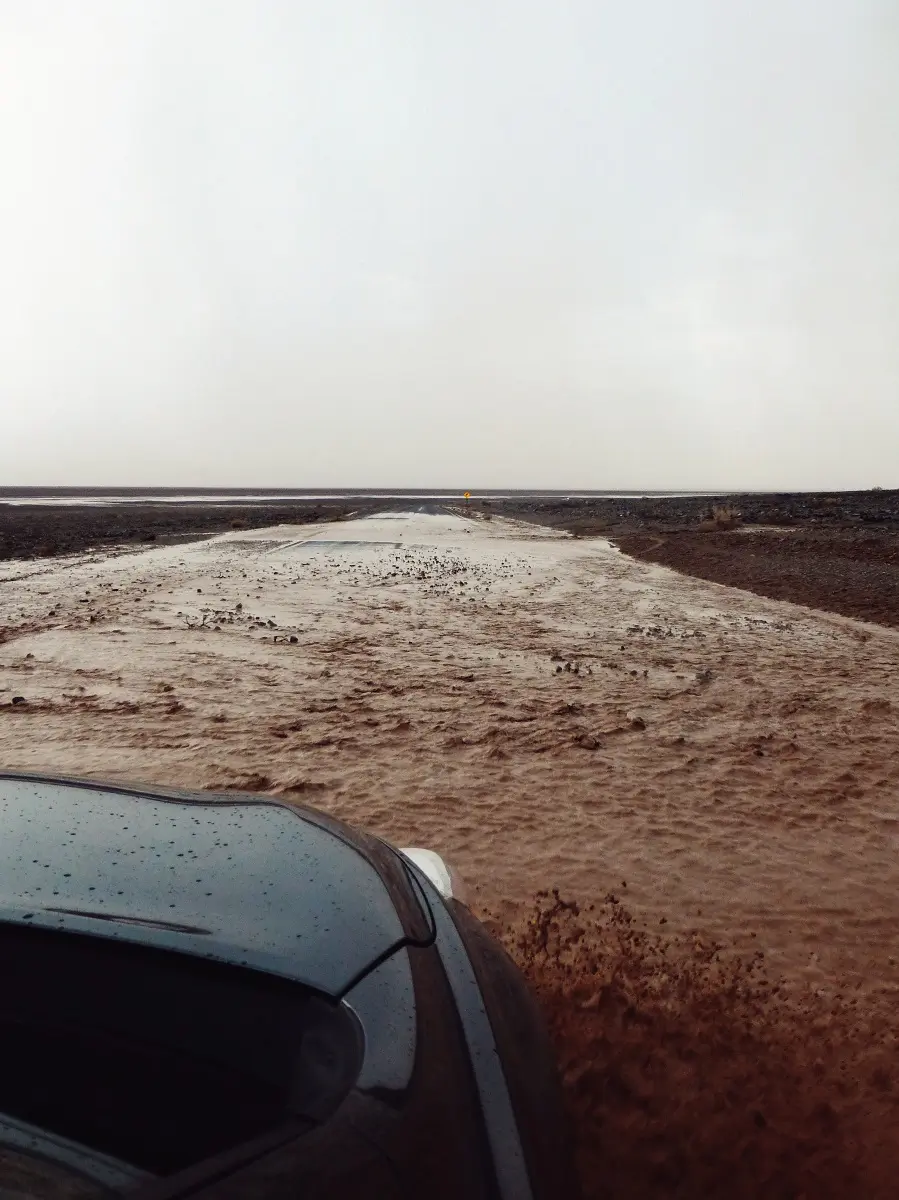
Everyone nodded, but as we reversed across the small two-lane road, the tarmac slipped away behind us in a torrent of rainwater. I later learnt that Death Valley is extremely hydrophobic – water is not absorbed by the ground and runs along the surface, so even a small amount of rain can cause huge deluges.
Apparently Badwater Basin road is old, which means it doesn’t hold up well to flooding. This was evident by the rivers, rocks and asphalt that were miraculously flowing at speed either side, but not directly into our car. Even if the road was still intact, the rain was pouring so hard by this point that the windscreen wipers were useless. We had no chance of seeing anything or moving the car safely.
We just sat there in silence. It felt so surreal to be stuck in an extreme storm in Death Valley of all places. After all, our preparation had been for heat, sun, and intense desert conditions.


Aftermath – Where’s the Road?
The rain subsided. My recollection might be incorrect, but it didn’t feel like it lasted very long, perhaps a few minutes. The murky clouds had streaks of sunlight pouring through now.
The rivers abruptly turned to fast trickles and streaks of sunlight illuminated the road. On our right, everything was entirely destroyed and there was no longer any evidence of a road. Our return route was covered in debris but partially intact. Without speaking, we set off, grimacing as our shiny rental crunched and scraped over the rubble and broken concrete.
Luckily, or unluckily, we only managed this drive for a few minutes, as we saw that the road was destroyed in the other direction, too. We stopped the car on what seemed like a little island of concrete; a few hundred metres of intact road. Both ends were missing and there was no way of getting our car across in either direction.
The many hours between our rescue and the realisation that we were trapped felt endless. It was an unnerving, uncomfortable stillness. The air was charged; our hair stood up on end. You could actually feel the electrical charge run across your skin from the storm.
We played like children with rocks in the desert, constructing buildings and making towers; hiked over to the mountains, following the lightly flowing streams that criss-crossed down the slopes; sat on camp chairs in the middle of our concrete island because it was slightly less hot than waiting in the car. We investigated huge ravines, many feet deep, sliced through the land by the torrents of water.

Our Death Valley Hero
It was all somewhat surreal and was nearly sundown when we saw another person, a ranger in a four-wheel drive truck.
‘We’re saved’ I figured. ‘He’s here because they’ve fixed the way out’. I was wrong again.
Without introduction, he informed us that we were going to have to dig ourselves out.
‘We’re going to have to reconstruct the road by hand with the loose rocks’.
My first instinct was not to worry about the temperature, or even that this sounds like a seriously shitty, exhausting task. It was about the car. I neglected to mention previously that we didn’t have fully comprehensive insurance; and this vehicle was very low clearance. We had already scoured the bottom across errant rocks. How were we going to get through without any damage?
We set to work; my hands and back were aching like crazy, but I was so fed up it didn’t fully register (I also didn’t want the ranger to think I was ungrateful or lazy). As time went by and the sun began to set, we found other groups just further down the road doing the same as us. At one point, we tried to help dig out a car that was almost entirely buried under rubble. That was the instant when it dawned on me how dangerous this could have been, and how naïve I was.
Late in the evening, after the sun set, we came across a French family with three kids in an RV. Creating a trail out of flood debris to help the RV cross was the most physically demanding moment of the day, by far. Every time a section of track was complete, we would wait nervously to see if the cars and RV would clear the hand-laid trails with minimal loud scraping noises from underneath. There were maybe 20 sections in total that had to be constructed – averaging maybe 50-100 metres or so each.

Finally Free
It was around 10pm, there was dwindling daylight and the sky glowed vividly with the remaining storm clouds. The ranger had assured us that the remainder of the road was fully intact and clear of any rubble. Driving over a smooth surface felt luxurious and such a relief after hours of uneven, rough roads. We headed for a lowland campground near the centre of the valley – it was far too late to camp at one of the higher elevation ones.
With no energy left, we parked the car in a random spot not too far from the bathrooms (as the only occupants of the entire campground) and mutually agreed that sleeping in the car would be the easiest option considering our efforts of the day.
My fellow passengers were those awful, irritating people that can sleep just about anywhere. Me though, I’m not that skilled, and the oppressive heat plus sitting upright in a jampacked car was not conducive to a comfortable night.


A Sleepless Night and Some Guilt
Sticky and alert, I ruminated over the events of the day.
The longer it circled around my mind, the more it dawned on me – we were pretty damn lucky, and I felt guilty. Although damage to the car was currently undetermined (too dark to inspect it), over all we came out unscathed. Our car could’ve washed away; it could have taken many more hours to be rescued; the heat could have made one or more of us really ill; we could have run out of water.
I am grateful that none of those things happened, but mostly it was due to luck and not brains. I felt responsible; being one of those tourists that ignores the warning signs. One of those ‘it’ll never happen to me’ people. I mentally chastised myself for a little while longer and how much time went by is a mystery.
I hung both my arms out of the open window of the car in some ungainly way and shut my eyes.

Are the coyotes telling me something?
I’m nearly asleep when I hear a faint howl. Coyotes are common in Death Valley, along with most areas of California and beyond, so we’ve seen them on previous trips plenty of times. They’re no harm to humans so I just ignore it.
A few minutes (or seconds or hours, in the middle of the night in the desert, it’s kind of hard to tell), I hear several more howls and yelps, closer to us now. Scratching was coming from the behind the bathroom block; assuming it was rodents, I once again shut my eyes.
The next thing I know, a coyote nipped at my dangling hand. Not in a vicious way, more like an investigative type of behaviour, and it didn’t break the skin (although I was instantly terrified of rabies). Immediately I yank my arms into the car, looking out to see a whole gang of coyotes. Occasionally, I question if this even happened – it is such a surreal moment in my mind.
I didn’t get much sleep for the rest of the night with the window mostly shut. This is not my finest night (or day, for that matter).
At dawn, after possibly the longest night of my life, we decide to set off. It’s so hot that within a few minutes, the car had that little overheating light on, and we couldn’t use the air-conditioning for the several hours it takes to escape the park.
Were the coyotes and air conditioning sending me a signal that the world was (justifiably) punishing me for my irresponsible choices? I could probably believe that to be the case if I was superstitious, but really it’s all down to luck, isn’t it?

The dangers of flash flooding in Death Valley (and beyond)
I’ve written in previous posts about the dangers of flash floods. Specifically, I talk about the risks when hiking in slot canyons and washes (and wadis) during monsoon season. I have also been very careless with this in the past too; I tragically discovered that several children died in a slot canyon from a flash flood that I had hiked just before.
It’s a real risk and I used to be very ignorant and naïve. The problem is, until I actually experienced a flood, I didn’t really understand the significant dangers they pose (despite everyone and everything giving me all the warnings). Now, I’m terrified of them.
Dry areas tend to be very hydrophobic, so water doesn’t get absorbed into the ground very easily. Death Valley, in particular, averages around 5.6 cm (2.2 inches) of rain a year, only 0.25 cm (0.1 inches) of which falls during a typical July. It is exceptionally dry. The conditions in the park make it prone to extreme flash flooding and many people do not take it seriously or even know much about it.
So, to persuade you that the risk is real (if you needed it), here are some interesting facts:
⬩ It only takes two feet of flowing water to wash away a larger SUV-sized vehicle, and only one foot for a normal passenger car.
⬩ Over a 30-year average, more people die per year from flash floods than from tornadoes or hurricanes.
⬩ Six inches of flowing water can knock an adult over.
⬩ More people die in flash floods inside vehicles than on foot.
⬩ The majority of flood victims are male.
What to Do in a Flash Flood
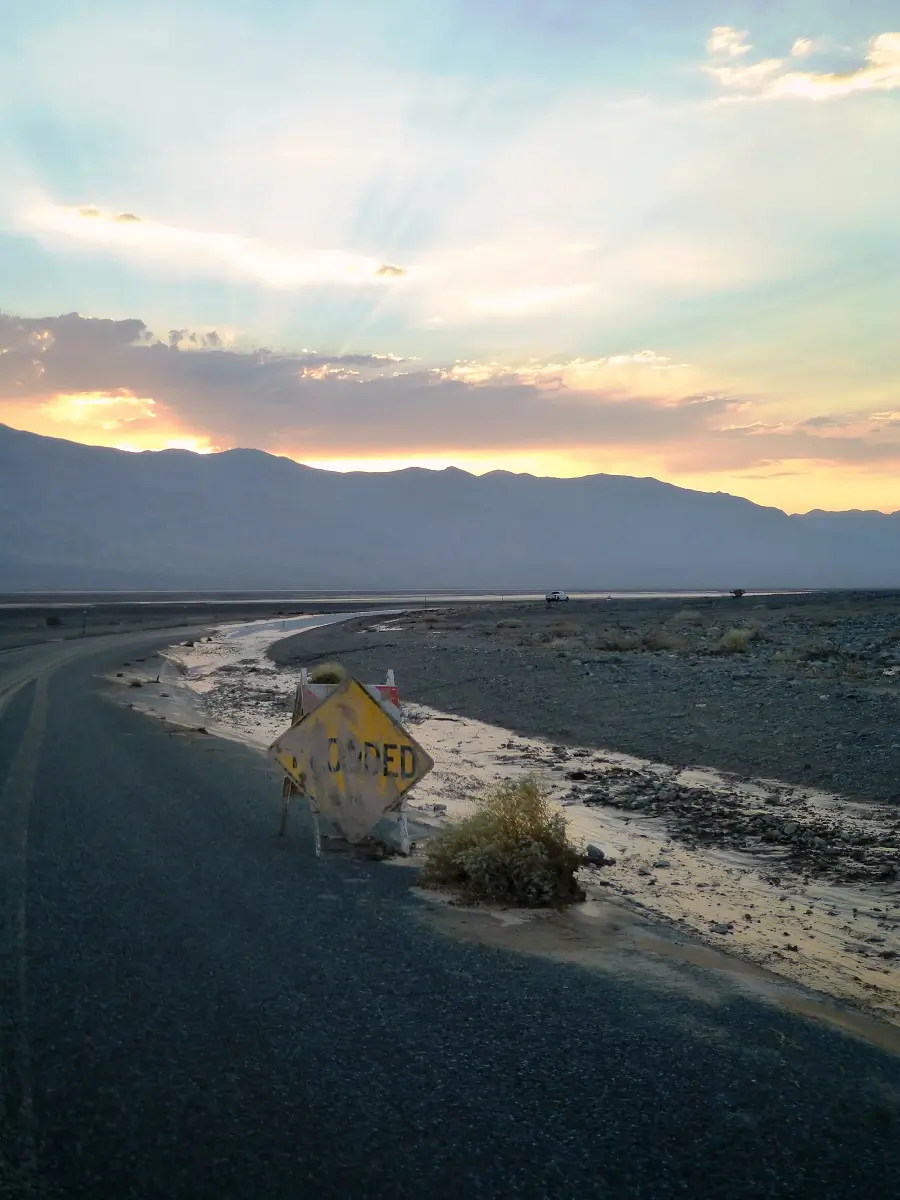
In August 2022, as I write this, Death Valley has one thousand stranded visitors and staff due to flash floods, with 60 vehicles buried in debris. Although these extreme precipitation events occur relatively rarely, it still happens often enough to be a concern, plus the frequency will continue to increase due to climate change.
In case you ever find yourself in the middle of a desert-storm situation like us, here are some general suggestions for flash flood safety:
⬩ Monitor the weather. The NOAA Weather Radio is good for this (in the United States).
⬩ During a flood, get to high ground as quickly as possible. Avoid low places such as washes.
⬩ Never cross a flowing stream. If you do and water goes above your knees, turn around immediately.
⬩ Never drive through fast flowing streams – you cannot be sure of the condition of the road.
⬩ If your car stalls, abandon it and head for higher ground.
⬩ Never camp in washes. It is harder to notice bad weather approaching during the night.
Final Thoughts – a Death Valley Summer
I’m not going to lie, sometimes this story gets told for fun. It’s mildly entertaining, with a sprinkling of peril, there’s no casualties and our car emerged from the experience intact (fun fact – we did not get charged for any damages – thank you Avis for being so lazy with your checks!).
But, as much as we laugh about it now, we have definitely taken away a newfound respect for the dangers of flash flooding. I read up on groups of people who have died in slot canyons, even in very well-known places like Zion National Park. I read about people being washed away with their vehicles, or who are quickly submerged and drown.
It’s unlikely to happen to you, but don’t increase your chances by being complacent. That’s my advice.
Hi, thanks for visiting our blog! If this post has been of help to you, or you’ve just enjoyed our random ramblings and musings, say thank you by buying us a coffee! It helps keep The Restless Beans blog up and running.
Thank you, Claire + Nick


