

14 Best Sparkling-Blue Wadis in Oman (with GPS and Maps)
Scribbled by Claire ⬩ 07 Aug 2026
Oman’s wadis are one of the country’s most popular attractions, but how do you decide which one to visit? Here, we talk about the prettiest ones, split into regions, and give you the low-down on how to reach them, including GPS coordinates. All of these have water year-round, so you can visit in any season!
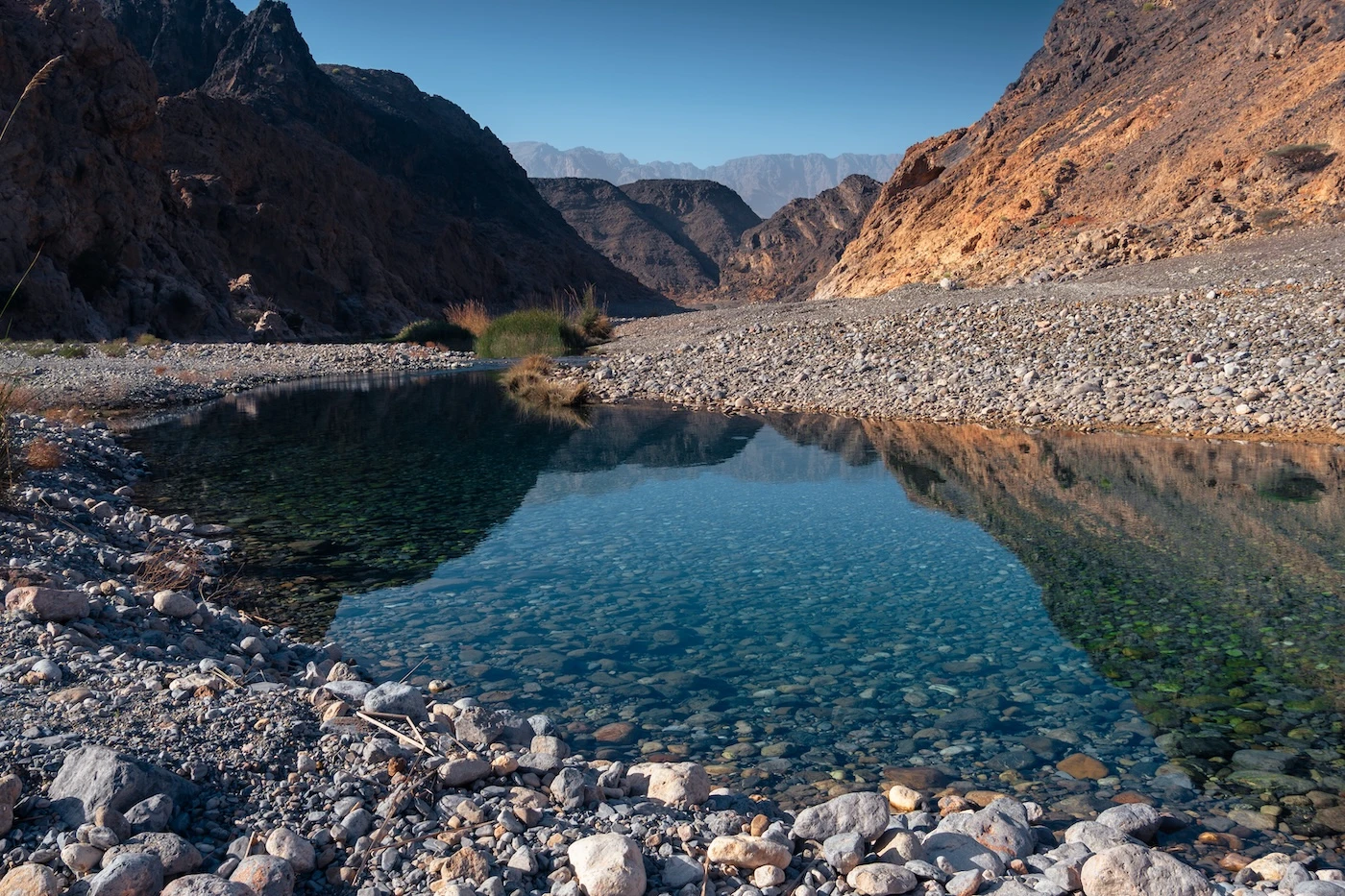
The second image I ever saw of Oman was a wadi (the first was of the Bandar Al Jissah coastline in a printed travel shop magazine). I felt a bit sceptical: if images like that were real, why would anybody ever go to beaches when there were places in nature as perfect as this?
I’m not an overly confident hiker and very incompetent swimmer, yet these shimmery-blue, glistening pools surrounded by what looked like Utah’s grandest canyons drew me in like a magnet.
So, I made a point of visiting as many as I could (and my scepticism about their beauty was immediately snuffed out).
Over my three months here, I’ve lost count of how many I’ve visited (maybe somewhere around a hundred?), and below is the shortlist of my personal favourites: picked for scenery, swimming, how much effort it takes to reach them, and those with the absolute bluest waters – just like that image I saw years ago.

IN THIS GUIDE //
Our Favourite Wadi Adventures
What is a Wadi?
Wadis by Region: Map
Wadis Near Muscat
– Wadi Dayqah
– Wadi Al Abyad
– Wadi Al Arbiyyin
– Wadi Hoqain
Wadis Near Nizwa
– Wadi Qurai
– Wadi Damm
– Wadi Bimmah/Snake Canyon
Wadis Near Sur
– Wadi Shab
– Wadi Tiwi/Mibam
– Wadi Bani Khalid
Wadis Near Salalah, Dhofar
– Wadi Darbat
– Wadi Al Nakheel (Khor Senaq)
– Wadi Ayun (Ain Ayuoon)
– Wadi Sayq
Oman Wadis: Google Map
How to Get to Oman’s Wadis
Useful Tips for Wadi Visits
Can You Camp in Oman’s Wadis?
Do All Wadis Involve Hiking?
What to Pack
Where to Next?
This post may contain affiliate links. If you book through these links we may make a small commission at zero cost to you. It helps us pay for the upkeep of this blog. Thank you!
What is a Wadi?
‘Wadi‘ is the Arabic term for a kind of channel, ravine, valley, or gorge that is often wet only after it rains (quite similar to a ‘wash’ in the United States).
Just like with washes in the U.S., there are thousands of valleys, channels and ravines all over Oman, most of which remain dry until the rain comes. I mean, you cross wadis while driving all the time without realising it – even the car park in the middle of old town Nizwa is a wadi!
This means that most of the wadis you’ll see labelled on a map of Oman are actually almost flat, wide, plains-like terrain and look just like a dry riverbed (they’re not all stunning slot canyons).
However, there are a few that have water flowing all year around from underground. These perennial wadis are an unexpected (to me!) feature of this desert land, where the appearance of water is a lifeline in the otherwise stark mountainous landscape. People flock to reliable sources from miles around, using aflaj (ancient irrigation systems) to utilise the water. It really emphasised to me how significant the existence of water is, since I live next to two rivers in ever-rainy England and in the omni-present tropical vibes of Thailand.
These water-filled valleys can be spectacularly picturesque, containing beautiful pools of water when the surrounding environment is crazy dry and unforgiving – making for some of the coolest hiking you’ll do in the country!


We’ve always found the best car rental prices for Oman on DiscoverCars. It’s our go-to car comparison website for every road trip because they have such good insurance. You can save loads of money and get great-priced comprehensive coverage.
Wadis in Oman by Region
Listed below are our favourite wadis, split into regions near:
1. Muscat
2. Nizwa
3. Sur
4. Salalah
Quite a few of the wadis near Nizwa, Muscat and Sur are in-between the cities – so you can potentially reach them from multiple hubs. Take a look at the Google Map at the bottom for specific locations.

OUR TOP FIVE WADIS IN OMAN: AT A GLANCE
Here is a quick summary of our top five Wadis in Oman:
Most interesting wadi: Wadi Abyad
Best for families: Wadi Bani Khalid
Prettiest wadi pools: Wadi Damm
Best for camping: Wadi Dayqah
Best waterfalls: Wadi Darbat
–
Best Wadis Near Muscat
1. Wadi Dayqah
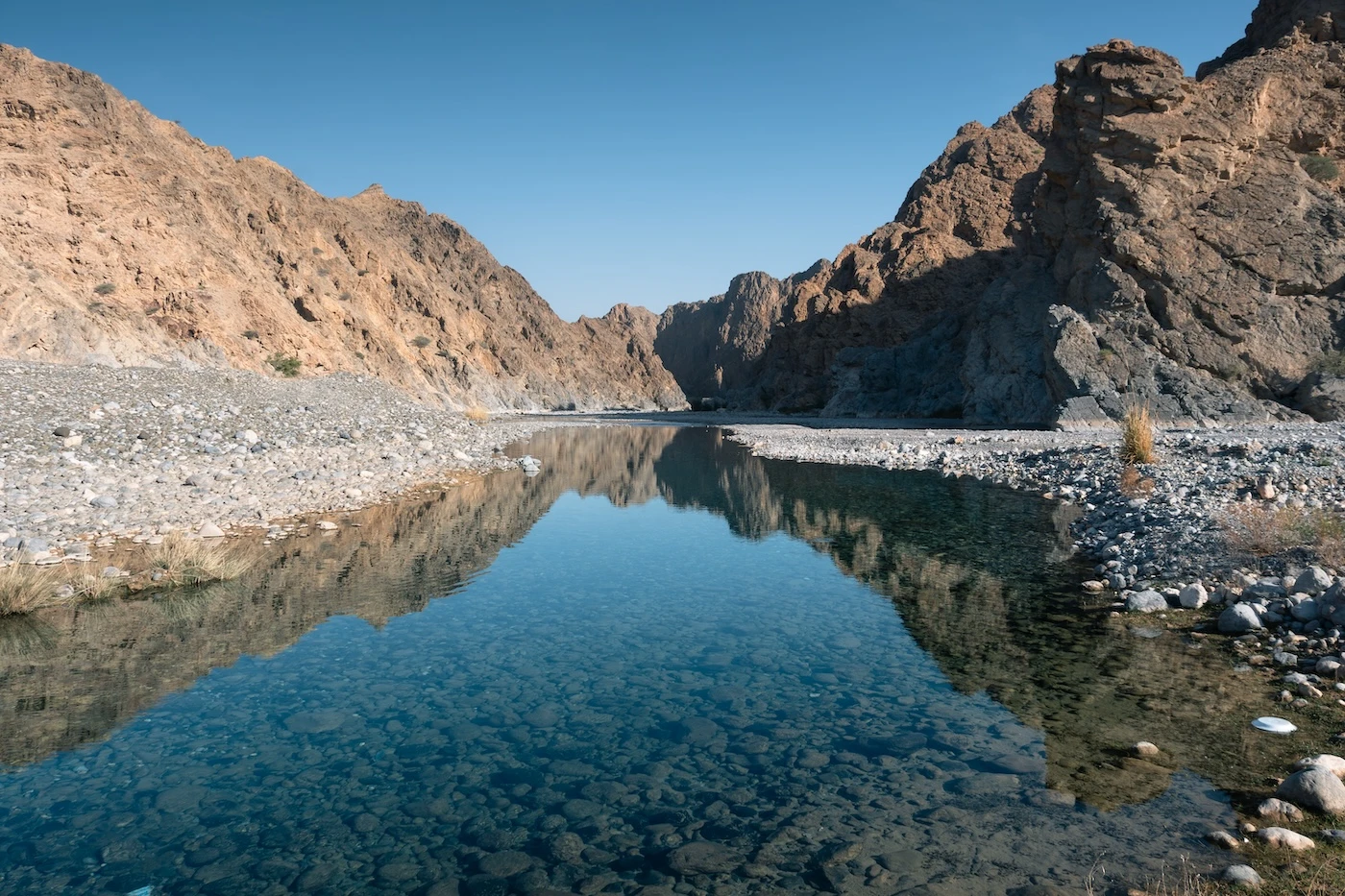
Wadi Dayqah, around 120 kilometres south of Muscat, is home to a collection of pools produced downstream from the largest dam in Oman, the Dayqah Dam (technically it’s two dams).
The water pools in the wadi are impossibly blue, completely void of tourists (from our experience), and are found by an easy and short (but adventurous) drive down these small canyons that have an oddly blue-ish hue from the pebbles on the ground. Visually, it’s quite a unique place – not the typical tall, narrow orange slot canyons you’ve probably seen on other posts (there’s still orange cliffs, though, but they juxtapose with the blue really beautifully!).
Wadi Dayqah is a fantastic option for people who don’t want to hike much – there’s technically zero hiking necessary and you can drive to all the pools. It does involve a small amount of car river crossings – but it’s not scary (unless the rains have just been, I guess?). The road can be a little tricky to drive, because the pebbles on the wadi bed almost feel like you’re skating across sand!
This is a spot we’ve returned to (at least) five times now – every time we go to Muscat, we pop by in our 4WD just because it’s such an underrated, beautiful place. It’s also one of the most photogenic areas, in my opinion, the camera just loves it.
Four-wheel drive: required for the pools
GPS: 23.122403, 58.904826
Cost: free
Accessibility: easy
–


2. Wadi Al Abyad
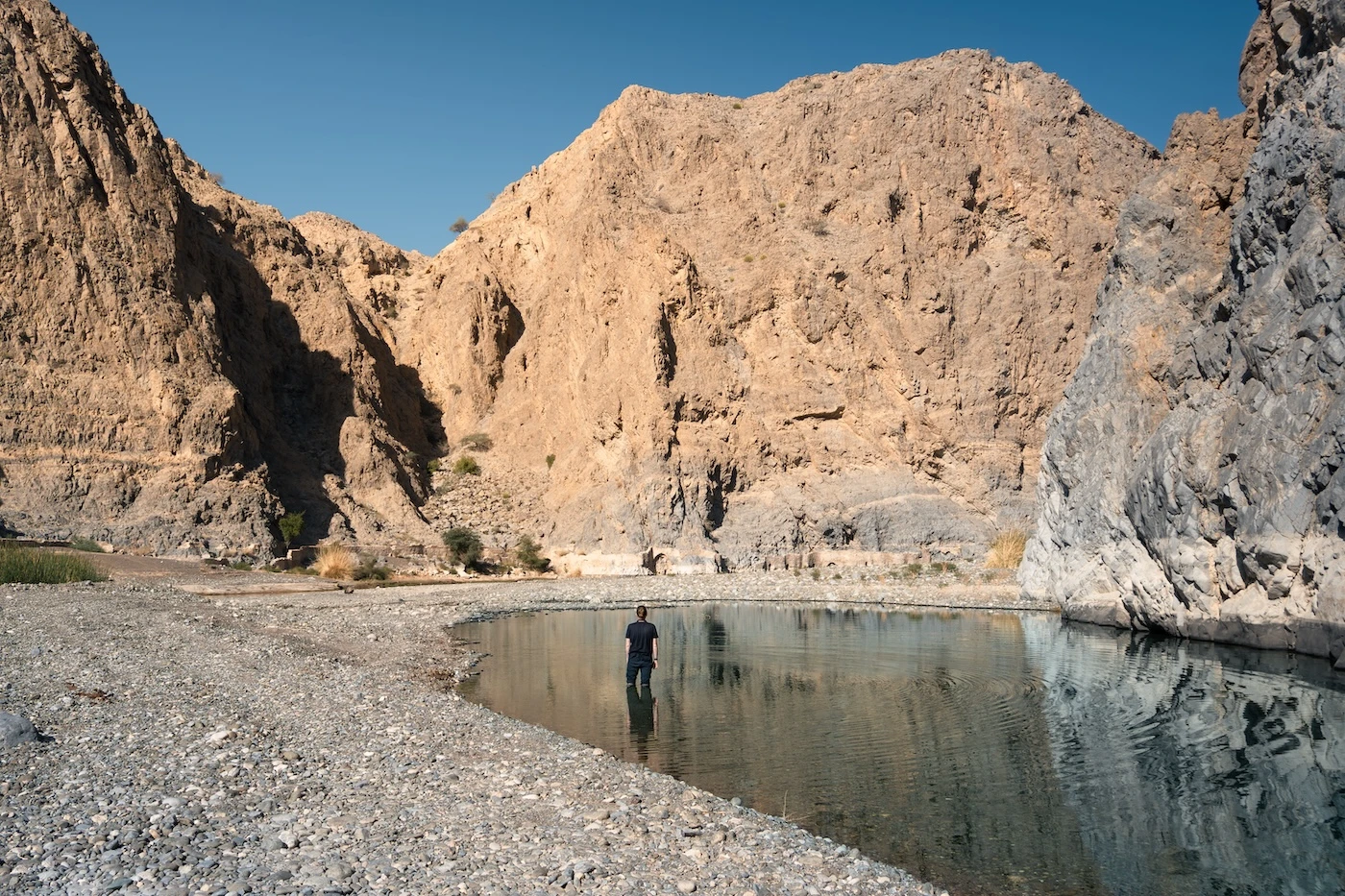
Wadi Al Abyad is a fun, off-beat little canyon, around 110 kilometres west of Muscat, with some surprising pools and very few foreign visitors.
This, like Wadi Dayqah above, isn’t the stereotypical wadi you’ll see in pictures, but is one of my favourites for pure weirdness and photogenic strangeness. The pools at this wadi are a bright blue, but in other areas also entirely calcite-tinted white (‘abyad‘ means white in Arabic).
The scenery is immaculate, with date palm reflections, and wide, shallow canyon views that are particularly impressive in the later afternoon. We enjoyed it so much here that we wild camped up top of a river bank.
The journey involves a little bit of river driving (easy stuff, I promise) and is just a super worthwhile day trip, especially if you are combining it with the nearby fort at Nakhal (one of our favourites in Oman) or Wakan Village in Wadi Mistal.
Four-wheel drive: required
GPS: 23.430711, 57.668020
Cost: free
Accessibility: easy, 15 minute flat walk to white pools
–


3. Wadi Al Arbiyyin
Out of the wadis on this list, Wadi Al Arbiyyin (or Arbiyeen), definitely had the most hospitable people. We had free dates, cardamom coffee, chai tea, oranges and watched TV with the local kids in their houses (no idea what was happening in the show); it was an exceptionally fun time.
The pools are also beautiful, set in the typical high-sided, rust-coloured canyons. There are waterfalls, various length hikes (and pools reachable without hiking, depending on your energy levels). On the drive in, you’ll see really deep, dark blue pools surrounded by high cliffs and completely transparent, shallow, green pebbly pools. Once you arrive and park near the small village, just follow the wadi west-ish for as long as you want.
All of this is enclosed by the barren, eastern Hajar mountains, only a little way from the ocean. Honestly, it doesn’t get much better.
The drive in is a dirt track and, although four-wheel drive is ideal, it is not a difficult route and we’ve never needed to engage it. It’s a pretty, winding route and you can’t get lost, either.
Four-wheel drive: not really required unless bad weather
GPS: 23.032666, 58.989176
Cost: free
Accessibility: easy to start, longer walk for waterfalls
–

4. Wadi Hoqain
This is one of my more recent wadi finds, an hour and twenty minutes west of Muscat.
It’s got these beautiful blue pools and is so easy to access via a set of paved stairs from the car park. This makes it magical for families with young kids and anyone who doesn’t want to walk far from their car to take a dip.
There’s also a nearby cafe and zero off road driving. It’s excellent.
Route to the car park at ‘Wadi Al-Hoqain Blue Waters‘ on Google Maps, not the ‘Al-Hoqain Waterfalls’. There are also white sulphur pools if you hike down towards ‘the trenches’ to the west from the car park. It’s a very cool place considering it’s so accessible.
You’ll also likely be hanging out with resident Omanis, rather than the foreign crowds that fill up Wadi Shab (see below).
Four-wheel drive: not really required unless bad weather
GPS: 23.032666, 58.989176
Cost: free
Accessibility: easy to start, longer walk for waterfalls
–


BEST PLACES TO STAY IN MUSCAT
Muscat has loads of great value hotels. We’ve stayed in around twenty different ones within the city and they generally offer super high-quality rooms for really great prices.
These are our current, 2026 picks:
⬩ W Muscat: we’ve actually only stayed at The Intercontinental next door to The W (which was lovely, too) but I really wished we’d stayed at the W. It was lively and seemed like so much fun and the pool area was awesome.
⬩ The Aloft Muscat: this is where we’ve stayed for the majority of time on our most recent visit and perfect if you have a car. It’s mad value for money, recently built so the rooms are immaculate, and our included breakfast was vast and varied.
⬩ The Golden Tulip Muscat: this quite traditional Omani-feeling hotel chain in Al Khuwair is in a prime location in the centre of town and has really decent rooms for often incredibly low prices.
⬩ Al Bustan Palace (The Ritz Carlton): Okay, so I definitely haven’t stayed here. I probably never will. But, if I had the money, there’s no doubt I would; it’s the definition of luxury.
⬩ Swiss-Belinn Airport Muscat Oman: near the airport and cheap as chips for the money if you have a car to get around. Really decent modern rooms, easy parking and all-around pleasant stay.
GOT MORE TIME IN OMAN?
Explore the cities and mountains:
Feel intrepid on an Oman offroad mountains itinerary
Discover what dramatic means with this Salalah itinerary
See some offbeat spots around Sur
Explore Oman’s cultural heart in Nizwa
Take a classic road trip from Muscat
Prepare with our Oman driving guide
Max out your time with these Muscat day trips
–
Best Wadis Near Nizwa
5. Wadi Qurai
Wadi Qurai is one of our more recent discoveries and, it turns out, one of our favourites!
It’s located in possibly the most convenient location, right off the main Route 15 between Muscat and Nizwa and doesn’t involve any off roading or 4WD car requirements.
Even better: it’s mostly an easy hike, quite a quick stop and also super pretty! The slightly precarious route follows an ever-flowing, slightly slippery falaj channel up the valley for around 45 minutes to some beautiful, gleaming (but quite cold) blue waterfalls and pools.
There’s a sketchy section at the beginning of the hike where you have to cross a small valley on top of the falaj, but it would be avoidable by taking an alternative route (I’m scared of ledges and heights, so it’s probably not dodgy for you).
You’ll likely have this place completely to yourself, too (minus a few goats): it’s not well-known by tourists.
Four-wheel drive: not required
GPS: 23.168753, 57.847387
Cost: free
Accessibility: moderate 45 minute uphill hike to reach the pools
–


6. Wadi Damm
If you have your sights set on visiting Oman’s tallest mountain, Jebel Shams, you should consider checking out Wadi Damm as part of your trip. The two are connected by a new road that links the jebel peak directly with the Wadi Damm pools hike (ideally use a 4WD car for this). Alternatively, take a longer route around and avoid the dodgy roads!
We think this is the most picturesque wadi on this list and, despite its outrageousness, very few people visit. I think it’s just a little bit too out of the way and a long way to drive if you’re based in Nizwa.
The Wadi is quite well hidden in a tall, orange-walled canyon, taking an adventurous little hike to find the best spots. At the end, the pools are magnificent, with spring water flowing through lush ferns and moss. There are also millions of fish all vying to eat your feet (I’m not a big fan of this). It’s just like a modern fairy tale (minus the carnivore fish, obviously).
Four-wheel drive: not required if you take a longer route
GPS: 23.230883, 57.069240
Cost: free
Accessibility: moderate 45 minute hike including ropes
–


7. Wadi Bimmah/Snake Canyon
Wadi Bimmah, colloquially known as Snake Canyon due to its twisting shape, is the toughest and least penetrable wadi on this list.
The shear canyon walls remind me of slot canyons in the U.S, like the Narrows in Zion National Park, but with more colours and prettier pools. To cover the full length, it’s a half/full-day canyoneering trip, with deep pools, abseiling and jumping into dark unknowns. So, unless you’re an expert, it is necessary to hire a guide.
However, it is possible to hike into the canyon for a distance without having to do any extreme sports. There are three entrances to the canyon, one to the north at 23.213276, 57.403742, one to the south at 23.197976, 57.390398, and one to the west at 23.210406, 57.385737. We’ve spent a few hours wandering through the north and south entrances without a guide, it’s easy to have a look around without any stress (your feet might get wet, though!).
We’d definitely recommend, at minimum, a short walk into the north as the towering black-cliffed entrance is Lord-of-the-Rings levels of dramatic and there are blue pools all over the place.
Four-wheel drive: required
GPS: 23.213276, 57.403742 (north entrance)
Cost: free
Accessibility: easy to very difficult depending on route
–


BEST PLACES TO STAY IN NIZWA
Nizwa has a great selection of hotels that cater for any accommodation preferences. Here are a few of our recommended hotels (we’ve stayed in all of them):
IntercityHotel Nizwa (+$$): the most modern hotel in Nizwa, with clean, simple rooms and super easy parking right next to a Lulu Hypermarket and the Nizwa Grand Mall. This hotel goes up in price *a lot* last minute, so if you’re looking to book, do it early.
Antique Inn ($$): quirky heritage hotel with some serious character, adjacent to Nizwa Fort and Souq. Parking can be a little tight if you arrive late in the evening and some rooms don’t have a window – upgrade to a King Suite if you can (I think the double rooms in this hotel are a little overpriced). Breakfast is excellent and the views of Nizwa old town from the terrace are fantastic.
Nizwa Inn (-$$): simple, clean and friendly hotel with nice modern rooms; ours always had nice views across the desert towards the mountains. The entrance is a little slippery, be careful! The location is fantastic, right opposite the Nizwa Grand Mall.
–
CAR HIRE FOR YOUR OMAN WADI ADVENTURE
We always rent our vehicles all over the world, including our recent trips in Oman, Saudi Arabia, Tunisia and Morocco, with Discover Cars. They’re often the most affordable, plus they paid out immediately on an insurance claim we made when our car took some heavy damage in Sicily.
Read more about why we love them so much!
–
TAKE A LOOK BELOW OR CHECK CAR RENTAL
Best Wadis Near Sur
8. Wadi Shab
Wadi Shab (or Wadi Ash Shab) is (probably) the most famous wadi in Oman. This is the one that’s super popular on social media, and the photogenic one shared all over blogs. Those blue pools in a giant canyon? Almost certainly Wadi Shab!
It’s worthy of its fame, in my opinion, but knowing how to avoid the crowds and when to visit will make your trip way, way better.
The journey sounds complicated, but is quite straightforward: a short boat ride, a meandering 45-minute hike through towering canyon walls, a swim through three stunning pools, and a waterfall in a cave! It’s an easy swim to reach the cave, but even if you don’t feel comfortable swimming the entire way, it is still worth the trip.
It’s an outstanding day out from Muscat or Sur and is one of the most beautiful places I have ever visited. If you have ever been to Utah and hiked any of the canyons there, add some impossibly blue-green water and you’ve kind of got the idea!
Four-wheel drive: not required
GPS: 22.839271, 59.246180
Cost: 1 OMR (for the boat at the entrance)
Accessibility: moderate, rough 45 minute hike
–


9. Wadi Tiwi/Wadi Mibam
Beautiful Tiwi is often up there on many visitor’s favourite wadis in Oman, however our experience was hassle from the residents, both along the access road and at the wadi itself. It’s a very rare time that Oman is disappointing (it’s the kind of scammy behaviour I was expecting in Costa Rica and Morocco – happy to say that Morocco is entirely hassle-free).
Having read bad reviews about the area, we knew it was a possibility, but checked it out anyway. It’s an undeniably beautiful wadi, so we would suggest you read recent reviews and consider if other people’s experiences at Wadi Tiwi put you off (read ones on Google for ‘Wadi Tiwi – parking place‘, for example).
There are three (sort of) parts to this wadi. The first is driveable by a 2WD vehicle and involves several hours of hiking to reach the pools you see in all the photos (residents will likely try to persuade you to take their car or a guide for exorbitant prices). The second is further up some steep, narrow roads which lead to Wadi Mibam, nearby the waterfall and famous pools. This is where you’ll potentially get hassled for a tour guide, and some people have mentioned that their way was physically blocked, aggressive kids, and they were victims of theft (but I can’t corroborate that).
The third option is a bit insane, but you can access Wadi Tiwi from the other side of the mountains to the west at 22.732634, 59.158894. From here, you can hike down and see some of Wadi Tiwi’s pools without any other people around. However, it’s not easy and to reach all the way to Mibam, you’ll need rappelling gear, life jackets and be a very strong swimmer. We’d absolutely recommend hiring an outfitter if you’re considering that hike! The road in is nerve-wracking – the tracks are crazy high, precipitous, rough, and narrow. It’s probably one of the worst we’ve driven in Oman (and much worse than the front entrance that people make a fuss about).
Four-wheel drive: required
GPS: 22.771808, 59.214761
Cost: free
Accessibility: Mibam end – moderate, back of Tiwi – strenuous
–


10. Wadi Bani Khalid/Wadi Hawer
Okay, so full disclosure – we did not visit here. But no ‘best wadis‘ list is complete without Wadi Bani Khalid.
The thing is, it’s quite touristy and family friendly, which is not so much our jam. However, we know several people who have visited and this is based on their reports – it seems like a fantastic place to go if you’re looking for a trip from Muscat and have kids.
Wadi Bani Khalid is probably the most built up, tourist-oriented wadi on this list, located next to the small village of Muqal. It has a set of large, beautiful pools, perfect for swimming. There are also some excellent hiking opportunities to a few lesser visited caves and pools if you want to avoid some of the crowds. Past the initial larger pools, there is a hike along the wadi to Miqil (or Muqal) Cave which we were informed is well worth the effort. Take a torch though, apparently this one is a wee bit claustrophobic.
This wadi even has infrastructure (which is a rarity in Oman!). Things like bathrooms, changing facilities and shelters – perfect if you have kids and want a chilled-out day. The problem with facilities is they inevitably bring crowds. Come early if you want to avoid the majority of day trippers from Muscat, although the main pools are absolutely huge, so you’ll never be crammed in.
Four-wheel drive: not required
GPS: 22.618506, 59.093213
Cost: free
Accessibility: easy
–

BEST PLACES TO STAY IN THE EASTERN HAJAR MOUNTAINS
We always stay in Sur when around the eastern coast.
There are several main ‘tourist grade’ hotels, including Best Western Sur and Sur Grand Hotel. If you are looking for a moderate, comfortable tourist hotel with a decent breakfast, we recommend these – we’ve stayed at both.
–
GOT EVEN MORE TIME IN OMAN?
Go camping:
Sleep under the stars at these amazing wild camping locations
Plan your trip with our Oman camping guide
Camp atop Oman’s highest mountain
or camp in the palest of Oman’s deserts at the Sugar Dunes
or have a totally unique adventure:
Spot the most remote beehive tombs in Oman
Wander around Oman’s most photogenic fort
Learn about livestock at the Nizwa goat market
Take a look around Oman’s most unique fortification
Drive up Oman’s most popular mountain
Find a way into Bat’s 5000-year-old tombs
–
Best Wadis around Salalah, Dhofar
11. Wadi Darbat
Wadi Darbat was our all around favourite for views, access, camping, and fun. It an easy 46-kilometre-drive east of Salalah, in the southern governorate of Dhofar.
The water was the brightest greeny-blue, there were so many different areas to visit, plus the waterfalls looked absolutely spectacular. The best part, to me, was that it felt like a safari park for goats, cows and camels, too. I’d never seen a camel amble down along a bright green river before. It’s a great place for a picnic and to spend the day, too, especially if you have kids.
The views absolutely set this place apart from everywhere else. It’s not like any of the other wadis on this list: from the top you can look out across the vast coastline of Dhofar.
Despite the water running all the way through the dry season, it doesn’t seem to get busy, either (we’ve visited twice and also camped here). We were really surprised at the amount of water – the waterfalls were pretty heavy even without any rain. The area does become very busy with visitors when the water is raging, though!
Four-wheel drive: not required
GPS: 17.073125, 54.433582
Cost: free
Accessibility: easy
–


12. Wadi Al Nakheel (Khor Senaq)
Wadi Al Nakheel is a sneaky one and rarely visited by tourists due to its extremely remote location. The nearest major city is Salalah, a 2.5-hour drive away! That drive is a spectacular one, though, with possibly the best scenery from a paved road in the entirety of Oman.
The wadi has easy access directly off the main highway, just as the Dhofar Mountains reach the sea. It’s a fantastic place to camp, more like a date palm lined river than a ‘clasic wadi’, and has some lovely water to swim in that leads out into the ocean. When we visited it was so peaceful, we were the only people there for both nights (we’ve wild camped here two separate times – the second time we were stared down by a donkey in the middle of the night).
Wadi Al Nakheel is a fantastic overnight stop if you are driving the coastal route south towards Salalah.
Four-wheel drive: not required
GPS: 17.599023, 55.250110
Cost: free
Accessibility: easy
–


13. Wadi Ayun (Ain Ayuoon)
Wadi Ayun is a set of blue pools in a beautiful golden-coloured canyon, around a one-hour drive from Salalah.
It’s a little difficult to access for people with physical limitations or for kids, because there’s a bit of a trek down to the pools, and it’s not great in summer as there’s no shade.
You can see the bright blue pools from the parking area, but to reach them involves following some trail markers over a rough path for around 15-20 minutes. Be aware, It’s a steep-ish climb down and back up with some cliff edges. These are nothing to worry about, but I’d probably not bring kids here. We have been twice, in separate years, and somehow got severely lost both times.
It was one of the most peaceful places we have been (minus the drama of getting lost and stuck down a canyon – we are incompetent at route finding it seems). At one point we sat on a cliff listening to the call to prayer from multiple different directions even though it felt like there was no civilisation for miles.
It’s definitely worth including on a trip to Salalah.
Four-wheel drive: not required
GPS: 17.246327, 53.888307
Cost: free
Accessibility: easy to view from above, more strenuous walk to reach pools
–

14. Wadi Sayq
Wadi Sayq is a bit of a bonus one, really, if you are heading towards the beaches of Dhalqut on the Yemeni border. You’ll find these suprisingly pretty, blue pools next to Route 47, a little over two hours from Salalah.
If you are willing to get your feet wet, you can also wander up the wadi; it’s a pretty hike up the canyon even after the pools end. Below the highway are more pools (since the water runs underneath the road) that are really, surprisingly bright!
There is not much parking around the area – park just before the photo symbol on Google Maps (downhill from – not the direction of the switchbacks, around 16.748717, 53.223933) where there is a small dirt track leading off the main road. If there is someone parked there, go to 16.748300, 53.224781 if it’s clear.
Four-wheel drive: not required
GPS: 16.748505, 53.223713
Cost: free
Accessibility: easy
–

BEST PLACE TO STAY IN SALALAH
Salalah has a myriad of accommodation options depending on your budget. There are numerous upscale, luxury resorts along the beaches and coast, budget apartments within the city and affordable business-style hotels in the centre to choose from.
For a mid-range business hotel that we have stayed in a few times, we recommend the Salalah Gardens Hotel. It’s in a mall with an attached Hypermax hypermarket and near a Lulu hypermarket as well. The hotel is central, has tonnes of free parking, access to shops, the rooms have small kitchenettes and there is an exceptional breakfast.
–
Best Wadis in Oman Map
Below is a Google Map with markers for everything mentioned throughout this post.
⬩ Red: wadis near Muscat
⬩ Green: wadis near Nizwa
⬩ Purple: wadis near Sur
⬩ Orange: wadis near Salalah
To save this map, select the star next to the title.
How to Get to Oman’s Wadis
Every Oman wadi mentioned in this post requires a car for access.
We suggest renting a car in Oman. The roads are very easy to drive, quiet and straightforward to understand, Omani drivers are generally polite and road signs are in English. We have driven more than 20,000 kilometres in Oman and it is our favourite road trip country in the world!
For more information, have a look at our Oman driving guide.
Is a Four-wheel-drive Car Needed to Visit Oman’s Wadis?
No, you do not need a four-wheel drive (4WD) car to visit all of Oman’s wadis, but for some it is extremely helpful and occasionally necessary.
It really just depends on which wadis you choose to visit. Many can be reached with a two-wheel drive (2WD), especially if you have higher-clearance. The access to certain wadis is also reliant on recent weather – rain is a disaster for some unpaved routes.
Each of the wadis we mention above notes the type of car needed for access. Only around four of them really require a rugged, fully off-road 4WD vehicle.
Another option is to hire a private driver and take a tour – check out Get Your Guide for options and prices. Alternatively, some more popular spots have drivers waiting to take people for a large fee – like Wadi Tiwi.
Useful Tips for Oman’s Wadis
Dress: Oman is a conservative country and the wadis are generally in rural areas. Do not swim in a bikini.
Safety: people have drowned in Oman’s wadis. Be careful if you are not a strong swimmer and never enter one if rain is forecast.
Entry fees: all of Oman’s wadis are free entry
Best time: the winter season is safest (temperatures are milder and there are no monsoon rains). Ideally, visit between November and March.
Footwear: bring appropriate shoes – hiking through wadis can be painful even if the pools look friendly!
Temperatures: despite Oman’s warm weather, some wadi water is very cold. Go prepared!
Avoid: visit on weekends (including Friday) to reduce overcrowding.
–
Do All Oman’s Wadis Involve Hiking?
No, a lot of wadis on this list do not involve hiking. Where any strenuous activity is involved, we’ve mentioned it.
Many wadis in Oman are accessible directly from a car, however there are rarely any pavements or paths. So, even if the access is easy, getting around them, and finding the best views might still be difficult if you have any physical limitations.
It might be common sense, but always wear comfortable, grippy footwear when exploring Oman’s wadis. The ground is often smooth and slippery (I fell, fully dressed, into a wadi pool in full-on hiking boots once and it was less than ideal).


Can you camp in Oman’s Wadis?
Yes, it is legal to wild camp in Oman’s wadis.
However, whether you should camp in wadis is a different issue.
Wadis, as is their nature, are prone to flooding, sometimes after even just a small amount of rain many miles away. People die every year in wadis, and it’s worth being hyper aware of the weather and season if you choose to camp in them.
Full disclosure, we’ve camped in quite a few wadis (I think at least seven on this list!). However, we have only done this in the dry season when there was no chance of rain, plus we chose campsites on higher ground. If you have even a little doubt, just camp outside the wadis.
If you’re interested, we have guides about general camping in Oman and also specific camping locations.
–
Things to Pack When Visiting Oman’s Wadis
There are a few common essentials to pack for any wadi trip to Oman. Specifically, note how far you may be from your car at any time. Some wadis require long, strenuous hikes, others are close to facilities or even just a few steps from your car!
These are a few things to consider packing for your Oman wadi trip:
⬩ Microfibre towel: to dry off if you swim. Also they’re useful if you are drying your glasses.
⬩ Swim wear: chose something non-revealing, like leggings. Bikinis are definitely not okay.
⬩ Sturdy shoes: most wadis involve some kind of scrambling and walking barefoot in the water hurts (from stones). I wear Altra Lone Peaks when hiking through rivers and wadis; they’re excellent and dry fast.
⬩ Water and snacks: important if you get hangry, like me. Also, Oman gets hot, so water is essential if you’re hiking.
⬩ Sunblock: it’s better to cover up than use sunblock. However, if you choose to swim, research your chosen product to ensure it won’t damage the delicate wadi ecosystems (think: proper reef-safe products).
⬩ Hat: Oman is sunny and nobody wants to look like a dick with a burnt head and face.
⬩ GoPro: these are cool if you want some underwater footage (but people do drop them so tie it to yourself).
⬩ Dry bag: this means you can hike through pools with your phone and car keys.
⬩ Hiking directions or map: some wadis are really obvious and easy to reach, but others can be tricksy nightmares.
⬩ Rope: useful for any of the more complicated hikes, or if you get stuck in a slippery pool, like I did.
⬩ Toilet roll: if you’ve got to go, then you’ve got to go. Pack out any paper – leave no trace.
⬩ Moisturiser/lotion: this won’t apply to everyone, but I found the wadi water dried my hands and feet out to the point I was really uncomfortable.
⬩ Goggles: there are tiny carnivore fish to spot in the pools (and some lost GoPros!).
What Not to Pack When Visiting Oman’s Wadis
There are a few things that are just unnecessary to bring to a wadi!
⬩ Flipflops: the typical Omani wadi terrain is simply not designed for flipflops (although some people would disagree). I even had a giant fish spine go through my flipflop straight into my foot once.
⬩ Money: apart from the boat access to Wadi Shab, there are no fees for any of the wadis or parking in Oman.
⬩ Bikinis: don’t wear anything inappropriate, even if you have seen people on social media basically naked in the wadis.
⬩ Bulky bags: there is a lot of scrambling, even on easy hikes. Travel as light as you can!
RESPONSIBLE RECREATION: LEAVE NO TRACE
Oman has a trash problem.
This is especially prevalent along the coastline and beaches, but also in popular spots like Jebel Shams and in the wadis. It’s not trash that has washed up from other sources, but rather left there by previous campers, residents and visitors.
We can’t police how Omani people choose to treat their lands, but we can ensure not to add to the issue.
Bring a bag or two and pick up some trash – always leave the area cleaner than when you arrived.
Follow leave no trace principles, always.
–
Where to Next?
Visiting the wadis in Oman was definitely one of the highlights of more than three months in the country. They’re such a fantastic contrast to the deserts and sand you typically see in photographs and on road trips!
Even without the enticing pools, the valleys and scenery comfortably rival more renowned places like southern Utah in the United States.
If you’re driving from Muscat or Salalah, take a look at our driving guide so you know exactly what to expect on the roads. Also take a look at our Muscat itinerary or Salalah itinerary for loads of things to do in both cities.
We hope this list helps you choose which of the Oman wadis are best for your trip – have a fantastic time!
Hi, thanks for visiting our blog! If this post has been of help to you, or you’ve just enjoyed our random ramblings and musings, say thank you by buying us a coffee! It helps keep The Restless Beans blog up and running.
Thank you, Claire + Nick


I swam the length of Ain Ayun in 1980, leaving my clothes and M16 on a rock at the water’s edge. A dragonfly swam with me, keeping just a few inches ahead of my nose. The Dhofar rebellion had just ended and I was probably the first ‘tourist’ ever to swim there.
That’s crazy. I can’t imagine what Oman would have been like back in 1980, would love to have seen that though. We definitely aren’t the first tourists to visit Ain Ayun, but we never saw another soul there either of the times we visited – so can at least imagine the isolation of your story!
Thanks for this great summary of the best Wadis in Oman. Special thanks for sharing the pictures and locations making it easy to find for everyone.
Thanks so much! You’re very welcome 🙂
Thanks for the recap! Traveling solo (female) and feel like it’s probably wise to take a guide just because, you know. In which of these wadis am I likely to find guides hanging out and offering their services?
Hi Melanie,
Thanks for your comment.
From Muscat, your best options for hiking with a guide are Wadi Shab, Wadi Al Arbiyyin, Wadi Bani Khalid and Wadi Tiwi. We haven’t seen guides at Wadi Damm.
Hope this helps!
Wonderful Blog! Thank you.
Hi Ram,
Thanks for your comment 🙂
At one point I stopped just to take in how quiet it was. No cars, no people, just the soft sound of sand shifting under my shoes and the occasional breeze moving through the narrow walls.