Adventuring Down Morocco’s Magical Coast – a Detailed Road Trip Itinerary
Scribbled by Claire ◊ 22 Oct 2024
Are you looking for an alternative to the typical, tourist route through Morocco? This Moroccan coastal itinerary includes plenty of well-known spots and cities, so you won’t miss out on any quintessential experiences, alongside quite a few alternative suggestions to help you plan a memorable trip!
Archetypal images of Morocco almost universally comprise of deep red tones, sophisticated riads, bustling medinas, steaming tagines and endless, camel-dotted sand dunes. However, this magical country is far more than that, with an enormous 3500 kilometres of coastline, sweeping west from the crystal-azure Mediterranean and south along the weathered, windswept Atlantic.
If you’re looking for a diverse, alternative road trip and are an ocean, beach or surf enthusiast, an adventure down Morocco’s coast is absolutely ideal (the Atlantic coast is particularly magic for surfers!). It’s also perfect for anybody searching for a less congested, wilder voyage across Morocco.
For more inspiration, check out our favourite historic landmarks across Morocco, our complete Moroccan budget or our favourite outdoorsy adventures.

IN THIS GUIDE //
Morocco’s Magical Coast
GETTING AROUND MOROCCO’S COAST
ABOUT THIS MOROCCAN COASTAL ROUTE
– ALONG THE MEDITERRANEAN
DAYS 1-2: AL HOCEIMA
DAYS 3-4: CHEFCHAOUEN
OPTIONAL: TETOUAN
DAYS 5-6: TANGIER
– ALONG THE ATLANTIC COAST
OPTIONAL: ASILAH
OPTIONAL: LIXUS
DAYS 7-8: RABAT
DAY 9: CASABLANCA
OPTIONAL: EL JADIDA, SAFI, OUALIDIA
DAYS 10-13: ESSAOUIRA
DAYS 14-16: TAGHAZOUT AND TAMRAGHT
DAY 17: AGADIR
DAY 18-19: MIRLEFT AND SIDI IFNI
MOROCCO COAST ITINERARY MAP
DRIVING DISTANCES
HOW TO DRESS IN MOROCCO
BEST TIME TO VISIT THE MOROCCAN COAST
FINAL THOUGHTS
This post may contain affiliate links. If you book through these links we may make a small commission at zero cost to you. It helps us pay for the upkeep of this blog. Thank you!
Getting Around Morocco’s Coast
The easiest way to explore Morocco’s coastline is to rent a vehicle.
We rented a very affordable car (a tiny Kia Picanto) for nearly six-weeks, which we drove 6000 kilometres all around the country, and had nothing but *entirely* positive road experiences. Morocco is actually one of the most easy-going and pleasant countries we have ever driven in! For more information about driving in the country, check out our Morocco driving guide.
However, the huge majority of this trip is totally possible on public transport (trains and buses are ubiquitous in Morocco), but the journeys may take far longer and be a little less scenic.
Along with our rental car, we also rode trams, buses and trains during our trip in Morocco, and found that, for the most part, Google Maps was magic for figuring out the best way to get from A to B. It was all safe, easy and affordable.
If you want to read more about getting around Morocco, there’s extra information in our post about the most beautiful cities in Morocco.
About This Moroccan Coastal Route
For a condensed route, this trip can be undertaken directly from the major cities of Tangier to Agadir (or the other direction). This coastal route can be completed in around two weeks (or even less), depending on your schedule.
We have listed additional add-ons at each end, which can extend this trip by a week or more. There are also a few inland options which make sense to include if you have the time.
Below is a map illustrating our Moroccan coastal journey in red (and a few are in green along the Mediterranean coast).
Also included on the map is our northern Morocco itinerary (green) and Atlas Mountains itinerary (blue).

Part 1: The Mediterranean Coast
Days 1-2: Al Hoceima
This coastal stop along the northern stretch of Morocco’s shoreline is a little different to most places shown in the media. Al Hoceima has a distinctly European vibe (I think it’s a popular Euro holiday hub during summer) and the stacks of white-washed houses around the coastal hills remind me of their equivalents in Spain.
We visited during a quiet October weekend and Al Hoceima was peaceful, with few people on the beaches, no traffic and some undeniably cracking sunsets. However, we visited out of season and cannot say how busy this region gets during peak summer!
Things to do
The main appeal for Al Hoceima (apart from the town’s pretty beaches) is the national park of the same name. The 470 square kilometre Al Hoceima National Park is a vast region that covers an enormous amount of craggy, dramatic Moroccan coastline and a section of the Rif Mountain Range.
This park is prime for hiking, with magnificent views and few crowds. There is also the peculiar Spanish fortification (which is legally part of Spain!), and the Fortress of Torres, a fortification on the cliff tops with magnificent panoramic views.
Where to stay
There are many accommodation options in Al Hoceima – from upper end resort-style hotels to locally owned, private apartments.
We chose something a bit less typical (for us) for our stay in Al Hoceima – the Mira Palace.
Instead of a riad or dar, it was a modern, large and friendly hotel (they had laundry facilities and easy parking!). It had a top-notch freshly cooked breakfast (the staff gave me extra salad every morning because on the first day I dropped mine and they remembered!), hyper modern, spacious rooms (a lovely change from the more compact riads) and spectacular views across the ocean and sea cliffs of Al Hoceima.
Truthfully, we booked it because it was affordable (for us in October), but it turned out to be a magnificent choice!
Length of stay
It depends on how much hiking, exploring and beach time you want, but we’d recommend two days at a minimum in Al Hoceima to have a proper look around.
_


Days 3-4: Chefchaouen
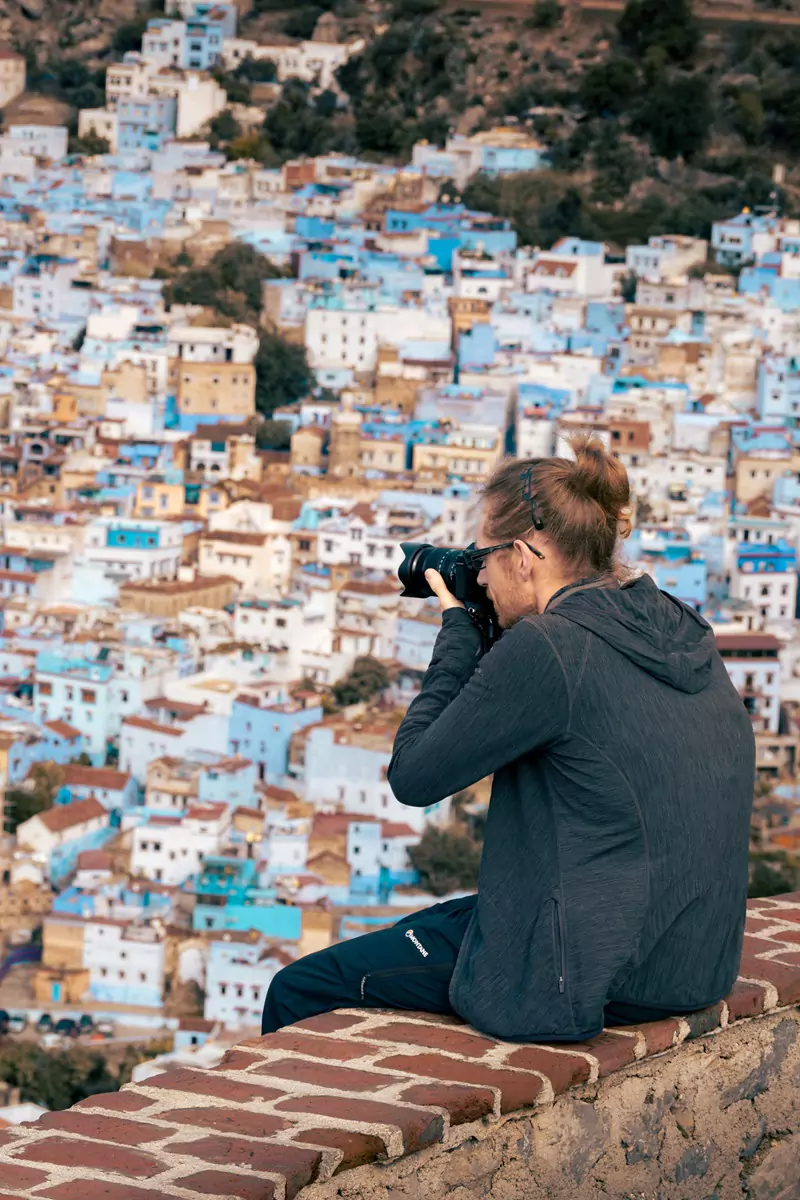
Although Chefchaouen is technically not on the coast, it is one of the most photographed cities in Morocco and makes sense for this coastal itinerary, location-wise.
This hillside city, concealed in the Rif Mountains, is known for being blue. Completely, utterly blue. And, true to its reputation, this city does not disappoint in the colour department.
We were told various reasons for this blueness when we visited, the most common being that blue wards off mosquitos (we were also told this in the blue-ish cities of Kairouan and Sousse in Tunisia, so maybe there’s a strand of truth to it?).
Either way, we didn’t experience any mosquitos in Chefchaouen, but we did get to see how unique this Instagram-famous mountain town was.
Things to do
Chefchaouen is pretty small but there’s a surprising amount to do. Below are few things to check out:
Akchour Falls | a series of waterfalls, scenic hikes and a natural archway. Free access, parking 10 MAD. This was my personal highlight of Chefchaouen.
Bouzafer Mosque (Spanish Mosque) | built by the Spanish in the 1920’s, and providing panoramic views of the blue city, this mosque is located an easy 25-minute walk from the main square of Plaza Uta el Hamman.
Kasbah | 15th century castle with a museum, found next to the Plaza Uta el Hamman. 60 MAD entry for foreign tourists.
Ras El Ma | a small waterfall located on the city outskirts and only a short detour if walking through the Chefchaouen Medina up to the Spanish Mosque above.
A note on cannabis farms | these are common in this area of the Rif Mountains; it’s extremely likely that somebody will invite you to buy some, or to even visit a farm. It’s not my vibe, personally, and lots of younger local people seemed stoned!
Where to stay
We chose to stay in a little hotel called Balcon Bleu, right in the centre of Chefchaouen, near to some friendly, convenient public parking. We loved this place, especially the buffet breakfast and the small, surprisingly modern rooms with terrace overlooking the city. The location was absolutely perfect, adjacent to the famous blue streets.
Length of stay
We stayed for three nights, which was a decent length to explore the city and surrounding region.
In one day, it would be easy to check out the twisting narrow blue streets of the city, grab lunch and take the easy wander to up to the Spanish Mosque for exceptional views of the city and surrounding hills.
–

OPTIONAL – TETOUAN (1 DAY)
Tetouan is a popular coastal town around an hour north of Chefchaouen. When we visited, it was raining endlessly (our only bad weather day in six weeks!), so we didn’t get to do much, but if you have the time, pop in, check out the beaches, and even stay overnight if you want to explore more in depth. Below are a few of the highlights in the area:
Design | have a look out for the bright colonial architecture on Avenue Mohamed V.
Iglesia de Nuestra Señora de las Victorias | built in 1927, this Catholic church is an unusual yellow and found on a roundabout, rather than tucked away in medina alleyway.
Royal Palace | whilst not open to the public, this recently built (1988) palace can be found by Michouar’s Square.
Martil Beach and Plage de Cabo Negro | both are clean and easy to reach beaches found less than 15 kilometres to the east.
–
Days 5-6: Tangier
Tangier, just a few miles across the Strait of Gibraltar from Spain, has maintained a lingering reputation from its decades as an international zone in the earlier half of the twentieth century. The historically seedy exploits, smoke-filled alleys occupied with infamous beatnik artists and less-than-wholesome proprietors made Tangier legendary. This is a city I have been mildly obsessed with for many years, all due to its infamy as a haunt of Ginsberg and Burroughs.
Despite its fascinating, notoriously wild past, in recent years Tangier has become a contemporary, cosmopolitan city that embraces its distinctive literary and artistic past. It’s home to bookshops, bars and cafes, quality local artisans and beautiful hotels, plus, of course, terrific coastal views and beaches.
Things to do
For such a large city, Tangier is not rammed full of classic tourist attractions; there are few museums, large architectural feats or internationally known wonders. However, the magic of the city is at street level, around the meandering streets of the kasbah and medina.
Grand Socco | a bustling square with a giant fountain centrepiece, perfect as a starting point before wandering through the Medina of Tangier.
Mendoubia Garden | a small park away from the bustling and busy streets, with views of the surrounding city.
Mosque Lalla Aabla | only recently built in 2017, this green and white mosque stands proudly near Tangier’s fishing port and is large enough to support nearly 2000 worshippers.
Dar Al-Baroud Tower | found on the outskirts of the medina, this ancient 15th century fortification, complete with cannons, has an on-site museum (50 MAD entry for adults) and provides slightly elevated views of the Mosque Lalla Aabla and the waterfront of Tangier.
Just outside of the city, there are beaches galore, plus some touristy spots, like the Hercules Caves, the meeting point of the Mediterranean Sea and Atlantic Ocean and Cap Spartel.
Where to stay
Tangier is a big place – there are lots of options for every kind of traveller here. We stayed in a few places in the city, here are our suggestions:
If you’d like to stay in the medina/kasbah area, we’d recommend Kasba Blanca. This traditional riad, on the peripheral of the medina, was an absolute find. Its classically decorated rooms and rooftop breakfast are impeccable – get an upgraded room though – as some come without windows. For a more budget-conscious option in the Medina area, consider Dar Rif Kebdani, with an impeccable location, lovely staff and pretty rooftop.
For a modern option outside the medina (with included parking), the Pestana Tanger ticks every box (it’s also adjacent to the train station). Rooms in this super-modern and clean aparthotel have large, fully fitted kitchen and living areas, plus private laundry facilities. We particularly loved the super convenient underground parking for our car.
Length of stay
There is a lot going on in Tangier and you could easily stay busy for most of a week here. However, if you just want to get a feel for the old town and visit a beach, it would be easy to do with one-two days.
–

CAR HIRE FOR YOUR MOROCCO TRIP
We always rent our vehicles all over the world, including our recent trips in Oman, Saudi Arabia, Tunisia, Jordan and Morocco, with Discover Cars. They’re often the most affordable, plus they paid out immediately on an insurance claim we made when our car took some heavy damage in Sicily. We fully recommend them.
–
TAKE A LOOK BELOW OR CHECK CAR RENTAL
Part 2: the Atlantic Coast
OPTIONAL – ASILAH (1 DAY)
One of the first points of interest down the Atlantic coast of Morocco, 20 miles from Tangier, is Asilah.
The compact, windswept, mural-adorned old town is enclosed by 15th century Portuguese fortifications and is bursting with a wide variety of local art. The city even hosts a yearly summer art festival (the International Cultural Moussem of Asilah – the first ever street art festival in Morocco, running since 1978!).
Take a wander around the ancient ramparts, examine the yearly-changing local art adorning the walls of the white-washed houses, have a nosey around the small stalls that dot the medina, then go grab a meal at Dar Al Maghrebia.
It’s possible to make a short stop in Asilah on the drive south to Rabat or to visit Asilah as an easy day trip from Tangier. You can also stay overnight, which we’d highly recommend if you have time (the cities in Morocco have remarkably different vibes in the evenings and early mornings).
Our accommodation preference is Riad Casa Bahia Asilah – it’s surprisingly modern, has a great included breakfast and best of all – parking. It’s around a ten minute walk from the old town Medina and nearby the best restaurants in town.
–


OPTIONAL – LIXUS ARCHAEOLOGICAL SITE
This 4th century Roman archaeological site features the remnants of temples, baths and an amphitheatre, along with a small museum, and is an worthwhile stop-off between Asilah and Rabat.
The route through the site follows an easy, maintained loop through rocky shrub areas, with steps in many places making it not disabled-friendly. There are views of the sea, the nearby river Oued Loukos and the town of Larrache as you meander.
When we visited, there was an unfinished museum block which provided some extra details but only in French and Arabic, so bring your translator app if you don’t read either. Two rooms on the ground floor had details on the history of Lixus, whilst a third section of the museum contained money, pottery, fishing hooks and iron knives/cleavers (no photographs were allowed in this third section). Without a deeper historical fascination or ability to read French or Arabic, fifteen minutes would be enough for the museum at Lixus.
Entry is 60 MAD, which includes free parking. At the entrance we were told it would take around an hour and fifteen minutes to stroll around the site. There’s only a small parking area outside, but the site wasn’t busy at all – we saw as many tortoises as we did people while there!
–
RELATED POST | VISITING MOROCCO’S PRETTIEST VILLAGE

MOROCCAN COAST FUN FACTS
Coastal length | 3500 kilometres
Best time to visit | spring and autumn
Largest coastal city | Casablanca
Whales | fin, sei and sperm
Best for surfing | Taghazout
Shortest distance from Spain | 15 kilometres
Most popular fish | sardine
–
RELATED | THE 15 MOST BEAUTIFUL MOROCCAN CITIES
Days 7-8: Rabat
Rabat, the lesser-known capital of Morocco (it’s not Marrakech!), is unassuming yet has just as much going for it as more well-known places like Fes, in our opinion.
Rabat’s lively but low-hassle medina has relatively few tourists. The adjacent coastline has surfers and a Kasbah, with insignificant crowds. To us, it felt like a very nonchalant city that was unconcerned by visitors but welcomes them all the same. It’s a curious place, probably the only one in Morocco that people we spoke to have universally good opinions about!
Things to do
Lighthouse Rabat | at just over 30 metres tall of gleaming white, this 1920s lighthouse by Rabat Beach is worth a little detour, especially at sunset.
Medina | jam-packed with compact stores selling oils, fruits and vegetables, along with hidden dars and riads in a tightly packed maze of buildings. The main market area of Rabat’s Medina can be found around Rue Souika.
Andalusian Gardens and Kasbah | a surprising find in Rabat, this free-to-visit garden is hidden behind the thick, high walls of the Kasbah des Oudayas and provides a peaceful area of verdant tranquility among the citrus and palm trees.
Corniche Bouregreg | an easy (flat) promenade by the Oued Bou Regreg, offering another route to the main sites of Rabat without heading back through Rabat’s medina.
Mausoleum of Mohammed V and Hassan Tower | these free-to-enter sites reside adjacent to each other to the east of the medina. The Hassan Tower’s unfinished red sandstone minaret looks across at the guarded 1960s mausoleum adorned with detailed, intricate Islamic decorations inside traditional Moroccan architecture. Views from here across to the Grand Theatre de Rabat are outstanding. I loved this area, it was the highlight of my visit to Rabat.
Where to stay
We choose a lovely little riad in the centre of Rabat’s old town called Riad Dar Soufa. It was within walking distance of everything, including both the train station and the bus stop to the airport. The owner was really friendly, spoke fantastic English and gave us lots of cake and tea on arrival!
If you are looking for a more modern hotel outside the medina (with parking), I would choose to stay in MyCity, an aparthotel with excellent secure parking and modern apartments, just a several-minute walk from the train station.
Length of stay
We stayed in Rabat for two full days/nights and did not run out of things to do in the city. It’s possible to cut it down to an afternoon if you only want to wander the medina and see the kasbah.
–


Day 9: Casablanca
Casablanca is tenacious, thrilling, heady and distinctively inimitable. Sat on the coastal promenade watching little kids ride bikes, families have picnics and groups of body builders work out, all in the shadow of one of Africa’s largest mosques (and, without a doubt, the most dramatic), I wondered – how does Casablanca not have anything but a stellar reputation?
However, speaking to many visitors over the years, Casablanca appears to evoke strong feelings – it either enthralls or appalls. I am very much in the former camp – Casablanca was the most interesting place we visited on our road trip, plus one of the most genuine, too.
Wandering through Casablanca’s old town medina, I felt invisible in a way I didn’t in any other city in Morocco. I could slip through narrow market streets, along smoky, barbeque filled alleys, past evocative street art – all without anyone even batting an eye at me. Nobody cared that I was there, or that I was a foreigner. It was refreshing.
We recommend you visit and find your way around this enormous city – it’s an experience.
Things to do
Hassan II Mosque | this is the second largest mosque currently in use in Africa. Set back from an elaborately designed promenade, the oceanside mosque’s intricately designed 210-metre-high minaret towers impressively above in hues of green and white. Even if you’re not keen on visiting Casablanca, do not miss this outrageously beautiful landmark – reservations are required to visit inside (don’t forget to dress appropriately).
United Nations Square | the main square, near the historic centre of Casablanca, is brimming with activity (perfect if you like to people watch) and occasionally features night time music events. It’s a great starting point if you plan to walk through the Casablanca Medina en-route to the Hassan II Mosque. There’s distinctive street art all over this area too.
Old Town Medina | this feels huge, a hive of activity and very locally oriented. We didn’t see anything intentionally designed for tourists here (or even any other tourists, for that matter!).
Where to stay
Casablanca is Morocco’s biggest city, by a *long* way. This means there are a myriad of places to stay, but we needed to be near a convenient tram stop and the Casa Port train station (which is handily located near the old town and a 45-minute walk to the Hassan II Mosque). Due to this, we chose a super-modern hotel called the Odyssee Boutique, which was strangely posh (for us), outrageously comfortable and incredible value for money. We even had a high floor with nice views. We’d fully recommend.
Length of stay
You can easily see the main sights in Casablanca in one day, so we’d recommend one/two nights.
–


OPTIONAL – EL JADIDA, SAFI, OUALIDIA (1-2 DAYS)
It’s around a 4.5-hour drive from Casablanca to Essaouira, so depending on how long you want to drive and how many breaks you take, one or more of these coastal Moroccan towns will make for a great stopover.
These coastal Moroccan towns are often missed on the average road trip itinerary, meaning they have a distinctly local feel with less tourists passing through.
El Jadida | a major port town containing a UNESCO World Heritage Site called the Portuguese City, which was built in the early 16th century.
Safi | since establishing a pottery school in the early 20th century, pottery making has thrived in Safi, with hundreds of workshops around the city today.
Oualidia | famed for its oysters and (to a lesser extent) flamingos, this is an overlooked area of Morocco situated around a tidal lagoon.
We stayed for a night in El Jadida in the Hotel Centre Ville due to some route choices and timings – it was perfectly situated by the beach in a lively area. We would stay there again.
–
RELATED POST | 11 OUTDOOR ADVENTURES AROUND MOROCCO


Days 10-13: Essaouira
The 18th century UNESCO designated medina in the spectacular coastal city of Essaouira is a tourist favourite, for good reason. The arty, relaxed, affable ambiance is a welcome change from the frenzied hubbub of Marrakech (where most visitors arrive from), and the natural beauty of the coastline is a sure-fire winner. It’s genuinely one of the most photogenic places I’ve ever visited.
Previously a hippie mecca in the 1970s, Essaouira has established a similar atmosphere to many of the coastal cities on this itinerary, with surfers (it’s the windiest city along the African coast!), cafes, high quality artisans and some truly superb restaurants. It’s become a comfortable escape, all whilst maintaining the traditional, historical heart of the city.
Essaouira is also a favourite for TV and film makers. Known in recent years for Game of Thrones locations, the city was even used in film as far back as 1949 for Orson Welles’ version of Othello (several places in the city are named after him!).
If you do not expect to have the city to yourself, there’s no doubt that Essaouira will absolutely wow you. This city has a rare allure.
Things to do
There’s lots of things to do in Essaouira, but our favourite thing was just to wander about. Below are a few of the landmarks:
Essaouira Medina | the highlight of any trip to the city – this compact maze is home to plethora of arts and craft artisans, predominantly cabinet makers and wood carvers (plus many outstanding and incredibly affordable bakeries).
City walls | the fortified sea walls from the late 18th century house a number of sea-facing cannons on the ramparts and are a popular spot for sunset (also popular because Game of Thrones filmed here!).
Port of Essaouira | a great sunset spot popular with fish vendors (and cats).
Place Moulay Hassan | a main square right by the beach, surrounded by restaurants and filled with buskers.
Horloge d’Essaouira | just off from the main square, this blue-tipped clocktower was renovated in 2012.
Plage d’Essaouira | a wide, sandy beach next to the Port of Essaouira that’s popular for kitesurfing and surfboarding thanks to the crazy windy conditions.
Where to stay
The best place to stay in Essaouira is in the medina. It’s not that large, so anywhere within the walls is fine, really. One thing to note is that if you are bringing a car, parking is only outside the medina walls. This means that if you have baggage, it’s worth choosing a riad that has easy access.
We picked Riad Dar Awil, which was a fabulous little place near the walls, only a several-minute walk from our car. The owner is particularly amicable, providing us with valuable local information, and the breakfast was one of the best we in Morocco (they can get a little samey, but Dar Awil was levels above the usual). We’d highly recommend this one – the room was really classy and the bathroom one of the best we had.
Length of stay
We’d recommend staying several nights in Essaouira, so you can experience the sunrise and sunset over a few days. There are also activities like horse riding (check the condition of the horses first) and surfing that can take up much of a day.
We stayed three nights in Essaouira, which we thought was perfect.
–


Days 14-15: Taghazout and Tamraght
This coastal region of Morocco, just 20 or so kilometres north of Agadir, is the place I’d choose to settle down for a few months if I were to stay long term in Morocco. It has youthful yoga-surf-skate vibes and, although its popularity is increasing, the region is still very much under the radar of most visitors to the Moroccan coast.
Taghazout is particularly popular, with iconic stacked white houses built along the steep, ocean-adjacent hills, skirted by a pretty strip of sand. There is minimal parking due to the geography of the town.
Tamraght, the village just next door, is debatably a little less picturesque, but it’s also a little less dense, which we found made it a little more relaxed. There’s more parking, more space, wider beaches and just as nice a vibe.
Popular for sunsets and surfing, both these tiny towns attract digital nomads because of their proximity to Agadir, decent internet connection and first-rate waves. It’s possibly to walk between the towns along the beach now on the semi-recently built Corniche Taghazout.
If you are looking for an even quieter surfing vibe, consider staying in one of the many surf houses in Imsouane for a few days. It’s got impeccable surf vibes and few people – around 70 kilometres north of Taghazout.
Things to do
Paradise Valley | less than an hours drive to the north-east lies an oasis hidden amongst the rocky cliffs, hiking routes and a popular swimming spot for tourists and locals alike.
Beaches | there’s a whole bunch of beaches to choose from for swimmers and surfers alike (Anchor Point and Banana Beach were the busiest when we visited). For a great sunset spot to watch the surfers at Banana Beach, try the nearby La Carretera viewpoint.
Where to stay
We’ve only stayed in Tamraght, where we found accommodation and parking to be better value. Our choice was the Surf One Hotel, a newishly built, modern hotel with bright, clean rooms, aircon and a great breakfast in their downstairs cafe. We’d definitely recommend this choice to anyone with a car – it has such easy parking! This hotel also avoids some of the humidity issues commonly faced by many of the older places in Taghazout.
Length of stay
Many people arrive in Taghazout and end up staying a month! You can explore the area in a few days or spend a week (or even more) taking surf lessons and hanging on the beach.
–


OPTIONAL – TAROUDANT (1 DAY)
Although technically inland (so a bit cheeky to include on a coastal Morocco itinerary), we think more tourists should visit Taroudant. This ancient, fortified city has remarkably preserved 7.5-kilometre-long ramparts and is, no doubt, one of Morocco’s most beautiful cities.
The real charm here lies in the lack of visitors and the distinctly traditional, enduring conservative culture. It’s unlike anywhere we’ve visited around Morocco, with zero stress, few visitors and purely local markets, shops and celebrations. It’s genuinely unique.
We stayed in Dar Tourkia, which we chose because it had particularly easy parking (parking is always one of our priorities!). Our room was lovely, set around this lush, green, walled garden with a pool. We did realise afterward that this hotel is used by the occasional large coach tour, so if that bothers you, avoid it (it didn’t bother us at all).
If we didn’t book this hotel, we’d have definitely chosen Riad Amnay, which has stellar reviews, crazy beautiful décor and is in a spot-on location with guarded parking.
–
RELATED | WHAT IS A MOROCCAN RIAD?

Day 16: Agadir
This coastal Morocco trip can be finished in Agadir if you do not have time to head further south.
Agadir has a busy international airport, so this is the perfect place to plan your exit (or entrance).
We don’t love Agadir, but the city has useful supermarkets, facilities and a lot of western-style resorts, so no matter who you are, you’ll find something of use here (even if it’s just for resupplies!).
Just a small note | if you are considering staying in a high-end luxury-style resort in Agadir to top off your Morocco trip, consider choosing one around Tamraght instead, they’re so much nicer and the beaches are better. Our friends stayed in the Hyatt Regency Taghazout and it was *crazy* nice (made me wish our budget was higher!).

Day 17-18: Mirleft and Sidi Ifni
The final leg of this Moroccan coast itinerary heads nearly 200 kilometres south from Agadir down the wild, mostly unpopulated Atlantic coast, towards the Western Sahara border. In some ways, this leg of our trip was the most exhilarating, with increasingly empty roads, endless windswept cliffs, timeless tiny towns and hazy sunshine. It’s a surreal drive.
The two main spots people visit along this route are the Berber towns of Sidi Ifni and Mirleft. These enchanting, exposed coastal communities are some of the most secluded we visited in Morocco and felt the most memorable. There’s a slower pace in these towns, and I found myself sat with the residents, just watching the misty horizon and sea spray from atop the cliffs.
The pretty ochre-earth walled town of Tiznit is also worth a quick stop en-route, especially if you’re looking to buy some silver jewellery.
Things to do
Sidi Ifni | it’s worth just wandering around this Spanish influenced town (Spain only left in 1969) which has Spanish road signs, low-key art deco architecture and cliff top views. Also, check out Plage Sidi Ifni, Parc Hassan II, Legzira Beach, and the Sunday souq held on an abandoned airfield (search for Souk Hebdomadaire de Dimanche).
Mirleft | Mirleft has a better beach than Sifi Ifni (in our opinion) and super welcoming people. Check out Plage Sidi Mohammed Ben Abdellah and the nearby Mosquée Sidi Mohammed Ben Abdallah.
Where to stay
We stayed in Sidi Ifni, rather than Mirleft, although I’m not sure I really had a reason for deciding that. Both towns are close enough that you can explore one from the other, so choose which works best for you. Our choice was a spectacular guesthouse called Janna D’Ifni, which I cannot recommend enough. The rooms are perfect, clean and individually decorated, the building is set in an enclosed courtyard with stunning flowers and even has a tortoise wandering about. The owner is friendly and breakfast was great.
Length of stay
It’s totally possible to check out all the sites around Sidi Ifni and Mirleft in a day. However, if you want to slow down, soak up the mesmerising small-town vibes, we’d recommend a few nights.
–


Moroccan Coastal Itinerary Map
Below is a savable, colour-coded Google Map with all the major stops mentioned on this itinerary. To save the map, select the star next to the title.
Orange | main towns, cities and villages along the Moroccan coast
Green | places to stay along this coastal itinerary
Red | points of interest and things to see and do
Driving Distances
Morocco is pretty big. It’s way bigger than we naively thought during the initial planning stage of our six-week trip!
However, it’s also super scenic (so much prettier than we realised during our planning phase), so the multitude of drives never felt like a chore. It’s worth noting though that this route (in fact, almost all cross-country routes in Morocco) include sections that take more than an hour or two to drive.
We used Google Maps for distances between the main points on this itinerary – it was pretty accurate for us and the times were close to precise.

How to Dress in Morocco
How to dress in Morocco is a hotly debated topic. Morocco is predominantly an Islamic country, where traditionally people wear conservative clothing (particularly women) and do not show shoulders and knees.
Despite this, you’ll find people that are insistent that you can wear anything you want in Morocco, and others who say the polar opposite. From our experience, it’s far more nuanced than that and there’s no easy black and white answer.
Certain regions of Morocco are far more conservative than others. For example, on this Morocco coast trip, we’d consider El Jadida, Sidi Ifni, Mirleft and Taroudant to be more conservative, while places like Essaouira, Tangier, Taghazout and Agadir are less so, in our opinion.
We’d recommend packing a range of clothing options and always have a (non-see-through) sarong to hand. Avoid walking around old town areas in skimpy clothing and be cognizant of how residents are dressed on beaches. Popular surfing destinations are generally less conservative and you can usually wear what you want (within reason).

BEST TIME TO VISIT MOROCCO’S COAST
The best time to visit Morocco’s coast will depend on which part you visit and what activities you want to partake in. Mid-late spring and early autumn/fall is the best time for most trips, with sunny, mostly dry, mild weather. The exception to this would be advanced surfers, as the winter months bring the best waves.
Rainy season | as a general rule, November to March is the rainy season along Morocco’s coastal areas, with November being the wettest month. The southern parts of the coastline, heading towards the Western Sahara (such as Sidi Ifni), experience less rain than their more northern counterparts.
Summer | unsurprisingly, the Moroccan coastline can be busy in the peak summer months, with the milder weather providing a relief from the scorching inland temperatures. The temperatures are still warm, but the Atlantic coast always has a decent breeze!
Temperatures | even in winter, the daytime temperatures along the Moroccan coast seldom drop significantly below 15-20 degrees C. Even night-time temperatures in the winter months rarely fall much under 10 C. In the summer months, day temperatures peak before 30 C; at night the temperatures along the coast hover around and above 15 C.
Inland | the temperatures are significantly higher away from the coast, depending on altitude. Marrakech, for comparison, is generally one of the hottest cities in Morocco, with summertime temperatures peaking close to 40 C in July.
Surf seasons | in summer, the waves are calm so the coast is perfect for beginners and the weather is comfortably warm, so no wetsuits are required; as the season turns from autumn into winter, the swells increase and the world’s expert surfers flock to the Moroccan coast.
Our experience | during our six weeks in Morocco we spent about half of that travelling along the coast. This was in October. For the most part, the weather was pleasant, warm and sunny. We had a few windy days, including a sandstorm in the evening in Al Hoceima. Our wettest time was in Chefchaouen, and we had one torrentially rainy day in Tetouan.
–
RELATED POST | 29 ESSENTIAL MOROCCO TRAVEL TIPS
Final Thoughts – Coastal Morocco
The immense Moroccan coast does not get anywhere near enough love from tourists, in our opinion (hence this itinerary). The epic journey is ever-changing, rarely crowded, visually spectacular, has remarkably fresh seafood, memorable activities, and perfect weather for most of the year.
If it’s your first trip to Morocco, then I know it’s tempting to feel like you’re missing out by not going to the hotspots of Marrakech, Fes, Ait Ben Haddou and the Sahara, right? I get it. The thing is, those places aren’t actually better, they’re just different. If you’re able, time-wise, we’d recommend this coastal itinerary, mixed with some of Morocco’s inland mountain and desert landscapes (Taroudant and Chefchaouen on this itinerary are great introductions).
Whatever you choose, we hope you have a magical time along Morocco’s coast!
Hi, thanks for visiting our blog! If our free content has been of help to you, or you’ve just enjoyed our random ramblings and musings, say thank you by buying us a coffee! It helps keep The Restless Beans blog up and running.
Thank you, Claire + Nick