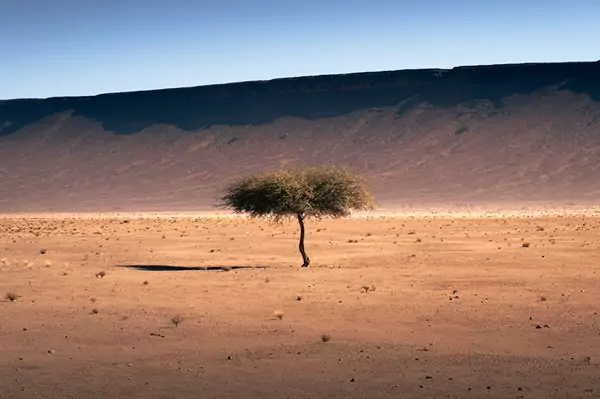
Morocco’s Most Impressive Natural Wonders (11 Outdoorsy Options to Get Off the Tourist Trail)
Scribbled by Claire ◊ 22 Nov 2024
Are you planning a trip beyond Morocco’s frenetic cities and famous towns? Here, we talk about the more off-beat and unusual outdoor destinations, including wild beaches, raging waterfalls, vast lakes, cliffside hikes, and much more, to help you get out into nature in Morocco!

Morocco is a pretty substantial country but, despite its size, visitors tend to congregate around only a few very popular (and often overcrowded) spots. Luckily, these places tend to be in the cities and towns, far from the immense natural landscapes that Morocco is blessed with.
After a 6000-kilometre, six-week-long escapade around this extraordinary country, we created a list of our most memorable, iconic, outdoor adventures from across Morocco. It includes some undoubtably well-known Moroccan highlights, alongside many off-the-tourist-trail spots.
No matter where you choose to visit, though, they are all very much worth your time and will undoubtably whisk you away from the crowds congregating around Marrakech’s medina!
For each entry, there are suggested methods of transport, recommended tours if you can’t drive, logistics, parking information and nearest cities, plus accommodation options if applicable.
We’ve also written another post specifically on 15 of Morocco’s most beautiful cities if you’re looking for extra inspiration for your next trip.
IN THIS GUIDE //
Outdoor Adventures in Morocco
ADVENTURES IN MOROCCO: GETTING AROUND
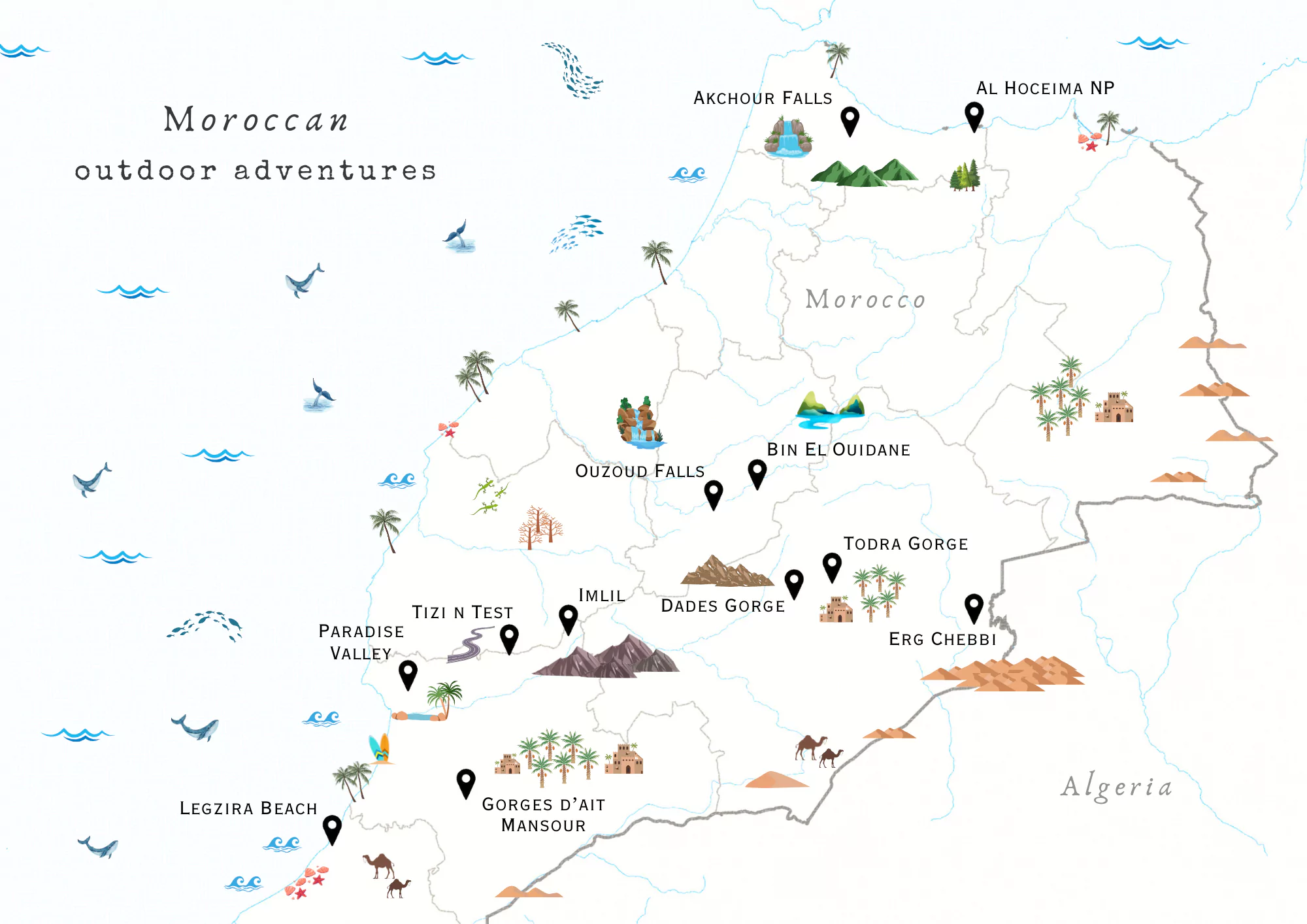
MOROCCAN OUTDOOR ADVENTURES MAP
1. discover hANDMADE bridges at Akchour Falls
2. experience the sahara AT ERG CHEBBI
3. Traverse the Tizi N’ Test Pass
4. Discover hidden FORMATIONS at legzira beach
5. HIKE around OUZOUD FALLS
6. Explore the Todra Gorge
7. SWIM IN Paradise Valley’S POOLS
8. WITNESS THE BARRAGE BIN EL OUIDANE
9. GET LOST IN GORGES D’AIT MANSOUR
10. Trek Around Imlil and Toubkal
11. HIKE THE CLIFFS OF AL HOCEIMA
ADVENTURES IN MOROCCO: GOOGLE MAP
TOURS IN MOROCCO
FINAL THOUGHTS – MOROCCAN OUTDOOR ADVENTURES
This post may contain affiliate links. If you book through these links we may make a small commission at zero cost to you. It helps us pay for the upkeep of this blog. Thank you!
How to Get Around Morocco
There are an extraordinary number of astonishing outdoor adventures in Morocco – the country is bigger than France, after all! So, reaching them all can be a challenge.
Many of the listed spots are accessible by public transport or tour, however we would recommend self-driving whenever you are able (the majority are far outside of the cities). Road tripping in Morocco is straightforward, safe and easy, providing a convenient way of seeing more of the country in less time. If you are curious, check out our detailed, honest guide to driving in Morocco which includes everything you need to know.
If you are looking for transport between cities, our favourite travel aggregator 12GoAsia is now operating in Morocco and lists thousands of reservable bus and train routes between major destinations. Check it out if you’re looking to book something in advance, are on a tight timescale or want to get some representative prices.

Moroccan Outdoor Adventures – a Map
1. Discover Hidden Bridges at Akchour Falls
Akchour Falls are a series of cascades hidden deep in the Rif Mountains, not far from the blue city of Chefchaouen. The scenery is astoundingly beautiful in this region, with winding roads hugging the cliff edges and boundless deep valleys slicing through the peaks. The entire area makes for a fantastic road trip.
The falls are located in an area that covers several entire gorges and are just one of a few reasons to visit. Our favourite discovery was actually an enormous natural feature named God’s Bridge, which has a clear, aquamarine river running beneath it. It was easily comparable to some of the amazing natural bridges we’ve seen in southern Utah. The spectacular (but easy) walking route follows the turquoise river and passes over handmade wooden bridges and waterfalls.
The valley is best experienced as a day trip from Chefchaouen, which is an easy drive away, or a simple bus journey. It’s also accessible from Tangier as a day trip if you’re short on time. Check out some organised tours to Akchour Falls if you’d like to book ahead or check prices.
Tip | if you want quiet, visit very early in the morning. We arrived a little after seven and were the only people in the car park. Nobody asked if we needed a guide, none of the tagine and coffee vendors had opened yet and the place was exceptionally serene. If you want to get lunch there and spend an extended amount of time, things started to wake up a little around 11 am.
Tip | if you are driving, there are other beautiful places in the region. Check out the route between Chefchaouen and Oued Laou, following the river. It has great vistas and lots of places for water-based activities. Views at spots like 35.279826, -5.233701 are spectacular. A little south of Chefchaouen is also the mountainous Talassemtane National Park, with incredible panoramas and near enough no people!
Best place to stay | Chefchaouen
Our hotel recommendation | Balcon Bleu, a cute blue hotel in Chefchaouen, is where we stayed and highly recommend. It’s central, with nearby car parking, the rooms are modern and the rooftop breakfast is top notch. It also had lovely owners and nice lighting in the rooms (a rarity in Morocco’s riad style properties). There is also good WiFi.
Cost | free entry, parking 10 MAD
Crowds | 4/10
Rental car necessary | no
◊


2. Experience the Sahara at Erg Chebbi
So, most people researching a trip to Morocco plan to see the sand dunes of the Sahara, and we could not have a Moroccan adventures list without including them!
Our experience was a bit unorthodox and unexpected. We nearly skipped the dunes in Morocco (we’ve been to ones in Oman, Saudi Arabia, Tunisia, and more previously), but last-minute thought we’d just pop in and have a peek at Morocco’s version. Driving into Merzouga, rising straight from the ground behind the low-lying, scattered town were some of the most vivid, striking dunes we’d ever seen. It was a super dramatic moment.
We were delighted that we made the effort to visit and also glad to have not paid for a tour!
Tip | I was prepared for Merzouga to be full of touts, hassle and scams; it’s a very touristy place, after all. Visitors have written horror stories about how crowded it is and that they were never left alone. However, our experience was completely the opposite.
We parked our car, checked into our (lovely) hotel and explored the dunes. There was one child who chatted with us but didn’t try and sell anything – that was the extent of our hassle. We had no problem driving on the roads – one man asked if we wanted a dune buggy, which we politely declined. That was all. Merzouga felt a world away from the tourist circuit (even though it wasn’t).
Tip | for a dunes experience, there are several sandy areas of Morocco you can choose to visit:
Agafay | the nearest and most convenient to Marrakech (the least exciting but best for people with tight time constraints). Have a look at some representative Agafay tours.
Merzouga for Erg Chebbi | the most popular option and the one you’ll see the most on Instagram. Have a peek at some Erg Chebbi tour options.
Zagora/M’Hamid for Erg Chigaga | requires some organised transport and more time, but is quieter and more remote (whereas Erg Chebbi you can just rock up and check out the dunes in your own hire car). Have a browse at Erg Chigaga tours.
Best place to stay | a desert camp is popular for Agafay and Erg Chebbi, and necessary for Erg Chigaga (best booked as part of a tour).
Our hotel recommendation | in Merzouga, if you want to avoid a tour – we loved our stay at Kasbah Mohayut, it’s literally touching the best part of the dunes and had enormous, clean, individually decorated rooms.
Tours | camel tours are popular, including an overnight stay in a desert camp. If you do this, be aware of the state of your camel and don’t ride if it looks sad, plus leave an accurate review (we’d recommend avoiding camel rides all together). If you want to book a desert camp ahead of time, or check prices, take a look at tours.
Cost | free entry to the dunes, parking included with hotels
Crowds | 2/10
Rental car necessary | no
◊

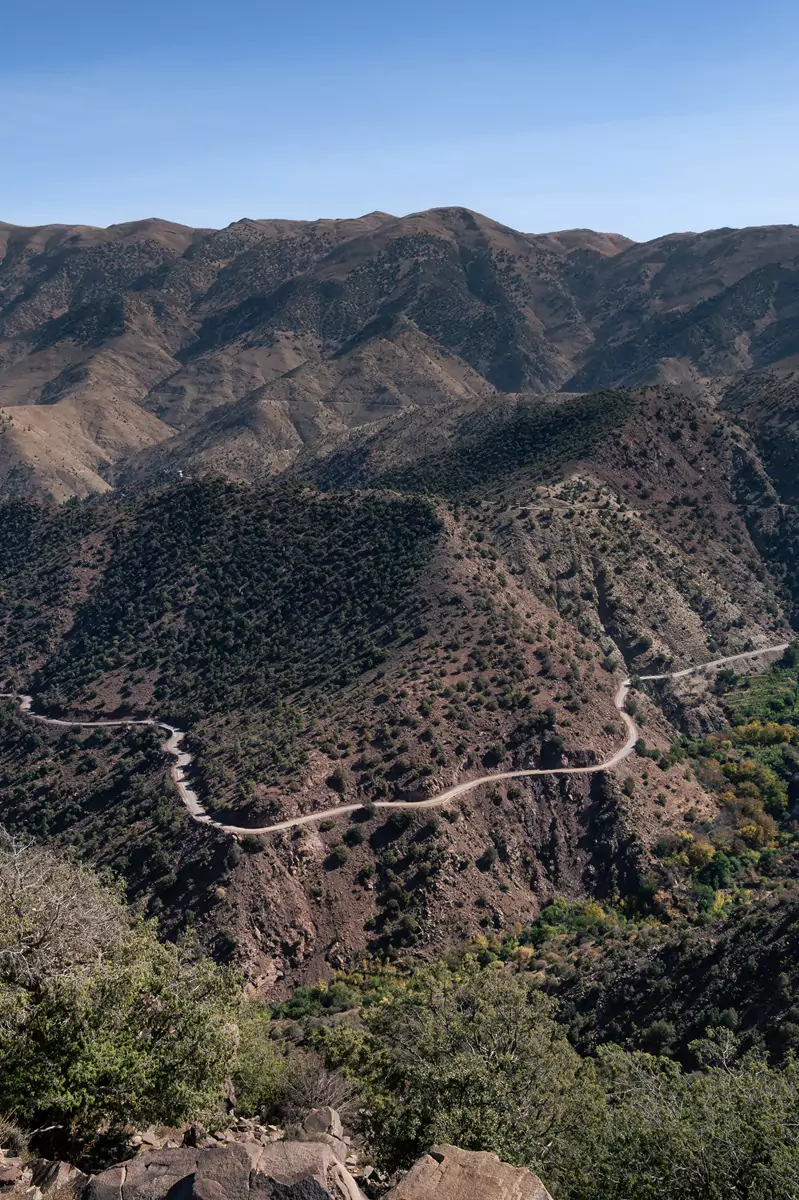
3. Traverse the Tizi N’ Test Pass
Morocco has an overabundance of outrageous, high-altitude roads, but none that we drove were more spectacular than the 2093-metre-high Tizi n’ Test pass. It was hours of isolated, stunning scenery, punctuated by waterfalls flowing onto the roads and precipitous edges, all of it traversed with almost no other cars in sight.
The pass is a route between the towns of Ouirgane and Taroudant (161 kilometres apart), a perfect road to take if both these stops are on your Morocco itinerary (they should be!). Here, we are specifically referring to the entire length between Ouirgane and the south side of the Tizi n’ Test pass, as the scenery is just magnificent from beginning to end.
Tip | the scenery around Ouirgane is extraordinary, but be aware that this area was heavily damaged by the September 2023 earthquake, the destruction of which is clearly visible in the area still. Be sensitive and do not photograph the villages, tents or people. It’s going to take years for this region to recover, especially the more remote parts; travel aware and be thoughtful.
Tip | small sections of the road on this route are unpaved, however it is completely suitable for a two-wheel drive, low clearance vehicle. We drove a minuscule Kia Picanto and it was totally doable with no stress whatsoever. Check out our driving guide for more information.
Best place to stay | Ouirgane, Taroudant
Our hotel recommendations | in Ouirgane, we liked the Ksar Shama. It’s so quiet, with smashing views and beautifully appointed, modern rooms, private parking and a great breakfast. It was definitely one of the nice places we stayed on our trip.
In Taroudant, we chose Dar Tourkia because it had parking, was centrally located, and was in a pretty walled complex set around a pool. This hotel does occasionally have tour groups stay, so if you’d like a more traditional option, we’d recommend the Riad Amnay. It has outrageously good reviews and is definitely a place we’d consider on our next visit.
Cost | free
Crowds | 1/10
Rental car necessary | yes
◊

4. Discover Hidden Formations at Legzira Beach
This far-flung, little-visited beach hides an astonishing sight – the Legzira Beach Arch. We popped down as we happened to be passing through, not really expecting much, but were blown away by the scenery and the arch itself.
The beach is wide, with only minimal tourist infrastructure, so it retains its wild, windswept ambiance. There were few tourists when we visited, but the jagged, inhospitable rocks are more commonly frequented by a few fishermen who, somehow, do not succumb to the enormous Atlantic waves. Beyond the arch, Legzira has miles of rocky, sandy sections to explore if you want to spend the day.
Tip | check the tides and try to visit when the tide is out. Apparently, you can’t walk under the arch otherwise (we visited at the lowest tide).
Best place to stay | Mirleft or Sidi Ifni
Our hotel recommendation | we stayed in the most beautifully appointed homestay/guesthouse type place in Sidi Ifni, called Janna d’Ifni. Each individually decorated room is so carefully presented, with unique art and so much charm. Every spot in this property had been thought through. A fantastic breakfast is served in a flower-filled garden courtyard.
Cost | parking fee of 20 MAD
Crowds | 2/10
Rental car necessary | yes
◊


5. Hike Around Ouzoud Falls
Ouzoud Falls is the largest in Morocco; a 110-metre-high, multi-tiered cascade that spills over the edge of a rugged green valley, one dotted with ancient rock dwellings and home to a group of macaque monkeys.
The area around the falls is fairly built up, with restaurants, vendors and car parks above. At the bottom there’s even flowery boats to transport people the few metres to the base of the falls. There’s a lovely little hike down into the gorge (this does involve walking up and down some steep, but easy, paths), plus you can explore further afield.
A visit to Ouzoud Falls is a pretty popular day trip from Marrakech, which is 150 kilometres south west and around a three-hour drive away. It is also possible to stay overnight adjacent to the falls, or in other towns near(ish) by, like Bin El Ouidane.
Tip | there is no need for a guide if you can get there by car, as the paths are clearly defined and you can’t get lost. The friendly residents of the area will try and (gently) persuade you that a guide is necessary though!
Tip | walk down the southern, more built-up side first. It’s full of restaurants, vendors and monkeys looking for a meal (never feed the wildlife). Then, take a slow wander back up the northern side where there are fewer people and it’s far quieter. This is opposite to the tour group direction (they’re smart and take people back up the steep way past the beverage stalls so people buy stuff!).
Best place to stay: Ouzoud Falls, Marrakech or Bin El Ouidane.
Our hotel recommendations: in Marrakech, we liked Riad El Habib, right in the central medina, a really smart little riad that we’d thoroughly recommend, adjacent to Jamaa el Fnaa. Opera Plaza, near Marrakech train station is a great modern option if you want secure parking, western conveniences, an excellent buffet breakfast and big pool. In Bin El Ouidane, we chose a lovely little hotel called Dar l’eau Vive right near the dam for the lake, with vast river views and one of the better breakfasts we had in Morocco.
Tour | not needed, but many people do this as an organised trip from Marrakech. If you’re interested, check out Ouzoud Falls tours, or have a look for representative prices.
Cost | free entry, parking 10 MAD
Crowds: 6/10
Rental car necessary | No
◊


LOOKING FOR MORE EXTREME ADVENTURES IN MOROCCO?
This list is not exhaustive, at all! There are so many incredible things to do for adventurers or thrill seekers in Morocco. Below are a few of the more adrenaline-based options you could consider:
Horse riding | this is a popular activity along Essaouira’s beaches, as well in the deserts (don’t ride a horse that isn’t well looked after, though).
Rock climbing | there are some fantastic options for rock climbing, particularly in the Todra Gorge and Tafraoute.
Cycling, bikepacking and motorbiking | the Atlas mountains are perfection for energetic cyclists and also motorbikers.
Skiing | home to Africa’s highest ski resort, Morocco’s Atlas Mountains have some epic snow-based activities during winter.
Quad-biking | there are quad-biking options everywhere!
Hot air ballooning | sunrise over Marrakech and the Atlas Mountains is a particularly popular spot for hot air balloon excursions.
Hitchhiking | this a bit of a weird one, but it’s really common and safe, so give it a go if you’re on a backpacking adventure!
Surfing | the entire Atlantic coast is world-class for surfers, from beginner to expert level. Check out surf schools in Taghazout for the best waves and vibes.
Sand boarding | this is a common activity in all of the desert areas and is often included as part of a desert tour.
Cliff diving | Paradise Valley is a top spot for cliff diving (it’s really scary high).
Paragliding | there’s loads of paragliding in Morocco (and something I really want to try!). There are coastal and Atlas Mountain options.
–
A DETAILED MOROCCO BUDGET | 29 THINGS TO KNOW BEFORE VISITING MOROCCO

6. Have a Gander at the Todra Gorge
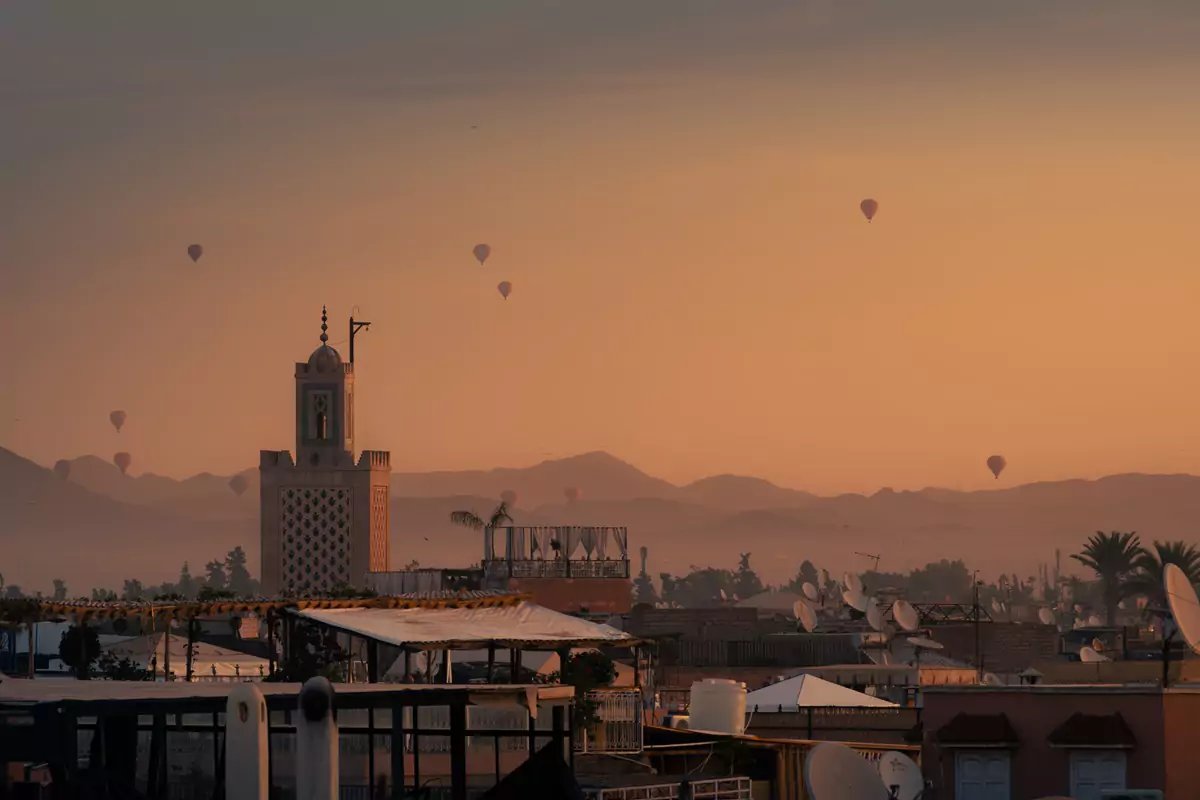
The Todra Gorge is a magnificent limestone canyon, reminiscent of Utah’s red rock country. This narrow valley towers up to 400 metres over the Todra River, which has carved a route through the mountains over millions of years.
Adjacent to the gorge are the burnt orange hues of scenic Tinghir, a friendly city lined with ancient mudbrick villages, all surrounding huge date palm plantations. It’s a seriously panoramic area of Morocco.
Tip | drive past the narrowest, most scenic part of the gorge and keep on going along the N12 past the dam. The scenery, at least in my eyes, just keeps getting more remote and even more dramatic!
Tip | the most popular and scenic part of the actual gorge is nearest Tinghir, where its width narrows to around 10 metres. This makes the Todra Gorge a quick and easy stop if you’re on a tight timescale, but ease of access also makes it a busy spot with tourist buses. Visit as early as possible (or late in the afternoon) to avoid most of the crowds.
Tip | there are all sorts of hikes and even climbing options around the Todra Gorge. The most well-known is the Todra Gorge loop hike, which begins around 31.589187, -5.596591 by the parking lot.
Tip | the Dades Gorge, just a little further down the N10, is worthy of an entire section on this post to itself, but it’s similar so I’ll just include it here. We actually preferred the Dades Gorge, so definitely check out both if you can! The Dades Gorge is less busy and has absolutely stunning village scenery from the road. It’s possible to link both the gorges in a sort of loop, if you prefer.
Best place to stay | Tinghir
Our hotel recommendation | we stayed in Auberge Camping Atlas, a little hotel/guesthouse between Tinghir and the Todra Gorge. It is situated in an envious position along the river, nestled in the date palms and the looming, rust-coloured cliffs.
The rooms were reasonably basic, but great value, with an an immaculate pool. The lodging also provides camping spots for RVs and tents. We’d definitely stay here again.
Cost | free
Tours | the Todra Gorge is included on lots of multi-day tours around southern Morocco, usually ones running from Marrakech to Merzouga and beyond. Have a look at tours for representative prices, routes and reviews.
Crowds | 7/10
Rental car necessary | no, but much better with one
◊

7. Swim in the Pools of Paradise Valley
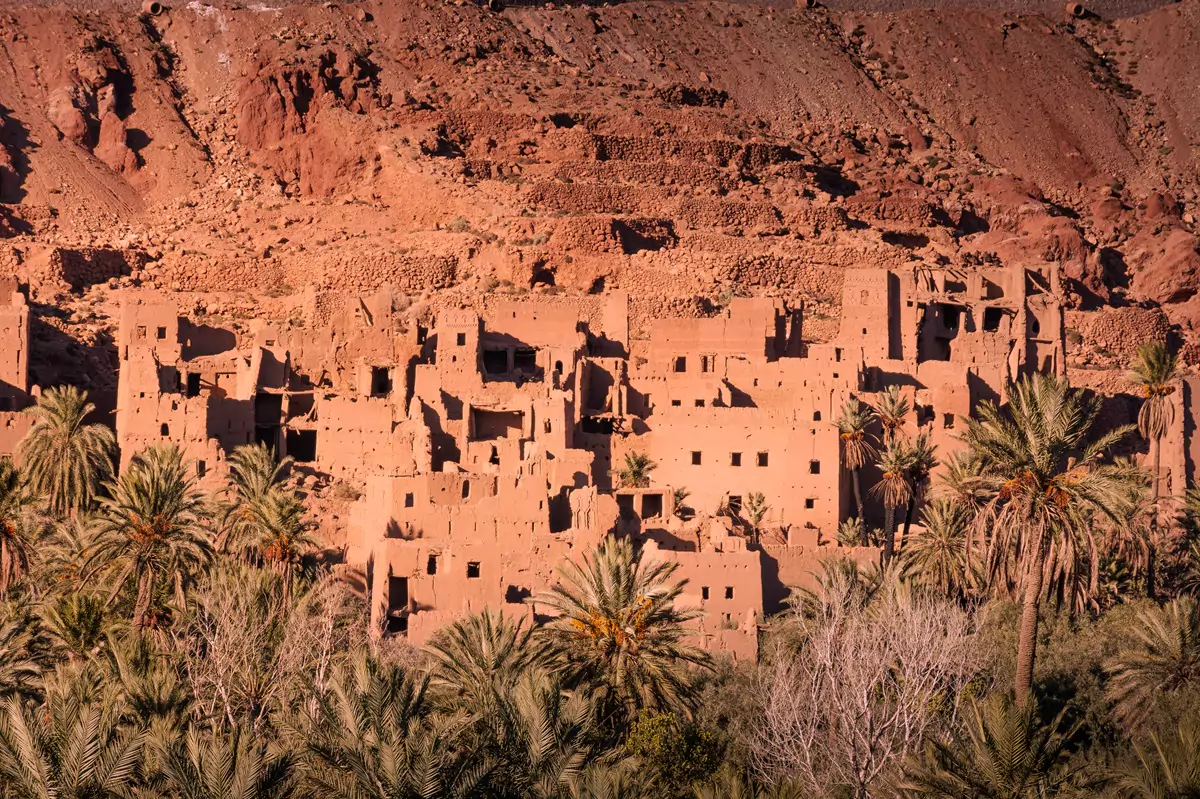
Set on the edge of the High Atlas Mountains, Paradise Valley is a tiny oasis hidden in a vast, rocky chasm. It’s a (mildly) rugged hike through date palms and river channels, leading to a beautiful set of natural pools that many brave residents go cliff jumping into (my anxiety is high just writing this).
The drive through the mountains from Agadir or Taghazout is also incredibly scenic, passing swathes of canyon-enclosed palms.
Tip | after you reach the pools (you’ll know when), head up to the right side and keep on hiking. The scenery is mind blowing and there are almost no people (they all stop by the initial pools).
Tip | this area is a bit touristy, probably due to its proximity to Agadir. We didn’t love the first part of the route, which is full of restaurants, tour groups and trash. The pools themselves are fun if you want to swim, but it’s not exactly serene like a wadi in Oman, for example. It’s kind of cool watching the local cliff divers for a while, though.
Tip | the hike in is a bit rugged and steep. It’s no major worry for people of even below average fitness, but definitely difficult for anyone with physical limitations of any sort. The paths are uneven, steep and sometimes you have to hop between stepping stones.
Best place to stay | Agadir or Taghazout
Our hotel recommendation | we stayed in Tamraght, near Taghazout, when we visited Paradise Valley. Our accommodation choice was the Surf One Hotel, which was so modern, clean and friendly, with perfect parking.
It was one of my favourite stays in Morocco and we highly recommend for a stay near the beach (much nicer than Agadir).
Cost | free entry, parking costs 10 MAD.
Tours | loads of tours to Paradise Valley go from Agadir
Crowds | 7/10
Rental car necessary | no
◊


8. Witness the Barage Bin El Ouidane
Bin El Ouidane is a tiny town in central Morocco, neighbouring a strikingly blue, artificial lake created from a large dam.
Entering the meandering valley by car in the early evening, I felt like we had arrived into an oil-painted landscape. The multi-toned chocolate-brown rolling hills, dotted with trees, surround the calm blue water were kind of mesmerising. It was all rather astonishing.
Tip | during the warmer months, there are ample outdoor opportunities, like kayaking and fishing. It’s also a great spot for photographers and, if you’re a dam enthusiast (is that a thing?), you can drive right over the arched dam.
Tip | we’d highly recommend this area if you are visiting Ouzoud Falls and heading north. We chose Bin El Ouidane purely as a convenient point between Marrakech, Ouzoud Falls and Meknes. However, it ended up being one of the most scenic spots we visited during our trip in Morocco.
Tip | the area is fairly remote – there are no obvious, popular tourist landmarks surrounding the area and that makes it perfect for anyone looking for a bit of tranquillity and peace. If you are after some lively nightlife, go elsewhere!
Best place to stay | Bin El Ouidane
Hotel recommendation | we chose Dar L’eau Vive in Bin El Ouidane. This hotel is perched on the cliffside in a valley just upstream of the dam. The views of the Abid River are incredible, it’s so peaceful and the breakfast views were majestic from the (highly rated) restaurant. The rooms were simple but comfortable and the whole building is full of beautiful little common areas. It’s a unique stay.
Cost | free
Crowds | 1/10
Car necessary | yes
◊


9. Get Lost in Gorges D’Ait Mansour
Somewhere in the dusty, rocky wilderness of southern Morocco is a magnificent, cavernous gorge. A hidden desert oasis, entirely overflowing with date palms, just like you’d see in a film. Through it, a skinny, snaking road winds its way down, with the palm grove so dense that you sometimes cannot even see the sky.
It’s such a beautiful region, but the drive in and out is equally as magnificent. The landscape will likely rival any other canyon backdrop you’ve seen in your life, with the added element of exploration because you just don’t see this place much on social media. It genuinely felt like a secret sanctuary, with small creeks and households concealed in the foliage.
Tip | visitors rave about the local Berber omelette at Abdou’s, but we didn’t try it (omelette gives me a weird headache for some inexplicable reason). Give it a go!
Tip | the few tourists we saw there were on bicycles, which we reckon is the best way to explore the area. There are also lots of easy walks and hikes to suit any fitness level.
Tip | the nearest proper town to Gorges d’Ait Mansour is Tafraoute, one of the top places on our six-week Moroccan tour. It’s a picturesque place, surrounded by boulders and mountains, perfect for any kind of outdoor activity – hiking, cycling, climbing – it’s all possible. Don’t miss a sunset here, either – the distinctive surrounding terrain literally glows.
Best place to stay | Tafraoute
Our hotel recommendations | in Tafraoute, we stayed in the Hotel Salama, which is the most tourist-oriented choice right in the middle of the town, adjacent to the central square and souq. It has basic, clean rooms, with pretty epic views from all sides on the upper floors (check out the roof).
If we were to return, we’d definitely consider staying in Auberge Kasbah Chez Amaliya, which has outstanding reviews and a beautiful pool. It was sold out when we planned our trip!
Cost | free
Crowds | 1/10
Car necessary | yes
◊

10. Trek Around Imlil and Toubkal
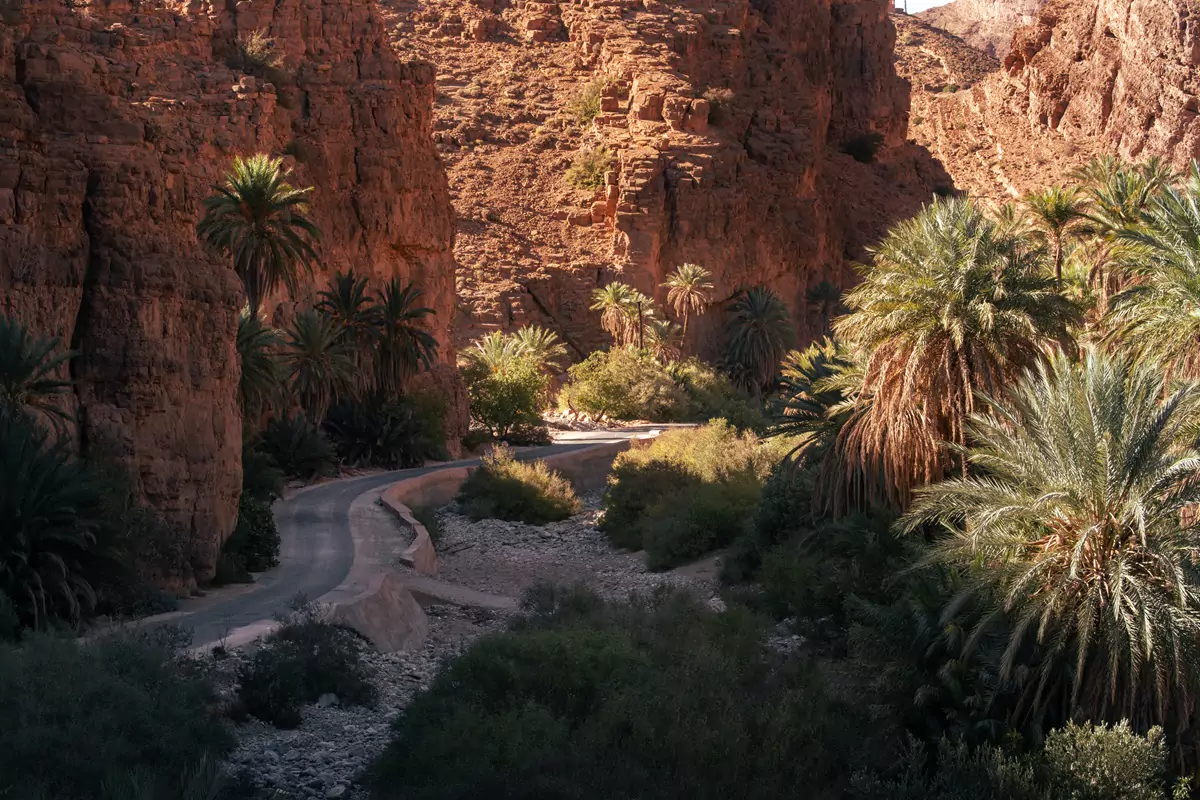
The tiny village of Imlil, spread over precipitous hillsides in a narrow valley, is the nearest settlement to Morocco’s high mountain, Toubkal. The peak of Jebel Toubkal, sitting at 4,167 metres above sea-level, is a guide-only (usually) two-day trek that requires moderate fitness but no specialised climbing experience.
However, not everyone wants to (or can) scale 4,000-metre mountains. Luckily, Imlil is also an excellent base for lower elevation hiking (the village is around 1,800 metres above sea level), with loads of routes and panoramic views for miles.
Tip | due to the town’s elevation, it can get very cold. Our accommodation had heating, but struggled to keep up with the cold in November. However, on the flip side, it would be beautiful during summer when Imlil offers milder temperatures than the low-lying surroundings, like the flaming-hot Marrakech.
Tip | add at least one-hour extra time to your journey – the only road in is paved, but often being repaired and covered with road works (it was also damaged in the major September 2023 earthquake). Also, the roads around Imlil off the main street can be a little nerve-wracking and narrow to drive. Check the parking situation in detail before choosing a hotel (have a look at the area on Google Satellite). We chose our hotel because the parking was doable, but still via steep, narrow roads.
Best place to stay | Imlil
Our hotel recommendations | there are lots of hiking lodge type accommodations in Imlil – we chose Atlas Prestige. It had exceptional panoramic views from all the terraces, mostly warm water and moderately adequate heating (not very warm, but enough not to freeze). It was located just around the corner from a view of Toubkal and a short walk from the nearby falls.
Many of the hiking lodges seem pretty similar around Imlil, so I’d choose the one with the warmest water and best heating, unless you’re visiting in the height of summer!
Cost | free
Crowds | 3/10
Car necessary | yes
◊

11. Hike the Cliffs of Al Hoceima
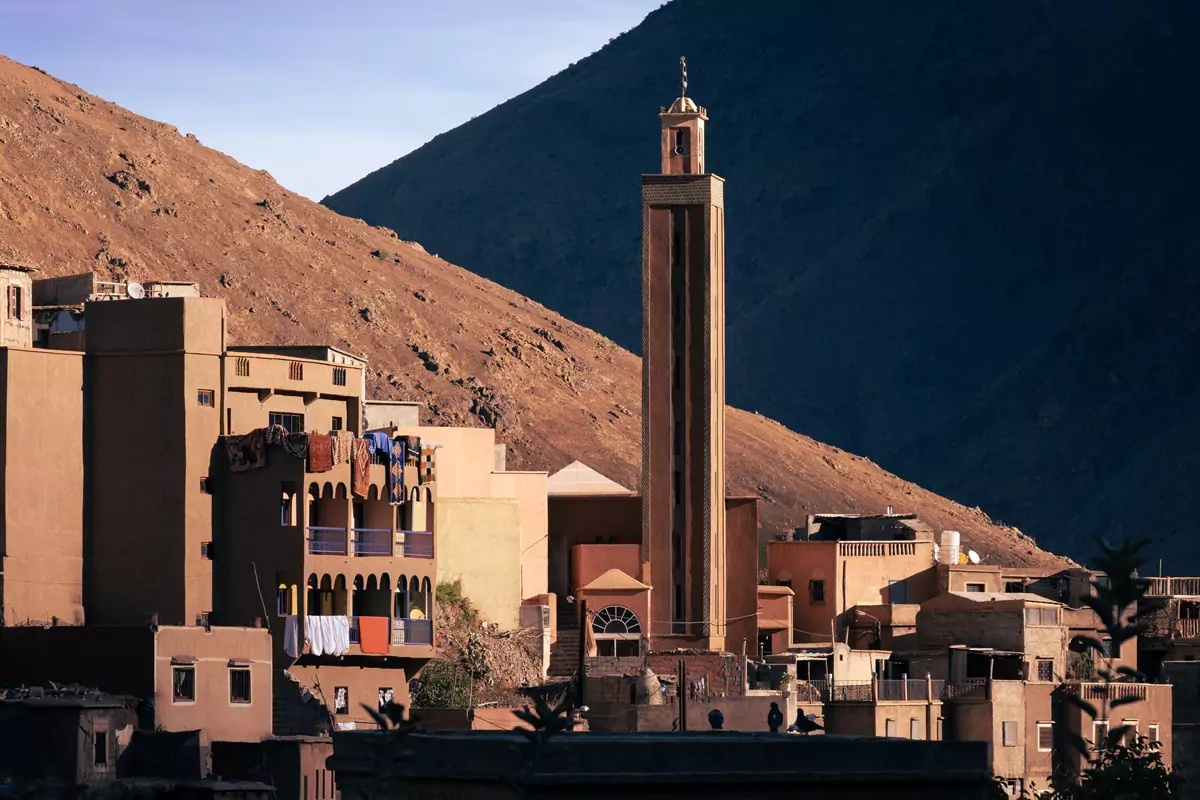
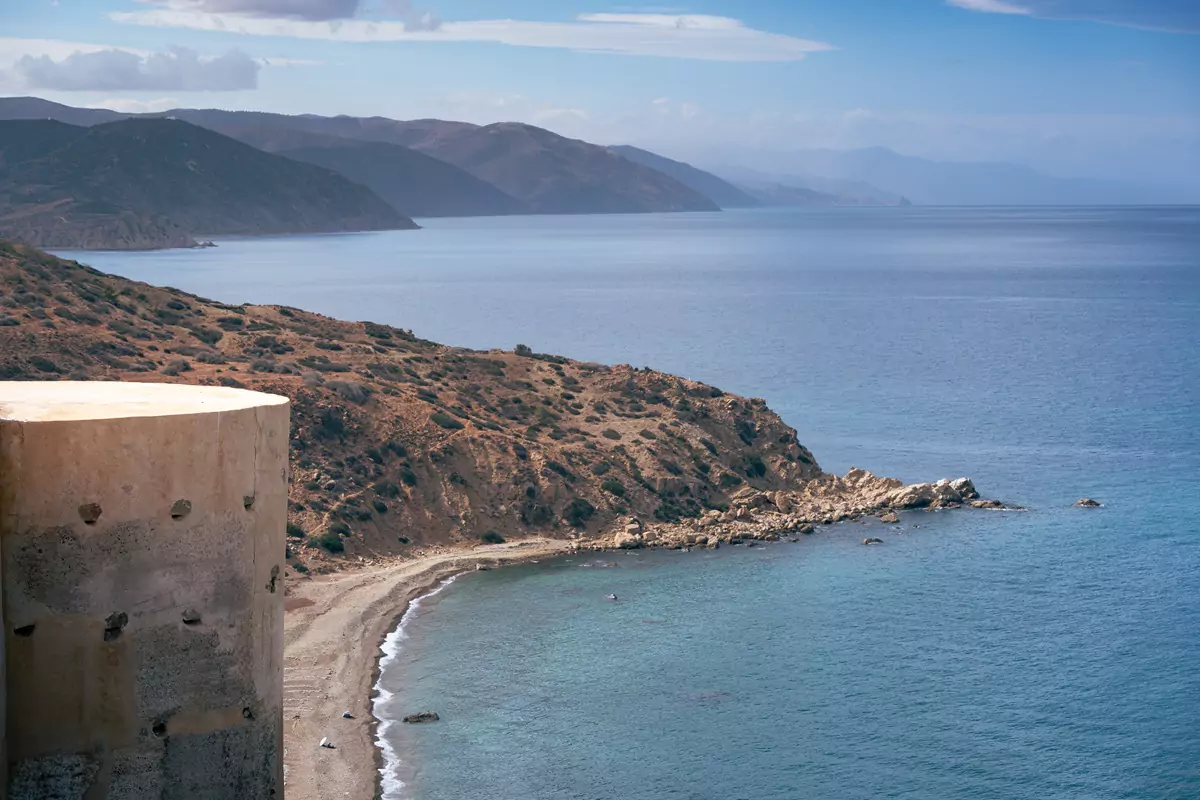
This nominally visited national park on Morocco’s Mediterranean coast didn’t really feel like Morocco, at all. The stark ocean cliffs are reminiscent of parts of Spain, or even Scotland (depending on the weather!).
The clifftop hiking possibilities around Al Hoceima are outstanding and the secluded drives are exhilarating (depending on how good your car is!). It’s a decent place if you’re into beaches too – there are small strips of sand all along the Med here – in the summer, there are water sports options like diving, kayaking, boating and more.
Tip | this stop is a bit out of the way – consider a journey along the coast to Chefchaouen and beyond – the Rif Mountain scenery is spectacular. Check out our full coastal itinerary or our northern Morocco itinerary for more information.
Tip | pop to Spain – there are Spanish exclaves along the coast here!
Tip | check out Qalaa Torres, a hilltop fortification with zero visitors and epic views.
Best place to stay | Al Hoceima
Our hotel recommendation | Al Hoceima is mostly beach resorts type properties or condos. For a great value, modern resort-style hotel with impeccable views, consider Mira Palace (it has a banging breakfast, very modern rooms and cost *very* little out of season). Alternatively, consider one of the many apartments available along the coast – there are hundreds, which is great if you are travelling as a family or like to cook.
Cost | free
Crowds | 1/10 (outside of summer)
Car necessary | yes
◊

Google Map of Morocco’s Outdoors
Below is a savable Google Map of all the outdoor adventures we write about below, plus any extra locations mentioned – select the star next to the title to save it. Below are the colour coded layers:
Yellow | outdoor adventures
Green | accommodation recommendations
Red | nearby towns and cities
CAR HIRE FOR YOUR MOROCCO TRIP
We always rent our vehicles all over the world, including our recent trips in Oman, Saudi Arabia, Tunisia, Jordan and Morocco, with Discover Cars. They’re often the most affordable, plus they paid out immediately on an insurance claim we made when our car took some heavy damage in Sicily. We fully recommend them.
–
TAKE A LOOK BELOW OR CHECK CAR RENTAL
Organised Tours in Morocco
If you are adventuring around Morocco without a car, or are on a time-sensitive schedule, consider booking through Get Your Guide. It’s great if you like to check tour reviews or just like to have things organised in advance. There are a wide range of Moroccan-led tours, plus reviews of each activity to help you decide.
Consider looking at food tours, multi-day desert tours, city walking tours, combo tours and more, which can help you fit more in to your trip, if that’s your style.
Where to Next
Morocco is far, far more than the Instagram spots of Marrakech, Fes and the Sahara. And it’s far, *far* more than just souvenir shopping in ancient medinas and staying in pretty riads. The customary visual impression of Morocco is not 4000-metre mountains, empty winding roads, palm groves, giant Utah-style gorges and isolated waterfalls, but it should be.
This country is a nature lover’s utopia. It was more than I could have possibly hoped for before we embarked on our road trip; adventuring across Morocco went way beyond my expectations.
If you are looking for more inspiration for your Morocco trip, consider checking our Morocco budget, a full coastal itinerary, a northern Morocco itinerary, our top historical picks, a guide to choosing a riad, Morocco’s prettiest village, or even our list of 29 things you should know before you go.
Have an exhilarating trip!
Hi, thanks for visiting our blog! If our free content has been of help to you, or you’ve just enjoyed our random ramblings and musings, say thank you by buying us a coffee! It helps keep The Restless Beans blog up and running.
Thank you, Claire + Nick