

· SOUTHEAST ASIA · THAILAND ·
Renting a Scooter in Thailand: How to Avoid Disaster (Insurance, Licences, Checkpoints and Scams)
Scribbled by Claire ⬩ 24 Aug 2026
Are you thinking of riding a scooter in Thailand, but aren’t sure how to do it safely while ensuring you’ll be insured in the event of an accident? We’ve got all the information, so that no matter your license status, you’ll actually have insurance cover, know how the Thai roads work, how to rent a vehicle (without getting a dodgy one), and what the rules are.

It’s the archetypal image of Thailand, isn’t it: the carefree young guy or girl, whizzing along a tropical, palm-lined street on a scooter, wearing flipflops and short-shorts, wind in their un-helmeted blond hair, with not a care in the world. They’re probably holding a GoPro, too, or possibly video-calling their mum (or followers).
Is this really the reality, though?
Well, sometimes it actually is.
It’s certainly the reality sold by the bloggers and social media influencers who glorify this image. They fail to mention, of course, Thailand’s horrendous road safety record, people going to Thai jail for causing careless road accidents, or the tourists starting GoFundMe accounts that beg for life-saving help to pay serious hospital bills because their insurance wasn’t valid.
I mean, they don’t call the gravel road rash scar a ‘Thailand-tattoo’, for nothing.
I’m not going to sit here and tell you what to do – I’m only here to correct the absolute mess of shitty, inaccurate information published online that often skates over the facts.
We live in Bangkok and ride motorbikes all over Thailand, including our daily commute around the capital city.
I know the deal better than a rando tourist who has only hung out in Chiang Mai, Pai, and Koh Tao for a few weeks. Someone who thinks they’re qualified to tell visitors how to do something that *literally kills* twenty thousand people in Thailand every year (some advice is just straight-up reckless).
So, some of the things I’ll clarify are: how to ride legally in Thailand, how to be insured even without a license (not that we recommend this, but it’s best to be covered either way); essential tips on road safety to minimise your risk of an accident; how to rent a decent bike, and police checkpoints. Plus a load of sarcastic, scathing, and tongue-in-cheek commentary, as is my style (I was feeling exceptionally pissy while writing this!).

IN THIS GUIDE //
Scooting around Thailand (without dying)
The Definition of a Scooter in Thailand
Is It Safe to Ride a Scooter in Thailand?
– How to be Safer
– My Experiences
Do You Need a License to Ride a Scooter?
– Can I Ride with a CBT?
– What Licenses Do You Need?
– How to get an IDP
– What If You Ride Without a license?
How to Rent the Best Scooter
What to Look for In Your Insurance Policy
– How to Get Valid Insurance with No License
Essential Riding Tips
Road Rules
Other Transport Options
Where to Next?
This post may contain affiliate links. If you book through these links we may make a small commission at zero cost to you. It helps us pay for the upkeep of this blog. Thank you!
The Definition of a Scooter in Thailand
Thailand does not differentiate between a scooter and a motorbike. If it’s motorised and two-wheeled, it’s classed as a motorbike.
It also does not differentiate between engine sizes. So, even if your home country license allows you to ride a 125cc, you’re not allowed to ride in Thailand without a full, class A motorbike license. We’ll explain this in more detail below.


Is it Safe to Ride a Scooter in Thailand?
Statistically, no, it is not safe to ride a scooter in Thailand.
The stats are pretty grim. Thailand has one of the highest road fatality figures in the world, and the worst in southeast Asia.
I’ve written about the accident statistics in relation to driving cars in Thailand, previously. It’s pretty grim when you look at the figures, but it’s extra bad when considering motorbikes.
So, the major statistic commonly quoted is that Thailand has 25.4 road deaths per 100,000 people. This is compared with:
⬩ the UK, which has 2.4 road deaths per 100,000 people
⬩ the USA, which has 14.2 road deaths per 100,000 people
⬩ Italy, which has 5 road deaths per 100,000 people
What makes these numbers worse is that more than 80 percent of deaths are motorbike riders. There’s no avoiding that this is a bleak statistic, and I can’t really sugar-coat it or twist the figures to look better.
There are many cultural reasons why these numbers are this bad, including a high ratio of people driving cars versus motorbikes, drink driving, a speeding culture, lack of helmets, plus a certain ‘what will be, will be’ attitude, amongst other things. Unfortunately, none of this really makes a tourist on a scooter feel any safer.
How to Be Safer on a Scooter
Firstly, it’s worth noting that not all areas are equal to ride in: an island with almost no cars is inherently safer than Bangkok, for example.
It’s also worth noting that riding a scooter with a proper helmet, protective clothing, and competency will enormously reduce your risk.
Also, in touristy areas, one of the biggest hazards is other tourists. So, you know the carefree young person whizzing along without a helmet I described at the beginning? Them. Avoid them like you would dengue-infected mosquitoes.
We’ve written more about how to ride smart further down.
My Experiences
At this point, you may be asking yourself: what made me this cynical about people having a good time on holiday?
Well, since I’ve seen so much carnage on the roads, it’s difficult to know where to begin. Although local people sometimes drive (what appears to be) erratically, I’ve rarely seen them involved in accidents that weren’t caused by a tourist.
Tourists, on the other hand: I’ve seen them ride a scooter through a glass shop window and sever an artery; I’ve watched them take a corner absolutely awfully, getting life-changing gravel rash. Most recently I saw someone run into the back of a motorbike delivery driver, which pushed the poor guy into an oncoming car and destroyed the driver’s bike (and livelihood).
Most recently, I saw a dead guy on the road in Bangkok (although I can’t be one hundred percent he was a tourist, but he was riding a scooter). I’ve never seen anyone dead before – it’s not an experience I’d like to repeat.
Personally, I’ve also had some close run-ins with people that shouldn’t be on a scooter. I’ve got no sympathy that they nearly killed me because they were ‘still just learning‘.
It’s tiring, because none of those tourists will have had any training or be capable of riding a scooter safely. I know you might think, ‘well, maybe they were experienced and it was just an unfortunate accident’, but no. None of the weird things I’ve seen tourists do would have happened if they had any formal training.
And, for what it’s worth, the place that gives me the most anxiety riding in Thailand is Ao Nang and Samui (tourist hubs). They’re horrendous and I’d recommend avoiding riding there altogether. The tourists are drunk, dickheads, or drunk dickheads.
Formal training exists for a reason – get some if you don’t have any!

Do You Need a License to Ride a Scooter in Thailand?
Yes, you need a license to legally drive in Thailand!
It’s a fully functioning country, where people take tests and have licenses to drive (and even if some residents don’t do this, that doesn’t mean we get to flaunt their rules as visitors).
A lot of people say that ‘technically’ you need a license to ride in Thailand. However, there’s no ‘technically’, about it.
I mean, if you don’t have a license and you hit and kill a kid, you’re going to jail. If you get stopped by the police, you’re going to get fined and your bike might get seized.
It’s the most ridiculous question. The question should be ‘what license do you need to drive in Thailand?’.
Can I Ride a Scooter in Thailand with a CBT?
If you ride with only a CBT in Thailand, you will not be riding legally. The CBT is a UK-specific document and is not recognised by other countries.
You must have the correct license to legally ride a motorbike in Thailand.
What Licenses Do You Need?
To legally ride a scooter in Thailand, you need your home driver’s license with the endorsement to ride any motorbike size (so not an A1, A2 or CBT license. In the UK, it needs to be a full A class license).
You also need to have the corresponding 1949 or 1968 International Driving Permit (IDP) with the ‘A’ stamp endorsement (both are accepted).
Bike companies will (mostly) not check that you have the correct license, but that doesn’t mean it’s legal to rent a scooter without one. In Thailand, the responsibility is on the rider, not the rental company.

How to Get an IDP?
This varies from country to country, but in the United Kingdom, only specific outlets can issue them (it used to be the Post Office, but they no longer do it). Check the PayPoint site for your nearest location. All IDPs in the UK cost £5.50.
Outside of the UK, check with your government license-issuing people to find out where to get one.
What if You Ride Without a License?
If you ride in Thailand without a license, you may be okay and have nothing adverse happen (hopefully).
However, you’ll likely come across some police checkpoints in popular spots like Chiang Mai, Ao Nang, and Phuket where police will fine you for having no license or helmet. These checkpoints usually result in on-the-spot fines of 1000-4000 baht depending on the infraction (so, £25-100). Rarely, your bike may be impounded, too.
We’ve never come across a policeman that has asked us for bribes in Thailand and, although it can happen, it’s not particularly common (despite what the 50 year old white dudes on Reddit threads like to shout in caps). Most people who use the word ‘bribe’ usually omit the fact that they were breaking the law in some way (a fine is not the same as a bribe, is it?).
The other consequence of riding without a license is the lack of insurance. Most policies will not cover you if you were to have an accident while driving illegally and need healthcare, or worse, repatriation. The costs can run into the six-figures if it’s serious and you’ll have to mortgage your house or bankrupt your parents. So, be cautious.
We’ve written a bit more about insurance policy options further down.

How to Rent the Best Scooter
It’s pretty straightforward to rent a scooter in Thailand. In any location with a lot of tourists, there will be rental shops everywhere. Below are few things to note:
Engine Size
Most scooter engines in Thailand are 125cc, like a Honda Click or Scoopy. We rarely see any bikes below this size – very occasionally a 110cc.
There are often larger scooters, like 150 or 160cc, etc, but they are more rare outside of popular regions.
How to Choose a Rental Shop
If there is the option, we’d recommend reading reviews on Google before heading out, so you can get a vibe for any sketchy companies. If lots of people talk about a company keeping a passport as collateral or charging for damage that they didn’t cause, then maybe give that particular place a wide berth.
Usually, by checking out the reviews, looking at the bike quality first-hand, and having a chat with the owners, you’ll get a vibe.


Documents Needed
Scooter rental companies do not consistently ask for the same documents, but we’d recommend having your passport on you, plus your IDP and license.
Some rental places will take a photo of your passport, others may take a photocopy for their records, and then there are the ones who will ask for absolutely nothing! In particular, if you rent directly with your hotel, you’ll usually not need to provide anything at all.
On Koh Yao Noi, for example, we were asked for our passport and IDP. The owner checked for the correct endorsement for riding a motorbike before taking a photocopy, which was attached to their copy of a signed contract. Conversely, on Koh Lanta, we were asked for nothing at all!
Check the Bike Condition
We’ve had our fair share of shitty bikes from all over the world (Vietnam is consistently the worst). Thailand’s bikes really aren’t bad in our experience and most of the time they’re in pretty good condition.
However, it’s worth eye-balling the bike and making sure it’s all in working order. So check:
⬩ It has intact mirrors
⬩ The tires aren’t threadbare
⬩ The speedometer works
⬩ The petrol gauge works
⬩ The lights work (if you’re alone, shine them against a wall to check)
⬩ Give the brakes a quick squeeze and make sure they feel decent (lots of Thailand is hilly and we’ve had some awful ones)
How Much Does Scooter Rental Cost?
This varies largely on season and location, but you can expect to pay 150-300 baht a day. Higher rates are usually from December to March and in the island regions, especially popular places like Phuket. You can also spend a little more for larger, nicer bikes.
For example, on some very recent trips:
⬩ In Koh Chang, we spent 250 baht for a larger engine bike which is better for the hills (from Pharsitchai Kohchang Motorbike for rent).
⬩ In Koh Lanta, we usually pay 150-200 baht per day (always through our hotels).
⬩ In Phuket Old Town, we pay 200 baht (through Chai Motorbike Rental&Sea Expert Travel Service).
⬩ In Hua Hin, we pay 200 baht (with Hua Hin Motorcycles).
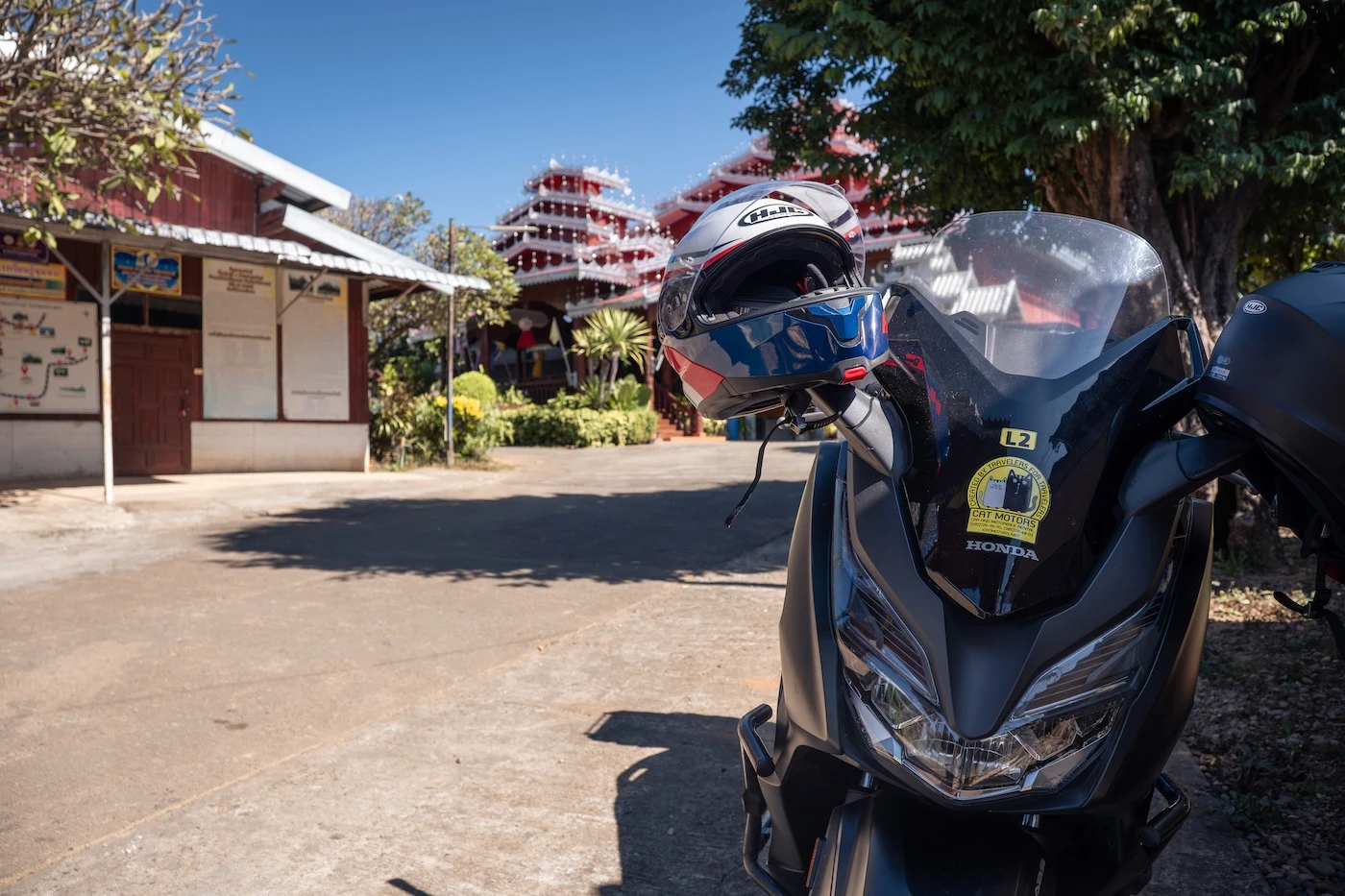
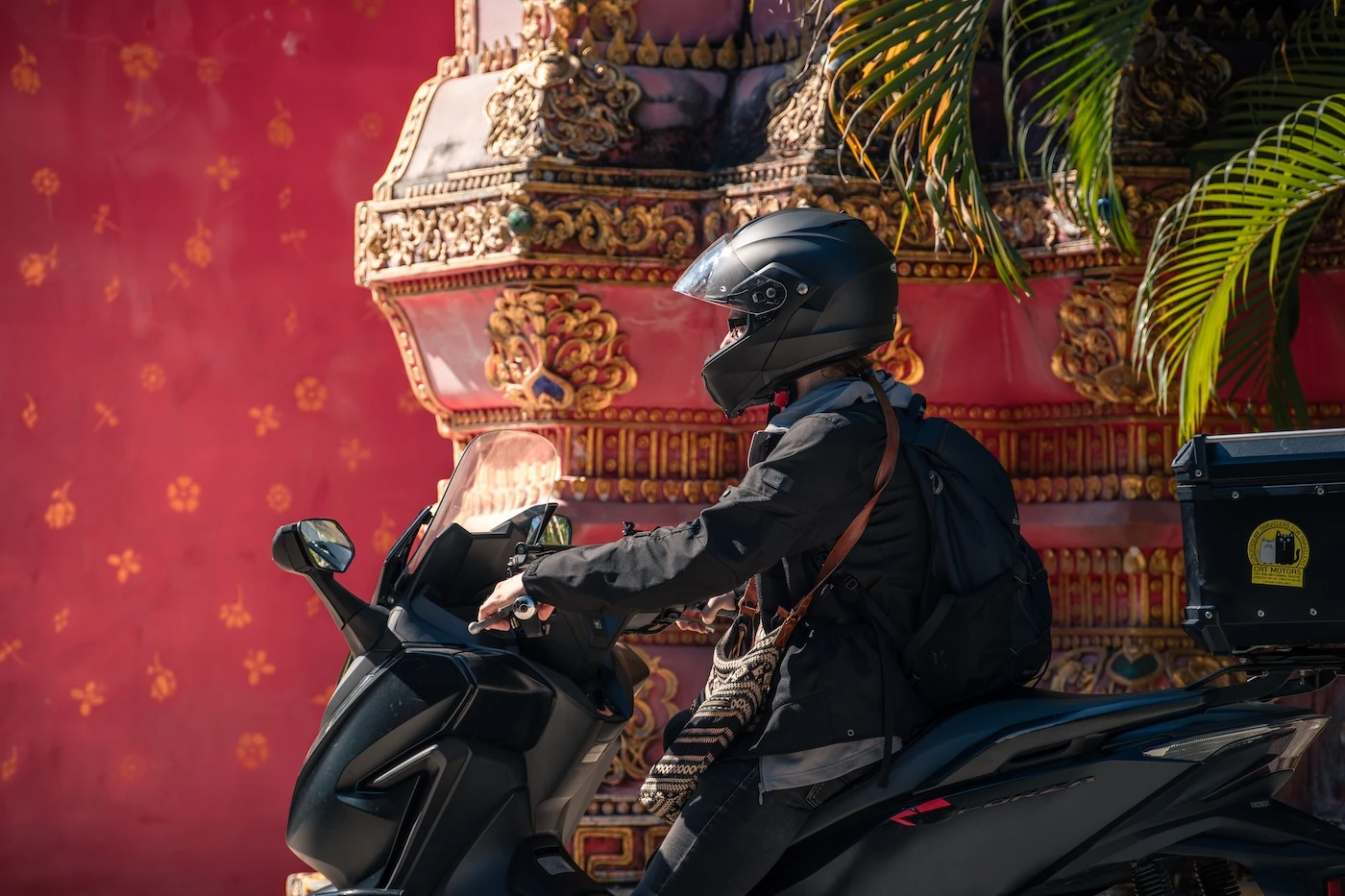
⬩ In Chiang Mai, we paid from 250 baht per day for a small bike and a fair bit more for a larger 300cc one (with the excellent Cat Motors).
⬩ In Ao Nang, we spent 300 baht for a larger, sportier bike (they’d run out of 125cc ones so we had a 155cc) (with Bina Bike Forrent).
⬩ In Koh Yao Noi we spent 250 baht a day (from Bann Anattaya).
⬩ In Koy Yao Yai, we paid 250 baht a day (from Koh Yao Modern Inn).
Across the country, prices are pretty consistent (also, we recommend all the companies above).
For longer term rentals, rates go significantly lower than this. Our monthly Bangkok bike rental costs less than 90 baht a day (which is around 2 pounds!).


Helmets
We’ve always been provided these by rental companies in Thailand but they are usually trash. I mean, absolute, complete, flaming trash.
Typically they’re dented, don’t fit properly, have broken chin straps, have no integrity (probably from having been dropped a thousand times), and are rarely full-face covering. Also, they’re usually totally sweat-soaked and gross.
For safety, we’d recommend getting your own helmet. However, we also know that people visiting for a two week holiday will probably not do this and we get it – we never used to do it either. Now, we use our own from the U.K. and it’s so much better (and, oh my lord, so much less grim).
If you don’t fancy taking the risk of riding with nothing but a glorified, ill-fitting coconut on your head, you can often find full face helmets at markets and local shops – in large towns places like Big C have them. Ask around – where there’s a decent density of people, you’ll find affordable helmets – for less than a tenner sometimes!
Deposits
To rent a scooter in Thailand, you’ll understandably have to leave a deposit. Usually this is a combination of cash or documents (they may request to hold your driver’s license).
For example, our most recent rental in Phuket requested a very reasonable 3000 baht cash deposit. In Hua Hin, we only paid 1000 baht. In Koh Yao Noi, we didn’t pay any deposit.
We specifically look for places that mention cash deposits in the reviews.

What to Check on Your Travel Insurance Policy
There are lots and lots of insurance policies out there and none of them are equal.
Check the wording carefully, because some well-known companies do not allow touring (without defining what they class as touring) and others refer to ‘light bikes’ without defining what a light bike actually is in the policy. Some claim you only need a CBT license to ride abroad but then contradict that with ‘must follow local laws’. It’s complicated.
Some policies don’t even cover you for getting on the back of a motorbike! We’ve checked all these things for ten of the major travel insurance companies, so have a look if you’re searching for an appropriate policy.
Things to check:
⬩ What their definition of a motorbike is, and are there engine size limits?
⬩ What is the exact wording on license requirements?
⬩ Do you need to wear a helmet?
⬩ Are motorbikes a policy add-on or covered within the standard cover?
⬩ What conditions are there for pillion passengers?
Some people travel without insurance at all. This is obviously a personal decision, but it’s a seriously bad idea, in every single scenario. Well, unless, you’re so loaded that forking out £100,000 for emergency healthcare wouldn’t make you blink an eye.
I had a few relatively minor outpatient treatments for something last year in Bangkok (unrelated to scooters). My bill was nearly £2,000 (which my insurance paid for, thankfully).
I’d hate to be stuck with a bill for inpatient treatment or even surgery – Thailand’s healthcare is not always super cheap, like you might imagine it to be.
Getting Valid Insurance With No Scooter License
There is one reliable insurance company that will insure you even without a proper license, as long as you ride a scooter that does not exceed 125cc and 110 kilometres per hour.
They’re called Genki and are a very reputable insurance company. The policies are mid-priced (because, you know, they’re insuring unlicensed individuals on motorbikes) but not as expensive as you’d maybe expect. However, they’re very comprehensive and it’s the option we’d choose if we didn’t have the appropriate paperwork (like if we’d forgotten our IDP or something).
It means that if a car smashes into you while riding and you go to hospital, there’s no issues with getting fixed up.


Essential Riding Tips for Thailand
Clothes and Gear
If you come off your bike, you’ll have a way less terrible time if you are wearing suitable clothes and closed-toe shoes. It’s just not smart riding around in only flip flops and a bikini.
We’d also recommend gloves, because you’ll instinctively use your hands to protect yourself when you fall off. They can make or break how bad your injuries are, even at quite low speeds.
I know it all sounds a bit overkill, but a pair of gloves costs almost nothing and are hardly inconvenient! Most of the photos here are from before we started wearing them, but now we do, and would recommend you do the same.
Don’t Forget What Bike You Have
Loads of people ride scooters in Thailand and they all kind of look the same.
Numerous times we’ve left our bike somewhere, like a market or mall, thinking there’s no way we’d forget where or what it was. On return, we realise we were mistaken. Sometimes, you’ll leave it somewhere obvious, only to find that it’s been surrounded by a hundred other identical vehicles in the space of an hour. So, take a photo of the reg plate, make a note of the colour, and be really precise with any information about its location.
Honestly, it’s hassle otherwise!

Are You Allowed to take Pillion Passengers?
If you have a full motorbike license, then you are allowed to transport pillion passengers.
However, don’t take a pillion passenger unless you’re used to it – an extra person changes how the bike controls, even down to where your mirrors sit and your stopping distances. It’s much harder with an inexperienced pillion who doesn’t know how to move with you through traffic, too.
The typical scooters in Thailand are light, so they’re not that stable with two adults on them!
Brakes
With automatic transmission scooters, you can’t use engine braking.
Be really, really careful as the brakes on a scooter can overheat quickly and become ineffective. If they feel a bit off, soft, or you can smell burning, pull over and let them cool down. Thailand’s islands and the areas in the north are particularly hilly. You do not want to suddenly find your brakes stopped working as you’re heading downhill!
Navigation
We use Google Maps for navigation and it’s always been fine in Thailand.
Most bikes we’ve rented had a phone holder, so ask for one if it’s not attached to your bike. On smaller islands, you can probably just remember the route, though!
Night Time and Alcohol
It goes without saying, but don’t drink and drive, ever. Alcohol has a weird affect on your spatial ability, even if you’re under the limit – be really careful.
Also, be wary late at night of drunk-drivers and people not using their lights. Evenings are the riskiest time to ride.
For your reference, Thailand’s blood alcohol limit is between 0.2 g/l and 0.5 g/l, compared with the USA and England, which have limits of 0.5 to 0-8 g/l depending on state, and 0.8 g/l, respectively.


Road Rules
Traffic Lights and Pedestrian Crossings
In Thailand, you can turn left on a red light if you stop first and it’s safe to go (and no signs prohibit this).
It’s very unsafe to stop where people do not expect you to. So, do not stop at a pedestrian crossing if nobody else is. I know that sounds dodgy, but it’s not. You risk getting hit by a car from behind if you give way where nobody else does.
Speed Limits
The typical speed limits in Thailand for motorcycles are:
⬩ Urban areas: 80 km/h
⬩ Rural roads: 90 km/h
⬩ Motorways: 120 km/h
Just don’t speed (I mean, you’re basically riding a glorified lawnmower – that thing isn’t built for speed, is it?). I know it’s fun, but don’t do it. Realistically you shouldn’t ever be going above 30-40 kilometres an hour in most scenarios. If you do speed in Thailand, you run the risk of being fined up to 5000 baht.
Since you’re probably hanging out on holiday, there’s no need to rush!
Stick to the Left
Riding your scooter on the hard shoulder is normal in Thailand, especially on wider, faster roads like dual carriages.
I know you probably wouldn’t do it at home, but it’s totally the done thing here.
Other Thailand Road Info
We’ve written way more road etiquette, rules and tips on our post about driving a car in Thailand.
Head over there and have a quick scan of the info. There’s so much that is applicable to scooters as well as cars!


Other Transport Options
‘It’s the only way to get around’, they say. Well, that’s just not true, is it?
If you don’t fancy a potential dice-with-death scooter ride in Thailand, that’s totally understandable (I kid, it’s not that dicey).
There are actually loads of ways to get around Thailand. For me, a car or motorbike is the best option, but they may not be the case for you.
Our personal go-to for longer journeys in Thailand is a rental car. We’ve rented numerous cars in all regions of Thailand and it’s so easy to drive here. These are some reasons why we think driving is a good call:
⬩ It’s way safer than riding a bike.
⬩ Aircon. Obviously.
⬩ In Thailand, car rental is not particularly expensive.
⬩ Road signs are mostly in English and navigating is really easy.
⬩ It’s great for groups of friends, or families. Also, road trip tunes make everything better.
⬩ Cars are even good on the islands. Places like Phuket, Koh Lanta, Ao Nang, Koh Samui and Koh Chang can all be easily navigated by car.
⬩ I’ll say it again, aircon.
Alternatives
There are always ways to get around Thailand without a car or scooter:
⬩ Songthaews (shared pick up type trucks that operate as a kind of bus): these are common on the islands and in Pattaya. Each place has they own version and schedule.
⬩ Buses: Thailand has local buses. In Bangkok, use the Viabus app to help plan your route around the city.
⬩ Taxis: lots of places are covered by apps like Grab and Bolt, which are the equivalent of Uber in Thailand.
⬩ Local trains: these are particularly useful for day and overnight trips from Bangkok, like the ancient city of Ayutthaya, Kanchanaburi and Hua Hin.
⬩ BTS/MRT: these metro-style trains are the main way to get around central Bangkok.
For longer bus and train journeys, have a look at 12GoAsia. It’s a reliable website we’ve used a bunch and great for booking ahead or checking company reviews. You can even book your inter-island ferries on there!

Where to Next?
I know this all sounds like I’m on a bit of a rampage, but I mainly want to make sure nobody crashes their bike into me because they didn’t know how to ride one. I’m slightly joking, but it’s also totally true.
Riding a scooter in Thailand is a contentious issue, I know. You’ve made it to the bottom of this post because you either appreciate or hate everything I’ve said (I’m all ears for discussions on either side, if you want to share in the comments).
Remember, there are alternatives, like renting a car, or at least getting yourself some insurance that will pay for your gravel road rash and save your mum from setting up a GoFundMe on your behalf (it’s not a cool look).
Have a great trip!
Hi, thanks for visiting our blog! If our free content has been of help to you, or you’ve just enjoyed our random ramblings and musings, say thank you by buying us a coffee! It helps keep The Restless Beans blog up and running.
Thank you, Claire + Nick


thanks