

· SOUTHEAST ASIA · THAILAND ·
Ayutthaya Historical Park: a Detailed Guide to this 17th Century Mega-City
Scribbled by Claire ⬩ 04 May 2026
Are you looking to make the most of your trip to Ayutthaya? Find out how to go beyond the usual tourist spots, prioritise the best temples, eat some seriously top-notch meals, plan the perfectly-timed itinerary, and loads more practical information.

Ayutthaya, Thailand’s historical capital, is a great escape from Bangkok.
The town can be a dusty, demanding place and, from a distance, isn’t much to write home about. But as you meander on foot, you notice the shops and restaurants sharing walls with remnants of ancient structures once home to Siamese royalty. Gradually you build a mental picture of how the largest city in the world at the time would have looked to its residents.
To me, it’s a fascinating place owing to how the history of one of the most significant economic and diverse trading hubs of the 17th century is eternally entwined in the contemporary town we see today. I like that kind of thing, you see.
It’s not just the centuries-old bricks, Buddhas and chedis that captivate me, though. It’s the thick atmosphere first thing in the morning and the warm hues on the Chao Phraya River as the sun dips below the horizon. The city has retained a unique aura that makes it special, even as it does nothing in the present day to demand it.
The ancient ruins are really quite impressive and worth your time as a trip from Bangkok on their own. But, as we’ll show, Ayutthaya is also more than just this – there are excellent museums, striking Buddhist temples, a royal summer Palace, and even decent day trips further out.
This town is overlooked and underappreciated by many people on the day trips that perpetually ferry people back and forth from Bangkok, day-in and day-out. After our four visits and more than a week overnight in the city, we’ve written about the Ayutthaya that we’ve experienced, and hope that this will make your trip more valuable!

IN THIS GUIDE //
Exploring Ayutthaya
Brief History of Ayutthaya’s Power, Diversity and Intrigue
Ayutthaya Tickets and Pricing in 2026
The Best Temples
– The Ones We’d Skip
Other Spots to Visit
– On-Island Sites
– Off-Island Sites
Getting Around Ayutthaya
How Long to Spend in Ayutthaya
Two-Day Itinerary
Elephants
Getting to Ayutthaya
Photography Tips
Where to Stay
Where and What to Eat in Ayutthaya
Practical Information
A Google Map
Where to Next?
This post may contain affiliate links. If you book through these links we may make a small commission at zero cost to you. It helps us pay for the upkeep of this blog. Thank you!
A Brief History of Ayutthaya’s Power, Diversity and Intrigue
Ayutthaya’s history is super interesting (coming from somebody with the attention span of a gnat).
Did you know it was one of the largest cities in the whole world with a population of one million in 1700? Ayutthaya was an absolute economic and diplomatic powerhouse.
London, in comparison, had around 600,000 people at that same time, so just over half – which is just astounding to my uneducated, ignorant European mind. It’s interesting visiting now with that knowledge, because the present-day population of Ayutthaya is under 60,000. These 60,000 people make the city feel quite lively and bustling, yet they’re nearly a twentieth of the number that resided in the ancient city at its peak. My mind cannot fathom it.
Anyway I digress.
Founded in 1351 by King Uthong on a small inland island bounded by three major rivers, Ayutthaya was designated the second capital of then-Siam after the fall of Sukhothai (another incredible site you should visit in Thailand).
Situated equidistantly between India and China, the city was a very strategic, wealthy and diverse hub. Large immigrant communities from China, Portugal, Japan, and Arabia, all lived there over the centuries in relative peace within their own districts. There is even a Japanese Village and Dutch Village remaining in Ayutthaya that you can visit which refers to this immigrant history.
The city was so diverse, it even had a Catholic Greek chief minister of the Kingdom (who came to a grisly end – read about Constantine Phaulkon if you’re interested). It’s also worth noting that his Portuguese-Japanese wife developed a load of popular Thai desserts that people eat today, such as Foi Thong (egg threads – I never considered that these had Portuguese roots!). The city also had a Muslim Sheikh of Persian descent as prime minister.
It was a very cosmopolitan, international place to exist in the 17th century – I imagine it to be the place to be seen.
Sorry, back to the story – my enthusiasm gets the better of me sometimes.

The city of Ayutthaya eventually fell to the Burmese after a lengthy 14-month siege in 1767, which forced the Siam Kingdom to relocate to Thonburi-Bangkok in the south. The entire city was razed and never rebuilt.
Interestingly, there are many Buddha statues that are missing heads in Ayutthaya, which was historically attributed to that Burmese raid. However, more recently it’s actually been accredited to looters, at least in part.
Anyway, to conclude this brief historical taster, a visit to Ayutthaya means having the privilege of walking through the remnants of a grand historical centre, once home to the most impressive cities of its time.
FIRST TIME VISITOR TO THAILAND?
If this is your first ever trip to Thailand, have a look at our monster-guide to visiting this beautiful country, which includes tips on money, food, transport, logistics, culture and more.
Also, if you’re landing in Bangkok, consider having a look at our overly ambitious one-day Bangkok itinerary (we live here, so we know it well).
Or check out our massive Thai island rundown – to help you choose your ideal one!
–
RELATED POST | A SOUTHERN THAILAND ITINERARY
Ayutthaya Tickets and Pricing in 2026
Ayutthaya Historical Park is split into seven temple sections, which are separated by public roads, parks, and private buildings.
Access to the seven Ayutthaya historical sites is paid individually at each section, costing foreigners 80 baht each. These are the sites (we’ve put them on a map further down):
– Wat Chaiwatthanaram
– Wat Phra Si Sanphet and Ayutthaya Royal Palace
– Wat Mahathat
– Wat Ratchaburana
– Wat Kudi Dao
– Wat Phra Ram
– Wat Maheyong
You have two options:
⬩ Pay for each site individually at 80 baht per entry.
⬩ Buy an all-sites ticket for 300 baht, which allows multiple-entry access to all seven sites over two days.
If you’re staying for more than a day, or are a photographer, it is well worth buying the all-sites ticket because you can re-visit the temples at different times over several days.
It’s also worth figuring out in advance which temples interest you the most if you’re short on time – pay the individual fees if you’re only actually keen on three of them.
There are ticket booths by each entrance – they’re obvious and the prices are very well signed in English (the staff seem to be almost universally moody, though, so be prepared).

Practicalities
Best time to visit: November to March
How long to spend: ideal option is 1.5 days
Entry fees: 300 baht per foreigner
Travel time from Bangkok: 1-1.5 hours
–
The Best Temples
There are seven paid temple sites within the Ayutthaya Historical Park complex (listed above), five of which are located centrally on the island. If you’re in a hurry, some of these temple sites are more worth your time than others, so below are our top five spots and the two we’d skip if we were on a tight schedule.
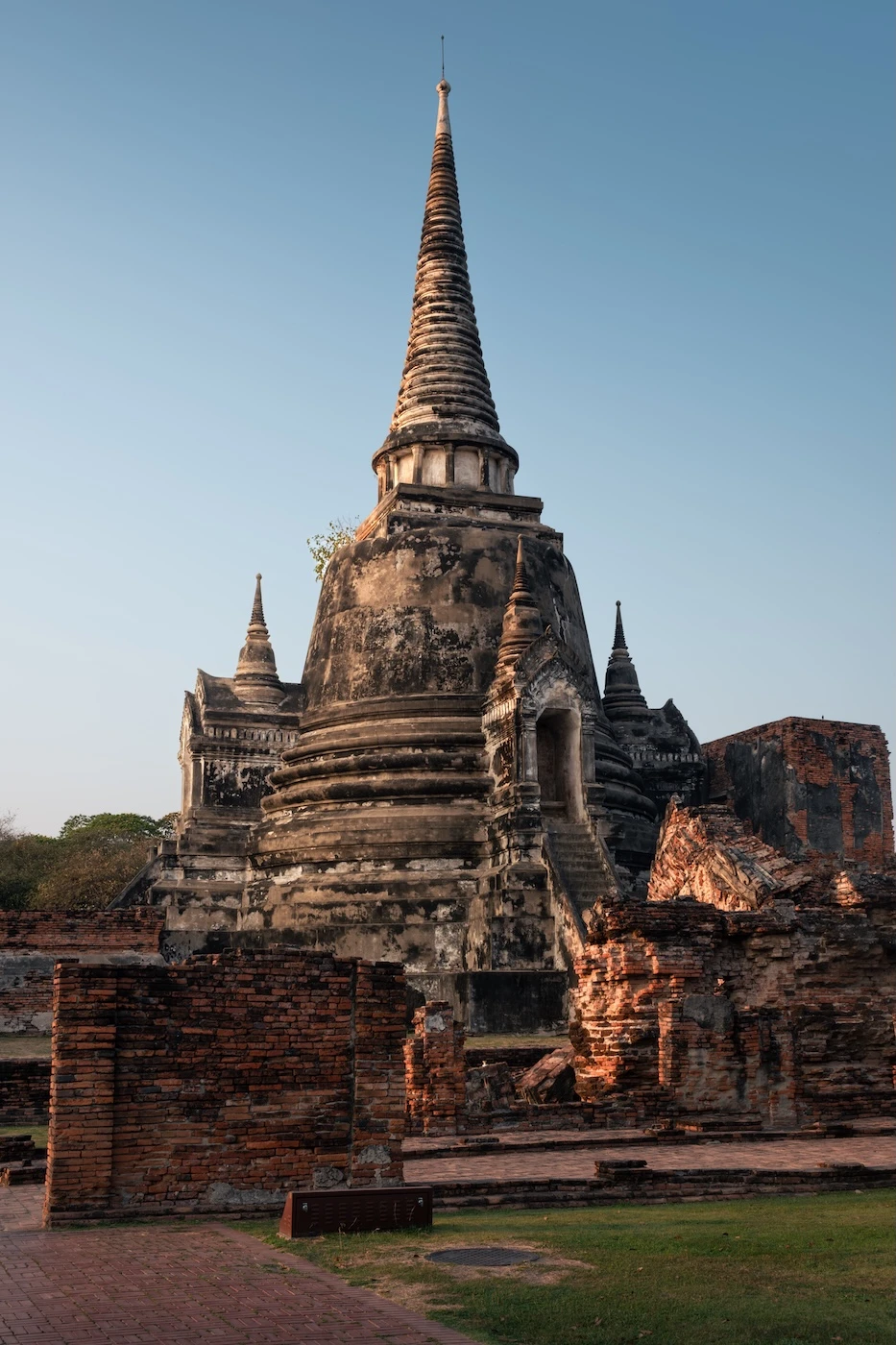
1. Wat Phra Si Sanphet
This one is my all-time favourite spot in Ayutthaya. I revisit it, over and over again, because it’s that magnificent.
I’ve never seen anything else like it anywhere in the world (pretty much). The ruins look quite Sri Lankan in style, but with more flair!
The main draws are the three entirely striking, 50-metre-tall, evenly-spaced stupas, which were renovated in 1956 after the Burmese attack in 1767 destroyed two of them.
Each stupa has one large banded spire with four smaller ones surrounding it. These sort of layer together to make the most incredible skyline against the setting sun (skyline comments are usually reserved for cities, but this is an exception).
I’m legit enamoured.
2. Wat Mahathat
Wat Mahathat is the social media favourite of Ayutthaya’s temple complexes.
This temple is particularly famous for the Buddha head that has inexplicably grown through the roots of a Bodhi tree (which gets rammed with tourists during busy periods, so watch out – it’s like trying to spot the Mona Lisa at the Louvre; if you know, you know).
If you look up generic photos of Ayutthaya – this Buddha head is probably what you’ll see – there’s a photo of it somewhere further down this page.
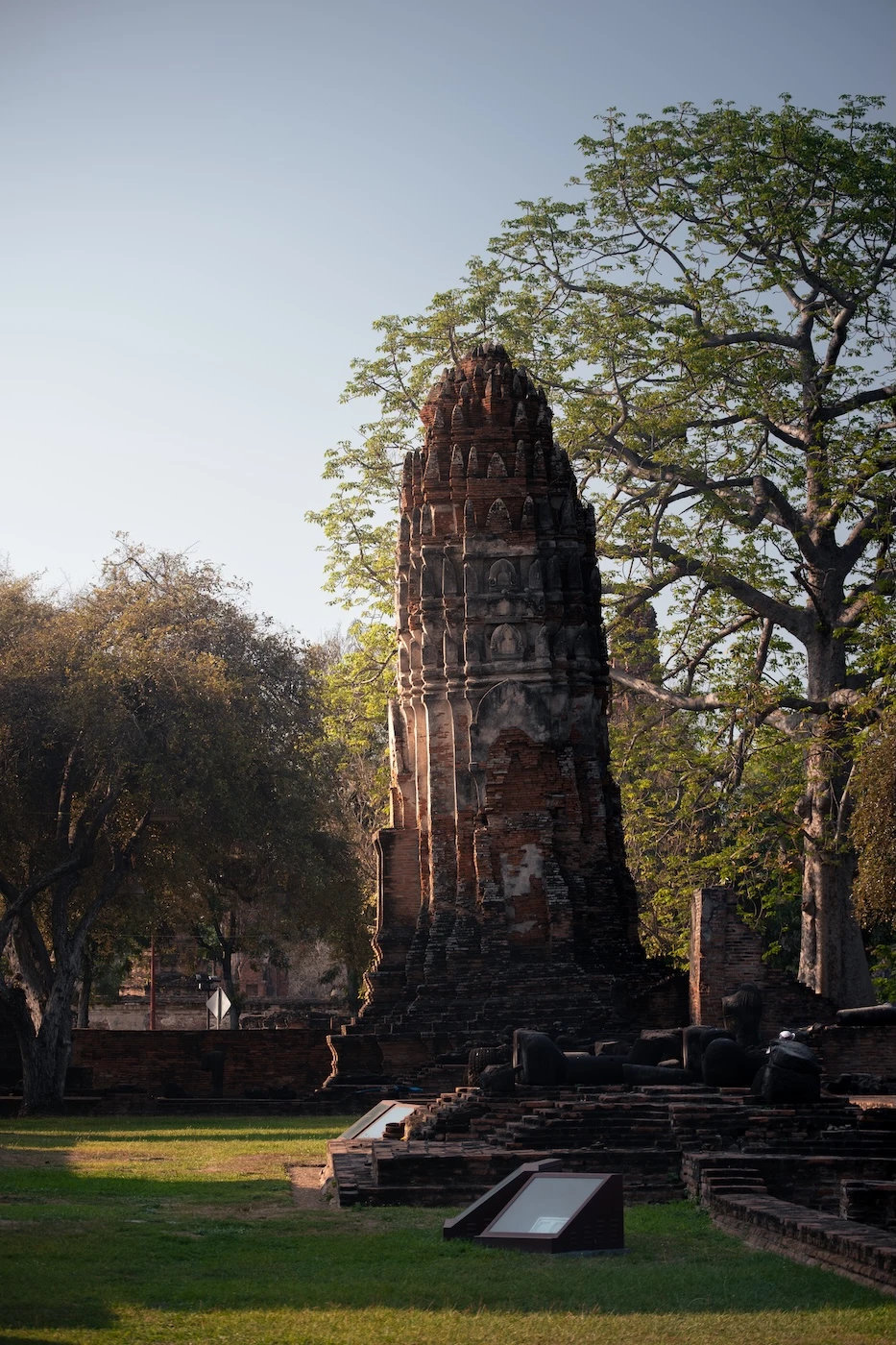
The rest of the complex is also worth noting for its rows of beheaded Buddha statues, semi-crumbling prangs and overgrown stupas. It’s one of the more impressive sites, so definitely don’t miss it.

3. Wat Chaiwatthanaram
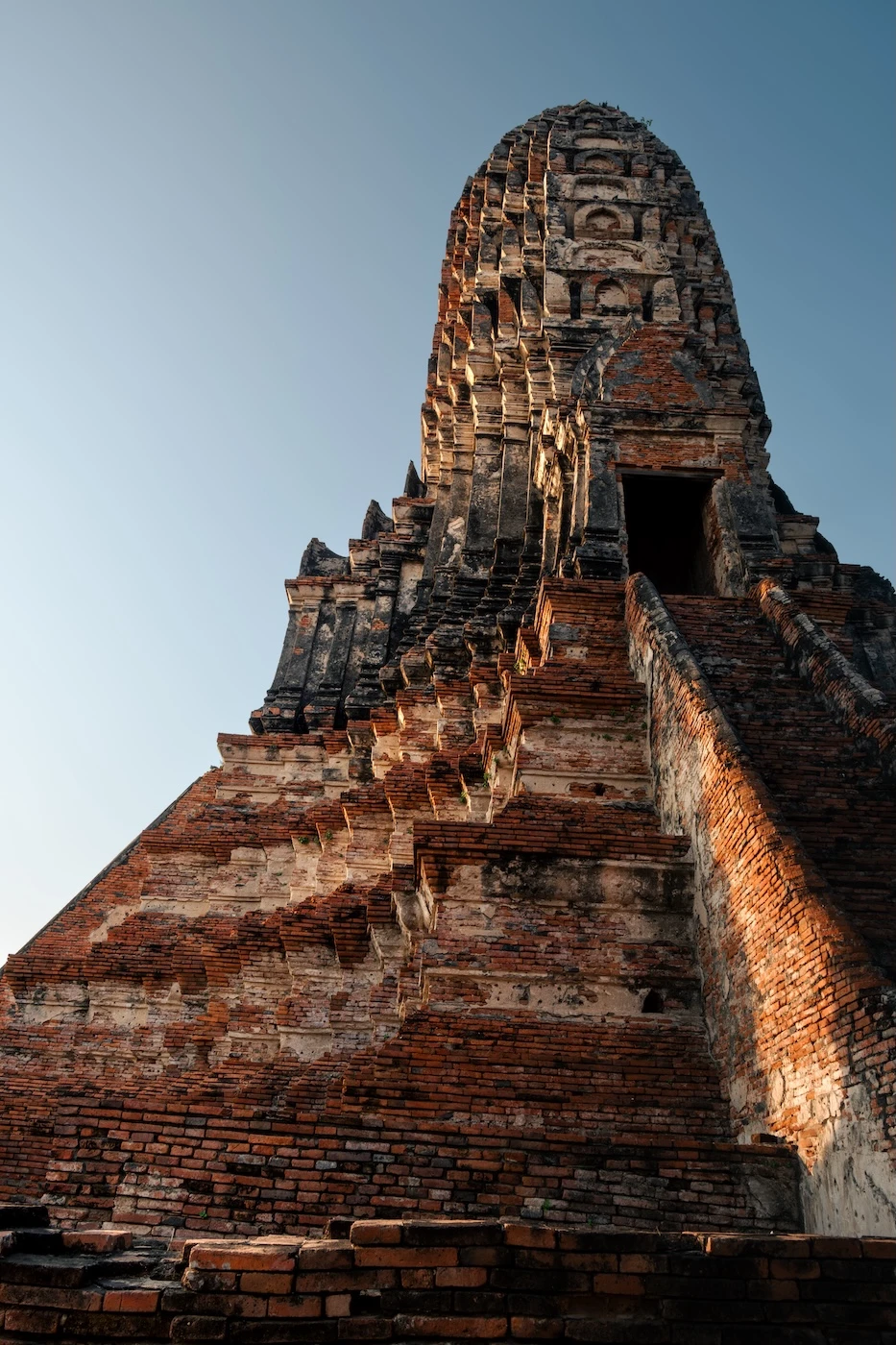
Wat Chaiwatthanaram is the most popular temple for sunset in Ayutthaya, possibly because it looks a bit like Angkor Wat?
It’s a large, symmetrical, Khmer-style site with lots of tall prangs and headless Buddhas, all set next to the river. It’s all rather lovely.
This is one of the sites that is outside the island area, so it requires some kind of transport to reach, and is often missed by day trip visitors. It’s also popular for photoshoots in traditional dress.
There’s some ongoing scaffolding works on the 35-metre central prang in 2026, but it’s still pretty. I’m always grateful for scaffolding – it means somebody is caring for it.
4. Wat Ratchaburana
Wat Ratchaburana wouldn’t be an overly stand-out site apart from its seriously impressive, intricate white prang that looms over everything in the area.
It’s uniquely adorned with garuda and naga stuccos, which I’m not sure I’ve seen in any of the other Ayutthaya sites (I might be wrong here).
There are also murals in the crypt (within the prang) from the early Ayutthaya Period (which we were told on a previous visit is between roughly 1350 to 1470). These depict all sorts of things, from Sukhothai-style art, Chinese Kings and the life of the Buddha, amongst others.
The prang was under renovation when we recently visited in mid-2026, but it doesn’t really affect your experience there, apart from not being able to go to the crypt.

5. Wat Phra Ram
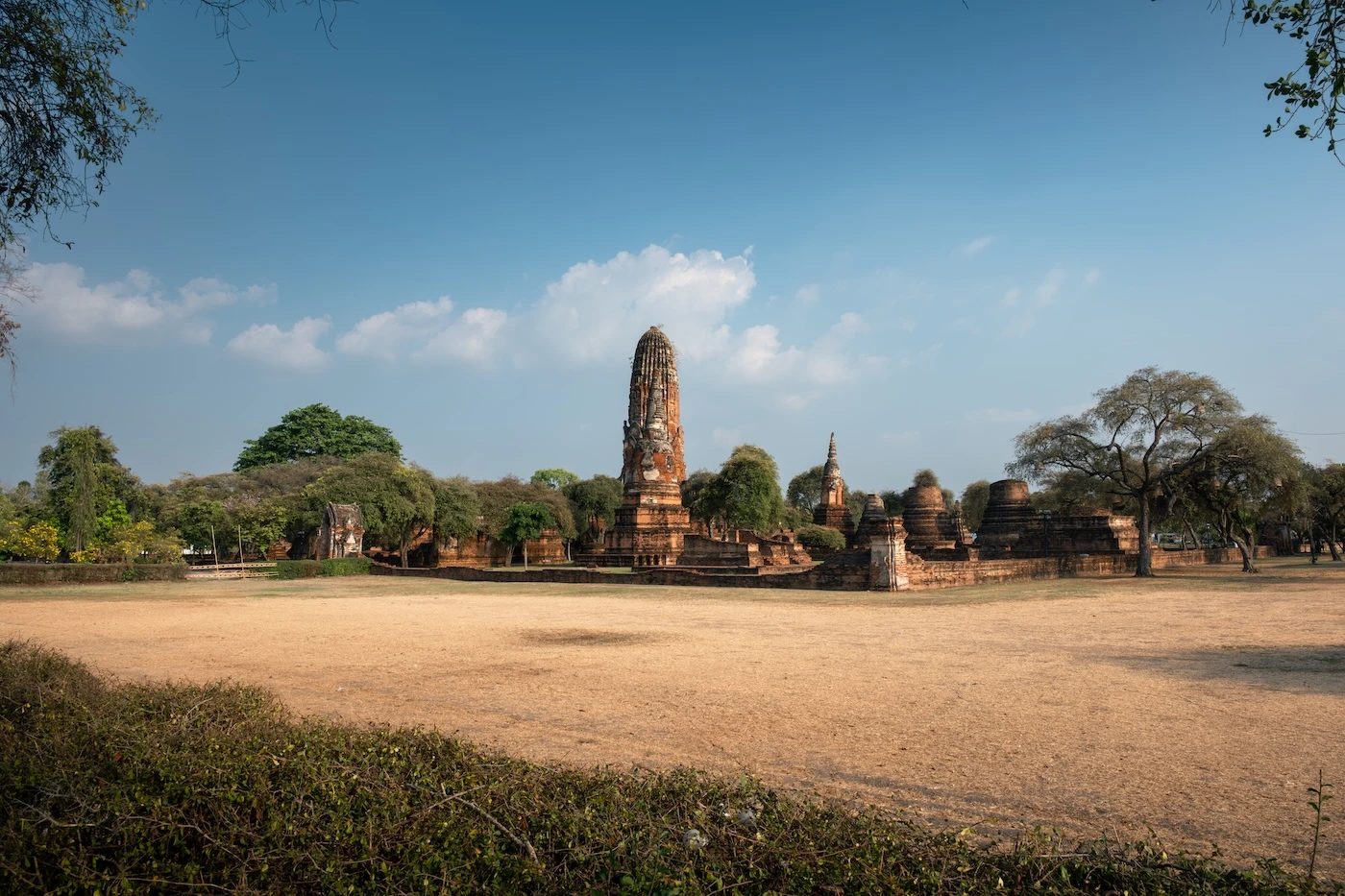
Wat Phra Ram is a slightly smaller complex right next to Bueng Phra Ram Park and Wat Phra Si Sanphet (so visit them together).
It’s not that large a site and only takes fifteen minutes or so to wander around the dominating central prang. As a whole, it’s quite typical of the other nearby sites, but I did quite like the trees.
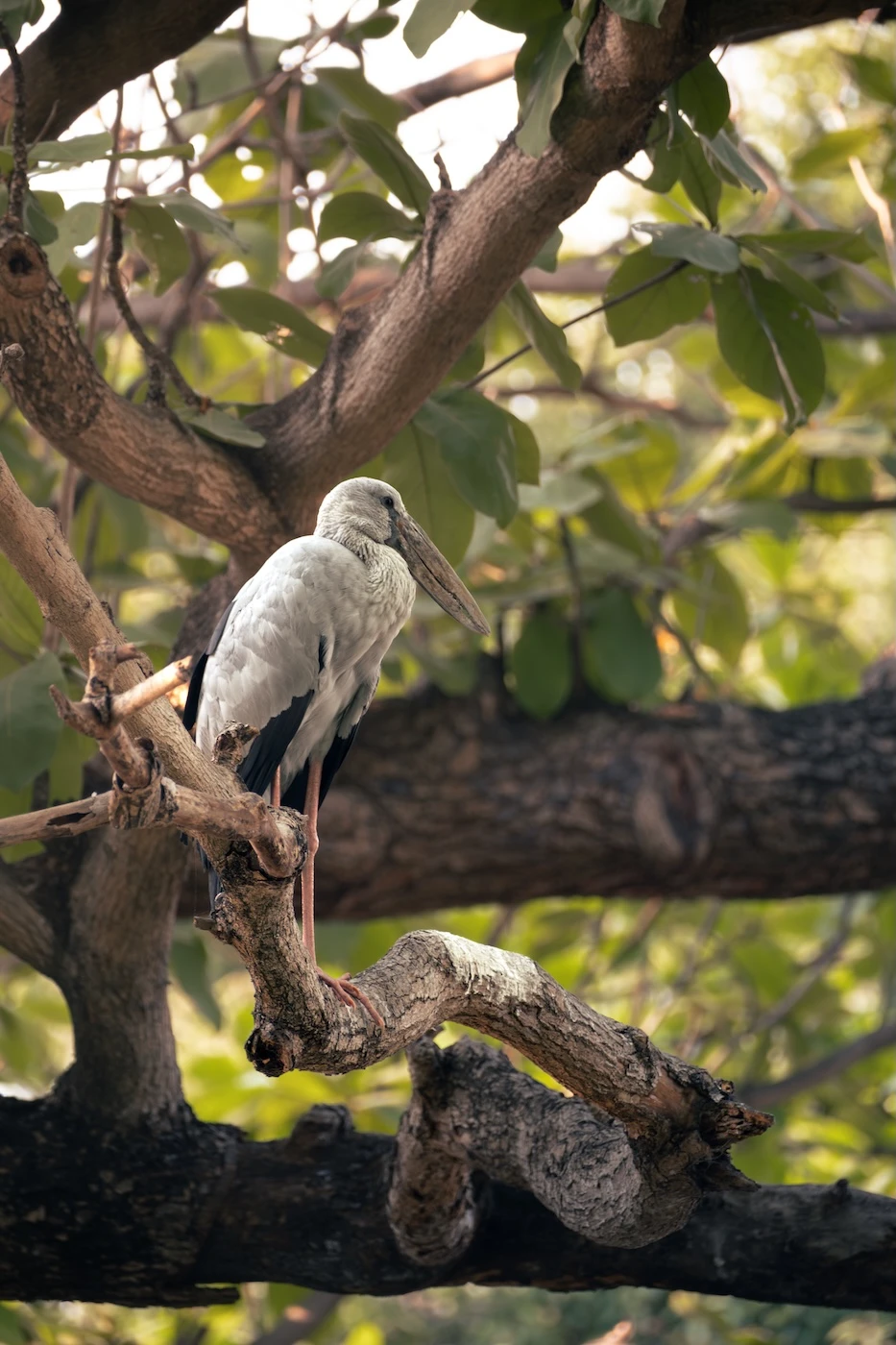
My main crush here is actually the adjacent park, and the meander towards the temple. It’s a little bit of shady serenity in an otherwise quite busy place, full of ponds, birds, bridges and the occasional ruin (‘Bueng’ means swamp or lake, so that makes sense!).
Also, the elephant rides don’t go in the park, which is nice, because if you walk down the roads you’ll inevitably see them (which is no bueno).
The Temples We’d Skip
I mean, I’m an enthusiast of all things old and brick so I’d say there are none! However, if you’re on a time limit or just tend to find yourself ‘templed out’ (a phrase I heard someone say once), we’d recommend skipping the following ones:
⬩ Wat Kudi Dao – we liked this one, but it’s a bit out of the way (off the island) and is not as impressive as the others. However we’d definitely recommend visiting if you’re staying overnight and going to Wat Maheyong (they’re next to each other).
⬩ Wat Maheyong – as per above, if you’ve got time, we really like this one. It was a highlight (especially the new side) with all the meditation students. It’s really interesting, but located outside the main area, so only visit if you have enough time to do it justice.
⬩ Ayutthaya Royal Palace – this one is actually kind of boring, if I’m honest. The name makes you think it’ll be super grand, but that’s a big ol’ lie. Honestly, I don’t even have any photos from there since it’s mainly just a few bricks and grass (at least it’s included with your ticket to Wat Phra Si Sanphet so you don’t have to pay a separate fee).


Other Spots to Visit
There are loads of other things to visit around Ayutthaya – the main temples are just the tip of the iceberg, honestly.
There are first-class royal Buddhist temples, other equally impressive ancient ruins, cultural villages, a summer palace, quality museums and even a Catholic church.
We’ve split this section into sites that are on the island (near the main temples) and ones that are further away, off the island that need transport.
On-Island Sites
1. Chao Sam Phraya National Museum
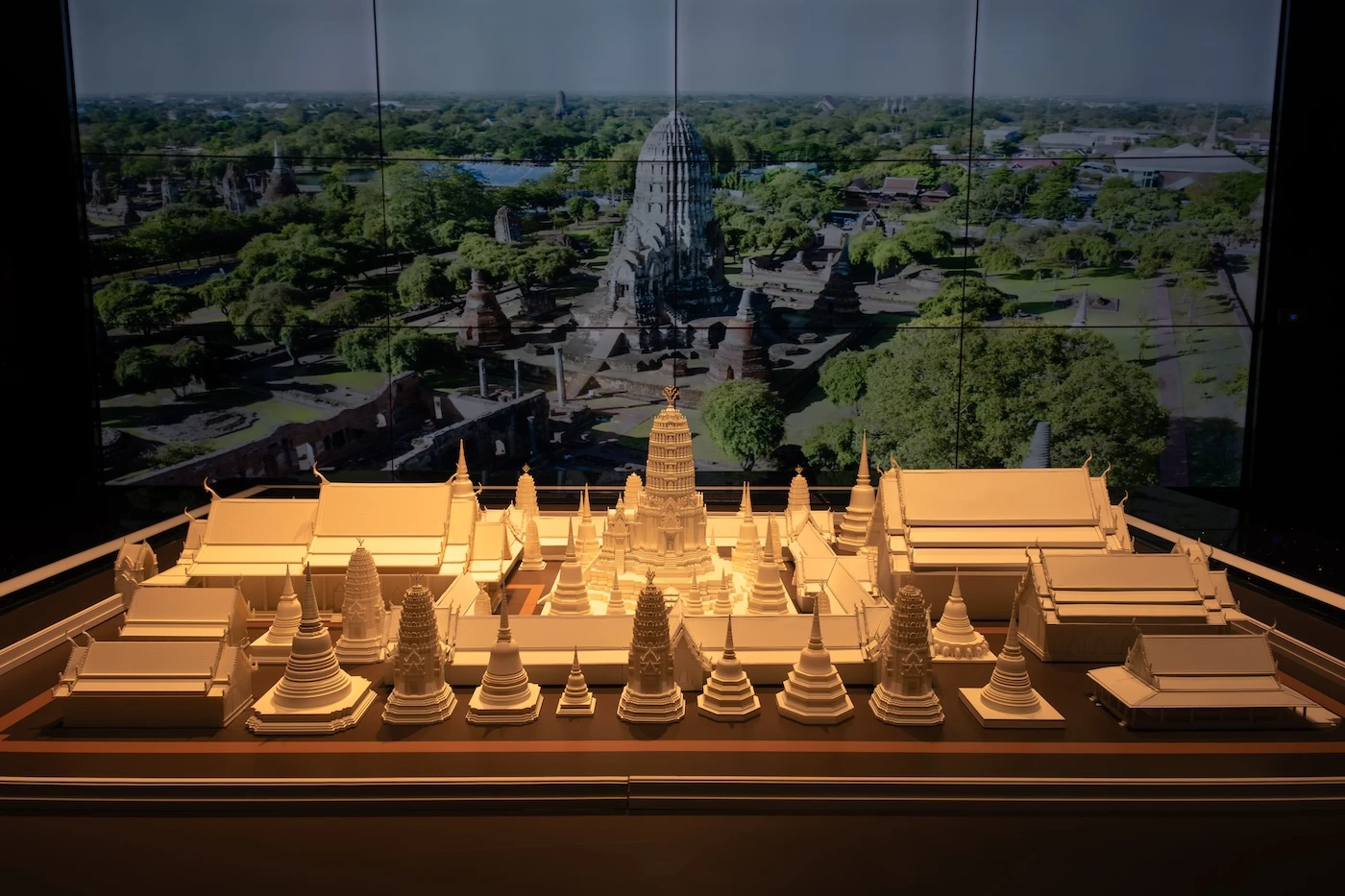
This modern museum, located right in the middle of the island next to the ruins, is a beautifully curated space which focuses on Ayutthaya’s history (and also has some exhibitions for other periods, like Sukhothai, Lopburi and even Rattanakosin eras).
Much of the signs are in English, but it’s quite impressive and worth visiting even if you don’t read much of the history. The actual space is really lovely, plus it’s air-conditioned, so a great choice to visit during the baking midday heat (this is what we did).
Specifically, we saw a large exhibit about Ayutthaya’s history with gold. There are loads of exquisitely crafted gold artifacts excavated from the crypts at Wat Ratchaburana and Wat Mahathat. It really demonstrates how prosperous the ancient Ayutthaya Kingdom was (there’s a lot of gold – especially since apparently most of it was looted and this is what was left?).
Currently, part of the museum is being renovated in mid-2026, but we thought the entry fee was very reasonable for what we saw (I guess it will only be even better value when it’s all finished). Also, the cafe is really nice and a good place to take a break from all the ruins.
Opening hours: 9am-4pm, closed on Mondays
Entry fee: 200 baht
2. Million Toy Museum
This quirky little museum is a great stop if you’re just a bit done with the heat, sun and temples in the afternoon (I’m a ruins enthusiast but even I have a limit). Also, I don’t have kids, but this might be a good distraction stop if they’re getting a bit fed up with looking at bricks.
The museum has multiple floors of toys, exactly like the name implies – vintage retro, lifesize, collectable – there’s so much stuff, it’s actually very cool and nostalgic. I can seriously believe there really are a million toys (but who really knows?). I found a bunch of Moomins, which ages me somewhat (it’s great for wandering down memory-lane for anyone born pre-1990s!).
We popped in just because it sounded fun and a bit different, but ended up loving it!
Opening hours: 9am-4pm, closed on Mondays
Entry fee: 50 baht

3. Wat Lokaya Sutha
This temple is located on the island to the west of Wat Phra Si Sanphet, so you can visit the two together. You’re basically here for the just absolutely eye-poppingly enormous (and recently renovated) 42-metre-long reclining Buddha (it looks very different in older pictures).
Wat Lokaya Sutha is a good little stop with easy parking, but if you’re on a day trip and in a rush, we’d recommend you skip it.
There’s also a large reclining Buddha at Wat Yai Chai Mongkol (not as large, though) – so if you go there, you could potentially skip this spot.
Opening hours: 8am-6.30pm
Entry fee: free

4. Wat Thammikarat
This is another lesser-visited temple, found in the north of the island not far from Bueng Phra Ram Park. It’s a compact site, with a chedi surrounded by more than fifty lion statues, a reclining Buddha statue, and a garden which (justifiably) has earned it the name of ‘Temple of a Thousand Roosters’.
The parking is super convenient, with one area to the south and one to the north of the complex.
Everything you can see here can be seen elsewhere in a grander scale so, again, if you’re short on time then give this one a miss. Although, you will miss out on the army of roosters (dedicated to a revered king and cock fight – I’ve written about it further down).
Opening hours: 8am-4.30pm
Entry fee: free
Off-Island Sites
5. Bang Pa-In Palace
This beautifully maintained palace was the Royal Family’s riverside summer residence and is full of lakes, gardens, pagodas and reflections. It’s such a nice, calm atmosphere, so if you’re a bit done with Ayutthaya’s slightly more hectic brick-filled island, I’d highly recommend a wander around to lower your blood pressure. It’s like a picturesque English park, but with east Asian buildings!
The palace is located around a 20-minute drive south of Ayutthaya, so is easy to visit on the way to or from Bangkok if you’ve rented a car, or by taxi from central Ayutthaya.
Opening hours: 8am-4pm
Entry fee: 100 baht

6. Wat Phutthaisawan and St. Joseph’s Church
These stops are on the banks of the Chao Phraya River, opposite the southern side of the island.
Wat Phutthaisawan is an active Buddhist temple and also one of my favourite non-ruin stops in Ayutthaya (I’m a bit of a Buddhist temple enthusiast). It’s not particularly unique but, when we visited late in the afternoon, it was completely empty and the riverside location added to the charm. It has a very old-and-new vibe going on – to the east, there is an old prang and reclining Buddha, and to the west is a huge, classic-looking modern Buddhist temple.
You can also see great views of the temple, especially at sunset, from the incredible Sala Ayutthaya hotel’s pool.
While there, I chased those fluffy dandelion puffs that float about in the air with an incredibly wizened old lady in the car park. She was more spritely than me, to my shame. It’s now a core memory.
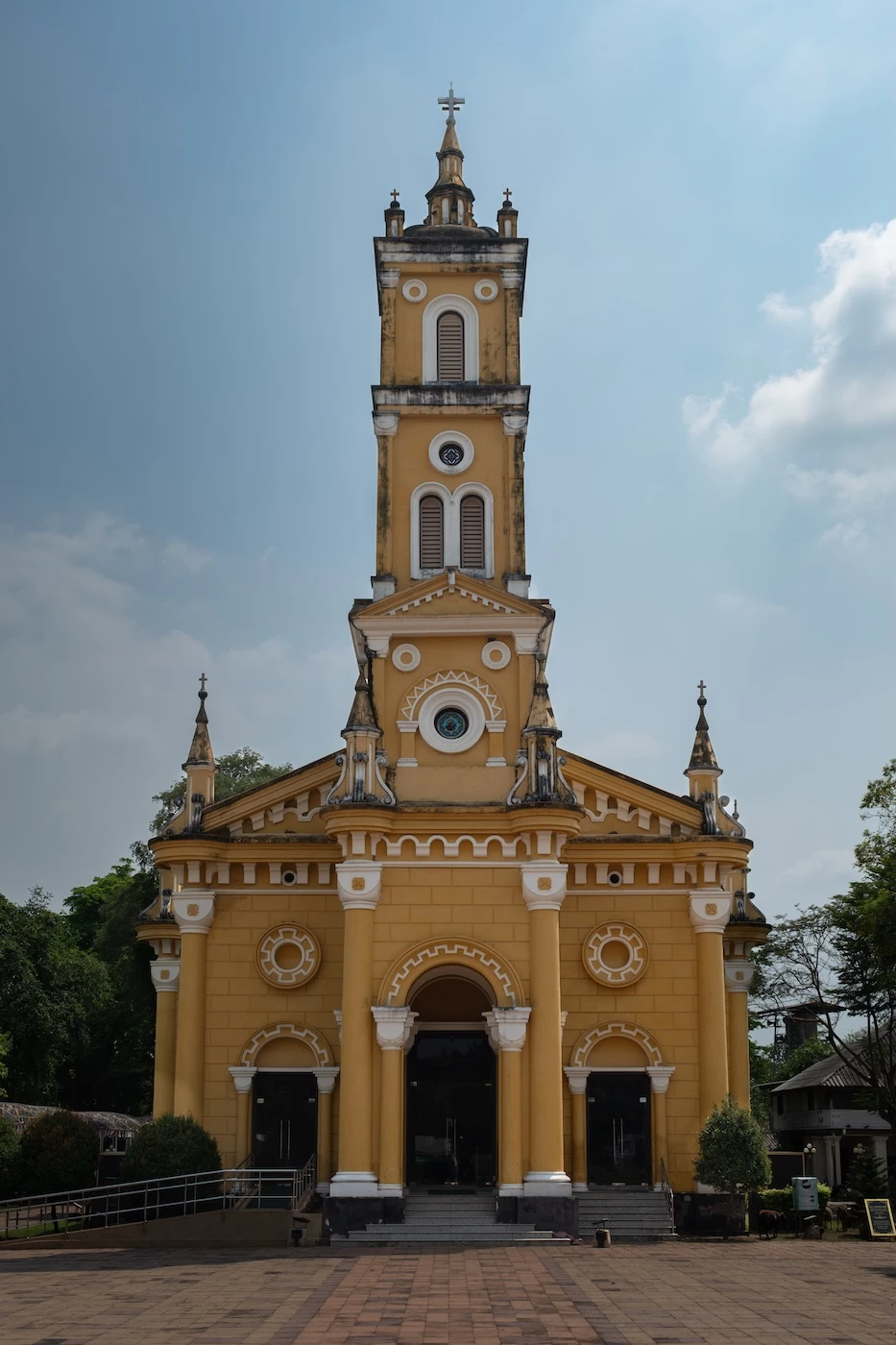
Nearby the wat is one of Thailand’s oldest Catholic centres called St. Joseph’s Church. It is a pleasant, alternative option to all the Buddhist sites, and it even has grazing sheep on the grounds. If you time it right, you can go to a service as the church is still in use. (I’m freaked out by the inside of Catholic buildings so didn’t do this).
Opening hours: 8am-4.30pm, 8am-5.00pm, respectively
Entry fee: free for both
7. The Golden Mount (Wat Phu Khao Thong)
This is just an absolutely enormous white chedi, originating from the 1300s, that’s been added-to and developed over many centuries.
Seriously, pictures really do not do the size of this structure justice – it’s huge. You can even climb up the stairs and walk all around the top of the chedi for vast views across the countryside.
It’s a totally different style to anything else you’ll see in Ayutthaya and rarely visited compared to the main historical site. At just a few kilometres north of the island, we’d highly recommend a quick visit if you can.
We popped in during a particularly sweaty mid-afternoon in April and it was so hot – bring a hat or umbrella because there’s literally no shade and the steps are steep.
Opening hours: 8am-4pm (the internet says 7am, but it’s actually 8am)
Entry fee: 20 baht per person
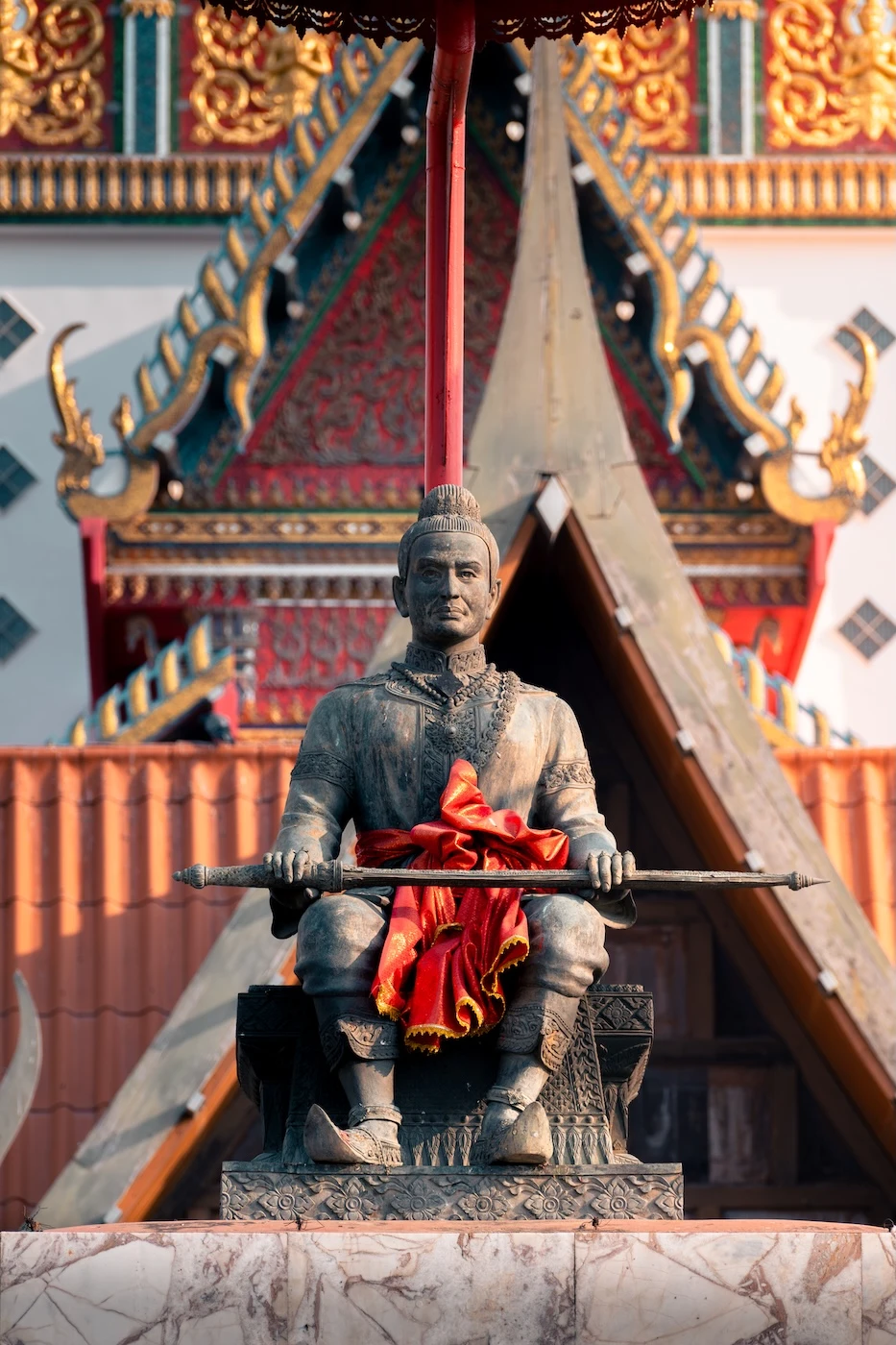
Info: adjacent to the Golden Mount is a pretty traditional-looking Buddhist temple and some covered ruins, and just a tiny bit further along the road is the King Naresuan Monument.
This equestrian statue depicts the King after his victory against the Burmese in the late 1500s (he had a fascinating and complicated story, and is one of the most revered Kings in Ayutthaya and beyond). You’ll also probably see a whole tonne of chicken statues surrounding the monument – these apparently appeared after the King was depicted in a movie winning a cock fight!

8. Wat Yai Chai Mongkol
This actively-used Buddhist temple is a mix of ancient Ayutthaya-style structures and a modern-day place of worship.
The large complex consists of a huge 60-metre-tall central chedi surrounded by many seated Buddhas, with a wishing well right at the top. There is also an almost 30-metre-long reclining Buddha, and lots more.
It’s a location for pilgrims to honour King Naresuan who used this site as a military centre (as mentioned above, so you’ll see a whole bunch of chicken statues here, too!) .
Don’t forget to head up the main chedi’s 50-ish steps to drop a coin in the wishing well with the other worshippers.
Wat Yai Chai Mongkol is located just to the east of the island, so is not easily walkable, but is definitely worth including on your itinerary if you have more than a day.
Opening hours: 8am-5pm
Entry fee: 40 baht

9. Wat Phanan Choeng Worawihan
This Chinese-influenced Thai Buddhist temple complex is situated on the confluence of the Chao Phraya River and the Pa Sak, to the south-east of the island.
It’s a lively temple (with wonderfully shaded parking), probably best known for its towering 19-metre-tall Buddha statue (known as Luang Pho Tho) seated inside an opulent red and gold shrine. I was mildly obsessed – it was one of the most beautiful I’ve seen on my many temple quests.
Interesting fact: apparently this Buddha statue cried just before the fall of Ayutthaya in 1767 to the Burmese (and somehow survived the pillaging!).
Opening hours: 8am-5pm (weekdays), 7am-5.30pm (weekends)
Entry fee: free to access the temple complex, 20 baht entry to Luang Pho Tho


Getting Around Ayutthaya
Ayutthaya is easy to get around, so you can choose the transport method that best suits your energy levels:
On Foot
You can technically traverse the entire of the island (where most of Ayutthaya’s temples are) by foot.
The main site of Wat Mahathat is a roughly 40-minute walk from the train station (which is not the nicest walk if you use Google Maps’ route, to be honest).
Tip: there’s the better option that takes a small passenger boat across the river from the Ayutthaya Train Station Pier (it takes literally two minutes to cross and costs 10 baht). This cuts the walk nearly in half and avoids the busiest roads.
The entire area is pretty much completely flat so it’s quite a comfortable walk, and there are even footpaths!
By Bicycle
This is very similar to walking, only sped up a little, so you can cover ground more efficiently.
Bicycles are available to rent at the train station for 60 baht per day. You can also take the bike across the river for an extra 5 baht (on top of your 10 baht per person charge).
Cycling is a really great choice, but I’d recommend being a proficient cyclist if you choose this option. The roads are very busy and packed with cars and tourist-related traffic between the sites. It’s not exactly a peaceful place to cycle round in the middle of the day.
We wouldn’t recommend cycling with your kids if they are not extremely capable on roads. Be aware that there are elephants on the roads and paths in Ayutthaya, so you need to give them an enormous berth.

With a Tuktuk/Taxi
Hiring a tuktuk to take you around for the day varies in price, from around 1000-1500 (or more) baht a day. This price depends on your negotiation skills, how nice the tuktuk man is, and length of time required. It’s pretty much the same cost as a rental car from Bangkok – so bare that in mind!
The Grab app offers hourly rates for driver rental. It’s worth considering, because rates in Bangkok are very reasonable for what you’re getting and I can’t imagine Ayutthaya being significantly more. Below are the current prices to hire in Bangkok on Grab for a four-seater car:
⬩ 2,500 baht (£57.20) for ten hours;
⬩ 2,100 baht (£48) for eight hours;
⬩ 1,600 baht (£36.60) six hours.
By Scooter
For scooter hire, we’d recommend Mr Biker Motor Scooter Rental, located on the island near the temples. Their prices are high at 350 baht per day, but don’t require you to leave a passport (and we had a good experience with them a few years back). The place opposite the station has been known to ask for a passport as deposit which we do not recommend (also, the bikes aren’t as good).
Scooter parking is available absolutely everywhere.
If you ride a scooter in Ayutthaya, the roads are easy to navigate because they’re mostly in a grid system with no hills. However, they are very busy with hefty traffic, like trucks, minivans and buses (so we wouldn’t recommend it for beginners).
With a Rental Car
This is our favourite option. It’s nice to get around a flaming hot town with aircon between every stop!
There’s easy parking everywhere, driving a car is super straightforward and really affordable, especially if you’re in a pair, group or travelling with kids.
We’d recommend renting from Don Mueang Airport in Bangkok to drive to Ayutthaya (other pick-up locations may work better for you).

How Long to Spend in Ayutthaya
Most people who visit Ayutthaya spend one short day at the site and arrive on an organised tour from Bangkok. However, we highly recommend staying overnight if you can because there is so much to do. The area is also unusually warm (so you really don’t want to rush) and it’s nice not to miss sunrise and sunset at the temples.
Some of the other great reasons for a longer stay are: the photography, sunsets, night market, or simply that it’s far more affordable than a night in Bangkok!
If you’re short on time, it’s definitely still worth visiting as a day trip, though. Have a look at tours that take all the hassle away.

A Two Day Itinerary
Below is how we’d spend two fast-paced days in Ayutthaya, seeing all the main spots while including a few bonus places. It assumes you’re arriving at around midday (via your chosen transport and accommodation) and leaving your stuff at your guesthouse. Then you’ll be leaving late afternoon/early evening the next day.
Day One
Grab some food before leaving your accommodation.
12:00 – Chao Sam Phraya National Museum (have a beverage at SaNeHa café)
14:00 – Wat Phra Ram
14:45 – Wiharn Phra Mongkhon Bophit
15:15 – Wat Phra Si Sanphet
16:30 – Wat Lokaya Sutha
Optional – grab a snack at Roti Sai Mai Abeedeen-Pranom Sangaroon or at one of the many food stalls just outside Wat Lokaya Sutha
17:30 – Wat Chaiwatthanaram for sunset
Go to Ong Gaan Tolasap Night Market and grab a budget dinner. For an upper-market option with a view, head to River Bar Ayutthaya.
Optional: Million Toy Museum (we thought it was really fun and it’s a nice break from the blazing sun). This stop is good if you’re a fast wanderer like us and have some spare time in the schedule above (I have to be speedy in the sun or honestly I’ll just melt). Be aware it closes at 4pm.

Day Two
Early breakfast: in or around your guesthouse, or have a quick bowl of something warm at Jieb Tom Lueat Mu before heading into Wat Ratchaburana (this stall opens really early but is very unfriendly for vegetarians, I’m afraid). For an alternative veggie breakfast, go to Ranahat Je Vegan Restaurant – they’re really good value and also nearby the site.
08:00 – Wat Ratchaburana
09:00 – Wat Mahathat
10:00 – Wander through Bueng Phra Ram Park
11:00 – Wat Thammikarat (optional if you have time)
12:00 – Lunch Noodles at Khanom Jeen Ton Kampu Ayothaya
13:30 – Wat Yai Chai Mongkol Worawihan
15:00 – Wat Maheyong
Optional: If you have time, visit nearby Wat Kudi Dao along with Wat Maheyong.
17:00 – Thai desserts at Khanom Mho Kaeng Mae Yai
Before 18:21 – be at the train station to buy your ticket (there’s a train at 18:21 leaving for Bangkok that doesn’t require reservations – although check this for your dates in case it changes). Alternatively, drive to Bangkok (it’s about 45 minutes to Don Mueang Airport if you rented a car there – although realistically add 15-30 minutes due to traffic at that time of day).


Elephants
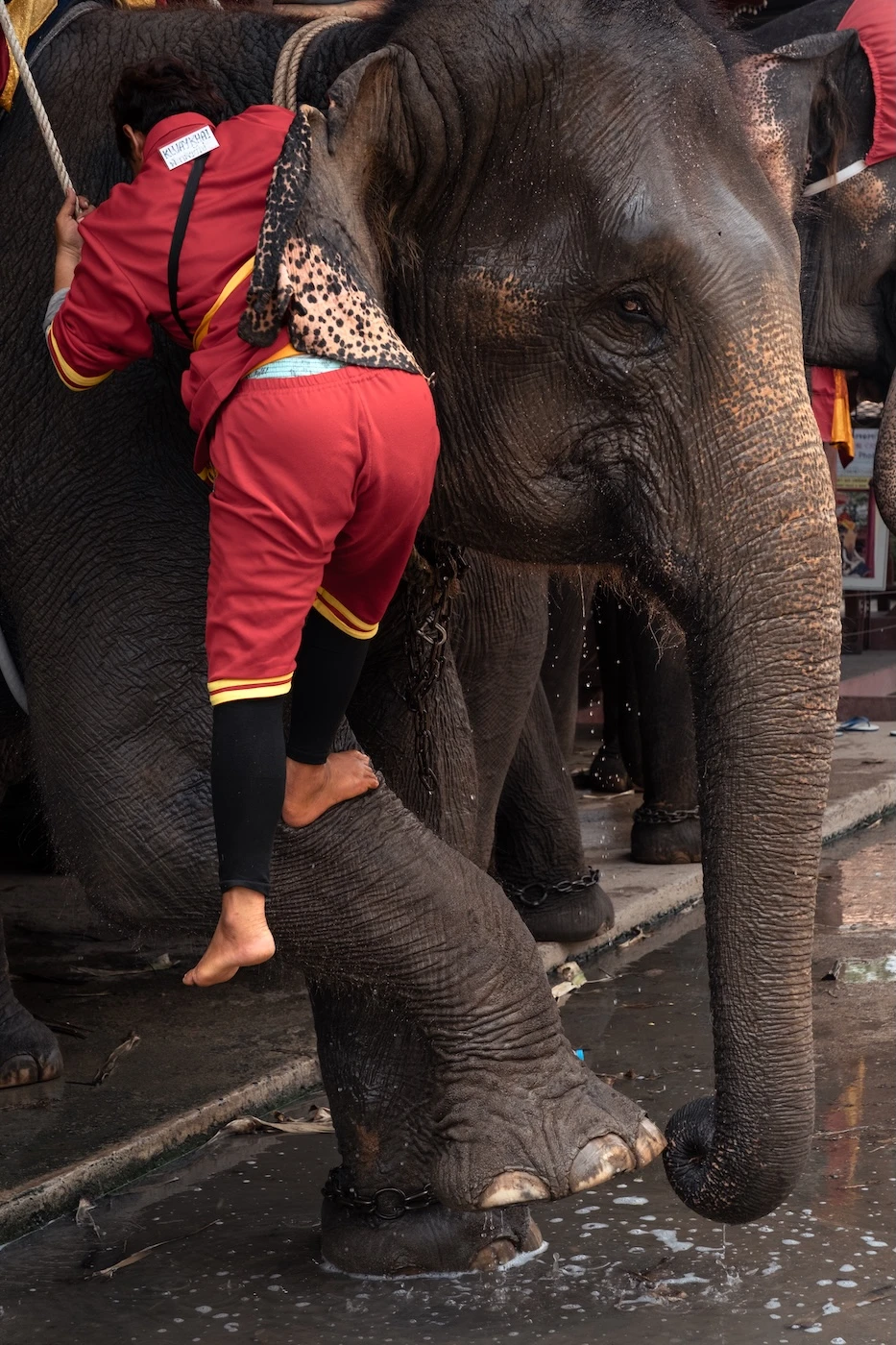
Ayutthaya has elephants. In fact, it has a lot of elephants – between 70-90 according to recent records, which is the highest density in Thailand.
Sadly, elephant rides are still permitted here (and actively encouraged) so you’ll see them all over the roads adjacent to the historical park temples, particularly around Wat Phra Ram, Wat Mahathat, Wat Ratchaburana, and the park.
We’d highly encourage you not to engage in any way with elephant tourism in Ayutthaya.
There’s a long history of elephant husbandry in the city. It’s a complicated and divisive topic, so if you want to know a little more about the elephants and their history in this area, as well as how to visit as a responsible tourist, have a read of our post on the subject.
–

Getting To Ayutthaya
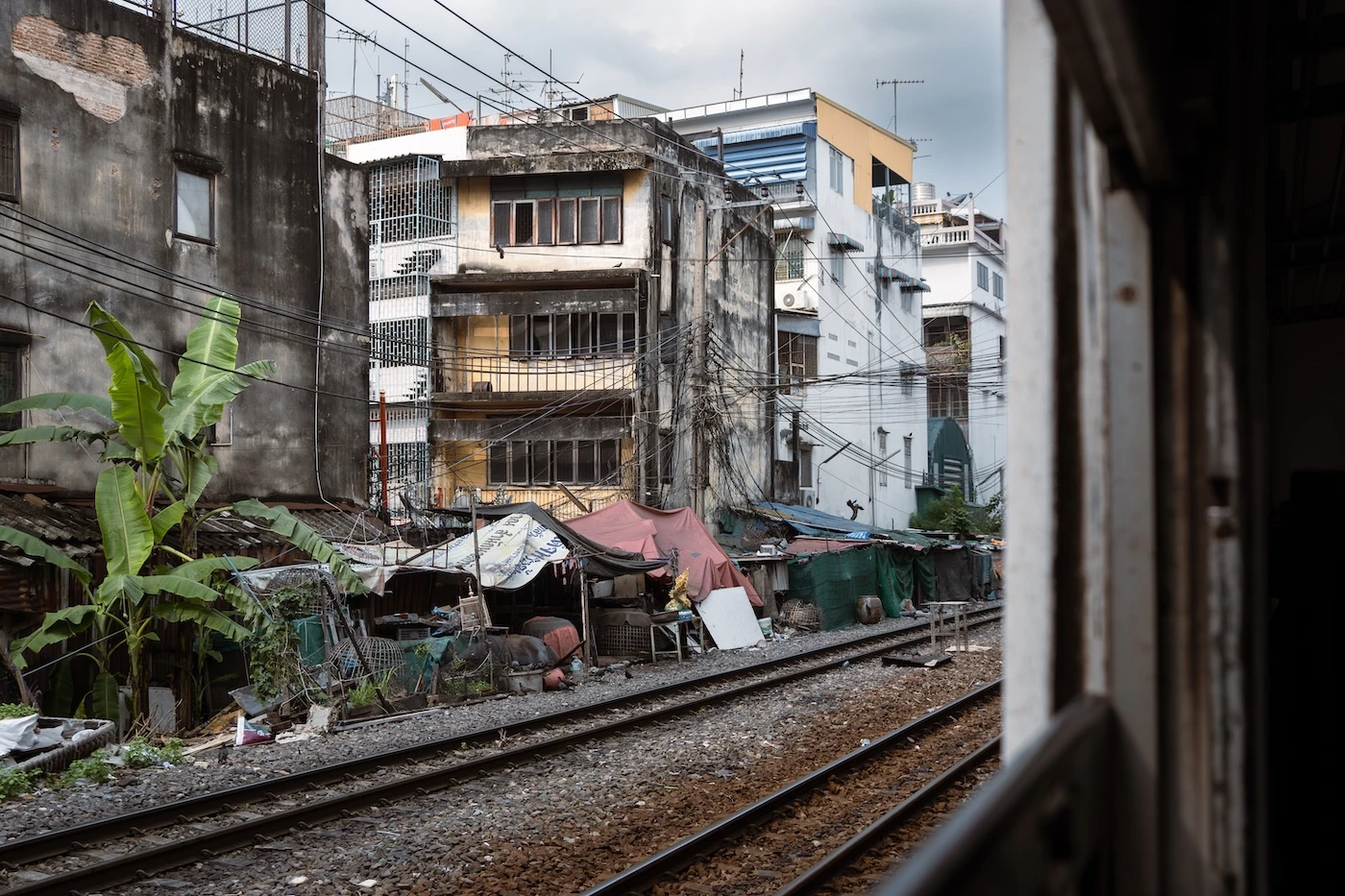
There are four main ways to get to Ayutthaya from Bangkok:
⬩ Rental Car – this is the best option for flexibility, speed, and already having transport when you arrive. It’s also affordable for a group and very easy to arrange a car.
⬩ Organised Day Tour – this is the least hassle, logistically, but also the least flexible, more expensive, and they sometimes include unethical activities.
⬩ Train – by far the most affordable, but a bit of hassle and the cheapest options don’t have aircon.
⬩ Minivan – same as the train but slightly faster, more expensive, not great for large luggage, although sometimes more convenient with drop off locations.
⬩ Private driver – very expensive but flexible and easy (but you have to trust your driver).
Photography Tips
If you’re interested in photography, Ayutthaya won’t disappoint (at least not during certain times of day!).
We’ve been four times and taken photos each time, so have mostly figured out the best spots and when the light is nicest (when it’s bad, it’s really, really bad).
It’s also worth noting the opening and closing times for the park because they’re surprisingly inconvenient for capturing sunset and sunrise!


Where to Stay?
Most people who stay overnight in Ayutthaya choose a hotel near the central temple complexes, on the island. There are also options just off the island, near the train station and bridge. Alternatively, you can stay in the newer part of town near the highway and mall, which is super convenient for people who are renting a vehicle and require hyper-modern amenities.
We’ve stayed in a selection of hotels during our time in Ayutthaya, ranging from business hotels to local guesthouses and luxury boutique spots. All our stays were excellent and I’d recommend them all:
Romyen Café Homestay ($): this 9-room riverside guesthouse had lovely clean rooms and was ideally situated for visiting the ruins on foot or by bicycle. We stayed with a friend, so had two rooms between us, both of which were surprisingly modern, with hot water and good aircon. The owners were lovely, too, and we felt super welcomed! It was excellent value for money.
—
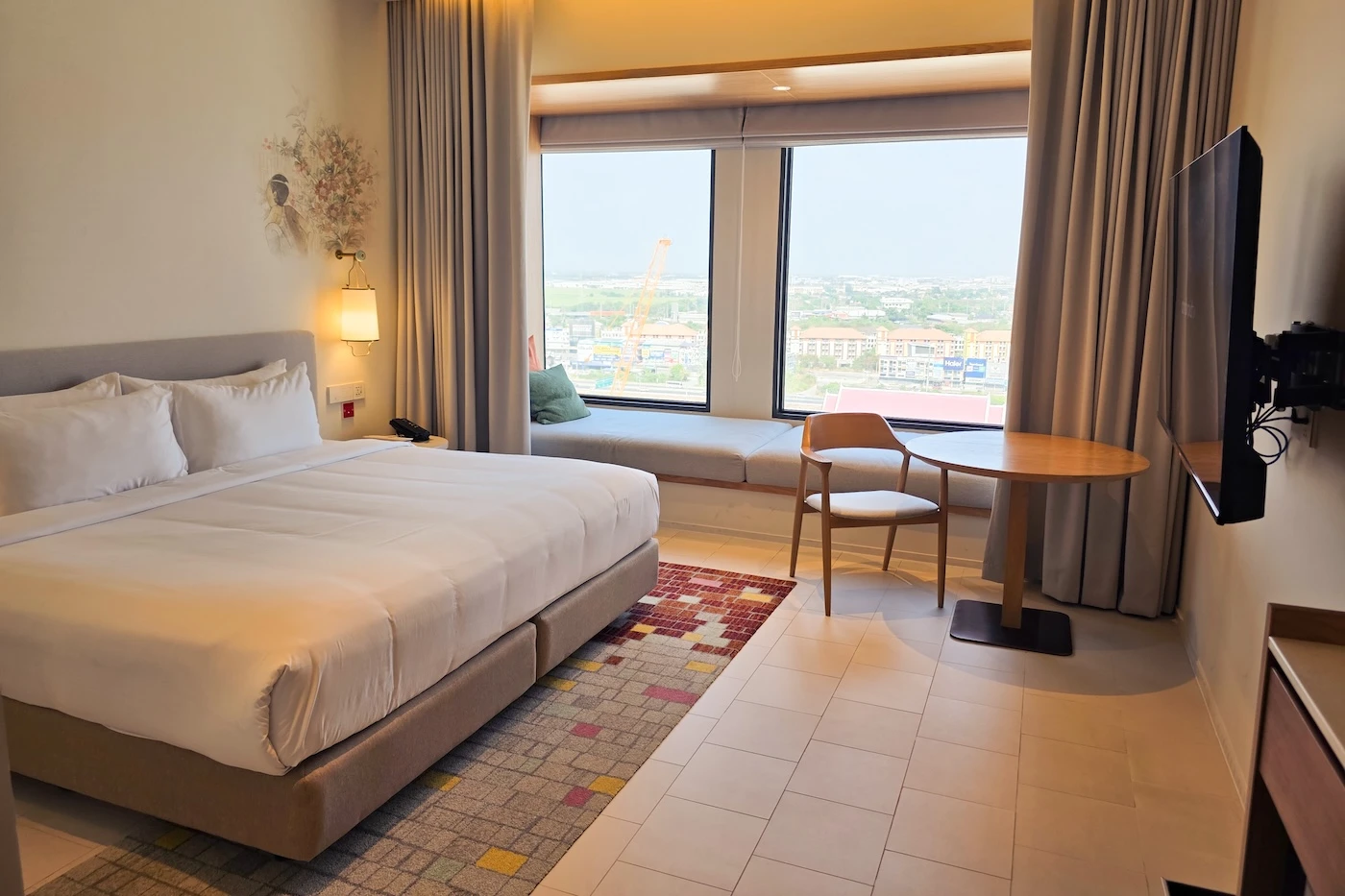
Centara Ayutthaya ($$): this massive business hotel is conveniently connected to the mall and nearby the highway. It has the by far nicest rooms I’ve stayed in for a long while – I’m not exaggerating. Absolutely exceptional value for money, too. If you’re looking for a larger business hotel with epic rooftop pool and you have a rental car, this is the one for you.
—
Sala Ayutthaya ($$$): this 26-room boutique hotel is exquisite. We stayed a few years ago now, but it continues to wow people to this day. It’s all about the design – modern, sleek interiors and an exceptional pool with a view. We’d highly recommend checking it out for something luxurious and a little different. It’s also ideally located for an easy walk to the ruins.
–
Where and What to Eat in Ayutthaya
Ayutthaya doesn’t have a lot of flashy, international cuisine like Bangkok, but you can still get a pizza or burger, as well as all the typical Thai staples at super affordable prices. There are a few well-known local offerings, too:
⬩ Boat noodles are famous in Ayutthaya (called kuay tiew ruea)
⬩ Roti sai mai are snacks, kind of like spun candy floss strings in a crepe, that you can pick up down on the riverfront along U-Thong Road.
⬩ River prawns are another major draw, fresh from the local waterways. Apparently they can be enormous – like, somebody told me half a kilo each but I find that crazy.
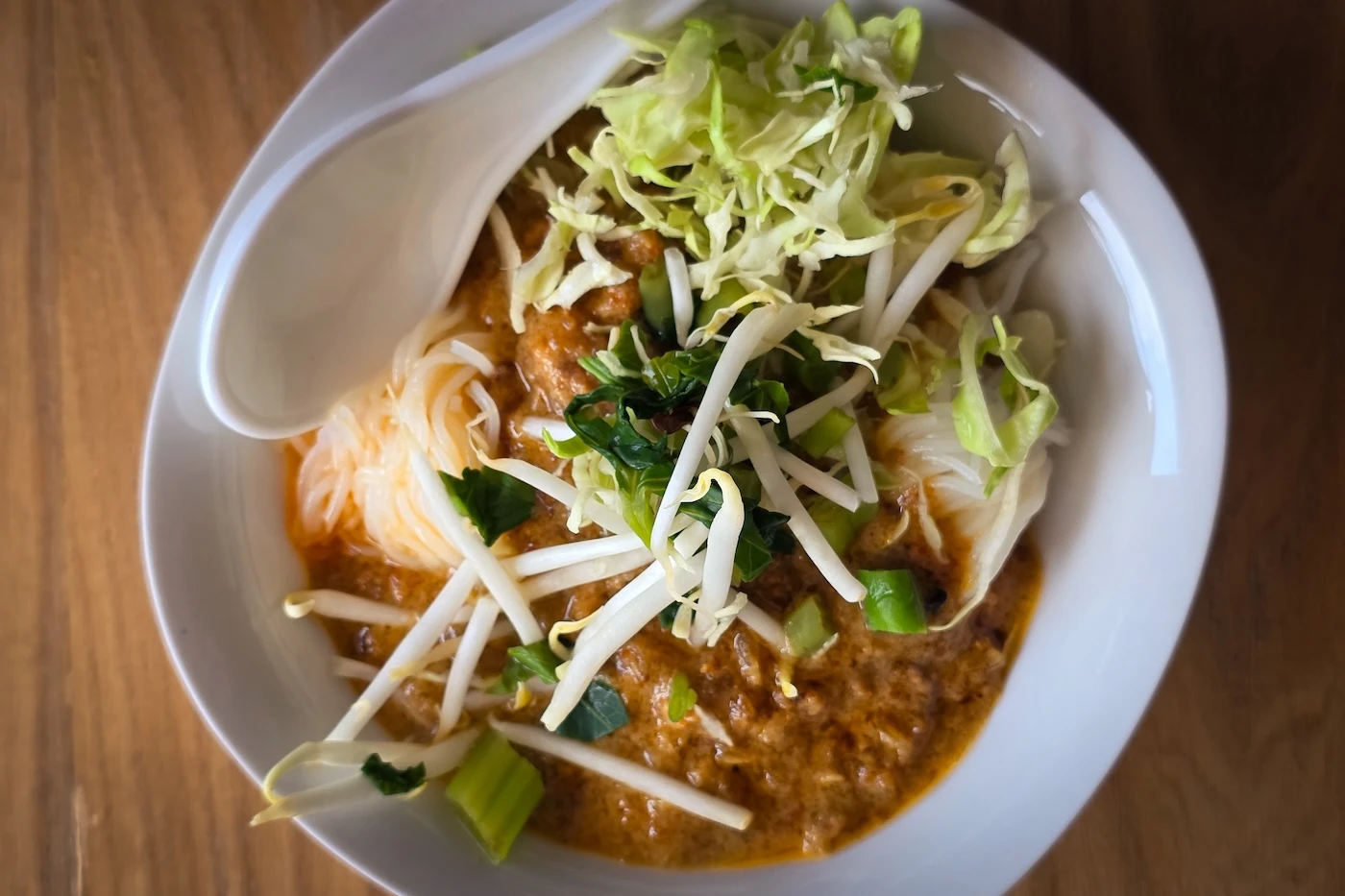
⬩ Khanom Jeen (fermented rice noodles) is another dish linked to the ancient Ayutthaya Kingdom.
Below are some of our recommendations from our four visits (with a bit of a veggie slant):
For Breakfast/Lunch
⬩ Ranahat Je Vegan Restaurant: super affordable, typical buffet-style vegan Thai food, great for a filling meal first thing in the morning or lunch.
⬩ Youta Jay Vegetarian Food: another top notch budget veggie buffet place – we stopped at this and the one above earlier in the mornings when we needed a proper-sized meal.
⬩ Sukunya Somtum: a perfect spot for lunch right next to Wat Mahathat. It’s got all the typical Thai offerings, including veggie meat alternatives. They’ve always exceeded expectations for us (we’ve been more than once).
⬩ Demure Cafe: best coffee/drinks we had – get the honeycomb one (also has aircon and is right next to the ruins which is a big plus).
⬩ Khanom Jeen Ton Kampu Ayothaya: this one was really nice, but I have no idea if there was meat in my peanutty noodle dish or not! It tasted good, either way (and I’ll never throw away food even if it has meat in) – so definitely check it out if you’re a meat eater, maybe avoid as a vegetarian!
⬩ Busaba: upmarket, bright, and modern with aircon, innovative food (although we only went for the crazy desserts and drinks), great for a cool-off lunch spot.
⬩ Pa Lek Boat Noodle: I’ve not been here, but it’s famous for the meaty boat noodles.
For Lunch/Dinner
⬩ Sampaonava: quite fancy, imaginative menu, riverside, incredible veggie options (one of our favourites for a nice evening).
⬩ The Summer House – nicely set along the river and an ideal location if you’re looking for a place to get a drink after the Japanese Village or returning from Bang Pa-In Palace, comfy, air-con, with insane desserts (when we’re inundated by meat options, we panic and eat a lot of desserts because we’re super healthy like that).
⬩ River Bar Ayutthaya: lovely riverside setting in the evening, thoughtful menu, perfect for cocktails and seafood (not the most veggie friendly, but we went for the bevvies and views).
⬩ Kung Phuean Praew: I’ve not been to this one because prawns, yunno, but it’s a very well-known local spot for river prawns and seafood outside of the main island – definitely worth visiting if you have a rental car (or take a taxi).
A bunch of the ‘nightlife’ spots mentioned further down are also good dinner alternatives.

Snackies
⬩ Roti Sai Mai: try literally any of the locations on U-Thong Road (the most famous place is Roti Sai Mai Abeedeen-Pranom Sangaroon, but I like to spread the love since they’re all making basically the same product).
⬩ Khanom Mho Kaeng Mae Yai: super cute spot, with loads of super affordable traditional desserts to eat in or take-away. We had some kind of square dense coconut things (maybe with taro or something?) and it was excellent.

Nightlife
Ayutthaya isn’t exactly a party all night, Khao San Road kind of a vibe, and surely that is a good thing, right?
There are still a selection of bars, restaurants and things to do in the evening, they’ll be unlikely to play Clubland ’93 at full volume. Having said that, there are quite a few dodgy late night spots in the new town around the Grand area, near the Balloon Ayutthaya Night Plaza.
Options on the island area include:
⬩ Earthling Craft – Coffee & Bar: quirky spot with decent drinks and pizza
⬩ Brown Ale Ayutthaya: banging little craft beer place with live music
⬩ Norrasingh Craft Beer Bar & Restaurant: live music at weekends, decent beer on tap, really comfy (my favourite evening spot)
Some Practical Information
1. Dress Code at the Temples
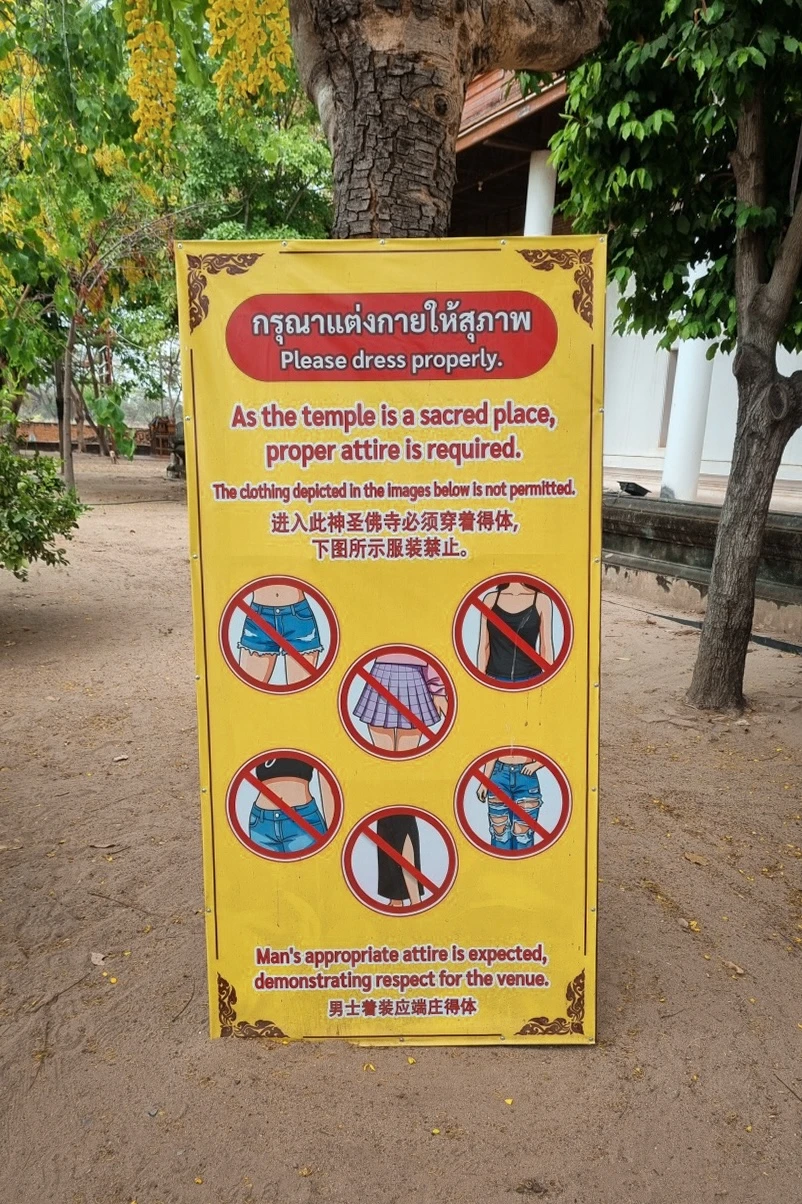
Although Ayutthaya’s ruins are ancient, they’re still sacred to some and are full of images of the Buddha. It’s essential to dress appropriately, even if it just seems like you’re wandering through bricks.
There are also active Buddhist temples that are worth visiting in Ayutthaya, too, which you should obviously dress respectfully for. The Chao Sam Phraya National Museum has a similar dress code as there are depictions of the Buddha, and Bang Pa-in Palace is very strict on clothing. If in any doubt, assume the dress code below applies everywhere.
There is a sign outside each of the official temple sites we visited that says:
⬩ No strapless tops
⬩ No tank tops
⬩ No wide neck tops
⬩ No crop tops
⬩ No shorts/low waist pants
⬩ No mini skirts
I’d also suggest not wearing pyjamas or ripped clothing, either.
This means you can wear leggings (I always do) and sports tops as long as they cover your skin adequately (which is good because these are ideal for active days in flesh-melting weather). Skin tight clothing is not allowed at Bang Pa-In Palace – it’s very strict.

2. Opening Times
All the official Ayutthaya Historical Park temple sites open at 8-8.30am and shut at 6-6.30pm, apart from Wat Kudi Dao and Wat Maheyong which close at 4.30pm.
These times seem to vary depending on who is working on the day.
Some days we’ve been hastily ushered out at 6.10pm by a frantic, flailing dude who was clearly desperate to get home. Other times, we’ve lurked around until nearly 7pm and nobody really cared.
In the morning, we’d turn up at 8.30am, only for the site to already have a bunch of people in – so it clearly opened earlier than the published time!
It’s hard to know – Google is definitely not accurate!
3. Stray Dogs
We have heard (third hand) about issues with aggressive stray dogs around Ayutthaya, but over the four trips we’ve had, there have been no interactions with any.
This includes early mornings and evenings, inside and outside the island.
So we’d recommend being cautious, but not scared.

Google Map of Ayutthaya
Below is a Google Map with markers for absolutely everything mentioned throughout this post. It’s colour-coded as per the below:
Yellow: Ayutthaya Historical Park Temples
Brown: other temples
Purple: temple parking
Dark green: ferry and train station locations
Mauve: other places to visit
Blue: ticket booths
Red: food and drink
Light green: hotels
To save this map, select the star next to the title.
HAVE WE HELPED YOU PLAN Your Trip to Ayutthaya?
If you’ve found our content helpful, consider booking your rental car (if you need one!), through the company we always use – Discover Cars. They’re the absolute best and have been our rental companion (and savior, thanks to their insurance) in many destinations across the world.
If you don’t drive, secure your overland transport through 12GoAsia – they’re who we use for all our bus and ferry journeys.
Also, consider booking you accommodation through Booking.com – we use them exclusively when travelling in southeast Asia.
–
Where to Next?
If you’ve made it to the bottom of this enormous guide, then I congratulate you! Ayutthaya Historical Park is a super fascinating place, and I hope my pervasive enthusiasm for it has won you over (if you weren’t already sold).
If you’re like me and enthusiastic about all things old and brick, check out Sukhothai Historical Park, too, for something a little different!
For visits to both, we wholeheartedly recommend renting a car, so have a read of our guide that tells you literally everything you need to know about taking a road trip in Thailand.
Have a fantastic trip!
Hi, thanks for visiting our blog! If our free content has been of help to you, or you’ve just enjoyed our random ramblings and musings, say thank you by buying us a coffee! It helps keep The Restless Beans blog up and running.
Thank you, Claire + Nick


