

· SOUTHEAST ASIA · THAILAND · BIG ISSUES ·
How to Travel Ayutthaya Responsibly: Beyond the Pagodas and Prangs
Scribbled by Claire ⬩ 28 Apr 2026
Are you planning your trip to Ayutthaya, but have concerns about the elephants and disrespectful tourists? Find out everything you need to know about how to travel here responsibly (and why I was supremely uncomfortable with the elephant situation).

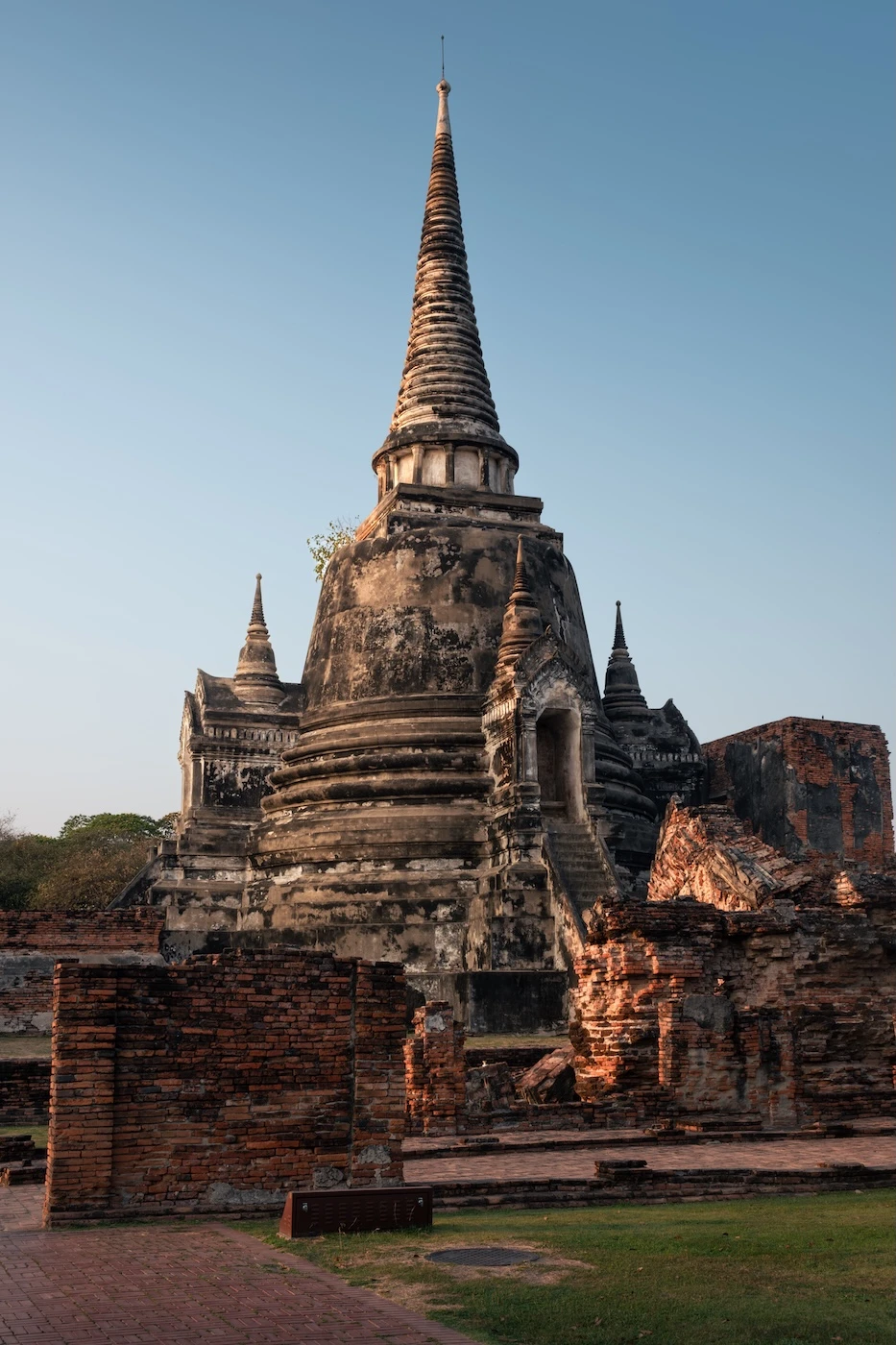
The UNESCO designated site of Ayutthaya is Bangkok’s most popular day trip, receiving more than three million visitors a year (it had 3.7 million visitors in 2008 according to the Thailand Department of Tourism, so it could quite possibly be a few more now).
I’ve been a part of that Ayutthaya tourist count four separate times in the past few years.
During my trips, I’ve observed countless elephant rides traipsing alongside the convoys of white-van tour groups coming from the capital city. I’ve watched semi-naked photoshoots under 500-hundred year old religious statues. I’ve stood beside throngs of jostling tourists trying to get that iconic selfie photo with their back to the Buddha, without any consideration that they’re in a sacred site.
The casual visitors that rock up to witness some of Thailand’s most impressive archaeological ruins don’t always do it with the care and consideration the site warrants. It seems to me that because it’s a popular guided day-trip excursion, their approach is often to treat it more like a theme park experience.
These thoughts have been causing me some discomfort for a while now (not just in relation to Ayutthaya, sadly) and, as I just came back from a trip there, I thought I’d write about a few things we should note as tourists before we go.

IN THIS GUIDE //
Ayutthaya’s Elephants and Ethics
The Issues
The Elephant Problem
– Ayutthaya’s Elephant Story
– Modern Day Elephant Culture
– What Will You See Today in Ayutthaya?
– Are Ayutthaya’s Elephants Treated Ethically?
– What Can We Do?
Other Problems
– Economic Disadvantages of Short Visits
– Cultural Insensitivities
Where to Next?
This post may contain affiliate links. If you book through these links we may make a small commission at zero cost to you. It helps us pay for the upkeep of this blog. Thank you!
A Summary of the Issues
So, as I mentioned, the site at Ayutthaya is unfortunately not without issue.
First and foremost is the explicit elephant tourism which, even towards mid-2026, is still openly offering elephant rides alongside the ruins and roads of the Historical Park. It’s actually my primary motivation for writing this post.
Elephant exploitation is a hot topic across Thailand, as a whole, right now and one that I can’t ignore, having encountered countless numbers of captive elephants over my very recent road trips throughout the country. I’ve seen them tied to trees in temples, transporting passengers behind diesel-chugging buses on congested roads, and swaying and pacing around enclosures while surrounded by tourists.
The worst part is, I’ve never once gone out of my way to see an elephant in Thailand. I’ve not even visited an elephant sanctuary – all of these uneasy observations happened during random moments on road trips, which just demonstrates how widespread this issue is.
It shocks me, every single time I see it. However, I really want to specifically draw attention to the situation in Ayutthaya, as the uncomfortable jolt I felt there was the most pronounced I’ve had in a while.
Along with elephants, there are other concerns to be aware of in Ayutthaya, too. Things like the inevitable economic disadvantage that occurs when people only visit as a hurried day excursion from somewhere else, and the wide-ranging lack of cultural sensitivity I’ve seen that accompanies these visits.

FIRST TIME VISITOR TO THAILAND?
If this is your first ever trip to Thailand, have a look at our monster-guide to visiting this beautiful country, which includes tips on money, food, transport, logistics, culture and more.
Also, if you’re landing in Bangkok, consider having a look at our overly ambitious one-day Bangkok itinerary (we live here, so we know it well).
Or check out our massive Thai island rundown – to help you choose your ideal one!
–
RELATED POST | A SOUTHERN THAILAND ITINERARY
The Elephant Problem
So, let’s start first with Ayutthaya’s elephant issue.
Ayutthaya’s Elephant Story
These majestic, house-scale pachyderms have an extensive and strategic history at Ayutthaya (and in the previous Siamese capital of Sukhothai, too). Their strength has been utilised for centuries by residents for security, battle, transport, and labour (Ayutthaya was Siam’s capital from 1350 to 1767 and was, at one point, the largest city in the world).
Historical reports have estimated enormous numbers – 500, 3000, and even 10,000 elephants in Ayutthaya – used for everything from delivering monk robes to capital punishment (which is a pretty gruesome notion, isn’t it?).
These elephants were kept within a kraal. A kraal is like a corral, or elephant enclosure, designed as a facility to capture, breed, and train wild elephants. They’ve been around basically since the city came into existence, in one form or another.
There are two which still exist in Ayutthaya today. One is outside to the north of the island, where the captured elephants were initially held after being hunted in the forests. The other is near the Grand Palace in the centre (this one is locally named Phaniat). If you’re on Ayutthaya’s island where the main temple complex is, you’ll likely see the latter (it’s kind of hard to miss).
In present day, the two kraals are home to between 70-90 elephants from recent reports, which is one of the largest concentrations in Thailand.
Modern Day Elephant Culture
Elephants are still revered in Thai culture, as they have been throughout the history of Siam.
However, contemporary research has been published about the injustices elephants have suffered from centuries in human captivity. This has naturally created complications for the traditional, cultural relationship between resident and elephant.
Unfortunately, it’s clear in the studies – these are wild animals that do not benefit from interaction with humans. We shouldn’t be doing anything with elephants, let alone riding them.
I’m not going to ramble on about generic elephant welfare – it’s well-known, established scientific fact and I’d just be rehashing the heavily worn-out words of others. Just pop over to World Animal Protection for what they recommend or simply Google elephant tourism and ethical practices.


What Will You See in Today’s Ayutthaya?
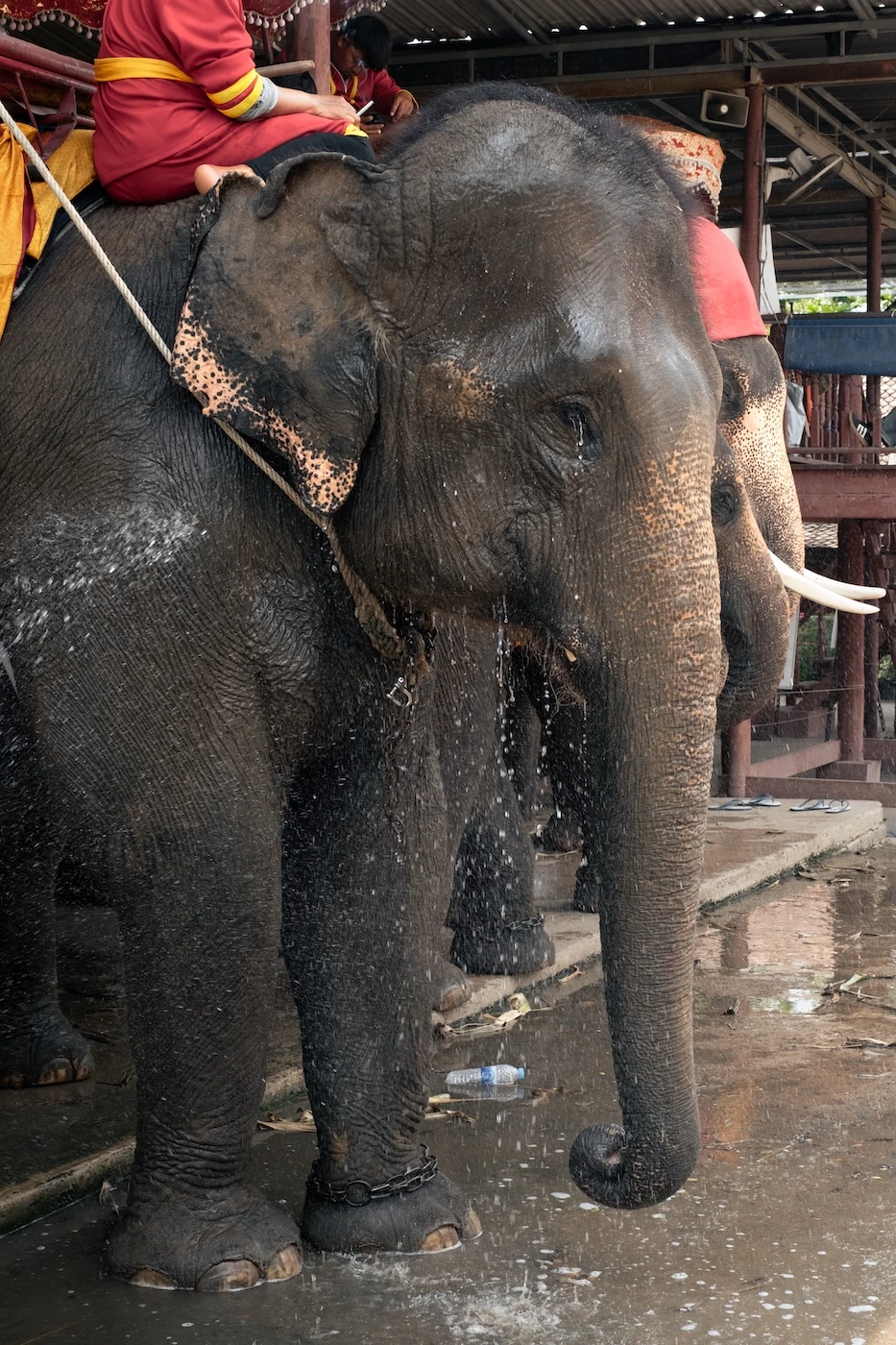
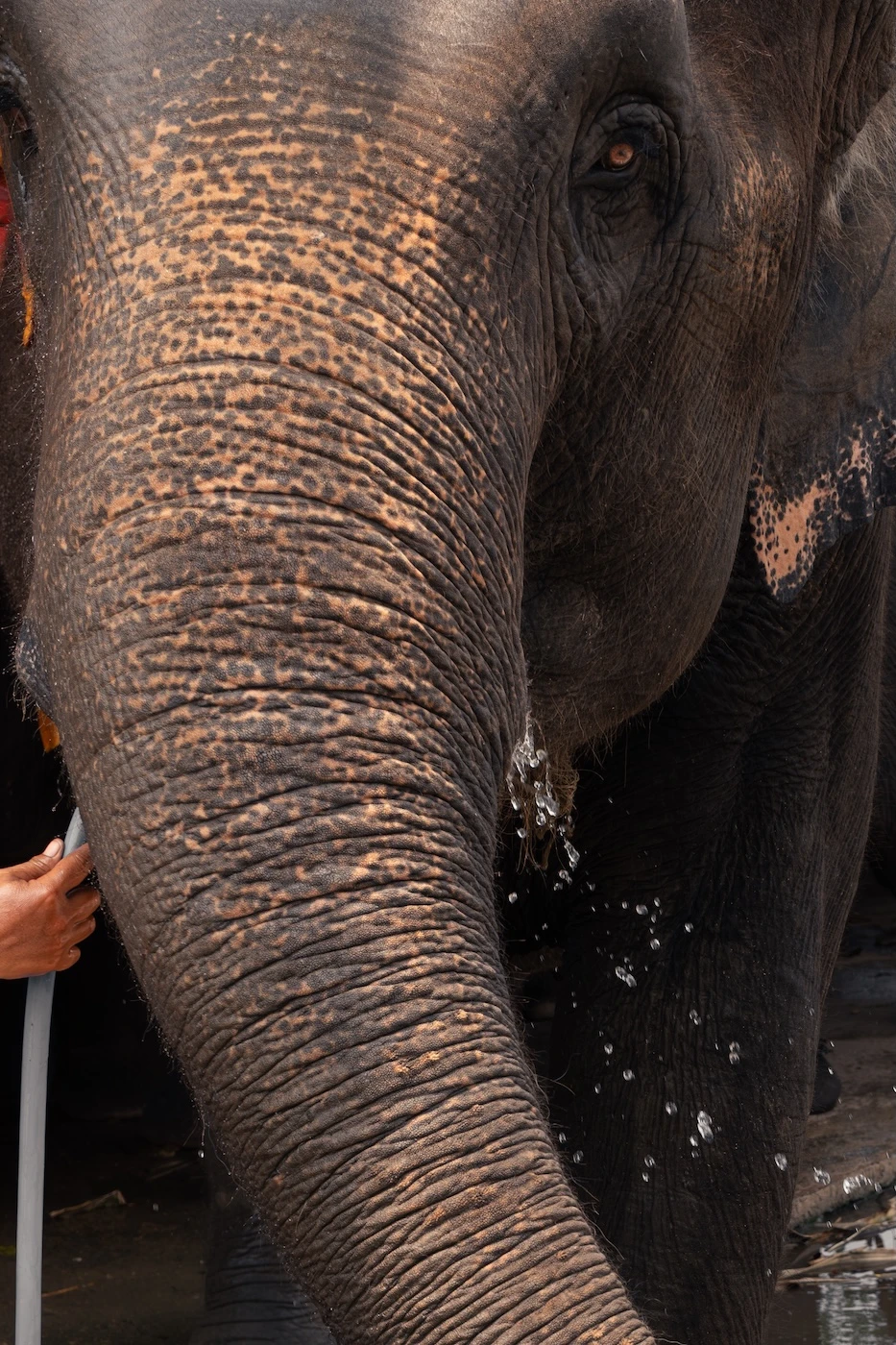
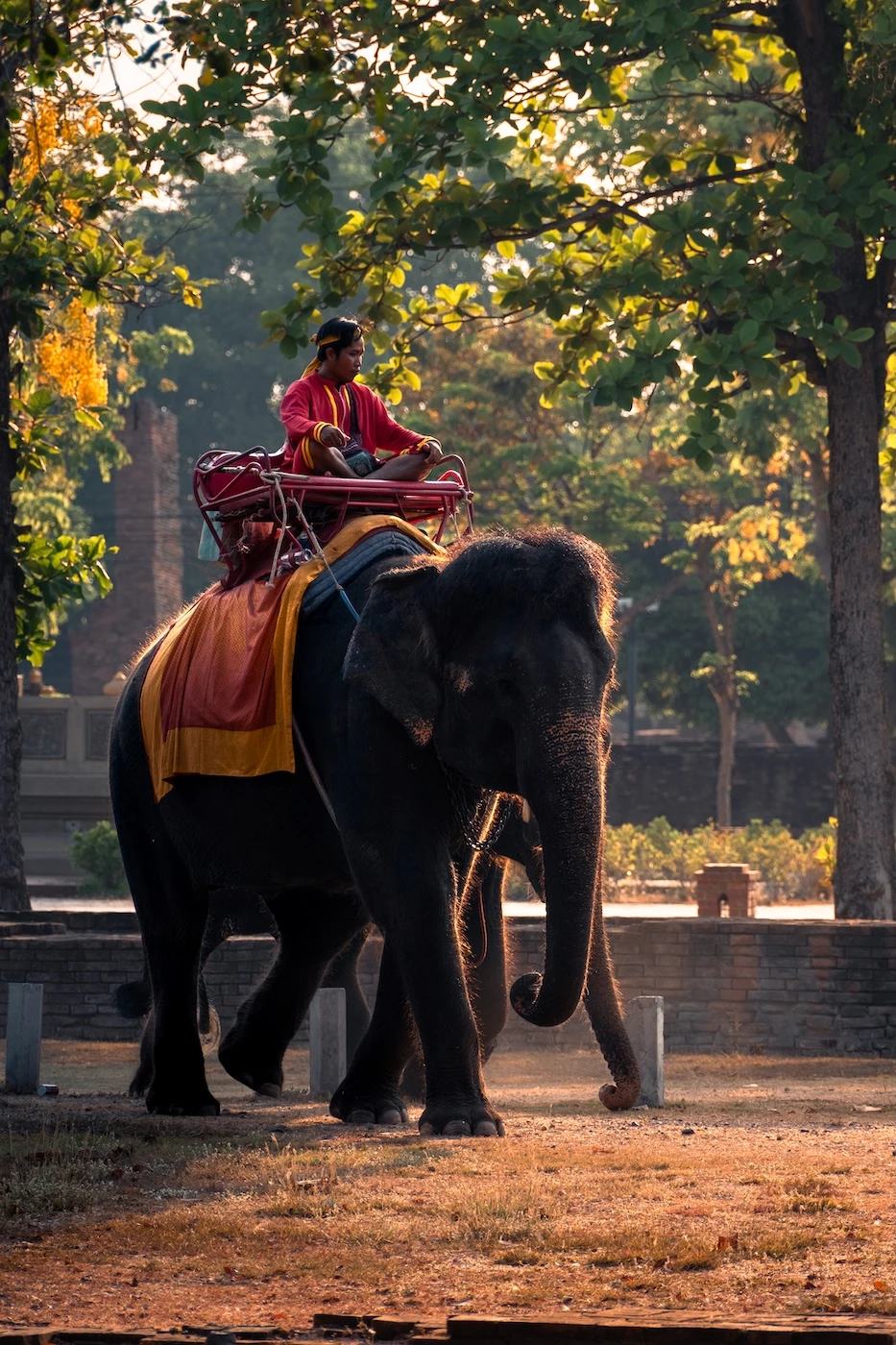
So, if you visit Ayutthaya in 2026, you cannot miss the parades of elephants, often with people sat atop them. There are daily processions, tracing the same steps around the main roads adjacent to the most famous temples.
You can tell where they are made to stand and wait in the sun because the otherwise dusty paths are drenched in urine.
For me, it’s quite heartbreaking to witness.
In Ayutthaya, it seems to me that elephants are treated like part of the furniture. It’s as if they exist there to compliment the ruins, as a historical accessory used to enhance the tourist experience and ‘authenticity’ of the space. This is the only place we’ve ever seen them used like this.
The word conservation is bandied around hard in relation to the kraals, but that’s one hundred percent not what that is. It’s basically greenwashing to let tourists think that these elephants are here for their own good, which is not what this appears to be.
Are Ayutthaya’s Elephants Treated Ethically?
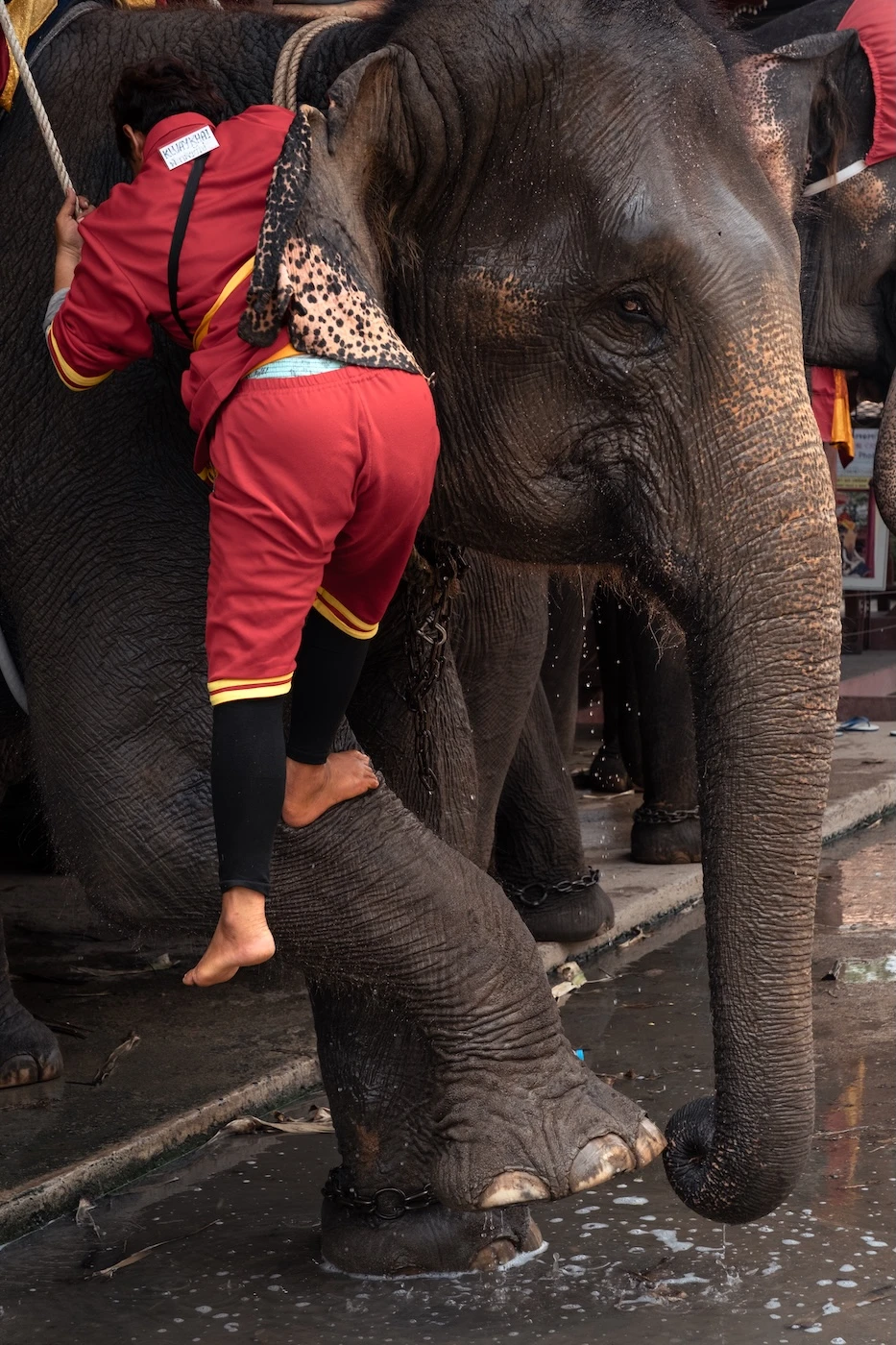
According to globally recognised standards, the elephants in Ayutthaya are not treated ethically, nor to an appropriate standard of care. Beyond the obvious riding and tourist interactions, there are further issues.
⬩ Any truly ethical elephant sanctuary will not have babies born in captivity intentionally (several have been born recently in the Ayutthaya Kraal and they’ve had at least 80 successful births since 2000).
⬩ Elephants should never be trained to entertain humans with tricks (reviews have reported this happening).
Tour guides will tell you that the elephants would starve without tourists. However, elephants keep being bred – so that, to me, implies that they are intentionally bred to provide a service. If it was just about rescue and sanctuary, producing little ones would not be on the cards.
It feels complicated, because either we don’t feed the elephants and end the exploitation, or we keep funding them, and ensure its inevitable continuance. This seems like a no-win situation, but it’s not. One of those choices ends the torment of dozens of elephants. The other perpetuates it.
Alternative elephant experiences
If you’re dead set on seeing elephants in an ethical setting on your trip, consider one of the below sanctuaries:
Somboon Legacy Foundation – Kanchanaburi
Chang Chill – Chiang Mai
Following Giants – Krabi and Koh Lanta
Boon Lott’s Elephant Sanctuary – Sukhothai
There are more hands-off sanctuary options listed on World Animal Protection.
–
What Can We Do?
⬩ The most important action is to (obviously) not partake in, or encourage, any questionable practices.
⬩ It’s also essential to make clear to any guide you hire that it’s not something you are interested in, and explain why.
⬩ Leave honest reviews, ideally with videos and photographs, for anything that you find concerning (and, conversely, anything you find to be excellent!). I’ve seen videos of pacing, swaying, apparently stressed elephants, and they can be quite a powerful statement without having to write a long, wordy review (although words are good, too).
⬩ Avoid day trips that include a visit to the kraals or local elephant camps. Even if you do not participate in activities when there, your money has already been inadvertently used to fund it.
⬩ Talk to people about animal welfare and more thoughtful ways to consider wild animals (I’ve written a little about wild and domesticated animals on my post about Japan’s Nara deer). It seems like such an obvious thing, but loads of people do not know what is appropriate. Share World Animal Protection’s simple elephant tourism guide with anyone who it might help.
Other Problems at Ayutthaya
Along with the elephant situation, there are a few other problems that the city faces with respect to tourism.
Economic Disadvantages of Short Visits
If you visit Ayutthaya on a day trip from Bangkok, you usually pay for your tour upfront, then maybe buy a one dollar coffee in Ayutthaya and, a few hours later, head back to the big city.
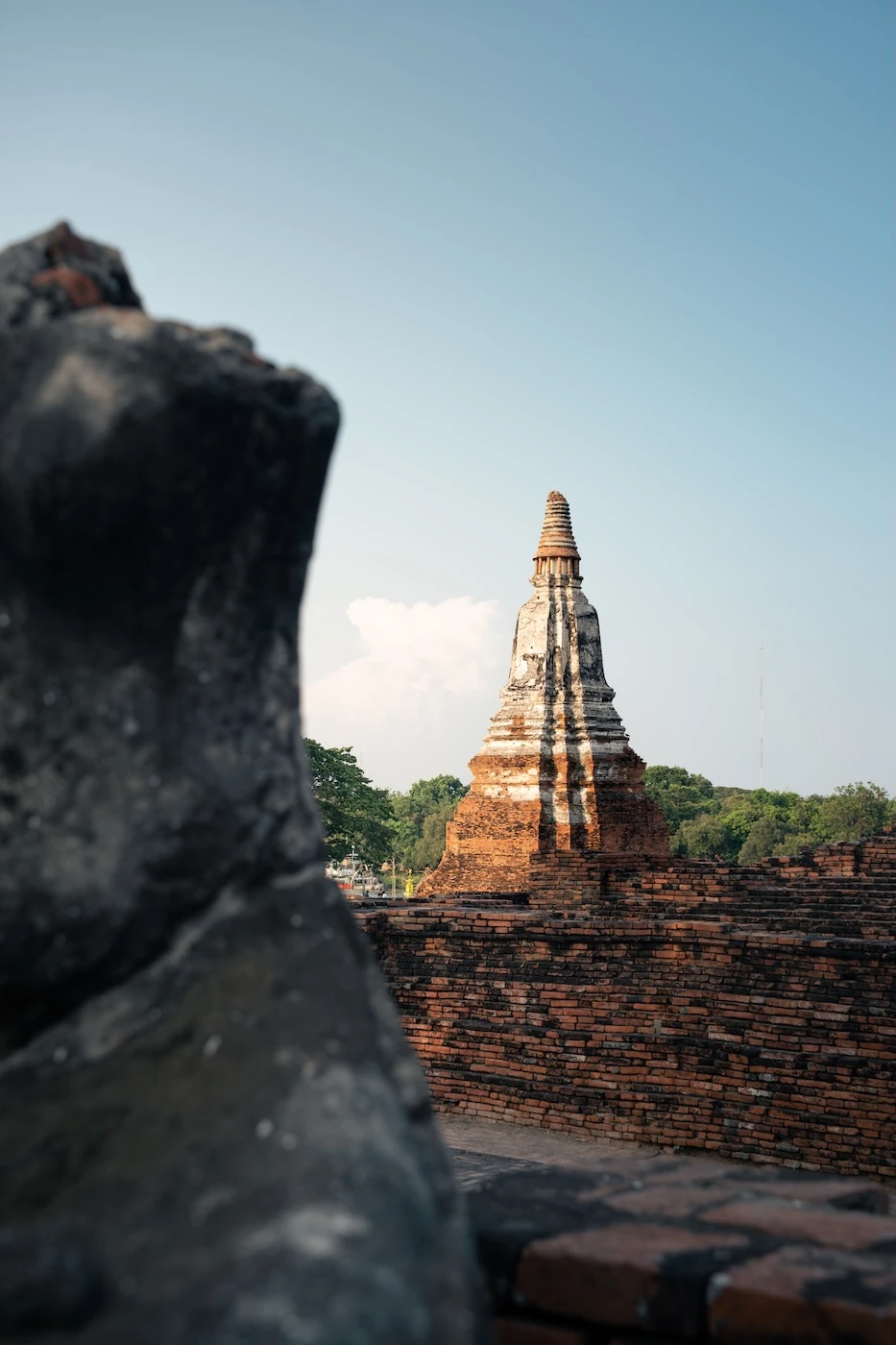
Alternatively, you could visit the city overnight, where you pay a local taxi or tuktuk to take you around, who in turn buys fuel from a local gas station. You buy some coffees or smoothies, a boat noodle dish for lunch, a riverside dinner and a roti sai mai snack. You stay overnight in a guesthouse which provides breakfast made from locally purchased ingredients, and pay a small entry fee to some of the less-visited sites in the area.
It’s all about the financial benefits and disadvantages of us briefly passing through a place versus spending real time there. It’s the exact same argument against massive cruise ships, which cause the exact same issues.
Many tourists, when asked what they want from their holiday, talk about wanting ‘authentic cultural experiences‘. Others talk about ‘seeing local life‘ (not my words – all quotes I’ve recently taken from Thai travel groups!). Despite this, they’ll choose to day trip to somewhere like Ayutthaya, rather than stay overnight.
Cultural Insensitivities
I think culturally insensitive tourists can be found almost anywhere, so it’s no news that Ayutthaya sees its fair share of them.
Below is a quick list of things to ensure you do to make sure your visit is respectful:
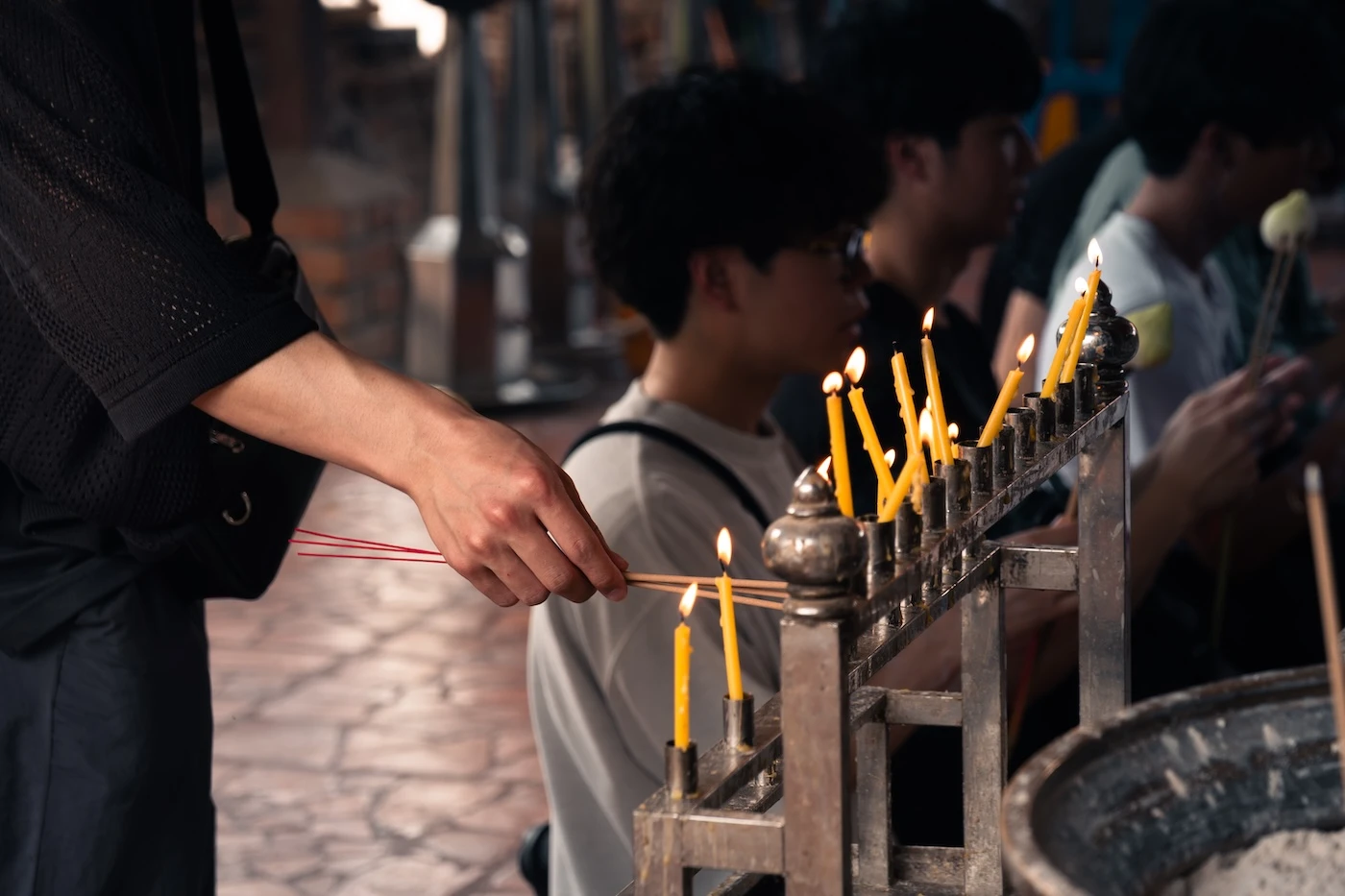
⬩ Dress appropriately – it’s a Buddhist site and a more rural area of Thailand. Cover your shoulders, cover your knees, don’t wear questionable slogans. It’s really hot there, but you’ll actually be cooler by covering your skin.
⬩ Take your shoes off – it’s super obvious, yet so many people don’t do it! Temples (not ruins) often require you to take off your shoes. Follow any signs you see.
⬩ Worship – some online guides and blogs say to visit certain spots early in the morning so you can see people actively worshipping or praying. However, I’d advise the opposite. Let people do their religious stuff in peace and anonymity. Nobody wants to be watched and definitely not photographed.
⬩ Selfies – don’t take these with the Buddha, especially the head in the Bodhi tree. It’s disrespectful in Buddhist culture.
⬩ Statues – don’t climb, sit or rest on any statue of the Buddha and don’t ignore the signs that tell you where not to walk (it’s just unfathomable that people do this, isn’t it?).
⬩ Don’t copy others – I mean, this goes for literally anywhere in the world. Just because one person does something, doesn’t make it right. So, always be a good influence and don’t assume others are!
Where to Next?
Thanks for reading my thoughts on the issues Ayutthaya faces from tourism. I’m grateful for anyone who wants to have a smaller (negative) impact on the places they visit.
None of the aspects I’ve written about here are really directly fixable by us as tourists (I’m such a cynic), but we can definitely avoid making things worse ourselves and help encourage others to make better choices, too.
I’ve written more on other similar topics, like Koh Chang’s elephant camps, for example, if you’re interested.
Hi, thanks for visiting our blog! If our free content has been of help to you, or you’ve just enjoyed our random ramblings and musings, say thank you by buying us a coffee! It helps keep The Restless Beans blog up and running.
Thank you, Claire + Nick


