

· BIG ISSUES ·
Why the Bowing Deer at Nara Park Made Me Uneasy
Scribbled by Claire ⬩ 02 Nov 2025
Are you planning a trip to Nara, but kind of concerned by practices relating to the famous bowing deer? I felt a bit weird about it too, so I’ve written about my experiences there and summarised my little bit of research about the deer and their welfare.
I wasn’t originally planning to visit Nara on my Japan trip, but I’m so glad I changed my mind at the last minute. After all, Nara was Japan’s first permanent capital and there’s far more to the city than just the deer.
Before visiting, my concern was for the renowned herds of bowing deer in Nara Park, near Osaka, which made me feel uneasy. I’ve always been told not to feed wildlife, in basically any form, and these deer are exactly that – wild (even though they appear tame). Deer have never been domesticated so, to me, touching them, feeding them, training them, or interacting with them seemed very off.
However, hand feeding purpose-made crackers to the 1200 or so deer, in exchange for a bow from the furry residents, has become quite the famous activity. This image, along with Japan’s almost non-existent attitude towards animal welfare, really made me less than keen to go.
It just gives me very icky, troubled vibes (especially the bowing part – I mean feeding wild animals is one thing, but modifying their behaviour, too?). So, I didn’t feed the deer. I did end up visiting Nara, though, and watched *a lot* of other people feed the deer to figure out how I felt about it.
I also researched about the practice in general – why people feed them, why the deer are there, what the dangers are, information on culling and dehorning and, fundamentally, asking if we should be feeding them?
So, here is my account of our visit, what we saw, what you don’t see as a visitor, a bit of research about the deer herd, and what you should know before you go.

IN THIS GUIDE //
Issues with the Nara Deer
What are the Bowing Deer of Nara?
Why Should we be Concerned About Them?
– What are the Deer Fed?
– Plastic Bags
Are the Deer Healthy?
– Deer Behaviour
– The Treatment Center
– – Controversies
– Nara’s Deer During Covid
– Accidents
Deer Culling
Shika no Tsunokiri: Dehorning
What Did I See at Nara?
Do I Think You Should Feed the Nara Deer?
Is Nara Worth Visiting?
Thoughts on Human-Wildlife-Environment Conflict
Where to Next?
This post may contain affiliate links. If you book through these links we may make a small commission at zero cost to you. It helps us pay for the upkeep of this blog. Thank you!
What are the Bowing Deer of Nara?
The deer of Nara are a special urban herd of sika (or shika) deer found in the eight square-kilometre Nara Park, located in the Kansai Region of Honshu, near Osaka and Kyoto. They’re celebrated for bowing their heads to gain treats from humans, the behaviour of which has become a bit of an Instagram sensation over the past few years.
The local Shinto folklore history of the sika deer in Nara goes back 1400 years. The abridged version is that in 768 CE, an important deity (the Kami – or God – of Thunder) travelled down to Nara, arriving on a white deer. Since then, deer have been considered sacred as ‘divine messengers’, and killing or harming them was an absolute no-no.
Fascinatingly, the Nara deer have remained genetically unchanged since around 700 CE when compared with other herds of deer of the same species. So, it is assumed that they have been cared for and protected by humans from around this time.
In 1957, the Nara deer were designated a national monument or ‘national treasure’ status by the Agency for Cultural Affairs. Since then, they’ve become a tourist sensation, as well as a revered feature of Nara Park.


Why Should We Be Concerned About the Deer in Nara?
Okay, so I mentioned at the top that I felt iffy about encouraging the feeding of mass numbers of wild deer and the behaviour modification that has come with it.
So, in the few sections below, I’ve written a little about some of the things to be aware of in Nara, so you can decide if it’s something you want to do.
What are the Deer Fed?
The deer are fed specially made wafers, crackers or biscuit type products, called ‘shika senbei’. These crackers are made specifically for deer, so don’t contain any added sugar, oil, or salt. They are made of wheat flour and rice bran, manufactured by one particular company.
These crackers are the only food you are permitted to feed the deer.
Interestingly, these deer crackers are thought to have been around since the early 1600s, which is just crazy to me.
Nowadays, they cost 200 yen for a bundle of ten, and are sold by vendors all around the park. You cannot miss them if you’re walking anywhere near Nara Park! Even the packaging is edible (honestly, we saw the deer try to eat everything, so it’s definitely for the best).
The thing for me is, deer really don’t need us to feed them – there is easily enough grass, leaves and acorns around the park to maintain the herd comfortably (it’s a very green area!).
Crackers should only ever be a supplementary treat, rather than the main diet of a deer.
Plastic Bags
Although the deer will try to eat almost anything around, most foods are actually harmful to them. Unknowing tourists have fed the deer all number of consumables, but the authorities are strict on this: only ever feed them the purpose made rice crackers.
It’s also really important not to litter; deer will eat whatever they can find on the floor, including plastic bags and other rubbish. There have been numerous reports of deer dying due to massive balls of plastic in their stomachs – the largest recorded weighing an outrageous 4.3 kilograms.
These tragedies are totally avoidable by ensuring that tourists don’t feed them anything remotely un-crackery, or leave any litter anywhere (that should go without saying, really).
Apparently, as of March 2025, the authorities have installed trash cans in Nara Park (a very un-Japanese decision) after an increase in littering from tourists.


Are the Deer Healthy?
This is a super interesting question. The deer population at Nara is increasing significantly, year-on-year, and apparently they live 5-6 years longer than sika deer in other areas of Japan. This would suggest that the herd was healthy, however it’s a little more complicated than that.
Here are a few things to know.
1. Deer Behaviour
The deer are, understandably, becoming more dependent on humans for food.
The problem with the senbei crackers is that although they are nutrient dense (more-so than grass, apparently), they make the sika lazy. This means the deer don’t forage, graze, roam, or basically walk anywhere! They just behave like cracker-obsessed zombies (we saw hundreds of them just lazing around on the main paths for hours, which is not a very natural behaviour).
To be fair on them, though, if I didn’t have to go out and get my own food, I wouldn’t either.

2. The Treatment Center
There is an on-site treatment facility or ‘deer hospital’ called the Rokuen Deer Preservation Center that was established in 1892, located near one of the main shrines in the park. It looks after unwell or injured deer, like ones hit in traffic accidents. This is the main reason why the deer have an extended lifespan.
The center also segregates pregnant deer to help with the fawns during birthing season (around May) and de-horn male deer ‘to prevent injuries’ in the autumn time.
Interestingly, the deer hospital is located in the protected zone of Nara (where no deer are allowed to be killed) and it’s not clear if they are allowed to euthanise any animal, even if it’s severely injured.
2.1. Controversies
There is another part of Rokuen, which consists of several 2.5-kilometre-square enclosures. These permanently house hundreds of deer that ‘cause trouble’, like crop damage, human injury or are simply found in the wrong place. The deer kept here are considered pests or vermin. This ‘deer prison’ is essentially trapping any deer that stray – which is the natural behaviour of any wild animal, especially within an unnaturally burgeoning population.
It has also been widely reported by a Rokuen veterinarian in 2023 who worked for the Nara Deer Preservation Foundation that the deer in the enclosures are seriously malnourished, and some have died of starvation. She reported that 50 bucks died every year due to malnutrition, and there were pictures released of emaciated deer with their ribs showing and fur missing. The conditions sound pretty grim, from reports I’ve read.
My thoughts are that this enclosure only really exists because of the unnatural environment these deer live in. Far fewer deer would congregate around the park and surrounding regions if humans didn’t feed them. It’s complex, but this problem of deer living (and dying) in small enclosures is one hundred percent a human-caused problem.

3. Nara’s Deer During Covid
The deer of Nara stopped being fed during 2020 because of the pandemic, which created an interesting scenario for scientists that would otherwise be impossible to study: what happens when all the people go away?
There were some surprising results, according to the NDPF’s veterinarian, Rie Maruko, who said that by analysing deer droppings, the deer seemed to be in better health after abstaining from the tourists’ rice crackers and reverting to a more traditional diet of grass and plants.
This is because deer need to eat grass to keep their digestive system healthy and were instead consuming more and more crackers. They apparently devour around 20 million crackers a year, which is more than 60 each per deer, per day – with some even eating up to 200 daily.
It was also worth noting that some deer never really got back into traditional foraging during the pandemic and lost a lot of weight, demonstrating an unhealthy reliance on the visiting tourists.
Since the Covid pandemic subsided, Nara’s deer population has increased by around ten percent each year, even despite traffic accidents killing an increasing number of the herd. This population increase is significant and can be directly attributed to human intervention.

4. Accidents
The result of a growing deer population, combined with a massive increase in tourists, is more accidents (obviously).
These accidents are typically related to aggressive deer attacks and road incidents. Reported numbers vary, but deer fatalities in Nara Park annually sit between 60-150.
Both types of accident are directly related to the feeding of deer, as it encourages them to congregate around people and roads. They are easily avoidable disasters, which is why I’d simply prefer not to feed them.


TAME OR DOMESTICATED?
There is a significant distinction between a tame animal and a domesticated one, even though they often appear to be the same.
If an animal is tolerant of humans, that does not make it domesticated. There are clear differences, including complicated things like genetics.
Domesticated cats, for example, are genetically different to their wild ancestors, having been selectively bred in captivity over centuries (or millennia). There are actual differences in their physical and behavioural traits.
Other domesticated animals include working animals like horses and camels, pet dogs, and farm animals like pigs and sheep.
A tame wild animal might still attack, even though they’ve grown accustomed to the presence of humans, like with elephants, for example.
Sika deer, in Nara, are wild animals. They are tame, not domesticated. Although their genetics have changed slightly due to their isolation and care from humans, they are still designated as wild.
–
Deer Culling
Technically, the deer in Nara Park are protected and therefore it’s illegal to kill or remove them. However, for centuries, tensions between humans and Nara’s deer have been high, due to agricultural damage and human injuries.
In 2016, a record 121 people were injured by the Nara deer. This, in part, led to discussions of culling the growing population, which was agreed to in a certain region surrounding the park, named the ‘controlled zone’ which includes agricultural lands.
Along with this ‘controlled zone’, there is also the ‘buffer zone’, where deer may not be killed but instead are captured and permanently detained in the Rokuen enclosures, mentioned above, to stop them from wandering into other zones.
During 2024, in response to damage on farmer’s lands (and also reportedly due to reports of neglect at the Nara Preservation Center), the areas in which legal deer culling is allowed was discussed to include the buffer zones, too. This was ultimately rejected by local experts, who decided to focus on more fencing, instead.
Despite the ongoing culling, the deer population in Nara Park has risen to its highest ever number of 1465 in 2025, coinciding with an increase in tourism (and, unsurprisingly, tourists feeding the animals).
The thing is, the minimum distance from the centre of the protected zone to the point where deer can be culled is only four kilometres, which really isn’t far to stray. This means that some of the ‘sacred deer’ are culled along with the more common ones.
It’s all rather odd, to me. I know that there are scientifically legitimate reasons for culling large herds of animals. However, the increased deer population density is, at least partly, due to the human encouragement of the deer to be highly localised in Nara’s park. So, it appears that humans have driven the increase in deer and now that they want to reduce it, this unfortunately involves locking up or killing them.
As deer numbers continue to rise, I’d imagine the issue is only likely to get worse.

Shika no Tsunokiri: Dehorning of the Deer
Traditionally, every autumn, the horns of the aggressive male deer are cut off at the Rokuen Center. This ceremony, called Shika no Tsunokiri, has happened annually for 350 years, and is said to be for the benefit of deer and humans to help them peacefully cohabit the region.
Technically, cutting off a deer’s antlers isn’t painful for them, because they apparently don’t have any nerves once fully grown. However, it’s another procedure that isn’t necessary if the deer weren’t in a small, confined area around humans all the time.
It feels a little weird as a tourist activity, plus it costs 1000 yen to watch. I guess, each to their own, but I’m not keen on seeing animals be stressed out unnecessarily so I’d give this one a miss.


What Did I See at Nara?
During our visit to Nara, I saw nothing inappropriate, at all.
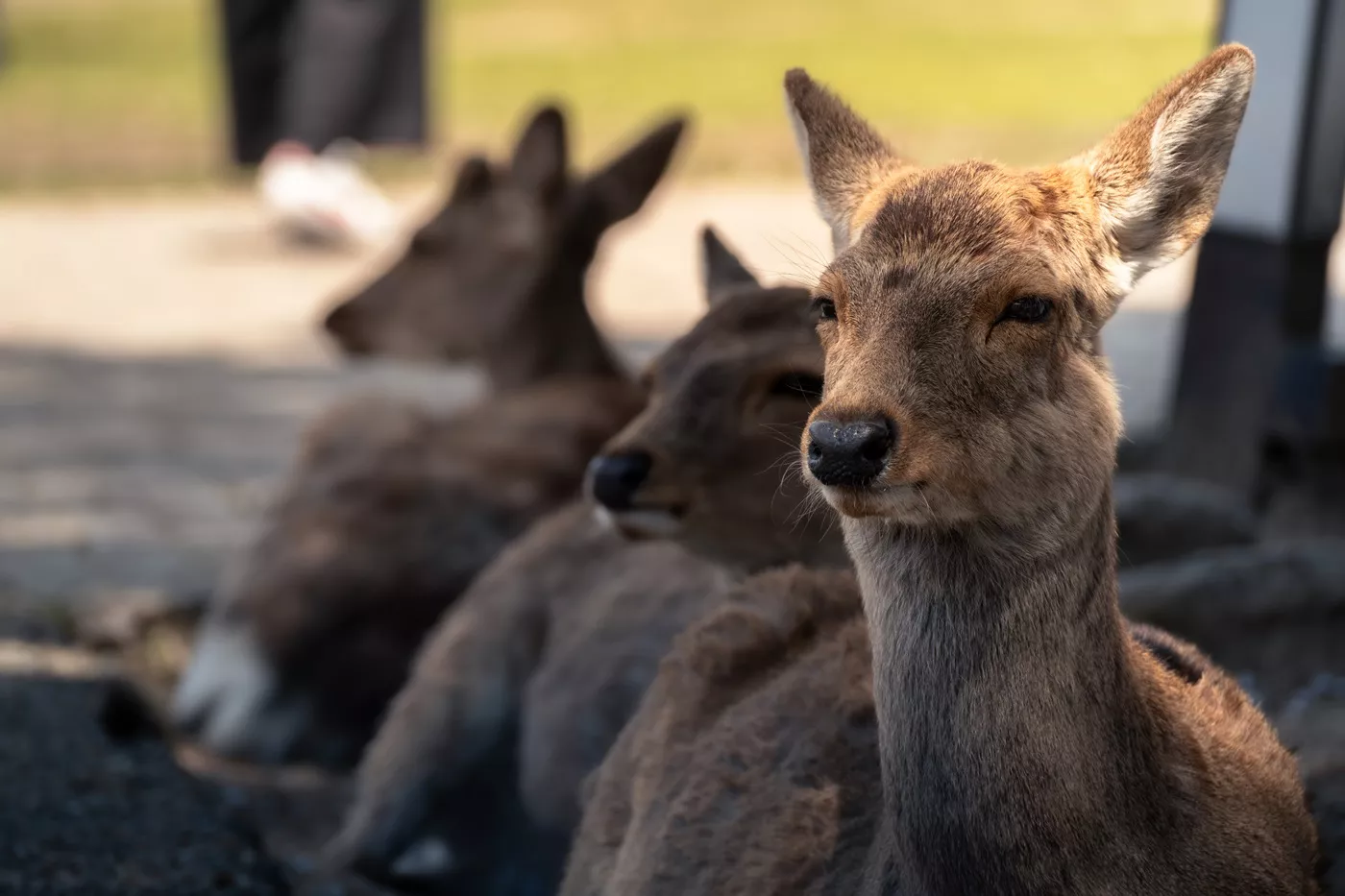
All I noticed were a few people being slightly accosted by overly zealous deer for their crackers, which is to be expected. The deer did not seem skinny or malnourished, and were mostly just laying down chilling by the sides of the roads and paths.
However, we went during peak tourist season (it was blossom time) so there was an over-abundance of tourist-cracker customers. The deer didn’t seem all that bothered by anything, to be honest, and I think there was a serious excess of food (it was busy as all hell).
However, I’m a wee bit cynical and believe that the authorities would likely attempt to hide any issues, so dodgy wrongdoings are not going to be immediately obvious to the average visitor. I think this purely because some of the justifications for deer not being well looked after in Rokuen seemed a little far-fetched.
For example, I saw comments about captured deer starving because they wouldn’t eat anything that had been touched by humans (even though they’ll happy devour a billion crackers an hour straight from a tourist’s hand). Others also said that the food amounts were adequate, but that does not reflect the vet’s findings or the photographic evidence.
These excuses make me think that officials would try to keep the plight of any mistreated deer out of the eyeline of tourists.


Do I Think You Should Feed the Nara Deer?
I think you should decide if it’s a good idea based on all the information you can find.
The best decision is an educated, researched one. Mine was that I’d prefer not to partake in this particular tourist activity, and I’m comfortable with that.
I’ve written a few mini ’exposes’ on various things I’ve seen on my trips around the world (things like Elephant Road in Sri Lanka, cultural villages in Vietnam, Thailand’s elephants, Native Americans in the Grand Canyon and Cambodia’s bat colonies).
They’re often unpopular opinions because, typically, they address an accepted tourist attraction that ended up being far less ethically transparent. However, Nara’s deer are probably the most popular topic I’ve ever written a semi-negative review for, and I’m curious (no judgement) to see how other people interpret the information here.
It’s ethically curious to me how these animals are seen in two very selective ways: as sacred messengers but also as commodities that can be culled if they stray too far out of line.
Japan isn’t exactly known for putting animal welfare at the forefront of, well, anything. It’s just not a mental headspace which they seem to have arrived at yet (animals are popular, but used more as tokens or fashion accessories). I’m hoping issues surrounding Nara’s deer, the exotic animal cafes, and the questionable zoo-esque snow monkey type situations, slowly become more considered, at least by international visitors who share more animal welfare-centric attitudes.
Every little positive action counts.

So, Is Nara Worth Visiting?
There were an absolutely obscene 21 million visitors to Nara in 2024, which means that Nara is a giant attraction for international and domestic tourists. (I mean, 21 million people is more than a quarter of the people in the U.K., which blows my mind, somewhat).
The area isn’t just full of deer, there are also genuinely astonishing temples, shrines, and forests to explore (I’ve included some photos throughout this post so you can see).
If you’re worried about the welfare of the deer and you don’t want to participate in feeding them, it’s possible to visit and not interact with the animals at all. In fact, you could spend an entire day exploring the temples, grounds, and museum without getting near the deer (that’s pretty much what we did).
The temples in Nara were some of the largest and most impressive that we saw around our six-week road trip in Japan. We would definitely recommend visiting if you have some spare time in Kyoto or Osaka.


Thoughts on the Human-Wildlife-Environment Conflict
Humans, throughout time, have altered and destroyed ecosystems (it’s pretty standard for our species). The deer of Nara are just one example where human intervention (in this case, more than one thousand years ago) has resulted in a genetically and behaviourally unique animal that would otherwise not exist in its exact form.
Aside from the religious significance of the deer, should we continue to intervene to preserve this particular genetically unique species that we created? One of the arguments for culling is that the deer in the protected zone won’t be ‘diluted’ by the deer in the buffer and controlled zones (there are whole complex studies on this). So, this pro-culling argument is borne from a need to preserve an artificially bred animal that *we humans made*.
This is a fascinating issue, and not one I have an answer to. It’s a conflict between human attitudes towards animal welfare, societal/cultural significance of the deer, and scientific interest in the genetics.
I just think it’s a thought-provoking problem.


WANT TO TAKE A BETTER TRAVEL PHOTO?
There are three parts to travel photography –
⬩ Planning your trip
⬩ Taking the photo
⬩ Editing the end result
To get the highest quality, most sophisticated photos from your travels, you’ll need to perfect all three (plus a tiny bit of luck).
So, we’ve written a lot of country-specific guides about planning trips to various destinations, and also collated our absolute top tips for taking photos on location. We’ve also written a dedicated post on how to take the best black and white travel photography. Check them out if you’re interested!
We also write about typical editing mistakes to avoid. To complement that, we’ve collated a more intermediate user’s guide to editing travel photography. This covers more elegant, advanced and refined skills, ones that will promote your photos to the centerpiece of anybody’s wall.
–


Where to Next?
This is my little ramble explaining some of the information I looked through before (and after) visiting Nara. It is by no means all the information I read (some was pretty complex), but it’s an interesting topic, nonetheless, and I quite enjoyed writing about it.
While researching this, there were a few other things of note that popped up, beyond the simple animal welfare issues that I thought I’d end up reading about.
For example, there is the zoonosis risk, where an infectious disease spreads between animal and human (think Covid-19 bats). There is no information around the site about the risk of diseases, including known issues such as ticks, despite millions of people touching these deer every year. Nara would be a disastrous place for an outbreak, since the number of international visitors is huge, and the human-animal interaction is one of the primary reasons for people to visit.
Anyway, even if all the information I read was incorrect or inaccurate, I’m still happier not perpetuating any potential problems that come from a human interfering directly with wildlife unnecessarily. It’s not really worth it for the Instagram likes, for me.
I hope something here was of help for your trip!
Hi, thanks for visiting our blog! If our free content has been of help to you, or you’ve just enjoyed our random ramblings and musings, say thank you by buying us a coffee! It helps keep The Restless Beans blog up and running.
Thank you, Claire + Nick


Thank you for providing research on the subject. I found myself also feeling uneasy whilst visiting and just constantly thinking “wild animals shouldn’t bow to humans”.
Although I find the argument to be well researched and justified, I think it’s ultimately a very self virtuous one.
Interactions between animals in general are complex, predator prey relationships for example are often necessary to keep an ecosystem functioning. And it is fundamentally human to want to interact with other animals. Dogs, cats, cows ferrets… Domestication exists because humans instinctively desire to extend their social group to include other species.
We can have an entire argument of if it was ethical to genetically modify wolves and make dogs out of them. But regardless of the conclusion, it was clearly something humans, as an animal, instinctively desired to do.
The relationship between the Nara deer and humans is a similar complex one. There is a genuine desire from humans to coexist with the deer population, but the current animals have a lot of their wild traits. Over time, the culling would create a similar process of domestication as with any other animal living with humans long enough.
Deer in the wild would still need to face food shortages, predators, environmental hazards, diseases … It’s not like they will be objectively better off in all ways without human contact.
So the decision to not feed them feels to me like it does more to feed the sense of virtue of the author than it does to address anything material about the situation.
Thanks for your comment – I love to see what other people think about contentious topics.
Everything I wrote was pretty much pulled verbatim from various articles and studies, all of which is verifiable pretty easily. I’d be really interested to read references for your claims, too, because a few statements would need verification.
I’m not really sure about the self-virtuousness of it all, I mean I just felt icky at the thought of making wild animals perform for me in exchange for food (I’m definitely not the only one to feel this way). This is purely why I didn’t feed them. Due to these feelings, I also thought I’d look into it a bit more and ended up consolidating everything I read, because writing about interesting topics is my job and this one is a banger.
Maybe I am a bit virtuous? I mean, I’m proud to have spent time considering how my actions impact others and I’m kind of mildly okay with that!
In your comment, you haven’t actually concluded about whether you’d feed the deer. I’m genuinely interested to know what your decision would be after reading all the evidence, and why?
Thanks again for your thoughts and have a nice day 🙂
Thanks for the research in this article. We were wondering about the ethics of it when visiting Nara too. Felt really weird watching kids run around and tease the deer with adults just watching and allowing it to happen!