

· MIDDLE EAST · SAUDI ARABIA ·
The Saudi Arabia Dress Code for Women (and Men)
Scribbled by Claire ◊ 17 Jun 2025
Are you planning a trip to Saudi Arabia and are wondering about what to wear? Yeah, I was too before my first trip. Here, I’ve detailed everything I can think of to help you plan what to pack, all while being respectful, comfortable, and at ease.

I was a little nervous about travelling to Saudi Arabia. Not for any of the usual (often incorrect) reasons people might be fearful of travelling to the vast Gulf nation. It was purely because the country felt like such an unknown. Specifically, to be visiting there as a woman and what the Saudi Arabia dress code meant in practice.
Reports of women only recently being allowed to drive, tourism being a reasonably new concept, and stricter conservative rules than previous countries I’ve visited, made me feel a bit on edge.
Having spent about six months in the Middle East, including extensive time in countries like Oman, a traditionally conservative nation, I should have been comfortable with the idea of travelling to Saudi Arabia. For some reason though, I felt an unease.
Saudi Arabia has been a nation heavily inaccessible to the wider world for so long. I was concerned that my appearance would attract unwanted attention and that any attempt to wear anything but a black abaya would draw negative looks, disapproval or criticism.
These quick thoughts are my take on the Saudi Arabia dress code as a woman, after my 8000-kilometre, one month road trip across the country and a second, shorter trip.

IN THIS GUIDE //
Saudi Arabia Dress Code
IS THERE AN ENFORCED SAUDI ARABIA DRESS CODE FOR WOMEN?
– WHAT IS ALLOWED?
RELIGIOUS POLICE IN SAUDI ARABIA
WHAT IS THE TRADITIONAL SAUDI ARABIA DRESS CODE?
– SAUDI ARABIA DRESS CODE REFORM
WHAT I WORE IN SAUDI ARABIA AS A WOMAN
– SAUDI ARABIA DRESS CODE FOR MEN
WHAT TO WEAR AROUND MOSQUES AND IN MADINAH
– WHAT IS HAYA?
WAS IT EVER UNCOMFORTABLE AS A WOMAN IN SAUDI ARABIA?
FINAL THOUGHTS
This post may contain affiliate links. If you book through these links we may make a small commission at zero cost to you. It helps us pay for the upkeep of this blog. Thank you!
Is There an Enforced Saudi Arabia Dress Code For Women?
As of 2019, there is no specific Saudi Arabia dress code for women.
Previously, women were expected to wear an abaya and head covering, enforced by the Saudi Commission of Virtue and Prevention of Vice (CPVPV) – the religious police. Iran has been all over the news recently due to the horrendous behaviour of their ‘morality police’, so is this also an issue in conservative Saudi Arabia?
I’ll write a little more on the CPVPV below, but it’s important to note that, although they do technically still exist, they have few powers now and there are no specific rules about the Saudi Arabia dress code for women.
As with any conservative country, there are unofficial expectations on how women should dress. There are also some official (though vague) instructions on how to behave and what to wear as a tourist, called the Public Decorum Charter. This, plus other (relatively obvious) conservative expectations, make up the Saudi Arabia dress code list of rules:
◊ No clothing with profanity or anything with ‘photos, figures, signs or phrases violating common decency’.
◊ Nothing revealing, only modest clothing below the knee and elbow
◊ No nightwear or underwear in public
◊ No bikinis
◊ No tight, skin-hugging or see-through clothing
◊ No visible religious symbolic jewellery that is not Islamic
What is Allowed?
Any kind of footwear | the Saudi Arabia dress code does not extend to feet! Don’t wear footwear in mosques though.
Make-up | women often wear a lot of (really beautiful) make-up, especially around the eyes in Saudi Arabia. This is accepted, although I’d probably stay away from bright red lipstick and super bright colours.
Patterns and coloured clothes | although traditionally women wear black, colours, decorations and patterns are becoming more popular, especially with younger women. Whether you wear an abaya or not, you do not need to wear black.
Children’s clothing | not subject to a dress code, young children can dress however they want. Until early teenage years, girls can wear any kind of clothing. Customarily they start wearing an abaya, then a hijab follows. Some families start clothing children earlier in traditional dress.

RELIGIOUS POLICE IN SAUDI ARABIA
The Saudi Commission for the Promotion of Virtue and Prevention of Vice (CPVPV), otherwise known as the Islamic morality or religious police, was established in Saudi Arabia in 1940.
This organisation, still functioning today, was, in theory, to act as a spiritual guide for society and to enforce the moral code of Islam. The members were known as mutawa/mutaween (one who compels obedience). In 1976, the CPVPV developed into the controversial form of religious police known today, gaining increased power in government and a widening scope to include smaller towns across the country.
Their main duties were to police Islamic norms and immoral behaviour, by imposing the dress code for women in Saudi Arabia, enforcing prayer times and dividing gender-mixed socialising. These rules, in general, were implemented far more harshly on the women of Saudi Arabia.
Between 1960 and 1980, Saudi Arabia gradually saw the rise of the Sawha (awakening) movement, also named the Islamic Awakening movement. This pushed a ridged, puritanical form of Sunni Islam called Wahhabism.
By 1979, after the Grand Mosque Seizure in Makkah, the CPVPV powers were almost unchecked. This led to the burning of books, the destruction of musical instruments, corporal punishment, attacks on beauty shops, and more. Much of this was directed significantly more towards punishing women than men.
In more liberal circles, the CPVPV were viewed very unfavourably, but generally not fought. Criticism was rare, until a fire in a Makkah girls’ school in March 2002, where 15 schoolgirls died. This was allegedly due to the mutaweens preventing the students from leaving the building for not wearing proper attire.
Over the decade that followed, the powers of the CPVPV were gradually diminished, until 2016, when Crown Prince Mohammed bin Salman effectively removed their role in modern Saudi Society.
In the present day, the CPVPV still exists but does not have police-like powers, is unable to dish out penalties and can only report infractions to law-enforcement. Punishments for violations have been reduced, with fines replacing punishments like flogging.
–
What is the Traditional Saudi Arabia Dress Code for Women?
Although there is no legal Saudi Arabia dress code for women, most still follow the previous expectations and wear an abaya and head scarf, a niqab or, rarely, a full burka. It is unusual to see a woman’s face or hair outside of the home in Saudi Arabia.
For reference:
◊ An abaya is a kind of loose, full-body robe, covering the arms, all the way down to the feet. The abaya can be open at the front, buttoned or zipped up, or a full over-the-head dress. It covers all but the head, feet and hands. They come in all colours and can also be very decorative, but darker colours and black are the most common in Saudi Arabia.
◊ A hijab can refer to modest dress in general, or specifically a type of headscarf, normally square in shape that covers the head and neck.
◊ A niqab is a face covering that leaves a gap for the eyes. This was a very common item of clothing for women when I visited Saudi Arabia.
◊ A burka is a full face and body covering, usually including the eyes, sometimes with a mesh to see through.
In Saudi Arabia, the vast majority of women wore a black abaya with a black niqab. Some women wore a hijab and an abaya, and few adorned any colour but black. I didn’t see any women in western clothing. Much of the time, the women I saw wearing a hijab instead of a niqab were in modern malls in places like Riyadh and Jeddah.
This is not the case for young children, who would wear clothes typical of children in the West.

SAUDI ARABIA DRESS CODE REFORM
The long-term effect of the infamous Grand Mosque Seizure at Masjid al-Haram in Makkah in 1979 was the strengthening of Islamic conservatism, resulting in the implementation of compulsory abayas for all women, residents and visitors alike. By the late 1980s, women were even banned from using swimming pools.
During the 1980s and 90s, the religious police became more extreme, harshly enforcing attendance at prayer, gender segregation and the Saudi Arabia dress code, especially for women.
In 2015, when King Salman was throned, he decided that the black abaya was no longer mandatory; any colour and pattern was allowed.
Between 2017 and 2019, significant societal reform was enacted. This benefitted women who were previously unable to drive, attend sporting and entertainment events with men present, or gain a passport without male permission.
In 2018, Crown Prince Mohammed bin Salman explicitly said that women did not need to wear an abaya or hijab in public in order to follow Islam. This permitted many women to choose what outer clothing they wore for the first time.
–
SAUDI WOMEN’S FOLKLORE ARTFORM | BEAUTIFUL PLACES IN SAUDI ARABIA
What I Wore in Saudi Arabia as a Woman
I did not wear an abaya, niqab or hijab while in Saudi Arabia, although I considered it.
It was a tricky thing to decide since I wanted to fit in and not be gawked at, but I also did not want to purchase an item of clothing I wouldn’t wear anywhere else. Plus, I’m an excessively warm person who doesn’t want to wear a long black dress in warm weather!
I chose to wear thick, black (very non-see-through) leggings, a flowy skirt that reached below the knee, a plain, loose black t-shirt that wasn’t low cut and a thin hoodie type jacket that covered my arms. For an entire month, I wore this exact outfit!
I also carried a black scarf, often worn around my neck. Occasionally, I wore this scarf over my head in areas I felt to be a little more conservative.
When I arrived in Saudi Arabia I wore a headscarf until I felt comfortable enough to take it off, which was about a day into our trip.
My Experience
Personally, I did feel stared at. However, it seemed like it was because I wore western clothing and I’m (very) white, not because my clothing was a concern to anyone.
I felt like a curiosity, rather than an offence. Residents appeared to enjoy noticing us and would shout, wave and greet us kindly (sometimes from cars in precarious positions!). When I spoke to Saudi Arabian people (occasionally in depth) about clothing, it was suggested that I was dressed adequately for a female tourist in Saudi Arabia.
It’s interesting, because although I wore western clothing for the entirety of my trip and was worried about seeming out of place, there were so many western clothing brands (like H&M) selling western outfits in the malls.
SAUDI ARABIA DRESS CODE FOR MEN
Just as conservative expectations are placed on women, similar, but less strict ones are also in place for men. Simply put: do not wear shorts, tight t-shirts, or sleeveless shirts.
Traditionally, in Saudi Arabia, men dress in a thobe (like a long smart, white shirt), or for more formal occasions, a ghutra (the traditional head cloth) or occasionally a kufi (a type of hat).
Nick wore reasonably loose, dark-coloured hiking trousers, a plain coloured t-shirt and a jumper for every day of our trip and didn’t feel he was being stared at (anymore than I did, anyway!).
–
A COMPLETE SAUDI ITINERARY | HEGRA VS. PETRA
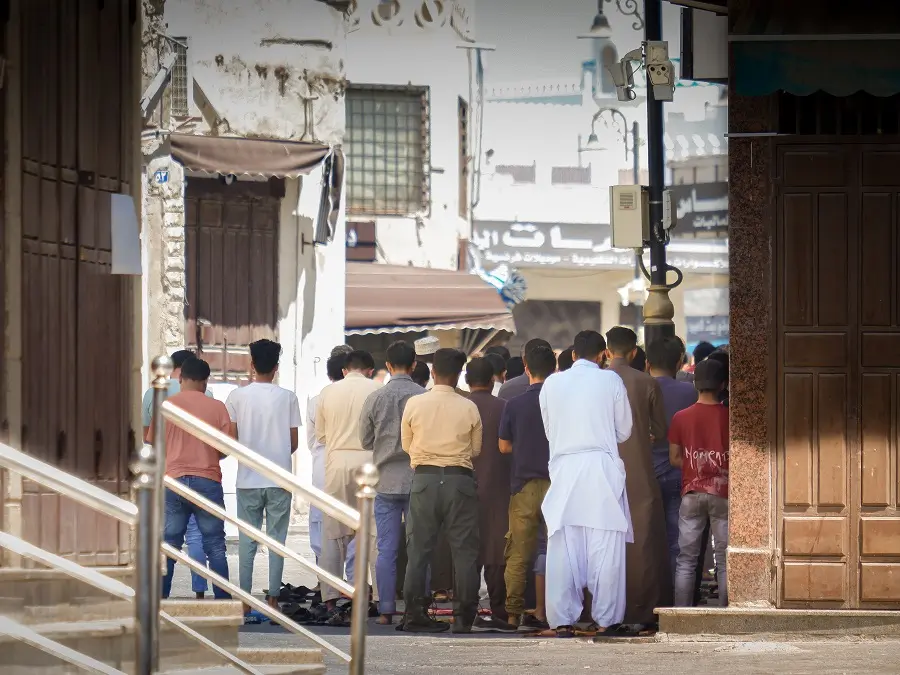
What to Wear in Mosques and Around Madinah
There are specific rules when entering mosques anywhere in Saudi Arabia (and across the world) and visiting the holy city of Madinah.
For women visiting mosques in Saudi Arabia, always wear a headscarf and ensure your clothing is fulling covering your entire body. Better yet, wear an abaya.
Although you can technically walk around the holy city of Madinah dressed however you like, out of respect, at minimum cover your head with a headscarf as a woman. The best option, as a female tourist, would be a headscarf and abaya. If you visit anywhere in the vicinity of Al Masjid an Nabawi, you should definitely heed this advice.
I’m sure others will contest this opinion, but I wouldn’t feel comfortable visiting one of the most holy sites in Islam, as a non-Muslim, not dressed in a way that was respectful for worshippers there.
Also, remove your shoes before entering any mosque.
WHAT IS HAYA?
In Islam, Haya corresponds to ‘healthy shame’ or ‘sense of modesty’. It’s more than just a visual thing or a dress code and relates to all the feelings that could deter a person from behaving indecently. In the Qur’an and hadith passages, the values of Haya require that women cover themselves, but is also used as a term for shyness and bashfulness.
Haya applies to both men and women, encouraging respectful behaviour and modest dress.
So, although you can wear what you want in Saudi Arabia now (within respectable reason), there is also the idea that you should present yourself well. It is more likely that you will be stared at negatively for being scruffy, unclean and unkempt than for wearing western clothing.
–
RELATED POST | RIJAL ALMAA – SAUDI ARABIA’S GINGERBREAD VILLAGE
Was it Ever Uncomfortable in Saudi Arabia as a Woman?
Truthfully, I didn’t feel uncomfortable at all in Saudi Arabia, despite my initial concerns.
Both Nick and I felt we got stared at a bit, but it’s because we looked different, not because we were in some sense offensive.
The only place I felt that people were unpleasant to me, as a woman, was in Al-Balad, the old town area of Jeddah. There was definitely an odd vibe there which I didn’t enjoy (around midday on a Friday, a holy day), where it was only men and I felt very unwelcome. However, I know other tourists have not experienced this and I really rate the area as a beautiful site in Saudi Arabia, so would still encourage any female traveller to visit. I didn’t feel unsafe, just uncomfortable.
Having spent several months in conservative Oman (far from the modern areas of Muscat) and many, many months in the Maldives local islands, Tunisia, Morocco, the U.A.E. and Jordan, we were used to being stared at a bit for being different. It is not offensive and people were always welcoming and inquisitive. The same goes for Saudi Arabia, too.


CAR HIRE FOR YOUR SAUDI ARABIA TRIP
We always rent our vehicles all over the world, including our recent trips in Oman, Saudi Arabia, Tunisia and Morocco, with Discover Cars. They’re often the most affordable, plus they paid out immediately on an insurance claim we made when our car took some heavy damage in Sicily. We fully recommend them.
–
TAKE A LOOK BELOW OR CHECK CAR RENTAL
Final Thoughts – Saudi Arabia Dress Code
To wear or not wear an abaya – it’s potentially contentious, I know.
I was ready to buy one if it felt necessary (shops are everywhere), but I never did during my month in Saudi Arabia. It was a topic I was focussed on before arriving in Saudi Arabia – this meant I was highly sensitive to how I was treated and perceived.
The judgement to dress as residents do is individual – after all, an abaya and headscarf are not technically religious garments, but cultural ones. It has been argued that they are to Saudi Arabia as a kimono is to Japan. I’m not saying that I necessarily agree completely with that analogy, but it’s certainly not the actual item of clothing that is religious – more the purpose of the item.
Another consideration is that if you are a non-Muslim visitor, this is often quite apparent. An unrelated, friendly conversation with a man in a Riyadh supermarket during Ramadan gave me some perspective. He said that he didn’t care if we ‘ate a burger’ in front of him because Ramadan is his holy holiday, not ours, and it ‘didn’t bother him in the slightest’ what we did. Similarly, as long as you dress modestly, most people are not likely to care if you do not wear an abaya as a non-Muslim.
The last comment I have is that it is illegal to take photos of people in Saudi Arabia. So, unlike my usual photography, you won’t see many street scenes, portraits or examples of clothing in this article! Also, I’ve found that generally, it is not a good idea to take photos of women in Muslim countries, many will refuse if you ask – so always ensure you get permission.
I hope this post of my thoughts on the Saudi Arabia dress code for women is helpful for you and clarifies the history and culture around it a little bit.
Let me know if there is anything I didn’t answer. Have a great day!
Hi, thanks for visiting our blog! If this post has been of help to you, or you’ve just enjoyed our random ramblings and musings, say thank you by buying us a coffee! It helps keep The Restless Beans blog up and running.
Thank you, Claire + Nick




Yeah it was good reading, but still I’m worried as I need to go to Riyadh for work as a teacher. So would like to have some idea from you about the same. Do non Muslims who work there wear sarees. I’m really tensed to move on. Please suggest. I have packed some Indian wear Churidars is it ok. How about colour. I love black but wearing black every day ?? If possible please guide.
Hi Julie, have your employers given you any idea about dress expectations? Non-Muslims, from my experience, do not always wear traditional dress, however some do (I know some expats who do for ease). I’m sure that conservative Western dress would be fine if your employers and hosts are okay with it. I’d definitely check with them!
Black is definitely favoured by Saudi women from my experience, so that might help you blend in. I didn’t wear black every day though. If you are covered up appropriately, it is likely to be okay.
As a saudi girl i want to add something, it is totally fine to wear Saree or your transitional clothes if it is non revealing. Plus it is totally fine to wear colorful clothes, we as a saudi if you are a hijabi not a niqabi girl we love to wear a black Abaya because it is more elegant, even if u a niqabi you can wear a colorful one it is okay but it is gonna be weird if you are saudi because we’re not used to it but other nationality no one care. Plus for sure in special occasions, national day or in work place that you need to follow the dress code of the company, i think it is weird to wear Saudi Ghutra and Thob in Japanese national day ceremony so it is the same for Saudi Arabia 😁. I hope this helps u.
If you work in education, you’ll be in a walled-in, all female area. You can wear what you want there as long as it’s modest. I taught in Saudi for years. Riyadh is very modern for Saudi and abayas can be very colourful and use patterns. But you only wear them in areas with mixed gender. And if you are only going out to a mixed gender areas (going to the mall or a restaurant), you can wear anything underneath, modest or not. I wore skimpy pajamas under mine in the summer heat. No one could tell!
Hello,
Thank you, this reading was very useful.
I was wondering, Should it be better to cover my head (not my face) if I participate in a Zoom meeting with a Saudi Arabian company as a sign of respect?
Thanks!
All the best,
Paula
Hi Paula!
I think in some cases I would, out of respect, but it would depend on the company and who you are talking to. I imagine if you were dealing with a progressive company that employs or communicates with people all over the world, they’d expect you to dress however you’d normally dress!
Lots of people travel to Saudi Arabia every day and do not cover their hair. I didn’t for the majority of my trip and nobody minded.
So, I think it’s potentially a nice thing to do, but not necessary nor expected 🙂
Would a v-neck t-shirt be unacceptable? I mainly wear summer dresses when I travel, but I do have a couple that are v cut. I am also going for a formula 1 race, would leggings be acceptable?
Hi Ann,
I think that as a visitor to the major cities, a V-neck would be okay if it isn’t low-cut. I wear a crop top thing under any t-shirt that is a little risky! I wear leggings in Saudi Arabia, but chuck a skirt or something over the top. For the Formula 1 race you’ll be fine – I assume that’s in Jeddah (I was there for it last year!). Jeddah is one of the most progressive cities in Saudi Arabia, I’m sure they’re expecting Westerners to turn up for the race wearing Western clothing. Just follow the rule to not show too much skin.
Have a fantastic time!
Thanks for sharing with us about saudi arabia dress code.
I’ve always admired how Saudi Arabia’s dress code reflects a deep respect for cultural traditions and values. It’s fascinating to see how these practices are woven into the fabric of daily life, offering a unique perspective on modesty and identity. The way traditional attire, like the abaya and thobe, carries such historical and cultural significance is truly remarkable. It’s a beautiful reminder of how clothing can be more than just fabric—it can be a powerful symbol of heritage and personal expression. Thanks for shedding light on this aspect of Saudi Arabian culture!
Hi Claire, I recently found your blog. It is very informative and beautiful photos both you and Nic provide here.
About the odd vibes on Friday noon you felt, I can tell you because Friday is a holy day for Moslems. At noon, the men are obliged to do Friday prayer congregation. They must stop doing whatever they’re doing at the time (working, selling something, etc.). Women usually pray at home because we aren’t obliged to do the Friday prayer. So that’s why around that time you only see men on the street/ public areas. It’s common situation in country with moslem majority (where I live) , altough Saudi Arabia is more strict regarding the rules I guess (never been there before actually)
We have an Acitivity at school and I was assigned to Arab culture and society, reading this did help me to have more knowledge about Arab country. Thanks!
Buongiorno,
complimenti per la precisione delle descrizioni.
Il vostro blog ci sarà utilissimo per il nostro viaggio di Natale in Arabia Saudita.
Vorrei però un consiglio…
Dato che viaggio con mia figlia, e per lei il mare è fondamentale, dove mi consigliate di andare?
Dove potremo utilizzare costumi da bagno occidentali?
Hi Massimo,
Thanks for your comment.
Western-style beachwear can’t be worn on public beaches in Saudi Arabia. However, there are a fair number of private beaches available. These are typically owned by hotels, and if their policy allows it, then bikinis can be worn on the beach.
Some hotels/resorts will include private beach access within the price of accommodation, others might charge extra for it. Buying a day pass from a resort is also an option, and these often include a meal!
Depending on the resort, or the amenities you’re after, the day pass price varies. I’ve seen prices ranging from 100 to 275 SAR (23-63 euros) for adults (and even more expensive too!).
I hope this helps and you have a wonderful Christmas trip.
Hi
Am a bit confused about all this clothing stuff. If am in a hotel can I just carry on being me? That is only bikini bottoms on the beach but dressing for lunch. I also rarely wear eye makeup which I know is a real thing…
Maybe stick to Europe?
Lizzie
Hi Lizzy,
If you are in a Western hotel, depending on the hotel dress code, you can wear what you normally do. This includes bikinis in the private pool or private beach (if the hotel has one). You cannot wear a bikini on a public beach in Saudi Arabia.
It is completely fine to wear or not wear eye make up in Saudi Arabia. It really doesn’t matter, it’s up to you to decide!
I hope this helps with your decision planning.