

How to Drive the White Rim Road in Canyonlands
Scribbled by Claire ◊ 06 Sep 2025
Are you visiting Moab and want to get away from the tourist trail in the most magnificent way? If so, consider driving the immense White Rim Road in Canyonlands National Park! We’ve included permit information, road conditions, car requirements, campgrounds, costs, Jeep hire, driving difficulty and more, to help you plan your perfect road trip.

If you are looking for a unique, adventurous, remote outdoors experience, then driving the White Rim Road in Canyonlands may well be the one for you.
Navigating the White Rim Road in a Jeep is one of my favourite ever experiences. (We’ve driven the entire route, and also hiked down to it, multiple times!).
I’m not sure if it’s the dark-sky nights with the Milky Way glimmering above you, the looming 1000-foot sandstone monoliths, the perfect stillness or the unfathomable vastness of the landscape. They all combine along the White Rim Road to create a national park trip-of-a-lifetime. It’s a breathtaking showcase of geology, nature and adventure.
Along with the outstanding scenery, there are permits required so you’ll hardly see any other people for your entire trip. This is a particularly welcome experience when compared to the crazy-busy Arches National Park next door – the serenity you get from the tranquillity of the Canyonlands desert is tough to beat.
It’s a fantastic journey, but there is definitely some planning, safety precautions and logistics needed to make it the perfect trip (including a slightly complex permit system!). Here, we run through everything you need to know, so that even if you’re a first-time off-road driver, you’ll have the best time!
For more things to do in the area, consider checking out our three days in Moab itinerary.

IN THIS GUIDE //
Adventures on the White Rim
WHAT IS THE WHITE RIM ROAD?
– HOW LONG DOES IT TAKE TO DRIVE?
– WHITE RIM MAP
ESSENTIAL THINGS TO KNOW BEFORE YOU GO
WHAT CAR IS REQUIRED?
THE BEST CAMPSITES ON THE WHITE RIM
– CAMPGROUND FACILITIES
– WHICH WHITE RIM CAMPSITES ARE BEST?
HOW TO GET PERMITS FOR THE WHITE RIM
HOW DIFFICULT IS IT TO DRIVE THE WHITE RIM?
WHAT DIRECTION SHOULD YOU TAKE?
BEST TIME TO DRIVE THE WHITE RIM ROAD
SIDE TRIP TO TAYLOR CANYON
OTHER OPTIONS
FINAL THOUGHTS
This post may contain affiliate links. If you book through these links we may make a small commission at zero cost to you. It helps us pay for the upkeep of this blog. Thank you!
What is the White Rim Road?
The White Rim Road (or trail) is an off road route located in the ‘Island in the Sky’ district of Canyonlands National Park, Utah.
If you have previously been to Canyonlands National Park, you may have spotted the tiny winding white tracks below the Island in the Sky district with the very occasional dot moving along them! That is the White Rim Road. The first time I saw that road from a distance, I was absolutely captivated by it.
It is a 100-mile-long trail (beginning and ending at the Canyonlands Visitor Centre) that loops all the way around below the mesa.
This magnificent route mostly follows the canyons which were eroded by two of the most important rivers in the Southwest, the Green and the Colorado (the confluence is within the national park). From up high, we always thought the terrain looked dry and baron, however up close it was surprisingly beautiful and teaming with life, especially if you visit in the spring when the are wildflowers are blooming.
The road is named ‘White Rim’ because the canyon edges it follows are made from white rim sandstone. This sandstone is more resistant to erosion so is visible around the edges of the lower canyons. It’s very stark.

How Long Does it Take to Drive?
The average trip takes two-three days by car and three-four days on a mountain bike (to travel the entire road).
However, you could complete it in less (in a car) if you were to rush. At a minimum, we’d recommend at least two days and one night (we’ve done it in three days, driving around six to eight hours a day). It is also possible to take on a smaller section of the road from the east or west side and return the way you came (day permit required).
There is no accommodation, water or services (apart from the occasional bathroom) along the route, so you must be able to camp and be self-sufficient throughout the drive.
White Rim Road Map
The red route on the map below is the White Rim route.
Hiking trails from Island in the Sky mesa to the White Rim and spur roads to Taylor Canyon, White Crack camp and the Colorado River via Lathrop Canyon are also marked.
The Potash Road towards Moab can be seen connecting to the trail on the east. The solid black lines are paved roads up on the mesa.
The White Rim campgrounds are all marked along the route.

Essentials and Rules: Quick List
Car | this is a four-wheel drive trail for high clearance vehicles. You cannot take standard cars down this route and definitely not a normal rental car, even if it is a four-wheel drive.
Gas | one tank of gas will get you around the loop, unless you drive it all in first gear! Make sure you fill up in Moab before taking on the drive.
Water | there is no potable water anywhere on this trail. The advised minimum amount to bring is one gallon (or four litres) per person per day. If you decide to cycle, it is strongly recommended that you have motorised support for this reason.
Phone Signal | we found there was some spotty cell reception in the eastern areas of the park, but do not rely on this. Satellite communication works well.
Pets | domestic animals are not allowed anywhere on this trail, even within vehicles.
Generators | these are not allowed anywhere along the road.
Seasons summary | the weather can make parts of the White Rim road impassable, especially along the Green River area. During winter it can get extremely cold and icy; summer can be dangerously hot. Early May to late June is flood season with a risk of monsoon rains. The most popular times to visit are spring and fall where the temperatures are milder. Make sure you come prepared for whatever season you choose.
Permits | these are required to access the area, even for day use. See below.
Fees | you will need to pay the standard $30 entry fee for Canyonlands National Park (or use the America the Beautiful pass) on top of your permit cost (detailed below).
Towing | I was advised that if you needed towing out, you may be charged $1000-2000 dollars or more.

WHAT TYPE OF CAR IS REQUIRED TO DRIVE THE WHITE RIM ROAD?
You must have a proper high clearance four-wheel drive car (equipped with high and low range gears) to traverse the White Rim Road.
We drove a modified Jeep Rubicon, which was more than adequate for this route (we didn’t struggle with it at all). We saw lots of other types of car/truck while there, and not all of them were super rugged off-road jeeps!
However, they all had a decent clearance and were not fake-it-til-you-make-it AWD vehicles.
We also wouldn’t recommend taking a standard rental car down there – even if it is 4WD.
Even if you don’t wreck your rental car, driving along the White Rim will definitely invalidate your insurance. The best and safest option is to hire a modified Jeep in Moab if you don’t have your own suitable vehicle. There are several outlets – we used Canyonlands Jeep Adventures who we thoroughly recommend. If you’re international, they will provide you with insurance for an extra fee (we paid $50 a day).
–

What is the Best Campsite on the White Rim Road?
The best campsite along the White Rim road is White Crack. Well, it is the most popular one, anyway (and objectively the coolest)!
In total there are twenty sites along the hundred-mile route, grouped within ten campgrounds.
Honestly, there aren’t really any bad sites – although people obviously have differing opinions on which campsites are the best ones. Here is a full list of the campgrounds in clockwise order (all recommendations are just our opinions):
Shafer
Airport A, B, C, D (D is best)
Gooseberry A, B (A is best)
White Crack
Murphy A, B, C (A is best)
Candlestick
Potato Bottom A, B, C (A is best)
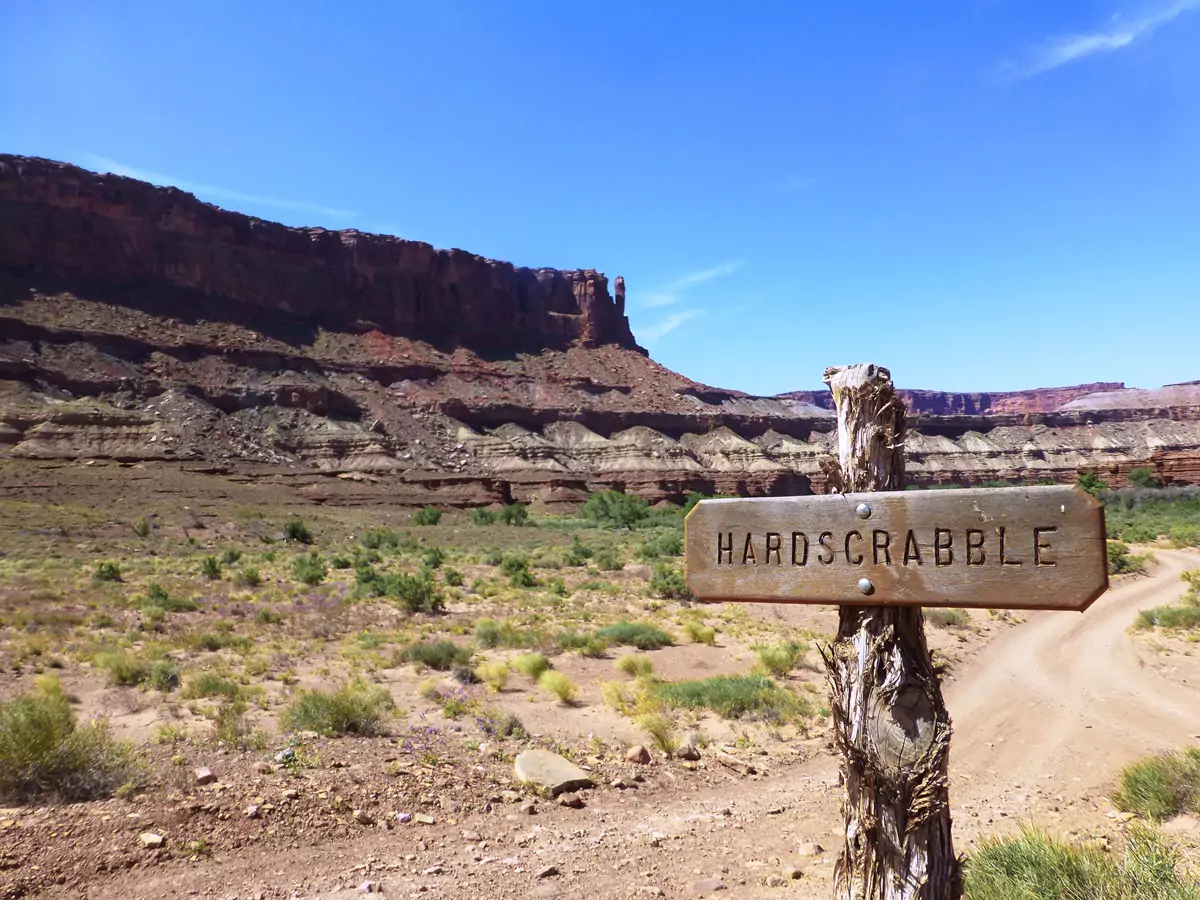
Hardscrabble A, B (B is best)
Labyrinth A, B (A is best)
Taylor
Campsite Facilities
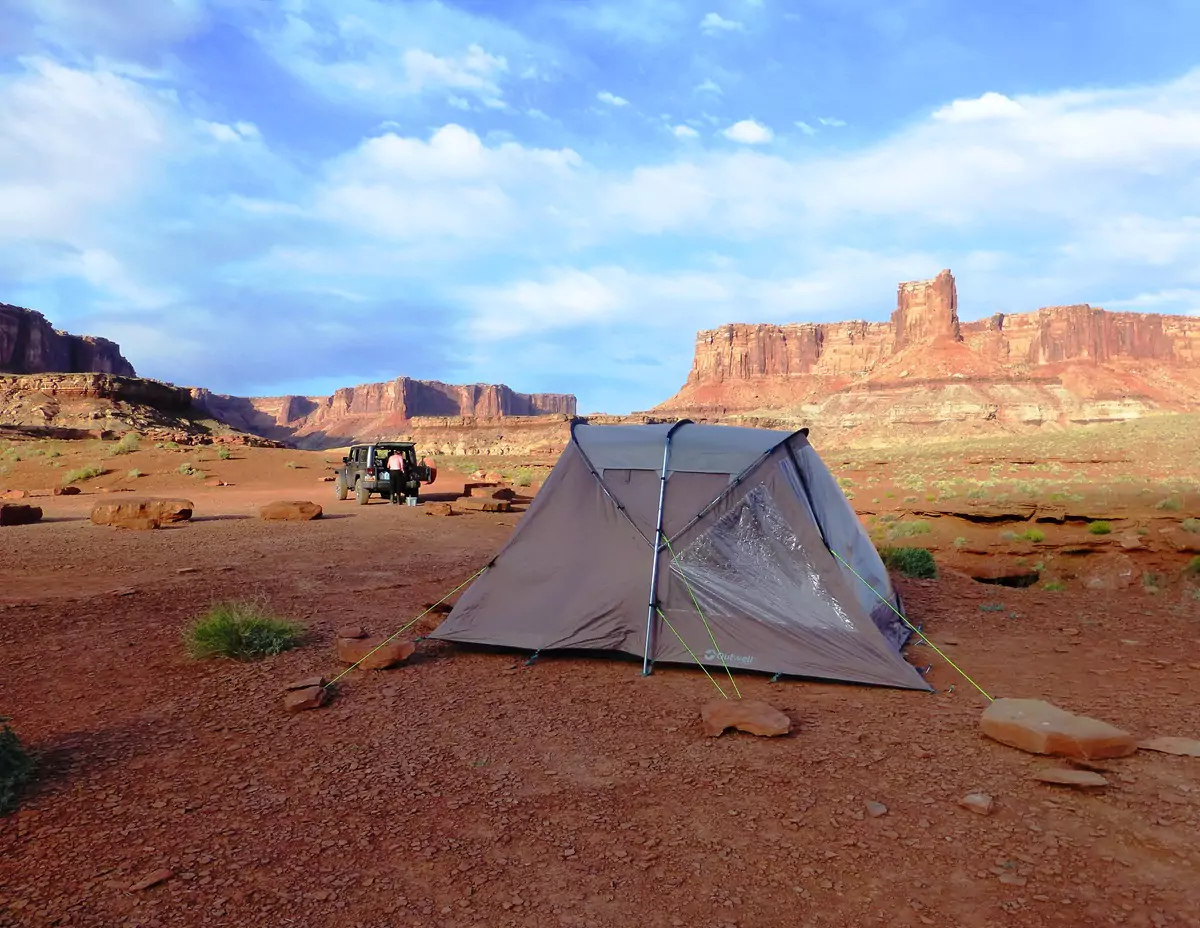
Each of the ten campground areas has one pit toilet (Airport has two) and that’s about it (apart from some seriously insane scenery).
There are no other facilities, including water. The sites are designed to have up to 15 people, so they are pretty well dispersed.
Fires are not allowed.

WHICH WHITE RIM CAMPSITES ARE THE BEST?
White Crack is by far the most popular and secluded, as it is down a spur road off the main trail. It also holds a central position on the main loop. The views are immense, too.
I personally like any campground that only has one site – but Shafer is very close to the beginning/end of the trail. So, for me, White Crack, Taylor and Candlestick provide the most seclusion and quiet and are my favourites.
Airport D is by far the most secluded of the Airport options – A and B are very close together so would be great to get both for a huge group.
If you want views of the Green River, Labyrinth A is on a ledge overlooking it.
Murphy campsites are on the top of a ridge with amazing views, but the elements, especially the wind, can get to you a bit up there.
If you want to be central because you only have one night, then Gooseberry, Murphy and White Crack are excellent options.
Potato Bottom has lots of shade from trees and is down by the water but sometimes has a buggy-mosquito problem.
We have camped at Airport D, Candlestick and Labyrinth A and honestly, they were all beautiful. I wouldn’t change our choices at all.
–
How to Get Permits for the White Rim Road
White Rim Road permits are a little complicated. There are day-use permits, backpacking permits and campsite permits. We’ve applied for all three, several times, so know how it works!
Day Permits
Day-use White Rim Road permits are limited to 50 vehicles a day, half of which are up for grabs online at 8am mountain time, a day in advance. Any remaining permits left are then available at the Island in the Sky Visitor Centre along with the other 25 permits. These are available up until one hour before the visitor centre shuts.
Another 50 permits are available for mountain bikes.
Permits cost $6 online (or free, in person, at the Visitor Centre if there are any left on the day).
Campsite Permits for Cars
You don’t reserve a driving permit for the road, as such, you just get a permit for the campsites, which includes permission to drive the road. So, before the booking window, we highly recommend you familiarise yourself with the campsites and which make sense for your trip.
The campsites are reserved through recreation.gov four months in advance of the season you will travel. Select the blue ‘Check Availability’ button on the right of the page.
You need to select ‘Island in the Sky- 4WD/Mountain Bike’ permit availability and a list of all the campsites pops up below. From there you can create a multi-day campsite itinerary.
The permits are made available four times a year at 8am MST on specific dates:
– November 10th
– February 10th
– May 10th
– August 10th
This means for reservations for travel between March 10th – June 9th will become available online on November 10th. It’s all a bit complicated, if I’m honest, so I’d recommend having a little look through the website in advance of your travels.
Note | it is possible to obtain a campsite permit, even if you do not have a car and are hiking instead. I checked with the rangers and they confirmed that although the section is called ‘Island in the Sky- 4WD/Mountain Bike’, that also includes hikers (we’ve actually done this on one of our trips).
Do Permits Sell Out?
Yes, it can be quite difficult to get a campsite permit for the White Rim Road, after all, there are only twenty campsites along the route. We’d recommend reserving your spots as far in advance as you are able to, although the competitiveness depends on the season of your visit.
Having said that, we have never logged on and reserved a campground as soon as they have been made available, and always found one or two later on (sometimes quite late)! Being flexible with your dates and routes helps enormously, too.
The most popular spots, like White Crack campground, go almost instantly, so you’ll only likely get that spot if you find a cancellation! (It’s an utterly magical camp spot though, so I can totally understand why).
How Much do Permits Cost?
An overnight permit costs $36 for the reservation fee, plus $5 per person, per night. The permit you secure includes your choice of campground.
The backcountry permit does not include the Canyonlands park entrance fee of $30 (free with an America the Beautiful pass).
Backpacking Permits
There are a load of permits for people to hike to the White Rim on foot, which sell out far less quickly! Backpacking permits allow ‘at-large’ camping, so no facilities and no designated campsites.
We’ve hiked several of the routes (Murphy and Lathrop) to the White Rim, and they are genuinely magnificent.
If you’re fit and able, consider this option to see the White Rim Road if the car camping options have sold out!

Is Driving the White Rim Road Difficult?
No, driving the White Rim Road is not particularly difficult. However, this answer is obviously subjective.
If you have never driven a four wheel drive vehicle, never driven off road and don’t know the difference between 4×4 low and high, maybe consider getting a bit of practice before you go. Having said that, we didn’t do this and had never driven a Jeep before!
If you are a competent, cautious and confident driver you will be totally fine. Just make sure you are comfortable with your car before driving it into the canyon.
What are the Roads Like?
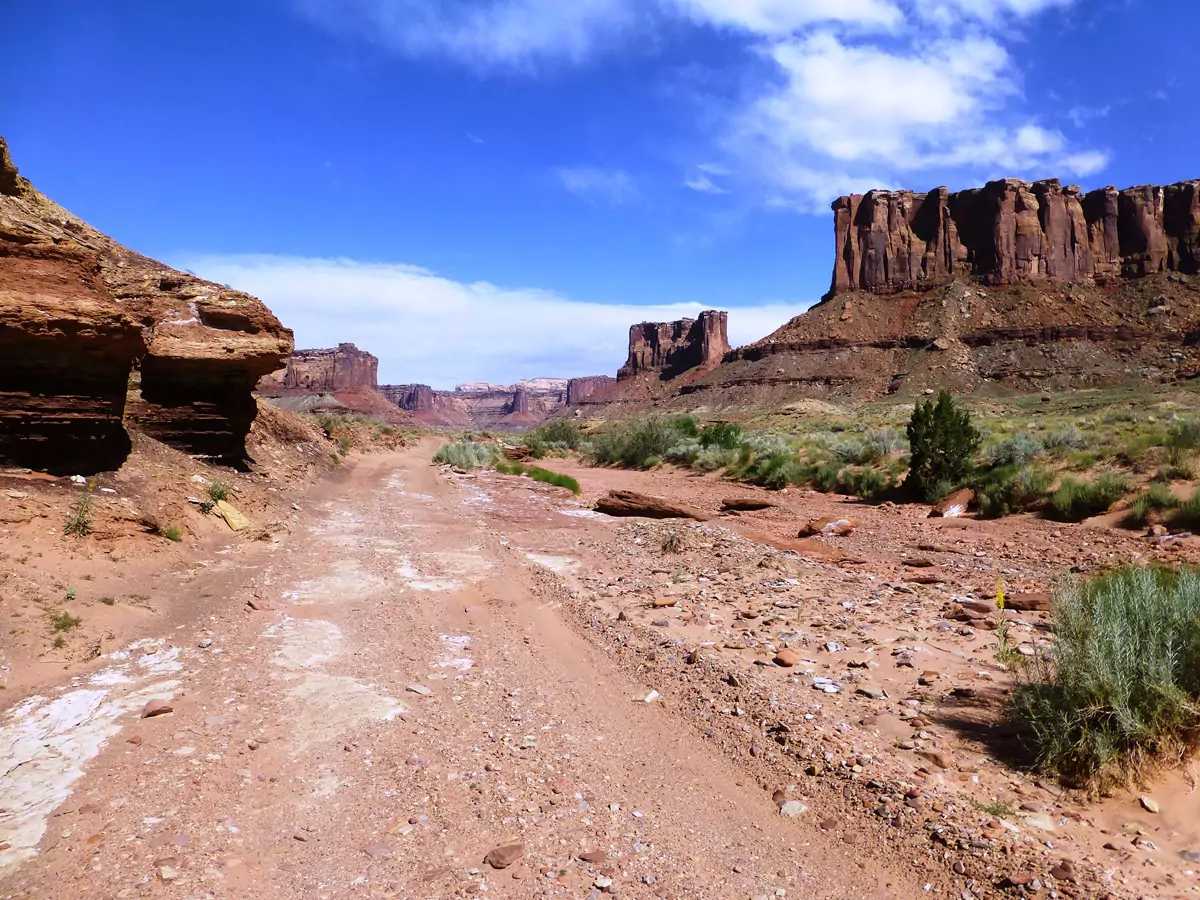
The entire White Rim Road is a (sometimes narrow) unpaved dirt road that follows along the edges of the canyons (we’ve put a few photos below so you can see). These roads have large potholes and rocks that you’ll occasionally need to traverse around.
To be honest, it is mostly just a bit bumpy and rough, and you generally drive a maximum of ten miles per hour, so it really isn’t that stressful! There are parts of the road that are slick rock, which can be slippery if wet and don’t leave obvious tracks of previous drivers to follow (following previous driver’s tracks would be my biggest driving tip!).
The only difficulty might come from avoiding oncoming traffic in narrow sections, and the couple of steep, narrow traverses with large drop offs.

Which Sections are the Most Difficult?
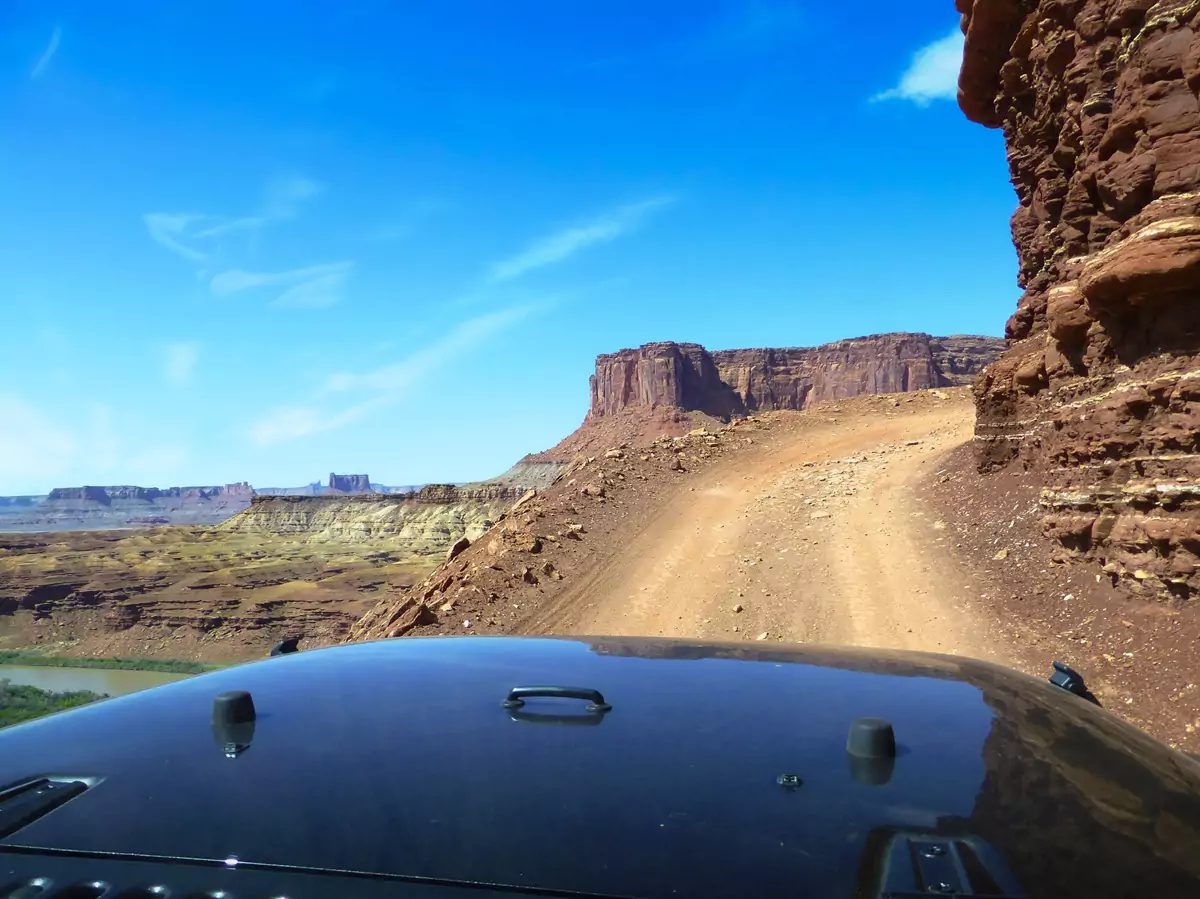
There are a few sections of the White Rim with large drop offs and extremely steep tracks where passing is impossible.
Murphy Hogback and Hardscrabble are two areas that are often mentioned as being a bit uncomfortable, with high, exposed sections. Personally, I don’t think they are very difficult if you take your time and are confident with your vehicle, though.
Passing can be difficult in a few other places, too, and you may be required to reverse down narrow tracks with drop-offs. For example, there’s a single-file section along the western end between Labyrinth and Mineral Bottom right above the Green River. It’s so pretty, but definitely no passing space!
We never had to reverse or have a head-on jam because there just aren’t that many cars out there at any one time (so grateful for limited day permits!).
Nervous passengers may have a difficult time – take a look at the photos below to see if you’re comfortable with it. I was gripping the car door pretty hard during a few of the sections and I’m not easily scared!


Switchbacks
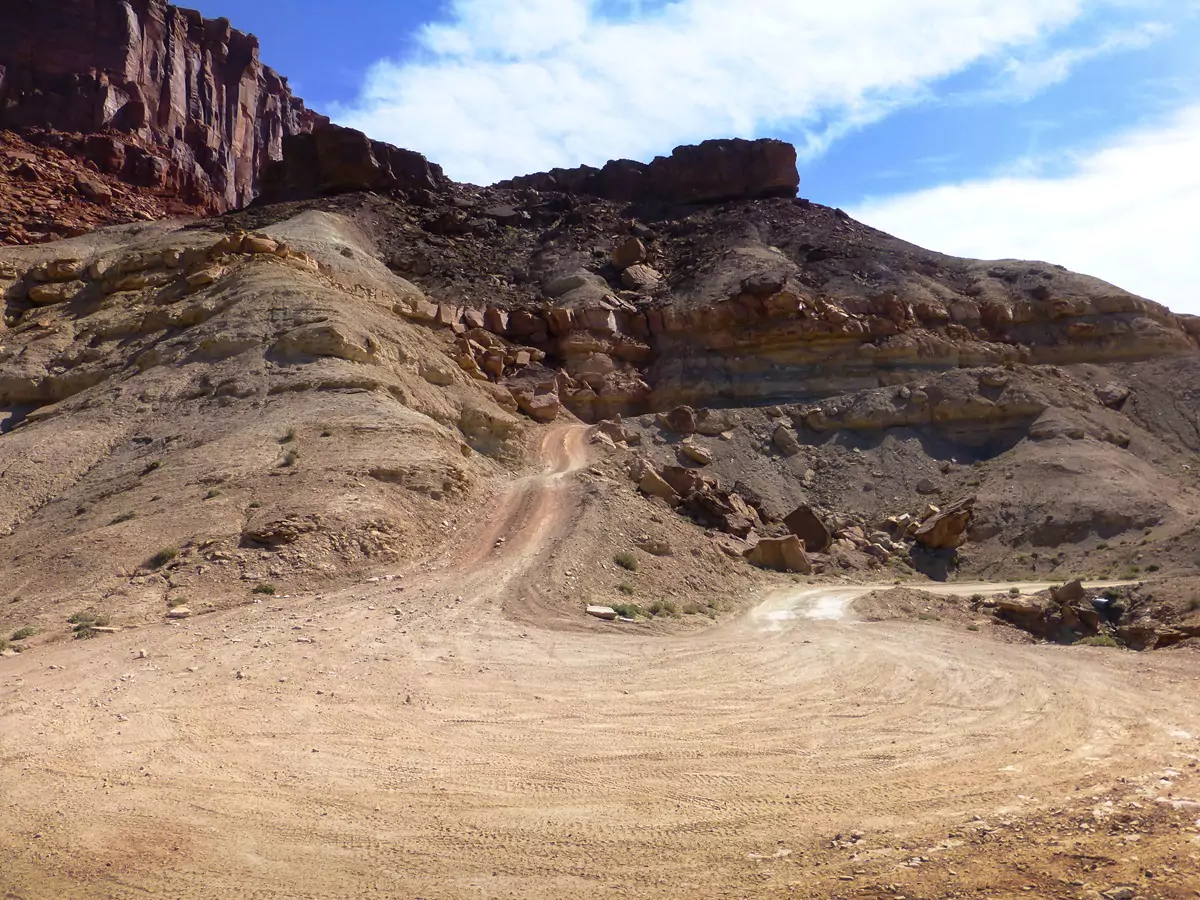
At the beginning and end of the route are some steep switchbacks, which some people may find uncomfortable.
The first is Shafer Canyon, which is the famous, obligatory photo lots of people take from Island in the Sky (there is a photo further down on this page). The second is Mineral Bottom, which does not have such good photo ops, so you probably won’t have seen it before (picture directly below).
Neither of these switchbacks are scary to drive, at all, they are just steep winding roads up the cliffs to the mesa top above. They’re smooth, not even that narrow and have lots of passing spots. However, if you’re uncomfortable with heights, they may be some of the most nerve-wracking parts of your trip!
Tip | if you want avoid the Shafer switchbacks, it is possible to start/end your drive at the Potash Road, which leads directly into Moab by a super-scenic route (the road is a bit rough, but not difficult – we’ve driven it in an AWD before, athough we probably shouldn’t have). You cannot avoid the Mineral Bottom switchbacks, though. (We’d avoid looking at the old car wrecks just off the cliffs there!).

Driving Tips
There are a few things to note if you’ve not driven off road before:
⬩ A vehicle travelling uphill has right of way, always.
⬩ Don’t ever drive in the dark unless absolutely necessary.
⬩ If you’re uncomfortable, find a safe place to stop, get out of your car and scout out the road. Usually this puts a lot of your fears in perspective.
⬩ Don’t rush – choose a route that fits your schedule, rather than trying to fit something that doesn’t work.
⬩ If it rains, head out as soon as you can! These roads are nightmares after rain and can flood.
⬩ Avoid driving off the tracks, even when passing, due to biocrust.
⬩ Put your car in four-wheel drive low, somewhere flat, and drive slowly. Make sure you know how it feels and works. It’s important (it’s saved us when we’ve been stuck in sand dunes, rivers and all sorts of other awkward moments!).
What to Pack For a White Rim Trip
Full tank of gas
Head torch
Lots of water (at least a gallon per person, per day)
Toilet roll
Hand sanitiser
Camping equipment
Weather appropriate clothing
A spare beer for hikers (this was a welcome gift when we hiked down!)
Your permit
All food
Empty memory cards for your camera
–
Which Direction is Best Along the White Rim Road?
It does not matter which direction you drive the White Rim.
The route is technically a two-lane road so, in theory, it is legal to choose either the clockwise or anti-clockwise direction. In reality though, you will have less oncoming traffic if you choose clockwise as more people choose that route, which makes some of those trickier sections much easier!
The direction you choose will depend on each specific campsite itinerary and how many nights you have. Check out the map and campsite mileage to decide whether entering from the east or west makes the most sense for you (for example, if you first campsite is on the west, then it’s better to drive anti-clockwise).
We did this route clockwise, starting at the Shafer Trail, which is the more popular choice. We ran into very few cars coming the opposite direction, after we passed Musselman Arch (which is actually a natural bridge, not arch!) between Shafer and Airport.
You can also start the clockwise direction via the Potash Road (route 279 from Moab), which is worth driving as an experience on its own.
To drive the White Rim anti-clockwise, entry is via Mineral Bottom Road.

Can You Drive the Entire White Rim Road in One Day?
Yes, you technically can drive the entire hundred-mile route in one day, but it would be very long, and probably achy!
Realistically, it would take you more than 12 hours, so you’ll need to take this challenge on during the summer months with longer days (so aim for May, as the weather would align nicely, too). You definitely don’t want to be driving this road at night!
There would be little time to stop, and no time to hike or explore, but might be suitable if you absolutely love driving!
However, the most sensible option is just to drive a section of the White Rim, then you don’t have to be quite so stressed for time. You have two options: start from the Shafer switchbacks/Potash Road side on the east, or start from the west and drive down Mineral Bottom.
One Day Clockwise from Shafer
If I had never driven an off-road route and were to choose a White Rim day trip, I’d go clockwise, starting at the Shafer switchbacks.
Then I’d head down to the Lathrop Junction via Musselman Arch, pop down to the Colorado River, and return to Moab via the Potash Road. This option gives loads of variety in the terrain, minimal tricky roads, a trip down the scenic Shafer Canyon and a different route to exit, so you’re not doubling back on yourself.
It would be a pretty magnificent day!
Tip | keep an eye on the time and know in advance when sunset is. How far you can go in one day will totally depend on how fast you drive, so it’s difficult for anyone else to judge this but you (so take anyone else’s timings with a pinch of salt!). Remember to turn around with enough time to exit before dark.
One Day Anti-Clockwise from Mineral Bottom
The option is a little more tricky to drive, but quieter and wilder, in my option. You also get to spend way more time next to the Green River with absolutely beautiful views, too.
The route would include a trip over Hardscrabble, one of the trickier sections of the road (but with that comes some of my favourite views!). It also includes the option to take a side quest into Taylor Canyon, one of my favourite areas of White Rim Road (most people miss it completely – we’ve written about it a bit further down).
We’d definitely suggest this route if you want a bigger challenge and some of the more striking and varied scenery in the park. We spent most of our time along the western half of the road due to our campground choices, so are biased and absolutely love this side.

THE BEST TIME TO DRIVE THE WHITE RIM ROAD
Although technically you can drive this route at any time of year, the ideal seasons to drive the White Rim Road is during the spring and fall.
Summer is hot – very hot (like over 100F degrees) and there is also a risk of monsoon storms that have been known to wash away parts of the road (or cause fast flowing washes that block it).
Winter is a bit chilly for camping (seriously, freezing)! It’s also snowy and icy for much of the winter which just makes the roads a dangerous mess. Chains are required through winter.
Heavy rains can make the roads impassable at any time of year, so always check the forecast carefully. It can be rainier during May and June, although we’ve always had good conditions during these months.
Spring and fall have milder temperatures and, for the most part, a lower risk of storms. With spring comes the wildflowers!
We’d recommend checking with the rangers before heading out – they’ll advise on up-to-date weather and road conditions.
–
Optional Side Trip to Taylor Canyon
One of my favourite side quests on the White Rim is Taylor Canyon, in the western section of the park. During the time we were there it was completely empty and felt, if it’s possible, even more remote!
The canyon is reached by a dirt road just off the White Rim trail near Labyrinth Campground (you can see on the map above). It is a dead-end, five-mile sandy track, flanked on both sides by gigantic crimson cliffs. The journey follows a wash from the White Rim Road towards the Island in the Sky mesa, where the two massive, looming spires of the Moses and Zeus rock formation come into view.
Hike | we did the Moses and Zeus hike which is a short but mildly strenuous out-and-back trip. It is one of the most beautiful areas of the park and the nearly symmetric impression from the canyon is spectacular. The walk itself is a rocky, slightly scrambly uphill adventure where the route is not always apparent.
It was really good fun (we got a little sunburnt though, so be careful – it’s very exposed!).
Camping | the campground here is remote and stunning. It is not near the river like all the others, but it feels more isolated and secluded. You do not get mountain bikers or Jeeps passing by as often so it’s easy to imagine you are all alone in the wilderness.


Other Options for Visiting the White Rim Road
We mention this briefly above in the permits section, but there is another option if you’re unable to get a four-wheel drive vehicle or are unable to drive – you can walk!
Whilst you can’t hike the entire length of the White Rim Road, there are many trails from the Island in the Sky mesa down to the White Rim where you can camp.
For example, we hiked down the Lathrop Trail and camped at Airport. We also recently hiked and backcountry camped along the Murphy Loop which passes through the White Rim Road.
These are a little more strenuous, but a great way to experience the White Rim Road without a car.
Be Careful of the Biocrust
Just a quick aside to say be careful of treading on the biocrust – there is loads of it all over the White Rim area!
It’s a blackish, lumpy layer that sits on the top of the soil or sand. It is essential to the health of the deserts and, amongst other things, literally stops the sand from blowing away.
It takes decades, if not longer, to regenerate, so please don’t damage it! (We had to do a whole educational thing on biocrust when picking up our Fiery Furnace permits in Arches National Park, so learnt all about it).
The best option is to stick to slick rock and where other people have already driven/walked, wherever possible.

BEST PLACE TO STAY BEFORE YOUR ADVENTURE
Moab is the nearest town to the White Rim Road and is the best place to sleep before your off road adventure.
We’ve stayed in loads of places in Moab at varying budgets (Moab is generally expensive – stay in Green River for slightly lower prices, or camp). These are the best ones we’ve found:
Bowen Motel ($$) – this simple motel has the most central location on the main street, with comfortable, clean rooms, and often a decent price point. We’ve stayed here a few times now and never been let down. It’s always our choice when the price is right.
Moab Rustic Inn ($$) – decent sized but slightly dated rooms, however it was clean, quiet, with a great price-point and also had a pool.
River Canyon Lodge ($$) – we’ve stayed here a few times since they did room renovations and it’s nice. The rooms are small, but modern, there’s a pool and the location is right next to the Moab Food Truck Park, which we love. You can hear a little through the walls, though.
Kokopelli West ($$$) – super cute, colourful cabins, lovely hosts, great location. This amazing little find has modern, up-to-date rooms with comfy beds, fire pits and a general vibe that I just loved.
Under Canvas Moab ($$$) – I’ve stayed in other Under Canvas locations, and this particular one lives up to the reputation. It’s like luxury glamping and I love it! The tents gets pretty hot though, so I’d give it a miss during the scorching summer months.
Red Cliffs Lodge ($$$) – if you’re looking for something a bit special, this could be it. Hidden down Route 128, surrounded on all sides by cliffs, perched on the shore of the Colorado River is this surprising find. The location is unmatched, the rooms have a modern twist but with a kind of wood cabin vibe, and the room patios are huge. We actually discovered this place by driving past it – then immediately booked it!
–
RELATED POST | 16 INCREDIBLE SLOT CANYONS IN UTAH


HAVE WE HELPED YOU PLAN AN OFF-ROAD TRIP IN MOAB?
If you’ve found our free content helpful, consider booking your rental car (if you need one!), through the company we always use – Discover Cars. They’re the absolute best and have been our rental companion (and savior, thanks to their insurance) in many destinations across the world.
Also, consider booking your accommodation through Booking.com – we use them exclusively when travelling in North America.
Help like this makes it easier to pay for the upkeep of this site. Thank you!
–
Final Thoughts
If you want to experience Canyonlands National Park in a more in-depth, sensory way and not just from the viewpoints, we strongly recommend you consider visiting the White Rim Road, either via hiking to it or by four-wheel drive. It’s an immersive outdoorsy experience you cannot forget.
Personally, spending three days in the Canyonlands wilds was what pushed me to do more backpacking, hiking and off-roading around the deserts and canyons of the American southwest. This one experience was so inspirational to me that it changed the way I travel in national parks.
We hope you have a great trip!
Where to Next?
Now that you’ve got your White Rim plans sorted, take a peek at how we would spend three days in Moab! It’s a fantastic, adventurous little town that packs in so much to do that it can feel overwhelming at times to plan a trip!
We’ve spent months in Moab and our itinerary covers all the bases for any kind of getaway – whether you love hiking, roadtripping, water activities, or eating!
Hi, thanks for visiting our blog! If our free content has been of help to you, or you’ve just enjoyed our random ramblings and musings, say thank you by buying us a coffee! It helps keep The Restless Beans blog up and running.
Thank you, Claire + Nick


Thanks for the information! I’m planning a trip and your blog is super helpful!