· SOUTHEAST ASIA ·
Kuang Si Falls: How to Visit Laos’ Most Beautiful Cascade
Scribbled by Claire ⬩ 13 Apr 2026
Are you considering a trip to Kuang Si Falls? This article covers everything, from transport options to the falls, things to do there, entry ticket pricing and more, to make your trip to this incredible natural wonder absolutely perfect!

I’d (maybe controversially) argue that no trip to Laos is complete without a stop in the steamy, sultry, cultural capital of Luang Prabang, flanking the mighty Mekong River.
And, when in Luang Prabang, there is no better day trip than to the superb, mesmerising Kuang Si Falls (also named Kuang Xi or Tat Kuang Si).
The falls are one of the most famous natural landmarks in Laos (and southeast Asia), for excellent reason. The milky-blue-ish white waters tumble over multi-tiered, curving, limestone ledges are actually surprisingly impressive (I’ve been let down by many waterfalls on my journeys!). All these entwined ribbons of water are enclosed by a thick, jungle canopy – it’s a little slice of easily-accessed magic.
I’ve been several times now, years apart, and I’m glad to say that they’ve not really changed much, at all (which is a rarity for a popular spot in a world of burgeoning overtourism).
So, we’ve answered all the questions you need to know – the best way to reach the falls (and if a tour is worth it), how hard the hiking is, ethical considerations of the adjacent bear sanctuary, up-to-date ticket prices to the different zones, when you should visit, and how to get the best photos.
Hopefully it helps you plan the perfect trip!

IN THIS GUIDE //
Laos’ Aqua Cascades
WHY ARE THE KUANG SI FALLS SPECIAL?
BEST TIME TO VISIT
GETTING THERE
ARRIVING AT KUANG SI FALLS
– OPENING HOURS
– BUYING TICKETS
– HOW DIFFICULT IS THE WALK?
WHAT TO DO AT KUANG SI FALLS
– HIKING
– SWIMMING
– BEAR RESCUE CENTRE
– PHOTOGRAPHY
WHAT TO BRING
WHERE TO STAY IN LUANG PRABANG
TOURS TO KUANG SI FALLS
GOOGLE MAP
FINAL THOUGHTS
This post may contain affiliate links. If you book through these links we may make a small commission at zero cost to you. It helps us pay for the upkeep of this blog. Thank you!
Why are the Kuang Si Falls Special?
Beautiful blue | Kuang Si Falls’ shimmering water passes through limestone rocks, meaning the falls and pools have a high concentration of calcium carbonate. This reflects light and, at certain times of year, makes the water colour a pearlescent whiteish blue. It kind of looks like it glows! They’re known as travertine waterfalls, due to the mineral-rich water and the unique chemistry going on (just like Wadi Darbat in Oman and Erawan Falls in Thailand – I clearly have a type).
Falls and foliage | the primary waterfall at Kuang Si drops a mighty 60 metres (around 200 feet), flowing through brightly coloured tropical foliage and flowers, pouring over ridged, white cliffs, all enclosed by the misty Laos jungle. It kind of reminded me of the paradise world in ‘The Land Before Time’ (this reference ages me somewhat). It’s one of those places that most cameras do not do justice.
Vibe | wonderfully, the Laos authorities have not overly commercialised the waterfalls (although it’s slowly developing which I’ve mentioned more about below) so, apart from a few food vendors, a small restaurant, some paths and bridges, there are few signs of human development. Ambling between the many shallow pools and falls with only the tranquil sound of the bubbling streams is a serene escape from southeast Asia’s general hecticness.
Hiking | walking to the main part of the falls is largely easy, too, so even if you have limited mobility, it will usually be okay to explore the lower section.
Entry price | the cost to get in is a very reasonable 60,000 kip (around US$2.70).
Transport | getting to the Falls is very straightforward (we’ve mentioned more on this below).

Best Time to Visit
As with most of southeast Asia, Laos has distinct seasons. These seasons have a significant effect on how Kuang Si Falls appear.
Dry Season
The pictures on the internet you’ll undoubtably have seen (and on this blog post, too) will have been taken during the dry season in Laos. After the rainy season ends, the water gradually returns to its renowned blueish-white colour as the water flow slows down in the dryer months.
Therefore, the best time to visit Kuang Si Falls is the drier season between December and April/May.
Wet Season
During June to November, while it is possible to visit the falls, the water will likely look a murky brown and be flowing at a much higher rate. It might even be flooded and impossible to reach the main falls.
Throughout this time, it is also extra-hot and humid and you will not be able (or want!) to swim in the muddy waters.
Time of Day
The best time of day to visit Kuang Si Falls is during the earlier hours or last thing in the afternoon (although I’d be wary of driving back in the dark).
Lots of tour buses and groups arrive around 9-11am and, honestly, it gets absolutely rammed with Chinese tourists who don’t always understand the concept of personal space. On our most recent trip, we entered at about 8.30am and left three hours later, around 11.30am.
We turned into an empty car park with just a few scooters parked in and left searching for our bike in a warren of buses, minibuses, tuktuks and an actually sea of motorbikes. The transformation of the car park was so astonishing that I even videoed it.

BEHIND THE NAME ‘KUANG SI FALLS’
Apparently, the word ‘kuang’ means deer and ‘si’ means dig (this is what the internet says, but ‘si’ appears in all sorts of Laos words and I doubt it always means ‘dig’. Google translate has been unhelpful in this case).
Anyway, this name came about from the legend of a man who dug a hole which filled with pearlescent blue water. This attracted a golden deer, who moved in under the nearby rock formations (this was destroyed in a recent earthquake though).
Hence ‘Kuang Si’ Falls.
The site is sometimes called ‘Tat Kuang Si’ – tat means waterfall.
–
How to get to Kuang Si Falls
It takes 45 minutes to reach the falls along the 29-kilometre (18-mile) route south of central Luang Prabang (dependant on vehicle).
There are various transport options to the falls, all with their pros and cons. Realistically, the trip will take about half a day in total. Also, it’s quite a remote area, so be wary of paying the full amount upfront if you hire a private driver in case you get left at the falls!
Public Minivan
These operate basically like public buses and shuttle people back and forth from the falls. A journey should cost around 65,000 kip but we didn’t take this option – our guesthouse told us this price though. So, if you don’t mind being at the falls without a guaranteed lift back, ask your guesthouse about it!
I’ve read about people being charged a huge amount to get back from the falls because there are no other options – so be aware.
Motorbike/Scooter
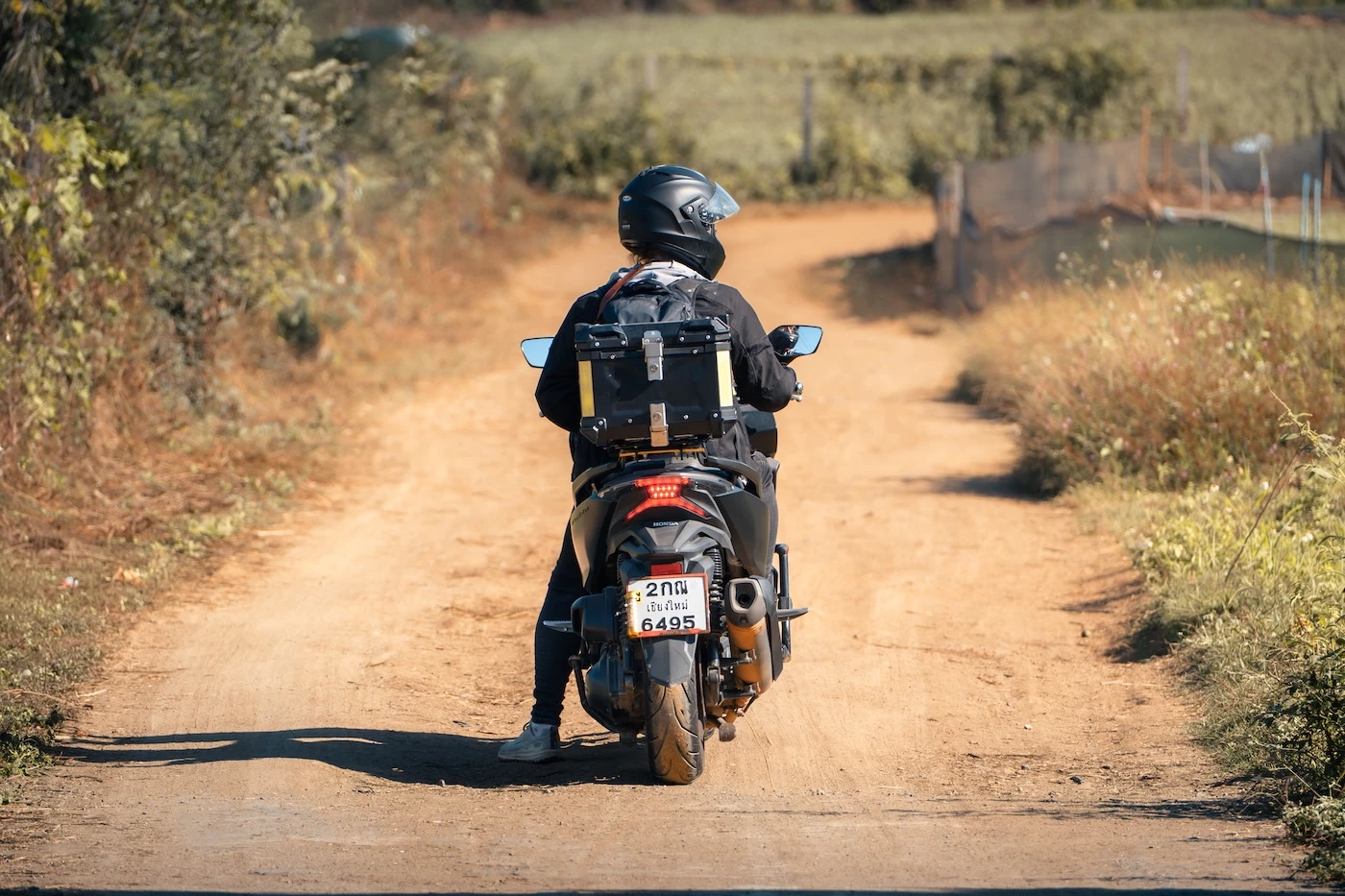
This is the option we always take. It depends on your experience, but to us, the drive to Kuang Si Falls from Luang Prabang was easy, with a few hills, some small towns and the occasional overzealous minibus.
The roads are currently (and constantly) under various works, so it’s dusty, rough and gross, particularly if it’s foggy since the grit in the air sticks to you. We would only recommend this option for experienced, licensed riders as the entire route isn’t paved and it’s not exactly short.
Motorbikes are easy to rent from most accommodations in Luang Prabang or specific rental companies.
We had a great experience with Anousay Motorbike Rental – we rented from them for several weeks previously and the bikes were, overall, better than many others we had in southeast Asia (apart from Ha Giang, Vietnam). We paid 120,000 kip per day for our rental motorcycle and even rode one of their bikes to Nong Khiaw and it was excellent.
Petrol costs are also very reasonable in Luang Prabang – we paid just under 23,000 kip per litre. Be aware that in 2026, the conflict with Iran and the USA have caused petrol shortages – check the situation before you go.
Private Tuktuk
Getting a private driver and tuk-tuk for a journey to the falls is a great option if you want flexible times to avoid the crowds and you don’t want to travel as part of a larger group.
It is usually around 250,000 kip to hire a tuk-tuk for the day and can be easily arranged through your accommodation on arrival. It’s a little more, around 300,000-350,000 kip, for a private, airconditioned minibus instead.
There is also an option to hire a taxi to take you to the falls as well. Check out the Loca app for availability or pre-booking options – one way was around 600,000 kip.


Shared Tuktuk/Songthaew
These are a kind of open-air truck-minivan thing that can transport about 6-8 people. They cost about 200,000 kip return to the falls for a pre-determined period of time (often around three hours). If you have a group, it’s a reasonably cost-effective option.
For a group, it is possible to pre-book a songthaew to take you to the falls. If you are individual, they can be found on the main street, often with ‘waterfall’ painted on the side (specifically near the Joma Bakery junction in central Luang Prabang, where the night market ends). You depart when the vehicle has filled up.
Bicycle
Renting a bicycle to ride around Luang Prabang is pretty common, but you’ll need an extra level of effort to cycle to the falls. It sounds like a nightmare to me, but I’m no cyclist.
There are a fair few hills, Luang Prabang is pretty warm, and it’s nearly a 60-kilometre round-trip. However, it’s scenic, cheap and healthy! Bike hire is about 20,000-30,000 kip per day so is also the most economical option. Many accommodations we have stayed at in Luang Prabang had bikes to rent.

LUANG PRABANG ELEPHANTS CAMP
Please don’t visit the Luang Prabang Elephants Camp – it’s on the road towards the falls. It’s basically a circus for tourists where the elephants are treated terribly. If you’re in any doubt, read the reviews and just have a glance in on your way past.
It’s really grim. I’ve written a little about elephant welfare on some posts about the Koh Chang elephants and at Ayutthaya, both in Thailand, if you’re after more information.
World Animal Protection have listed two ethical sanctuaries in Laos – Mandalao and Laos Elephant Conservation Centre if you want to see elephants during your trip.
–
What to Expect on Arrival
All transport options above will stop in the official car park for the falls.
The car park is obvious; through an authoritative-looking gate/manned checkpoint – you get waved in and then park up. For us, motorbikes were stored immediately to the right under a shelter. There was a friendly attendant who we paid 5,000 kip for parking and he secured our bike and helmets.
We were handed a ticket with the registration number of the bike on to show the attendant later (good thing, because I always forget what our bike looks like).
Across the huge car park (which was empty on arrival) there is a very official-seeming ticket office. After purchasing a ticket for Kuang Si Falls, you pass through a kind of gate where the ticket is checked by an attendant, who directs you to a white electric vehicle. This drives up the small hill to the actual entrance – you can walk this if you want.
We walked back down at the end, it’s about a ten minutes on foot or a one-minute drive). The hill is jammed full of friendly food and souvenir vendors if you fancy something on the way back.
Opening Hours
Kuang Si Falls is open daily between 8 am and 5 pm – it’s written on the board where you buy the tickets.

Buying Tickets
In 2026, entry tickets for Kuang Si Falls have increased to 60,000 kip each for foreign visitors, and motorbike parking is now 5,000 kip. The entry ticket includes a return trip via the electric cart transport in the park and access to the Tat Kuang Si Bear Rescue Centre.
Children under 120 cm get free entry.
Places like Tripadvisor recommend booking your ticket in advance, but you do not need to do that. Buying a ticket on arrival is fine.


How Difficult is the Walk?
From the Kuang Si Falls entrance, it’s an easy, mostly flat, sometimes muddy walk to the beginning of the pools.
There are tree roots and the amount of mud depends on how recently it has rained. Although the path is uneven in parts, it’s not difficult. The trail passes through a bear sanctuary (see below) which involves walking along a few boardwalks. The route is straightforward for most, but not particularly suitable for wheelchairs and pushchairs due to the uneven ground.
The main risk is falling over, since it can be pretty slippery. Be especially careful at the edge of the pools, I saw someone fall over.
Beyond the main falls, there is an area called ‘The View’ where the trail gets rough and steep.


Things to do at Kuang Si Falls
Hike to ‘The View’
Once you reach the main Kuang Si waterfall with the wooden bridge crossing it (you’ll know!), there is some further hiking up the hill behind the falls.
To the left of the bridge, there is a pathway up which is a bit steep, so make sure you wear sturdy shoes. The round-trip walk goes all the way up around the back of the main falls to some more pools and returns on the right side.
Previously, there was basically northing up there, but now a company has developed the area and installed a cafe, viewpoint and zip-lining place, called ‘The View’.
It’s a nice little walk that gets you away from the tourist throngs, however we don’t think it’s worth worrying about if you have limited time. The views are minimal, it’s not as photogenic as the lower part and it’s quite strenuous. It’s pretty and worth some time if you’re not swimming and enjoy a humid, steamy jungle hike (and want to go zip-lining!).
The cafe is lovely as well (quite Instagrammable) so, if you are not pressed for time, it’s a lovely place to have a rest. There is also an option to take a bamboo boat ride to the source of the falls for 20,000 kip per person.


Zip-Lining Through the Jungle
If you walk to the top (to The View), there are options to zipline. It’s pretty new, like maybe a year and a bit old (it wasn’t here on our previous visits!).
This costs US$30 per person and you also have to pay 30,000 kip to enter the view area with the cafe and viewpoint.
I’m not a zipline enthusiast, but other people seemed to have a good time!


Swimming at Kuang Si Falls
Swimming is allowed at Kuang Si Falls, but only in certain locations at the lower falls.
This is due to safety and also because certain areas are sacred and considered holy in local traditions (pay attention to any signs). Most of the best spots to swim are lower down – as soon as you reach the first and second pools. Here, the water is calm and safe for kids, and beautifully blue.
Be careful, the ground is particularly slippery in places by the pool edges! We’d recommend bringing hiking sandals, Crocs or water shoes of some sort. Watch your children carefully.
There’s also lots of fish that swarm you in the pools. They’re harmless, but I’m always terrified I’m going to squash or hurt them – not sure if this is irrational or not.
There are changing ‘huts’ along the route but we didn’t use them so can’t comment on the cleanliness or quality.


Tat Kuang Si Bear Rescue Centre
Run by Free the Bears, this small sanctuary for around 20 rescued Asiatic black bears (moon bears or white-chested bears) is the first thing you’ll see on your visit. Walking through a small area between the trees, there are plaques that explain what the charity does and various viewing platforms that provide an opportunity to see the bears in their enclosures.
These bears have been rescued from poachers and bear bile farms, who use the bile and other body parts in traditional Chinese medicines. It’s actually seriously barbaric – I won’t write more here but look it up if you’re interested.
I’ve done a bit of reading around and this organisation definitely seems to be a legitimate place with genuine intentions. Support them however you can!


Photographing Kuang Si Falls
Kuang Si Falls is super photogenic. Here are a few things to note about taking the best pictures:
⬩ First and, most importantly, get there early – the less tourists in your pictures, the better (it suddenly gets busy around 9am). Race to the main falls first so you can be there before everyone else arrives. Then, work your way back.
⬩ The lighting can be tricky to manage because there’s lots of speckled shade and sketchy reflections. Early mornings can be misty, which can be a pro or a con depending on the vibe you are going for. We found the sun hit the falls in February around 10am.
⬩ If you don’t have ND filters but want long exposure shots of the falls, early is best because the light is quite low. (These reduce the light coming into your camera, so you can set it to a longer shutter speed). I’m so lazy and rarely use mine, but always wish I had after I leave when all my photos are taken on a dodgy soft aperture of, like, f/22.
⬩ The bridge opposite the falls at the end is very vibrate-y, so when people walk on it, you’ll not be able to use a tripod or handhold a long exposure shot easily. It sucks, so you’ll have to wait for the right moment (basically impossible when the tour groups arrive) or improvise with different angles!
⬩ For the bluest, clearest waters, visit during the dry season. Check out recent pictures on social media to see what the water colour is currently (heavy rain makes it run brown).
⬩ I’ve mentioned this above, but bring filters and tripod if you want to take professional-quality pictures of the falls. I didn’t bring a tripod for any of my visits, so everything was taken by hand (which explains the slightly sketchy quality of the photos). The first time it was Christmas day, I was hungry, coming down with dengue fever, and my motivation was low. The second time I was just plain lazy.


What to Bring to Kuang Si Falls
Tripod | if you want those high quality, smooth, fluid waterfall pics, you’re going to need a tripod (we didn’t take one on our trips and regret it!
Camera | this one is obvious – again the best photos you see online are taken with a proper camera.
Swimming gear and towel | if you swim
Sunglasses | although this definitely depends on the time of day and weather
Grippy, sensible shoes | essential, especially if you go on a walk up to the top. We visited on Christmas Day in the dry season and it was still pretty muddy.
Cash | the businesses in the area do not accept credit cards.
Go Pro | perfect for capturing footage if you swim (this is what we use)
Reef Safe Sunblock | never put chemicals in sensitive waters like Kuang Si Falls if you can avoid it.
Dry Bag | this is useful for keeping your stuff safe when you swim. I’ve read that theft is not unheard of at Kuang Si Falls, however it seemed safe enough to me.
Bug Spray | we experienced zero mosquitos at Kuang Si Falls (that we noticed, anyway). However, it was the dry season, and a week later I got dengue fever, so be careful!
Snacks! | if you are going to hang around and swim for a few hours, you may want snacks. The restaurant in the actual falls is well rated but we didn’t use it. If you don’t intend to either, take some sustenance with you.
Polarisating filter | this one really improves photos of water and anything with reflections. If you’re taking your pictures more seriously than I was that day, get one of these.

WHERE TO STAY FOR KUANG SI FALLS
The best place to stay to visit the falls is in Luang Prabang.
Luang Prabang is full of attractive, heritage-style colonial buildings. It’s such a distinctive city and well worth staying a minimum of a few nights. The old quarter, or just surrounding it, is the most popular area to stay – anywhere in the historic district will have beautiful buildings, many with river views.
The region around Kingkitsalat Road and bordering Wat Wisunarat is popular and often a little cheaper, but still very local to everything you’d need.
We’ve spent close to two months in Luang Prabang, in total, so have stayed in a bunch of hotels over that time. These are hotels we have personally stayed in (and recommend – we keep adding new favourites after every visit):
La Casa Hostel ($) | smashing little newish hostel with lovely private rooms and dorms. Surprisingly comfy beds, breakfast included and family dinners. What’s not to love? Oh, exceptional price-to-quality ratio, too.
Thatsaphone Hotel ($) | small hotel with large rooms, central location in the middle of the historic district but really quiet, great aircon, refillable water tank. Friendly and family-run.
Villa Mahasok ($$) | resort type vibes on a budget. Great if you want a nice pool without a huge price tag in a central location. Buffet Breakfast was decent too.
Museum Inn Luang Prabang ($$) | our top place on this list for value for money. Lovely fresh-cooked breakfast, incredibly functional rooms, super-friendly family, amazing range of TV channels! It books out fast – try and get the deluxe double.
Houngvilai ($$$) | larger hotel, beautiful, dark-wood rooms, with probably the best location on this list. Incredible buffet breakfast too. Staff were less cooperative in helping us organise a bus, but stunning hotel nevertheless.
Sunrise Hotel Luang Prabang Mekong River ($$$) | I stayed here for an extended period with dengue fever. They were really flexible with how long we needed to stay. The rooms are decent, clean, well-furnished and the pool is lovely. Breakfast buffet was reasonable.
Sofitel Luang Prabang ($$$$) | every now and again, you treat yourself (or you have points to burn!). This was one of those times; the property is exquisite. Definitely one of the best hotels in Luang Prabang, no doubt.
–
Tours to Kuang Si Falls
If you are on a time sensitive trip, like to book in advance, or want a tour, we recommend using Get Your Guide.
There are all sorts of tour options out there, some of which can whizz you around a bunch of sites in a short period of time. This is a smart option if you’re in a rush or like to reserve your activities in advance.
Consider taking an scenic tour down the Mekong River to reach the falls – the most romantic way to reach them!
BUFFALO ICE CREAM
Along the route to Kuang Si Falls from Luang Prabang is the Laos Buffalo Dairy.
We’d recommend stopping for an ice cream if you have your own transport! It’s one of those cute places with great produce at a fraction of the price of home.
They also offer short tours, meals, and have a cafe.
–


Map of Kuang Si Falls (and around)
Below is a Google map of the local region, marking any places of note in this post.
To save this map, click the star next to the name.
Where to Next?
The Kuang Si Waterfalls are exquisite and memorable, no doubt about it – the photos don’t lie! In fact, the entire scenery of Laos is too.
It’s our favourite southeast Asian country, and wandering through thick jungle, surrounded by milky, blue-white waters cascading over smooth limestone cliffs makes Laos a little slice of paradise. One of the only waterfalls that even comes close in the region is Erawan Falls, in Kanchanaburi west of Bangkok (check it out if you’re travelling via Thailand!).
We hope you have a great trip!
Hi, thanks for visiting our blog! If this post has been of help to you, or you’ve just enjoyed our random ramblings and musings, say thank you by buying us a coffee! It helps keep The Restless Beans blog up and running.
Thank you, Claire + Nick