

How to Visit Wadi Darbat: Exploring Oman’s Most Beautiful Waterfall
Scribbled by Claire ⬩ 05 Sep 2026
Looking for the best waterfall in Oman? Read on for a complete guide to visiting Wadi Darbat, home to Oman’s prettiest waterfall, including parking information, seasonal changes, all the things to do and see, swimming, facilities, camping and more!

I rocked up to Salalah’s Wadi Darbat during a particularly mild, February winter and wasn’t expecting all that much. In fact, I’d been camping for several days and, despite the perfect weather, was not really in the mood to explore, at all.
So, my immediate thought was to ‘get-in and get-out’, see what it was all about, then find somewhere to sleep.
Well, little did I know that my indifferent attitude was just not going to be a match for Wadi Darbat’s grandeur, *at all*.
I’d been to many of Oman’s more famous wadis by this point but understated Darbat, set in the Dhofari mountains, stole all the glory.
For starters, it’s not your typical wadi with a few pools of pretty water in a gorge or valley. Instead, it’s an entire complex of waterfalls, pools, trees, and rivers which could easily take a day to explore. Situated up on a plateau overlooking the ocean, the vistas are smashing and the landscape totally unique (and full of camels).
We’ve been to Wadi Darbat twice now (obviously had to pay a return visit a year later) and this is everything you need to know to visit, including the various seasons, where the best waterfalls are, and all the different areas.

IN THIS GUIDE //
Exploring Wadi Darbat’s Falls
Where is Wadi Darbat?
Getting to Wadi Darbat
Parking
Best Time to Visit the Wadi Darbat Waterfalls
Things to Do
– The Lower Wadi Darbat Waterfalls and Travertine Curtain
– Upper Area of Wadi Darbat
– Darbat From Above
– Upstream
Swimming at Wadi Darbat
Facilities at Wadi Darbat
What to Bring
Things to Do Nearby
Wadi Darbat Google Map
Where to Next?
This post may contain affiliate links. If you book through these links we may make a small commission at zero cost to you. It helps us pay for the upkeep of this blog. Thank you!
Where is Wadi Darbat?
Wadi Darbat is a 35-minute, 40-kilometre drive east of Salalah, Oman’s southernmost city in the Governorate of Dhofar. For more detailed information on travelling to (and visiting) Salalah, take a look at our Salalah itinerary.
Wadi Darbat is tucked into the coast-adjacent Dhofar Mountains located just off the main Route 49 running east from Salalah. It’s a quick drive up into the hills at the roundabout signed to Khor Rori (which is on the opposite side).

How to get to Wadi Darbat
It is essential to have a private rental vehicle or an organised tour to visit Wadi Darbat as there is no direct public transportation and everything around Salalah is car access only.
There are three main areas of Wadi Darbat you can drive to:
⬩ The first is ‘Darbat Waterfall View Point’. This allows you access to the lower falls and pools.
⬩ Second is the road with ‘Darbat Step Waterfalls’ and ‘Top of Wadi Darbat’. There are many places to park along here.
⬩ The third is just a picnic viewpoint above the wadi at GPS coordinates 17.078916, 54.446038.
Head to the Darbat Step Waterfall Parking first.

We’ve always found the best car rental prices for Oman on DiscoverCars. It’s our go-to car comparison website for every road trip because they have such good insurance. You can save loads of money and get great-priced comprehensive coverage.
Parking at Wadi Darbat
As with most things in Oman, parking at Wadi Darbat is free everywhere.
For our trips during February and March, it was very quiet with no issues finding parking (it was often empty). The three areas mentioned in the above section all had adequate space for everyone.
During the peak Khareef (rainy) tourist season in July-August, Wadi Darbat can get extremely busy with traffic due to the popular of the raging waterfalls. If you are visiting during that time we would recommend arriving early.


When is the Best Time to Visit the Wadi Darbat Waterfalls?
There is no obvious best time to visit the Wadi Darbat waterfalls: the monsoon season and the dry season both offer different benefits.
Wadi Darbat Waterfalls During the Khareef
The most popular time to visit Wadi Darbat is during the summer monsoon (Khareef) months of June, July and August, where the heavy rainfall causes the waterfalls to surge.
During this time, the landscape is bright green and carpeted with verdant, thriving plant life, contrary to all the usual images of Oman. The summer temperatures are a little more moderate than much of the typically-sweltering Arabian Peninsula, too (weather in Salalah in July-August is around 28 degrees C versus Muscat’s 40-ish degrees C!).
The negative that accompanies Salalah’s more clement weather is the inevitable misty, damp, rainy conditions which can obscure the views and turns the usually idyllic water a far less crystal-turquoise-blue. It can also hamper hiking and camping in certain regions.
The crowds tend to be far larger in July and August due to the Salalah tourist season, too.
Wadi Darbat Waterfalls During the Dry Season
We have always visited Wadi Darbat’s waterfalls during the dry season, several times in separate years. I would fully recommend this season if you are looking for clear blue pools, sunshine, impeccable camping, and few tourists.
In the dry season, from December to April/May it’s dry! The plants are a bit dry and dead-looking, and the water flows a lot less heavily. Benefits of this season are the calm waters, easier hiking, blue skies, and accessibility. It is also extremely quiet, tourist-wise.
The other waterfalls in southern Oman are literally non-existent during most of the dry season, though, so it depends on if waterfalls are your primary reason for visiting. Our trips are about exploring the dramatic mountains and beaches in Salalah, plus camping, which is perfect in December through March.
However, if you are visiting Salalah purely for waterfalls, then this may not be the season for you!

LOOKING FOR SOME MORE INSPIRATION?
Explore some more wadis:
Take a look at our 13 favourite wadis
Hike Oman’s favourite Wadi Shab
Drive through rivers at Wadi Dayqah
Live in a fairytale at the Wadi Damm pools
Explore the quirky white pools of Wadi Abyad
Explore the north:
Feel intrepid on an Oman offroad mountains itinerary
See some offbeat spots around Sur
Explore Oman’s cultural heart in Nizwa
Prepare with our Oman driving guide
Max out your time with these Muscat day trip ideas
Check out Muscat’s best viewpoints
Max out your time with these Muscat day trips
Have the best two-day city break in Muscat
–
Things to do in Wadi Darbat
There is no well-defined hiking route to a specific attraction in Wadi Darbat, like in Wadi Shab or Wadi Damm. It’s more of a picnic, camp and explore sort of place and you can be as strenuous or lazy as you fancy.
These instructions are littered with GPS points and Google search terms – they’re all in the Google Map included at the end of this post.
There are four distinct areas to visit, all with different road entrances:
1. Lower Wadi Darbat Waterfalls and the Travertine Curtain
This lower area is an opportunity to see the incredible Travertine curtain and Darbat falls from the bottom. Access is up past ‘Darbat Waterfall Carpark‘ at 17.066962, 54.431214.
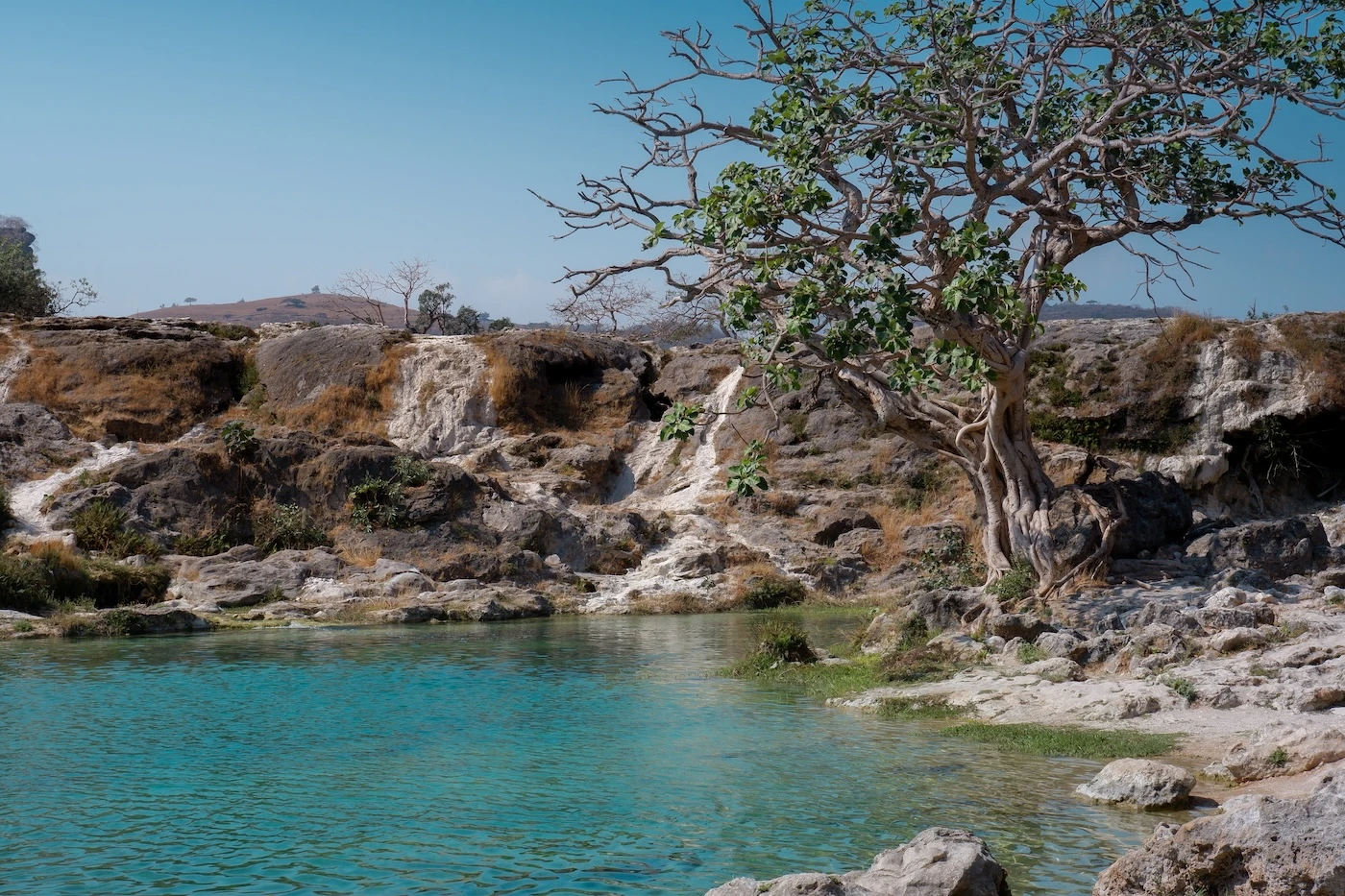
Travertine Curtain: this is a giant cliff, around 150 metres high, and during the Khareef, the monsoon waters fall along its entire length. In the dry season, the waterfall is confined to the furthest eastern side. I think the cliff rock looks like it is melting because it’s covered in stalactites due to the travertine, a type of limestone that is deposited by rainwater after passing over the rock face.
Waterfall views: to see the waterfall from above (the best view), follow the road to the ‘Darbat Waterfall View Point‘ on Google Maps.
This upper viewing area has been developed into a lovely picnic area as part of Oman Vision 2040. There are shelters, trees, paved roads and parking. Easy steps lead right down to the waterfall and pools, making the walk to the base far less precarious. The route used to be really hazardous but is now family friendly (I nearly died hiking down there in flip flops on our first visit!).
Lower pool access: from the parking lot at 17.073872, 54.431816, trails lead down a mostly well-defined path to some small lower falls along some insanely blue water. Depending on the season, you can hike up through the pools and follow the small waterfalls.
The hike gets a little rugged with some scrambling over boulders, but there is nothing particularly difficult (and it’s fun). We spotted camels around this area, too.
This is a spot that you can explore on foot for as long as you want. There are not really many pre-defined paths.


2. Upper Area of Wadi Darbat
This upper area is reached by following ‘Darbat Cafe’ and ‘Top of Wadi Darbat’ on Google Maps. It’s vast and open, unlike most other wadis. There are smaller falls, walks, and a few off road options.
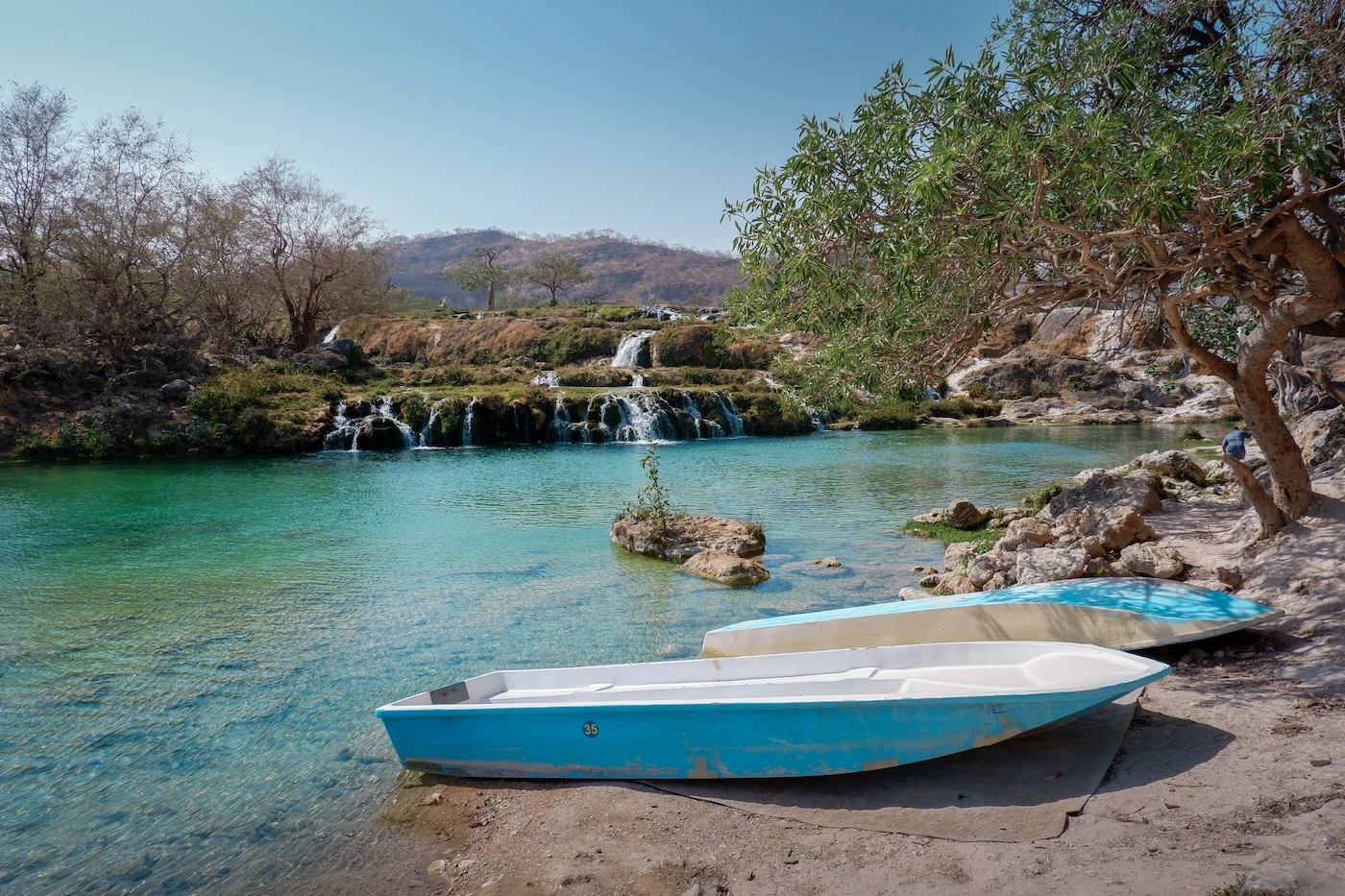
‘Darbat Step Waterfalls’: these are super pretty, cascading waterfalls surrounded by gnarly trees and boulders. You can walk further down towards the top of the travertine cliffs by following the pools (just head in the direction of the ocean!). Boat rides are available here during busier periods.
There is plenty of parking with picnic benches right next to the Step Waterfalls. Outside of peak season it’s mostly empty, but in summer you may have to park further down the road – there’s a huge paved area available.
From the car park, try to spot the tiny arch in the top of the cliffs behind you.
‘Top of Wadi Darbat’: further along the road, the main part of the wadi resembles a wide river. This was peaceful in winter with no boats or people, but plenty of nonchalant camels. There are quite a few cute, flower-covered boats to rent during the busier season though. Where the road ends, there is a large parking lot, places to sit and a few small food/coffee vendors.
Across the wadi: along the main road at 17.089722, 54.434006 (just after crossing the wadi), turn left onto the dirt track and head back south towards the falls. During the dry season, this area is full of animals and feels a bit wild, like a safari. There are lovely picnic spots under trees by the wadi and the end of the track leads to the top of the Travertine Curtain.
To reach the top of the Travertine Curtain, head for GPS point 17.078353, 54.436329, past the date palm field – here you can explore the pools at the cliff edge. This is also a great wild camping location in winter (we have written more about camping in Oman if you are curious).
2.1. Wadi Darbat Boating
Although swimming in the river and pools of Wadi Darbat isn’t recommended, there are opportunities to boat along it instead. The main vendors can be found at the end of the wadi, as far north as you can drive in the upper area.
⬩ The first option is to hire a manned boat which will take you for a short tour along the wadi and back, for about 10 OMR.
⬩ The second option is to hire a kayak or pedalo – these cost 3 OMR for 30 minutes (when we went).
⬩ There are also options to rent a boat at the Darbat Step Waterfalls, and near the carpark at the lower falls.
3. Darbat from Above
There’s a recently built picnic area on the top of a mountain on the eastern side of the wadi. It is reached by exiting the main area and driving north for a few minutes.
It has vast sweeping views looking north of the wadi, bathrooms and shelters to protect from the sun and rain.
Search ‘Darbat from Above‘ in Google Maps.
4. Far Upstream Wadi Darbat
Wadi Darbat extends back up into the hills for many miles. There are several places to have a look around, without the crowds that flock during the summer season. The area is centred around a spot named ‘Wadi Qaitha, mirbat‘ on Google Maps. It’s all very rough and lesser-visited, so you’ll need a four-wheel drive or more rugged vehicle.
Waterfalls: there are some decent waterfalls which can be viewed at ‘Adgharian Waterfall viewpoint‘.
Pools and off road adventures are everywhere in this area. Depending on the water flow and season you visit in, consider checking out the pools near 17.141444, 54.469640 and 17.139552, 54.483335.


SWIMMING IN WADI DARBAT
You shouldn’t swim in Wadi Darbat, despite the super-welcoming looking pools and waterfalls. The water flow is deadly and has killed visitors in the past.
Even if you are an extremely strong swimmer, you also shouldn’t swim here due to schistosomiasis, a parasitic disease endemic to Salalah, which is prevalent in the waters of Wadi Darbat. This illness, which comes from vector snails, can make you seriously sick from swimming in or drinking from the pools.
During our second trip, we noticed more signs everywhere warning visitors not to swim in any of the Wadi Darbat waterfalls or pools. We also noticed families swimming with their kids despite the signs, so I have no idea what to think.
–

CAR HIRE FOR YOUR SALALAH TRIP
We always rent our vehicles all over the world, including our recent trips in Oman, Saudi Arabia, Tunisia and Morocco, with Discover Cars. They’re often the most affordable, plus they paid out immediately on an insurance claim we made when our car took some heavy damage in Sicily.
Find out why we fully recommend them.
–
TAKE A LOOK BELOW OR CHECK CAR RENTAL

FACILITIES AT WADI DARBAT
There are minimal facilities at Wadi Darbat, as with most natural attractions in Oman.
Wadi Darbat does have more than most, with public bathrooms, designated parking, picnic areas and several coffee/food vendors, which is impressive compared with many other nature-based places you may visit in the country.
During our second trip, we noticed newly built, high quality western bathrooms, including ones with disabled access.
Check out the Darbat Cafe, which overlooks the top of the Travertine Curtain – its location is unbeatable.
–
RELATED | THE BEST BEACHES IN SALALAH


What to Bring to Wadi Darbat
Wadi Darbat is not far from civilisation, so isn’t that bad if you forget something. We suggest (depending on the season and planned activities) you bring:
⬩ Food and drink: this is a perfect place for a picnic and, don’t forget not to drink the water here
⬩ Sunblock and hat: it is quite exposed
⬩ Decent shoes: if you are going to climb/walk anywhere
⬩ Waterproof phone case: if you are heading out in a boat
⬩ Toilet paper: the bathrooms might not have any (although they actually did when we were most recently there)
⬩ Waterproofs: in the wet, summer season
⬩ Clothing: wear conservative clothing, even if it’s hot

Things to do Nearby
The immediate area surrounding Wadi Darbat is home to a few quirky spots:
Taqah: this small seaside town has a 19th century Islamic fort, a wide, white sand beach with viewpoints and cliffs, plus a very distinctive and attractive mosque. I really liked this town – it’s so pretty, and we found some outstanding bread in a bakery.
Khor Rori: this ancient port on the eastern bank of the Khor Rori estuary is home to the 4th century ruins of the old city of Samaram, which is part of the UNESCO designated frankincense route. There’s a very pretty sand bar that we spotted spot camels crossing over, and the views towards the ocean are majestic.


Wadi Darbat Map
Below is a saveable Google Map with everything we mention within this post, including GPS markers, parking, locations of the waterfalls and scenic points.
To save this map, select the star next to the title.
GOT EVEN MORE TIME IN OMAN?
Go camping:
Sleep under the stars at these amazing wild camping locations
Plan your trip with our Oman camping guide
Camp atop Oman’s highest mountain
or camp in the palest of Oman’s deserts at the Sugar Dunes
or have a totally unique adventure:
Spot the most remote beehive tombs in Oman
Wander around Oman’s most photogenic fort
Learn about livestock at the Nizwa goat market
Take a look around Oman’s most unique fortification
Find a way into Bat’s 5000 year-old tombs
Figure out which of Oman’s UNESCO sites are worth visiting
Take a chill day on one of Muscat’s beaches
Drive up Oman’s most popular mountain
–
HAVE WE HELPED YOU PLAN A TRIP AROUND OMAN?
If you’ve found our content helpful, consider booking your rental car (if you need one!), through the company we always use – Discover Cars. They’re the absolute best and have been our rental companion (and savior, thanks to their insurance) in many destinations across the world.
Also, consider booking your accommodation through Booking.com – we use them exclusively when travelling in the Middle East.
Alternatively, leave us a tip to say thank you.
Help like this makes it easier to pay for the upkeep of this site and ensures our small business survives the onslaught of AI!
Thanks for reading.
–
Where to Next?
I hope this Wadi Darbat post has persuaded you that it is worth a visit – it’s a unique and photogenic attraction to add to your Salalah itinerary!
The number of bright blue pools and waterfalls were actually astonishing, plus I have never seen anything on the scale of the Travertine Curtain before. It kind of looked like the mountains and walls were melting all around us. The main Wadi Darbat waterfall is definitely one of the most beautiful and dramatic I have ever seen.
If this post has inspired you, we have written about all our favourite wadis in Oman. We also have a specific post on all the beaches around Salalah, some very near Wadi Darbat.
Have a fantastic trip!
Hi, thanks for visiting our blog! If this post has been of help to you, or you’ve just enjoyed our random ramblings and musings, say thank you by buying us a coffee! It helps keep The Restless Beans blog up and running.
Thank you, Claire + Nick


Very helpful n nice article describing each n every detail about Salalah ….Thanks for your hard and nice work thumbs up