

· MIDDLE EAST · SAUDI ARABIA ·
What is the Hegra Tour Like?
Scribbled by Claire ◊ 17 Jun 2025
So, you’ve decided to visit the lost Nabataean city of Hegra, but want to know what the tour is like? Here, we talk about getting tickets, where to get picked up, what the route is like (including maps), how busy the tour was, how comfortable we were, and some quirky info.

The lost city of Hegra, in northern Saudi Arabia, is a bit of an enigma. If you want to visit, it’s only accessible by a guided, organised bus tour. There’s not a lot of information online about it, so you’ve got to buy your tickets, show up, and hope for the best!
We did the Hegra tour recently, not really knowing what it would entail, what we’d get to see or what exactly the tour even included.
So, this is a nice little rundown of where we bought tickets, what the process was like, what the tour involved, how to get to Al Ula, and more. Plus a few little bits of quirky bonus background nuggets and stories about the ancient city for you to take with you on your tour.
We’ve included everything you need to plan you trip seamlessly!

IN THIS GUIDE //
Hegra – What is the Tour Like?
WHAT IS THE HEGRA TOUR LIKE?
– HEGRA TOUR MAP
WHERE IS HEGRA
– GETTING TO AL ULA
TICKETS AND COSTS FOR THE HEGRA TOUR
WHERE TO STAY IN AL ULA
BEST TIME TO VISIT HEGRA
SOME BACKGROUND INFO FOR YOUR TOUR
WHO ARE THE NABATAEANS?
IS HEGRA CURSED?
FINAL THOUGHTS – HEGRA VS. PETRA
This post may contain affiliate links. If you book through these links we may make a small commission at zero cost to you. It helps us pay for the upkeep of this blog. Thank you!
What is the Hegra Tour Like?
An organised tour is the only way to access the ancient city of Hegra. We did the ‘Hegra day tour’, which we’d highly recommend.
Below we’ve written exactly what happened on our tour, so you know what it’s like and how to prepare!
Where Does the Hegra Tour Begin?
The tours begin in either Winter Park, or the Hegra Visitor Centre.
When we did the standard Hegra tour, it began at Winter Park, an area in the north of the Al Ula. There is masses of parking at Winter Park and it is safe to leave your rental car here.
Your QR code is checked in a small office, located at 26.665225, 37.905181 (you can’t miss it!). There are adjacent clean bathrooms, a shaded seating area, plus a Burger King and a café, too.
After your QR code is check, you wait around until the ‘Experience Al Ula’ coach picks you up.
If you drive directly to the Hegra Visitor Center, you’ll skip this section.
The Hegra Visitor Center
The coach ride to the Hegra site from Winter Park, north of Al Ula, takes around 15 minutes.
On arrival at the Hegra site, you exit the bus and are directed to sit in a slightly out-of-place (but pretty and shady) outdoor waiting area at the Hegra Visitor Center, where there are staff members, refreshments and dates. The visitor centre has bathrooms – there are no others around the site.
After a short break, the staff provide a quick explanation of the Hegra tour in English and Arabic (it took around five minutes for us) and a different coach turns up which takes you on a tour around the actual archaeological site.
The Tour
Our Hegra tour bus stopped four times over a short loop around the site, allowing you to get off and explore each area for as long as your choose.
The bus then picks up other waiting visitors and moves on to the next point of interest (you can’t go back and revisit a stop). Every ten minutes another bus turns up, so it’s a kind of hop-on, hop-off situation, and you can stay in each area for as long as you want (up to closing time, obviously).
The buses we took usually had about five other people on it (so nearly empty) and there was also free water.
Guides | at each of the four stops, there was an English and Arabic speaking guide (or a ‘storyteller’/’Al Rowah’), mentored by archaeologists, who provides information on the tombs. They’re really quite good.
Eventually, after you’re finished at all four stops, a bus will take you back to the waiting area where you began your Hegra tour. You have time to use the bathrooms, check out the small museum in the visitor centre and buy souvenirs in the shop.
From here, a separate bus will then take you back to Winter Park (if you need this).

Useful Things to Know About the Tour
Hiking | each area you get to explore is relatively small and there is no hiking allowed. So, you can’t hike from one area to the next, for example, even though they are not far apart.
Kids | the site is totally suitable for kids (although I have no idea if they’d get bored!).
Footwear | walking around the site it really easy, so wear any footwear you’re comfortable in. Like, if flip flops are you jam, they’d be fine!
Water | this is available on the buses.
Shade | there’s no shade really, apart from the bus! A sun umbrella and sunblock would be useful here!
Accessibility | I wouldn’t say that the site is overly accessible, however, it’s not particularly hilly and there are no steps. Pushing a buggy or a wheelchair would be challenging, but not totally impossible. There’s a lot of deeper sand around parts of the area.
How Long is the Tour?
The official website says the Hegra tour lasts about an hour and 5 minutes. However, we spent around three hours on the Hegra tour, from beginning to end, from Winter Park.
So, if you take no photos and park directly at the visitor centre, you could easily be done within two hours.


Hegra Tour Map
Below is a Google Map of the places we visited on the Hegra Tour.
To save this map, click the star next to the title.
How to Get to Hegra
The site of Hegra is 20 kilometres north of the palm-lined Saudi Arabian settlement of Al Ula, nestled between soaring, honey-coloured rocks.
Surrounding Al Ula is a remote area of desert, with very little in terms of large-town facilities. The nearest major town to Hegra and Al Ula is Tabuk, around 300 kilometres north towards the Jordanian border. To the south, the holy city of Madinah is around 360 kilometres away.
All the routes between these cities are easily travelled by paved, well maintained roads.
Getting to Al Ula For Your Hegra Tour
There are several options for reaching Al Ula for a visit to Hegra:
◊ The easiest (but most expensive) is to fly directly into nearby Al Ula International Airport (airport code ULH). The airport is around a 30-minute drive south west of the centre of Al Ula. Flynas and Saudia operate direct domestic flights from other cities in Saudi Arabia such as Riyadh and Jeddah, while FlyDubai connects Dubai to Al Ula.
◊ It is also possible to fly into other cities in Saudi Arabia, such as Tabuk, Madinah or Jeddah and then travel to Al Ula by car or bus. These flights are often cheaper, but then it is necessary to add on the cost of a rental vehicle. The national bus company, SAPTCO, operates bus routes between all major cities, is pretty reliable and good value.
◊ Renting a vehicle and driving from any city that is affordable to fly to is an excellent option since self-driving around Al Ula provides the opportunity to explore the epic scenery in the surrounding region.


Tickets and Costs for the Hegra Tour
Hegra tickets should be bought directly from Experience AlUla, the official website, in advance of the date you intend to visit; from there you choose a time slot.
Tickets cost 150 Saudi riyals and includes airconditioned coach transportation to Hegra from an area called Winter Park, in Al Ula town. There are also crazy-expensive private Jeep tours – we wouldn’t recommend them – you don’t get any more from your money than the bus really!
Once you’ve paid, you get a QR code and ticket via email.
Note | although slots looked limited online when we booked our tickets, the buses were pretty empty when we arrived, so we’ve got no idea if tickets/slots actually sell out or not (this was during March).
We’ve written more about Hegra, in respect to Petra, if you’re curious about if we thought the Hegra ticket fee was worth it.
Where to Stay in Al Ula
Although you could technically just about do a Hegra day trip from places like Tabuk, we wouldn’t recommend it. It’s a really long way, the scenery is beautiful around Al Ula and there are lots of other things to see and do. We’d suggest staying at least one night.
While there are quite a few accommodation options around Al Ula, they are pretty much all over-priced. Despite our recommendation to stay overnight, do not spend longer in this region than you must if you’re on a budget.
Dotted about the rocks outside of the town are a few desert Bedouin type camps (think Wadi Rum, Jordan, but with a monstrous price tag and a little bit more luxury). In Al Ula, we stayed in one of these (cashed in a fair few reward points for our stay here because it was completely out of our budget and way over-priced!).
There are also some quirky places like Caravan by Habitas, which is a collection of luxury Airstreams hidden between the looming cliffs outside of Al Ula. Cool places like this come with an extreme price tag though!
There are a few more budget accommodation options near Al Ula, but most of these are also excessively over-priced. Honestly, if you like camping, just do that instead.
When is the Best Time to Visit Hegra?
The best time of year to visit Hegra is during the winter months, between October and April. These months are cooler and the harsh desert sun is less likely to be uncomfortable.
Summer | during the summer, temperatures soar to way beyond 35 degrees Celsius (95 Fahrenheit) and there is little shade at the site.
We visited in March and it was lovely, sunny, warm weather.
Light | if you are looking for the best light on the carvings for photography, visiting in the afternoon provides a better opportunity for this since the most prominent tombs roughly face west. However, there are lots of tombs, all of which face in different directions, so any time of day would be okay. I’d recommend avoiding the unflattering light of midday.
Our chosen slot in March was the last of the day, around 2.30pm. However, in different seasons, the available slot times may change. Also, check what time the sunset is at the time of your visit.


A Little Hegra Background Info For Your Tour
Hegra is the second city of the mysterious Nabataean Kingdom (also known as Mada’in Saleh, although the tourism board do not want you to call it that – read the story further down to find out why). This powerful state flourished in the Middle East around the 4th century BCE to 1st century CE, before being annexed by the Romans.
Despite being nomadic, the Bedouin Arabic tribe had several important, permanent centres, including the famed cities of Petra and Hegra. Petra, the capital of the Nabataean empire, situated in southern Jordan, was the caravan trade route conduit to Europe. Hegra, in the Hejaz region of northern Saudi Arabia and 500 kilometres south east of Petra, was settled by the Nabataeans during the 1st century CE, as a thriving trade hub for the south.
In the Present Day
In the present day, Hegra, meaning ‘rocky tract’, is a highlight of any tourist experience in Saudi Arabia.
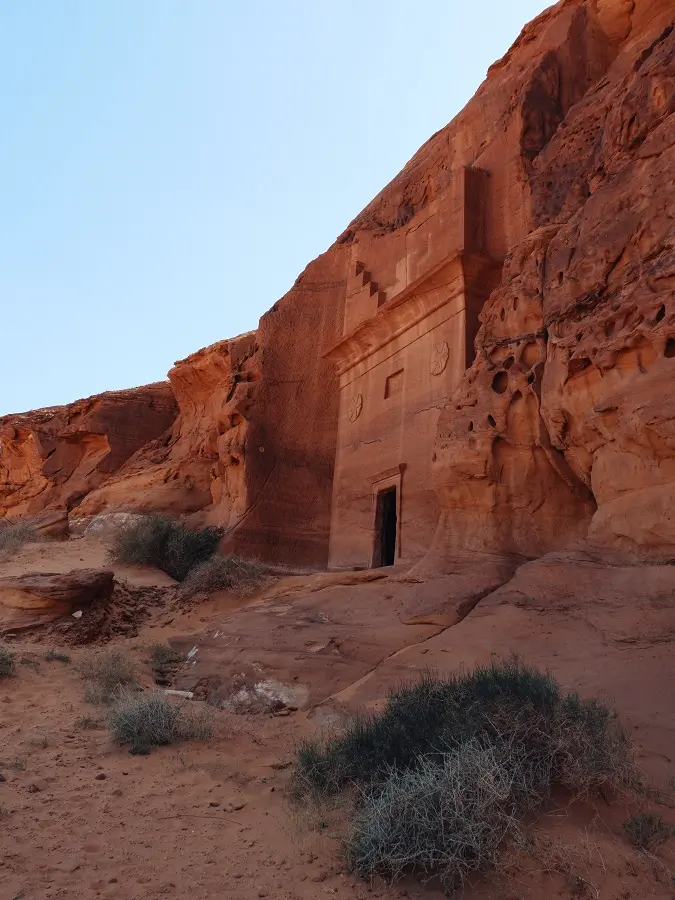
Having been left undisturbed for nearly 2000 years, the government is pushing infrastructure development to encourage visitors, and the site is now easily accessible by the public. Hegra is a collection of more than 110 huge sandstone carvings, straight into the rocks protruding from the desert, showcasing the ingenuity and creativity of the ancient Nabataean culture. These exquisitely preserved rock-hewn carvings were tombs for important officials of the Nabataean tribe and are often accompanied by inscriptions.
Of the 110-plus tombs, most prominent is the 72-foot tall sandstone monolithic of Lihyan Son of Kuza. This enormous, stand-alone rock, although unfinished, is the unofficial image of Hegra, much like the Treasury is to Petra.
WHO WERE THE NABATAEANS?
The Nabataean Kingdom, in existence for half a millennia from 400 BCE, was a wealthy tribe of desert-dwelling wanderers who traded in spices and incense.
Strategically positioned, the Nabataeans controlled the flow of highly in-demand supplies such as frankincense, myrrh, ginger and sugar between the Middle East and the Mediterranean.
Over their prosperous reign, they controlled movement across a huge region, including parts of modern day Saudi Arabia, Jordan, Egypt, Israel and Syria.
In 106 CE, the Nabataean Empire came to an end when their land was occupied and independence was lost to the Romans. At this point, their successes and wealth were gradually lost to history.
There are no direct texts written by the Nabataean people, making it difficult to know much about them apart from whatever can be gleaned from inscriptions left on the tombs. Other civilisations reference them, but as they did not record their own history, information is scant.
–
SAUDI WOMEN’S UNIQUE ARTFORM | SAUDI ARABIA’S GINGERBREAD VILLAGE
Story Time – Is Hegra Cursed?
In Islam, Hegra is also known as Mada’in Saleh, translated as ‘Cities of Prophet Saleh’.
Mada’in Saleh was the home of the Thamud people, who were originally a tribe called Ad (Bani Ad) from Yemen, according to Islamic scholars. They resided in Hegra and became wealthy, cruel and worshipped false idols.
Prophet Saleh (PBUH), a son of Thamud, was sent from Allah to change the tribe’s ways and spread the monotheistic word of God. The Thamud did not want to accept the word of Allah and challenged Saleh to evidence his words with a miracle – make a rock split in two, from which a 10-month pregnant she-camel should emerge.
The Prophet met their challenge and a she-camel appeared from the rocks. Instead of caring for the camel, under Saleh’s order, several unbelievers killed the camel.
The Prophet Saleh then told them “Enjoy life for three more days, then the punishment will descend upon you.” However, instead of changing their ways under the promise of retribution from Saleh, nine Thamud men plotted to kill Saleh, but were struck down by birds sent from Allah.
Three days later, with the Thamud unrepentant, Allah sent violent lightning, thunder and earthquakes in the night, killing the Thamud people and all living creatures across the land.
In Recent History
Millennia later, Prophet Muhammed (PBUH), on his way to the Battle of Tabuk, forbade his followers from entering the area around Hegra, allowing them only to drink from the well of the she-camel, fuelling fear of the area.
These hadiths and excerpts from the Quran have acted as a warning for followers of Islam; do not visit Mada’in Saleh.
In the early 1970s, there was even an official fatwa (a ruling based on Islamic law) forbidding any visitation, development or excavation of the site at Hegra. It was believed that Hegra was a place of the wrath of Allah, who struck down the Thamud people. There even used to be billboards surrounding the region, warning people to discover Islam, not Mada’in Saleh.
The current government are rolling back the ‘cursed’ reputation of Hegra and are embracing pre-Islamic history across Saudi Arabia in order to increase tourism in the region.
CAR HIRE FOR YOUR SAUDI ARABIA TRIP
We always rent our vehicles all over the world, including our recent trips in Oman, Saudi Arabia, Tunisia and Morocco, with Discover Cars. They’re often the most affordable, plus they paid out immediately on an insurance claim we made when our car took some heavy damage in Sicily. We fully recommend them.
–
TAKE A LOOK BELOW OR CHECK CAR RENTAL
Final Thoughts – the Hegra Tour
We were really happy with our Hegra tour, even though we love to hike and the experience over all is a bit restrictive. I mean, it’s still worth doing – how often do you get to explore a hidden, pre-Islamic Saudi Arabian city?
If you’ve visited Petra in the past, you may have been wondering how this site compares, and if it’s worth visiting. Check out our direct comparison if you’re questioning if it’s worth the effort.
We hope you have a great time!
Hi, thanks for visiting our blog! If this post has been of help to you, or you’ve just enjoyed our random ramblings and musings, say thank you by buying us a coffee! It helps keep The Restless Beans blog up and running.
Thank you, Claire + Nick


Just want to say thank you. Just read your posts about Nizwa and Al Ula. Really appreciate your info and thoughts.
Hi David,
Thanks so much for your comment. 🙂
Thank you for the inspiration and overview about Hegra. Planning a trip myself and this was valuable information. Especially appreciated the information about tour duration, prices and fees as well as accommodation in Al Ula.