

How to Kayak Horseshoe Bend: the Complete Guide
Scribbled by Claire ◊ 29 May 2025
Did you know you can actually see the famous Horseshoe Bend from the bottom? Here, we’ve talked about how we organised our kayaking trip along the Colorado, with information on costs, how difficult the kayaking is, what the temperatures are like, parking details and lots more.

The overlook at Horseshoe Bend is a screensaver image: it’s one of the most famous attractions in the entire world.
The equivalent view from the bottom of Horseshoe Bend, though? This one has, so far, escaped the crowds and fame (even though it’s arguably much better).
So, with all that screensaver-fame comes the hordes of tourists, necessary crowd management schemes, and associated costs. Even the parking to take the short hike now costs an outrageous $10 and there are ugly guard rails by the cliff edges.
I visited a fair few years ago and it wasn’t like that, at all. There were few people, no charges, no rails, and no ticket booths.
I was planning a new trip and Nick had never visited. I wanted to show him the beauty of the region, but was desperate to find a way to avoid the resulting over-tourism that came with Horseshoe Bend’s world-renowned image (plus, I try to avoid crowds of people at all costs!).
Here was my solution – why not take a kayak along the Colorado River and see it from the bottom up? There were a fair few logistics to figure out, but it was easily the most epic way to see this magnificent spot!
We hope the below helps convince you to see this wonder of nature from a more tranquil perspective, and that you have the best experience kayaking around Horseshoe Bend!

IN THIS GUIDE //
How to Kayak Horseshoe Bend
WHERE IS HORSESHOE BEND?
WHY KAYAK HORSESHOE BEND?
BEST TIME TO KAYAK HORSESHOE BEND
IS IT HARD KAYAKING AROUND HORSESHOE BEND?
HOW TO ORGANISE YOUR TRIP
– HOW LONG DOES IT TAKE?
– BACKHAUL COMPANY
– REMEMBER YOUR PARK PASS
– PARKING AT LEES FERRY
OUR COSTS
CAMPSITES AT HORSESHOE BEND
PERMITS FOR KAYAKING AND CAMPING
GEAR SUGGESTIONS
HINTS AND TIPS
OUR EXPERIENCE
WHERE TO NEXT?
This post may contain affiliate links. If you book through these links we may make a small commission at zero cost to you. It helps us pay for the upkeep of this blog. Thank you!
Where is Horseshoe Bend?
If you are reading this post, then the chances are that you have already seen pictures of Horseshoe Bend. It’s a striking emerald green segment of the Colorado River, just downstream from Glen Canyon Dam and Lake Powell in Page, Arizona.
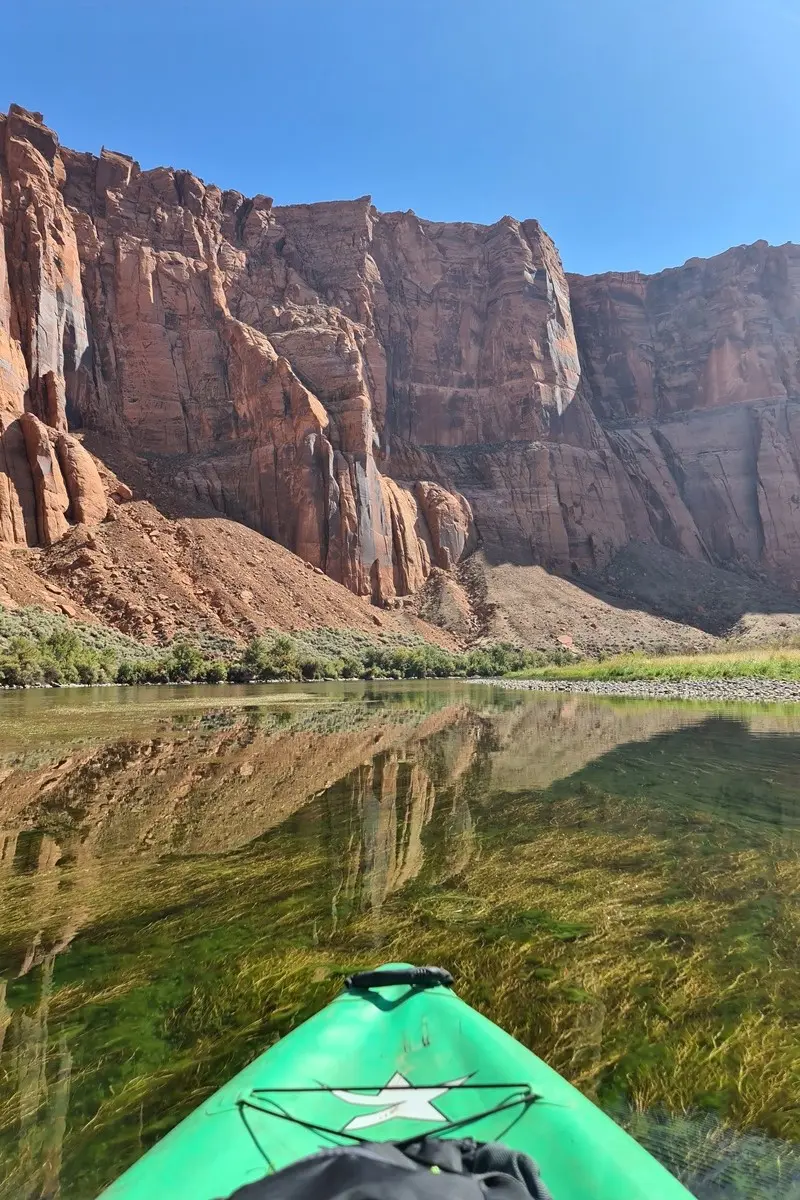
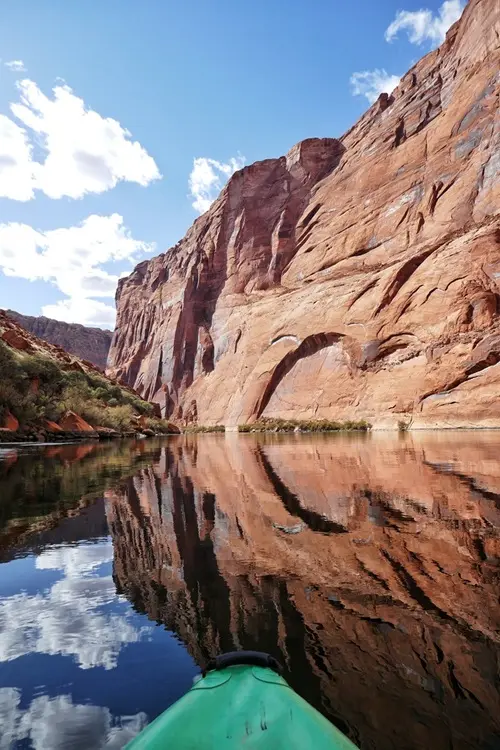
This ribbon of water is surrounded by 1000-foot, sheer, glowing sandstone cliffs. It’s almost otherworldly how utterly immense and vertical they are. The views from the Colorado River are *seriously* impressive.
The iconic viewpoint above overlooks a small section of the 15-mile stretch of river between Lees Ferry and the dam: shaped, unsurprisingly, like a horseshoe.
Lees Ferry is the beginning point of kayaking trips in the area. It is a tiny place situated on the edge of the Colorado River and acts as the gateway for many of the multi-day Grand Canyon rafting trips (and Horseshoe Bend kayaking trips!).
Why Kayak Horseshoe Bend?
⬩ Avoids the crowds on the Horseshoe Bend overlook – this is honestly priceless.
⬩ Kayaking on the Colorado River is more adventurous than any viewpoint.
⬩ It’s way more more beautiful than the overlook! Seriously, *way* more beautiful.
⬩ You can camp for free.
⬩ It’s really easy (mostly) – you float in the direct of the flowing river and there are basically no rapids, plus it’s shallow.
⬩ No guides/tours required – it’s an adventure you can have without any supervision.
⬩ Your friends at the viewpoint will all be enormously jealous.
⬩ It’s the only way to see the petroglyphs all along this part of the Colorado River.
⬩ You get the Grand Canyon river-rafting views for a fraction of the money and time commitments of the actual national park.
BEST TIME OF YEAR TO KAYAK HORSESHOE BEND
The best time to kayak Horseshoe Bend is during Spring (late March-May) and Fall (late September-October).
The best specific months to kayak Horseshoe Bend, overall, are late September, early October and May.
The weather matters enormously in Horseshoe Bend, because the water is pretty cold and the air temperatures in the canyon can get extremely hot in summer (well over 100F degrees) and cold in winter.
There are also monsoon storms in July and August which would make for an absolutely awful kayaking trip – violent storms are unpredictable and there is a risk of lightning on the river. There is also very little shade in summer and the nights don’t cool down much.
In winter, the air and water are extremely cold and there is very little sunlight in the canyon. Even for seasoned kayakers, this would be tough, although it is technically possible to kayak still at this time of year. However, the outfitters do not operate the backhaul service during winter months, from late October to the beginning of March. For example, the outfitter we used will not take bookings past the 21st October in 2025.
In March and April, the weather is better but unpredictable – it can snow or be scorching! High winds are also a risk.
–
RELATED | 16 INCREDIBLE SLOT CANYONS IN UTAH
Is it Difficult to Kayak Around Horseshoe Bend?
No, it is not difficult to kayak Horseshoe Bend.
We are definitely no experts, having only casually kayaked a few times in the past. Honestly, I’m not even a very good swimmer (really awful, in fact).
Horseshoe Bend was the longest kayaking trip we had ever done, but because you paddle in the direction of the river flow, you never really have to put in that much effort! We were told that the river moves you around one mile an hour without any interference, so it removes a lot of the work involved.
The river stream is also controlled by the dam, so it is not fast flowing or turbulent (Class I rapids). There are a few little rapids on the river, nothing intimidating though. The depth is pretty shallow and it’s mostly just casual floating!
We didn’t experience any wind during our trip, but this could cause difficulties if it picked up in the bottom of the canyon. Kayaking directly into a strong headwind would have made our day far more difficult.
How to Plan Your Horseshoe Bend Kayaking Trip
Before kayaking Horseshoe Bend, there are a few logistics and preferences to figure out. Here are some things to consider:
Length of Trip – How Long Will it Take?
You will need to decide the length of your trip.
The distance between the dam and Lees Ferry is 15 miles, which is a very long day if you are not feeling energetic. Another option is to be dropped off ten miles from Lees Ferry at Petroglyph Beach which makes for a far more leisurely day trip. The final option is to spend a night at one of the five free campgrounds along the route and split your journey in two. All of these choices include kayaking the actual section of river that you can see at the Horseshoe Bend overlook.
To summarise:
⬩ A shorter one-day trip – total of 10 miles kayaking from Petroglyph Beach
⬩ A longer one-day trip – total of 15 miles kayaking from Glen Canyon Dam
⬩ An overnight camping trip – 15 miles split over two days from Glen Canyon Dam
Select a Backhaul Company
You need to decide where to get your kayaking gear from (assuming you don’t have your own). You will also need to arrange a backhaul provider to take you to the dam or the ten-mile point at Petroglyph Beach. It takes around 30-40 minutes to travel to the dam by boat from Lees Ferry and a little less to the ten-mile point.
We used a company called Kayak Horseshoe Bend who provided both the double kayak and the backhaul service together. They gave spot on advice, gear and were really accommodating considering we booked the day before our trip!
There were options of hard shell or blow-up kayaks (I think we got a blow up one – I am not a pro at kayak things though and don’t know which is best!) and various choices of times to get our boat to the dam. We arranged for a relatively early start because we decided not to camp. We were also provided with life vests.
Ensure you Have a National Park Pass
Kayaking Horseshoe Bend requires a Glen Canyon National Recreation Area pass which is $30. This is because the area is part of the National Park Service. You can pick one up from the kiosk on the way into Lees Ferry, just past the Navajo Bridge.
If you have an America the Beautiful pass (you should get one if you don’t already!) you don’t need the Glen Canyon pass.
Travel tip | Page is in Arizona, on the border with Utah and near to the Navajo Nation reservations. Remember that they all do not share the same time zone – so ensure you use Arizona time for any arrangements you make!
Parking at Lees Ferry
There are marked areas for day and overnight parking at Lees Ferry. Ensure you park in the correct place – park rangers do check! It is free to park here but ensure you display your Glen Canyon or America the Beautiful pass visibly in the window of your car.
There are also bathrooms in the lot.


Costs to Kayak Horseshoe Bend
I think the prices are normally roughly the same, no matter who you get to provide the backhaul service. We paid:
⬩ Backhaul service: $80 per person plus taxes (2025 prices)
⬩ Tandem kayak rental: $55 per double kayak plus taxes
Total – $226.30
For an entire day of activities including a boat ride, we were very happy with the cost.

Can You Camp Along Horseshoe Bend?
Yes, you can camp along the river at Horseshoe Bend.
There are five campgrounds you can use when kayaking the route. These are all free and first-come, first-serve.
We did not camp but checked out the campgrounds as we travelled down the river. Here they are in order from the Glen Canyon Dam to Lees Ferry boat ramp (distances from Lees Ferry):
Ropes Trail Campground | on the right side at mile 14. The quietest camp but also leaves the longest distance for day two!
Ferry Swale Campground | on the left side at mile 11. A nice, spread out campground.
9 Mile Campground | the most popular campground and overlooked by the crowds above! It is on the right, near enough smack bang in the middle of Horseshoe Bend. This one had a lot of friendly people fishing here when we visited.
8 Mile Campground | on the right as you are heading out of the actual Horseshoe Bend section. It is very well hidden and probably my favourite of the five.
6 Mile Campground | the closest camp to Lees Ferry. On the right around the six-mile mark.
Campground facilities | all campgrounds have toilets and fire pits. Have a look on Google Maps satellite view – they are all marked on there. You can see where the toilet blocks are, how big each campground is and which one you might fancy.
PERMITS FOR KAYAKING AND CAMPING HORSESHOE BEND
There are no permits necessary for either day-use kayaking Horseshoe Bend, or to camp there in one of the five campgrounds overnight.
The sites between Glen Canyon Dam and Lees Ferry are first-come, first-serve and the campgrounds are often full during high season.
The only fee is the $30 Glen Canyon National Recreation Area pass, or free with an America the Beautiful pass.
–

Gear Suggestions
Now you have all your transport and backhaul stuff organised, what else do you need to kayak Horseshoe Bend?
For a Day Trip
Warm clothes in layers: it is very cool in the early mornings and evenings but can be hot in the middle of the day. We did our trip in October and it was warm in the sun and freezing in the shade! Merino wool is the best option here – it keeps you warm and dries far more rapidly than cotton.
Cover for your legs: sunburn comes easily here.
Dry bag: stuff will get wet. Put your clothes, electronics, and food in a reliable dry bag.
Food: bring loads and loads of food. We found that kayaking around Horseshoe Bend was far more tiring than expected and we just wanted to float along and eat all day. Even worse, we tragically dunked a third of our sandwiches by accident.
Water filtration option: it is better to filter before drinking Colorado River water. We use a Sawyer squeeze.
Sunhat/head cover: this is especially important in the summer when there is little shade and it is *hot*.
Microfibre towel: as above – stuff gets wet. Plus, it can double up as your leg cover!
Sensible shoes: getting in and out of the kayak would be painful without decent footwear. Either open toe hiking shoes like Tevas or some type of lightweight trailrunner would be good. I wore my Altra Lone Peaks and, as always, they performed amazingly well.
Waterproof phone casing: even if your phone is technically waterproof, it still probably doesn’t appreciate getting dunked.
Toilet paper: for the campground bathrooms.
Neoprene Socks: my feet got so cold and I may have been more comfortable if they were less wet.
Extras for Camping
Standard lightweight camping gear: remember it must fit on your kayak!
Firewood: if you are intending to have a fire.
Cooking equipment: this will depend on your culinary standards.
Power block for your phone: if you take a lot of photos.
Torch/headtorch: there are no lights along the Colorado River (obviously).
Warmth: personally, I was cold and damp, so would have struggled in the evening without a full change of dry clothes and some hand warmers (outside of summer, anyway).
Hints and Tips
As complete novices, here are some things we learnt while kayaking Horseshoe Bend:
Following the faster streams on the river also helps if you want to get back quicker. The outside of the turns flows faster than the inside.
Gusts of wind can blow your kayak down the river, especially in spring. Be very careful when securing it if you stop for a break.
Avoid boat channels. They have right of way and can only use the deeper parts of the river so it is best to avoid these areas if you are not a confident kayaker. You can apparently hear the boats half a mile away, so don’t worry about them creeping up on you!
The water is cold. Hypothermia is a real risk. Be aware and wear sensible clothing.
Give yourself plenty of time. I think you could technically kayak it in a half day if you were fast, but why would you want to? Plus, if you are terrible like us and keep kayaking backwards, you will need as much time as you can get.
Find out how much shade there will be at your chosen time of year. This will determine how cold you may get!
Avoid whirlpools. These are scary and can spin you around and tip you over.
Wear your life vest. They’re hot stuff, literally – mine kept me warm (and also might save you if you fall out).

KAYAKING HORSESHOE BEND – QUICK FACTS
WATER TEMP – AROUND 50 F
NEAREST TOWN – PAGE, ARIZONA
TRIP LENGTH – 10-15 MILES
BEST SEASON – SPRING/FALL
RIVER FLOW SPEED – 2-4 MPH
DIFFICULTY – EASY/MODERATE
TIME NEEDED – 1-2 DAYS
CAMPGROUNDS – 5, FIRST COME, FIRST SERVE
GUIDE – NOT REQUIRED
PERMITS REQUIRED – NONE, JUST AN AMERICA THE BEAUTIFUL PASS
–
RELATED | 17 MAGICAL THINGS TO DO IN PAGE
Our Experience Kayaking Horseshoe Bend
In the Morning
First thing in the morning, we arrived at a chilly Lees Ferry and parked in the day-use car park (nearest the boat launch, there were loads of spaces).
Our boat was waiting for us with the kayaks already loaded. We were instructed to leave our kayaks near the boat launch at the end of the day for collection, so no need to wait around for anyone.
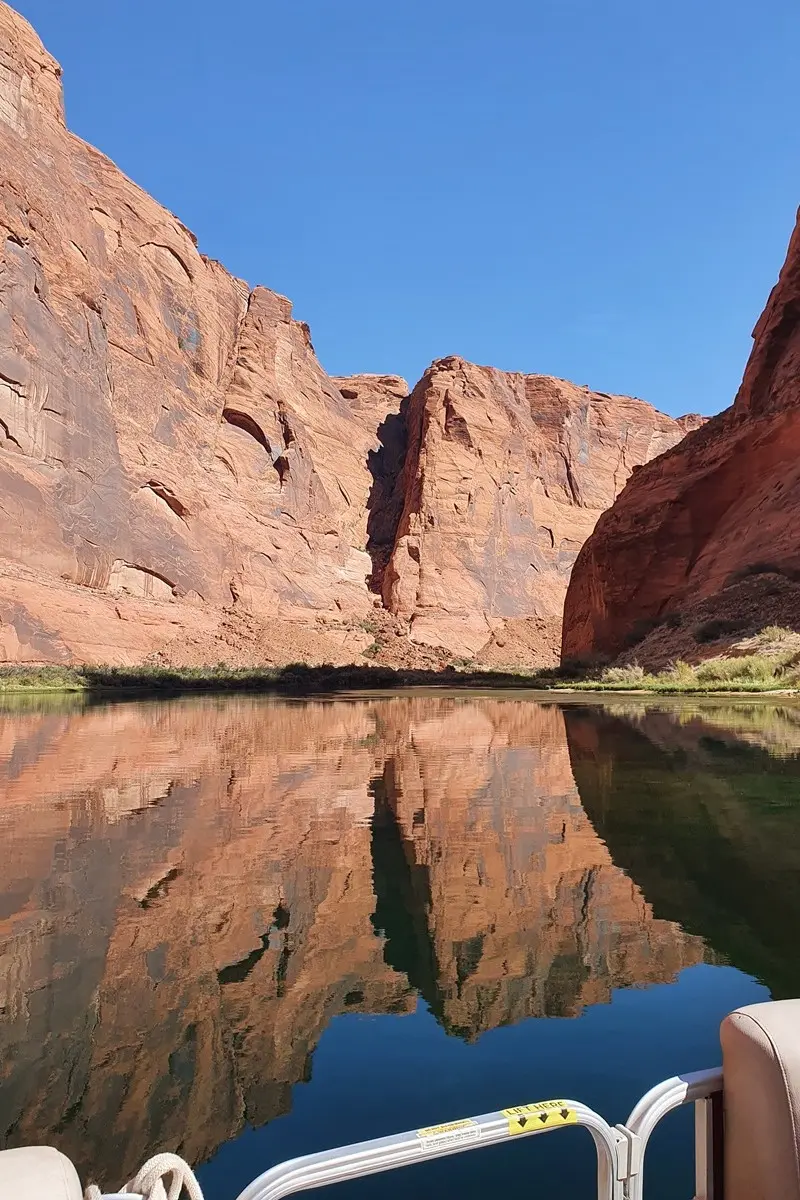
The backhaul boat trip was a lovely addition on top of our kayaking experience, our boat driver was so helpful. She showed us where the rapids were, which routes to take, where the bathrooms were and pointed out how far we had travelled so we could gauge the distances.
She also showed us where to find Native American petroglyphs and pointed out the crowds looking down on us from above (the people look so small at the viewpoint).
The Journey
We were dropped off on a wide, flat sandbank where we organised our stuff and ate some food (realising quickly that we had packed too little).
Throughout the journey we stopped quite a few times – it was nice to stretch our legs. At the ten-mile point (Petroglyph Beach) we found petroglyphs of some sheep (there are toilets here, too). We also stopped at the campgrounds and had a stroll around some of the other sandy banks. The views are magnificent the entire route and keep changing, so you want to continually stop.
We saw a lot of trout in the river swimming past our kayak (much fast than we could go!), which explains all the people fishing.
Our total journey took all day, so around 9-10 hours, I think. We did get our pace on a little when we were worried about getting back late, but luckily towards the end the river helped us a lot! We’d recommend doing the 10-mile route if you haven’t kayaked before or just want to chill a bit (also, the best bit is in the middle, in my opinion).
Some Difficulties
For some reason, we found the kayaking a little more tricky than other people appear to find it!
Sometimes we would get turned around and occasionally kind of ‘beached’ in the middle of the river because it is so shallow. None of these things were scary or worrying, just a bit awkwardly embarrassing! Luckily, we rarely saw any other people, so our ineptitude went mostly unnoticed.
Most of the difficulties we had came from the weather. The water is very cold (around 50 degrees F), so when your feet inevitably get wet, they stay wet and my feet were almost numb by the end of the day. It was also frustrating having to keep adding and removing layers while wearing a lifejacket! We were told that you could get hypothermia if you stay in the water for more than five minutes without a dry suit (this was in early October, though).
I would say that despite our inexperience, kayaking Horseshoe Bend was well worth it! We did not feel like we needed to be part of a tour or hire a guide – it was well within our (very) basic ability.

WHERE TO STAY NEAR HORSESHOE BEND
Page, Arizona, is the nearest town to Horseshoe Bend.
However, we find nearby Kanab to be a more affordable option than Page, with nicer, more unique overnight options. So, here are the places we’ve stayed in Page (and a number we wish we could), plus a few suggestions for Kanab (we’ve stayed in almost every hotel there).
In Page
Motel 6 – I wouldn’t routinely recommend a Motel 6, but it was *easily* the cheapest place we stayed in Page on our most recent trip. It wasn’t too bad and if you intend to be out of your room the entire time, it’s tolerable.
Other central motels – we’ve stopped over in many motels in central Page, our favourites being the Holiday Inn Express, Country Inn and Suites and the Baymont by Wyndham. Honestly, we wouldn’t usually choose pricier chain motels but Page has so many (mostly bad) budget options. Check the reviews carefully if they’re rated below an 8!
Under Canvas Lake Powell – for a proper glamping experience, look no further than Under Canvas. This outrageously pretty place has luxury tents with private bathrooms, but it might be worth skipping in the hot months – there’s no aircon. There is even a slot canyon on site, if that helps persuade you!
Amangiri – ok, straight up, we can’t afford this one, but if you take a look at it, you’ll know why it’s on our bucket list. For a once-in-a-lifetime stay, check this out.
In Kanab
Red Canyon Cabins – quality, mid-range budget accommodation, with cute, individual little huts, laundry and parking right outside your cabin.
Best Friends Mercantile – just a totally amazing place to stay. Beautiful rooms, enormously pet friendly, lovely vegan breakfast. We recommend this one over and over.
–
CAR HIRE FOR YOUR SOUTHWEST ITINERARY
We always rent our vehicles all over the world, including our recent trip in the United States, with Discover Cars. They’re often the most affordable, plus they paid out immediately on an insurance claim we made when our car took some heavy damage in Sicily. We fully recommend them.
–
TAKE A LOOK BELOW OR CHECK CAR RENTAL
HAS OUR FREE CONTENT HELPED YOU PLAN YOUR KAYAKING TRIP?
If you’ve found our content helpful, consider booking your rental car (if you need one!), through the company we always use – Discover Cars. They’re the absolute best and have been our rental companion (and savior, thanks to their insurance) in many destinations across the world.
Also, consider booking your accommodation through Booking.com – we use them exclusively when travelling in North America.
Help like this makes it easier to pay for the upkeep of this site. Thank you!
–
Where to Next?
This was one of the few times we decided to pay lots of money for an adventure. It is a rarity in the United States that we do this since with a national park pass there are so many free outdoor activities! This felt like a special treat for us, and we are so pleased we chose to do it.
If you are interested in kayaking Horseshoe Bend and seeing the Colorado River from a different, more peaceful point of view, we hope this post helps you plan your trip. Have a great day!
If you’re spending more time in Page, we’ve written a big list of our favourite things to do in the area. Have a peek if you’re interested.
Hi, thanks for visiting our blog! If our free content has been of help to you, or you’ve just enjoyed our random ramblings and musings, say thank you by buying us a coffee! It helps keep The Restless Beans blog up and running.
Thank you, Claire + Nick


I found this bet helpful as i am planning my 1st journey to Arizona. Thank you!
Thank you so much for your comment – glad to be of help. Have a fantastic trip!
This really felt like the best way to experience the river versus closer to Page, where there might be more boats/wake to contend with. Were boats allowed on the stretch of river you were on? Also wondering about cold feet with the temperature of the water. Of course, I am planning for a couple of weeks from now Mid-March! So we’ll see. Thanks for a great description/pics of your trip!
Hi Ellen,
Thanks for your questions.
Boats were allowed on the river, though there weren’t that many when we were there – the river certainly didn’t feel busy at all and they didn’t bother us.
In terms of temperatures, the air was okay but the water was quite cold. We’re not great at kayaking, so the bottom of the kayak had some water in it constantly and my feet were freezing. It all felt extra cold once the sun went in behind the clouds and cliffs; it would probably have been smart of us to bring a change of socks and wear something thicker/more waterproof on our feet. I’d suggest taking something extra warming in a waterproof bag, just in case.
Hope this helps and you have a great trip – we’re going back to Page in April-May too!