

The Nizwa Goat Market: What to Expect at Oman’s Most Chaotic Auction
Scribbled by Claire ◊ 04 Apr 2025
If you’re including a visit to Nizwa’s famous livestock market on your Oman trip, read on for everything to expect, where to park, when to arrive, what actually happens, how to dress, and much more.

I’ve visited Oman three times now, totalling nearly three months, but was never in the right place at the right time.
The famous Nizwa goat market, held weekly on Friday mornings, was one of the most talked about fascinations in a city with an extraordinary number of attractions. I kept missing it, time and time again.
So, on my most recent trip, I actually planned something in advance (one of the wonderful things about Oman is the complete lack of organisation necessary to have a flawless trip). This is very out of character for me, but I’m glad I did. You see, I’d never have made myself get up otherwise, at the crack of dawn, on the correct day, in this particular city, to see goats.
This little post is just about what the Nizwa goat market is, what you should know if you’d like to visit, plus a few photos. It was an interesting morning and I felt like sharing a bit of that here!

IN THIS GUIDE //
Visiting Nizwa’s Goat Market
WHAT IS THE NIZWA GOAT MARKET?
GETTING TO NIZWA GOAT MARKET
WHEN AND WHERE IS THE NIZWA GOAT MARKET?
IS THERE AN ENTRY FEE?
OUR EXPERIENCE AT THE NIZWA GOAT MARKET
– PARKING AVAILABILITY
– ARRIVING AT THE MARKET
THE NIZWA GOAT MARKET
– HOW TO BUY A GOAT
– ANGRY COWS
OMANI WOMEN AT THE GOAT MARKET
WHAT TO WEAR
SHOULD YOU VISIT THE GOAT MARKET?
WHERE TO STAY FOR YOUR VISIT
FINAL THOUGHTS – NIZWA GOAT MARKET
This post may contain affiliate links. If you book through these links we may make a small commission at zero cost to you. It helps us pay for the upkeep of this blog. Thank you!
What is the Nizwa Goat Market?
The Nizwa goat market is a traditional livestock fair, held weekly in the well-known Nizwa souq. I have no idea how long this weekly tradition has been a thing for, but Nizwa Fort has been around since the 17th century, so I imagine at least since then. The city of Nizwa has been a centre of Islamic learning since the days of Mohammed, and I imagine they had regular markets back then too.
In the present day, it’s similar to any other energetic, weekly town market, only with lots of added goat flamboyance. It’s an experience that many visitors rave about, which isn’t surprising since self-proclaimed intrepid tourists generally love to visit a local market.
I think my cynicism is showing through here! This market is a weekly ritual for many Omanis, who attend to support their livelihoods and buy provisions for their week. I find that visitors often refer to it like it is purely a tourist attraction, rather than a regular necessity for many people.

Getting to the Nizwa Goat Market
Nizwa is 156 kilometres south from Muscat (about a 1.5-hour drive). It is possible to visit as a day trip from Muscat, but you’ll have a very early start (leaving around 5-5.30am).
Car rental | the easiest way to travel independently from Muscat to Nizwa is to rent a car. Driving in Oman is safe and easy, we fully recommend it (check out our Oman driving guide if you’re interested).
Public transport | it is possible to get the public bus from Muscat to Nizwa. There are buses, run by Mwasalat, that leave several times a day:
⬩ Number 54 departs from Azaiba Bus Station in Muscat (near the airport) at 8am and arrives at ‘Nizwa Saal Walking Bridge 1’, which is the nearest stop to the Nizwa goat market. This bus stop is around a ten-minute walk to the souq and the journey is a little under three hours.
⬩ Number 53 departs Azaiba Bus Station at 10am, arriving at ‘Nizwa Saal Walking Bridge 1’ and also takes around three hours.
Timetables can be checked on the official Mwasalat bus website.
Bus note | if you choose to get the bus, you’ll need to stay in Nizwa overnight before the Friday goat market, since they get in too late.
Taxi | Otaxi is a useful taxi app, if you need one. Taxis are expensive in Oman, though.
CAR HIRE FOR YOUR OMAN TRIP
We always rent our vehicles all over the world, including our recent trips in Oman, Saudi Arabia, Tunisia and Morocco, with Discover Cars. They’re often the most affordable, plus they paid out immediately on an insurance claim we made when our car took some heavy damage in Sicily. We fully recommend them.
–
TAKE A LOOK BELOW OR CHECK CAR RENTAL
When and Where is the Nizwa Goat Market?
The Nizwa goat market is held in the circular venue, attached to the southern end of Nizwa souq which is identifiable on Google Satellite from its octagonal, white roof (GPS 22.931416, 57.532588). It is marked as ‘Nizwa Sheep Market’ on Google Maps.
The Nizwa goat market runs every single Friday, starting at around 6am and lasting until 9-10am.
Is there an Entrance Fee for the Nizwa Goat Market?
Entry for the Nizwa goat market is free for everyone, so just walk right on in – there are no barriers or guards.
Tourists are not charged anything to watch and are apparently an accepted part of Friday mornings in Nizwa now, although I wonder if people just think we are getting in the way. (Personally, I’ve found that Omani people are so polite, they’re unlikely to tell you if you were).
GOT MORE TIME IN OMAN?
Explore some wadis:
Take a look at our 13 favourite wadis
Hike Oman’s favourite Wadi Shab
Live in a fairytale at the Wadi Damm pools
Explore the quirky white pools of Wadi Abyad
or the magnificent waterfalls of Wadi Darbat
Explore the cities and mountains:
Feel intrepid on an Oman offroad mountains itinerary
Discover what dramatic means with this Salalah itinerary
See some offbeat spots around Sur
Explore Oman’s cultural heart in Nizwa
Prepare with our Oman driving guide
Have a chill day on Muscat’s best beaches
–
Our Experience of the Nizwa Goat Market
We were advised by various sources to arrive at the goat market before 7am, to get the most out of our visit.
Oman has a special, glowing light at dawn and dusk, so I’m always content to see a sunrise here (waking up in a tent is a perpetual joy in this country). This means I got up early, willingly, for once.
Parking
We arrived at the usual Nizwa souq parking wadi before 6.30am and the entire area was absolutely jammed. It was teeming with hurried men in white, Hilux pickup trucks loaded with animals, and an enormous variety of goods on display.
It wasn’t worth trying to park in the main area, so instead, we left our white sedan under the bridge at 22.935185, 57.533486, next to a bunch of other cars, not without issue (we got blocked in which we only realised when we tried to leave).
We’d recommend arriving earlier than we did (although I was told it is rammed solid from 5am onwards). The entire area around Nizwa souq is basically unrecognisable from a typical day, which is ordinarily moderately peaceful! There is no problem finding parking though. You just have to drive further away from the souq – Oman rarely has parking restrictions.
Arriving at the Goat Market
We walked towards the souq through the crowded, heaving car parks, rammed with kitchen equipment, textiles and live chickens. Evidently, it’s not just livestock that is sold on Fridays in Nizwa!
People, for the most part, ignore me (white, female) in Nizwa. They don’t make eye contact or acknowledge me. The problem is, I’m the kind of weirdo that smiles at everyone I meet, especially if I have no way of communicating verbally (they say a smile is worth a thousand words, right?). I observed this during my first visit to Nizwa and it felt uncomfortable, but as my time spent in the city increased, I grew accustomed to it. It isn’t an unwelcoming thing, just a politeness thing.
So, I walked through the car park, being ghosted for the most part, and I liked it. It’s rare to feel invisible in a foreign country. Here though, dressed all in black and keeping a low profile, I’m almost transparent, which makes observing this little slice of the world all the easier. (Having said that, younger men are more receptive, and I have had many a valuable conversation in Nizwa – it’s just a general atmosphere I’m describing here).
Anyway, arriving at the edge of the circular goat market, you can smell the animals. That warm, farmy waft, the exact same one I grew up with in rural England as a child. Add the noise of young children, and it was totally reminiscent of childhood birthday parties on a farm.
Skirting around the left edge of the souq, there’s no entrance gate as such, just a gap leading to the livestock market. We wandered in, passing men selling tea and kids climbing atop the white gazebo style roof covers.
What is the Nizwa Goat Market Like?
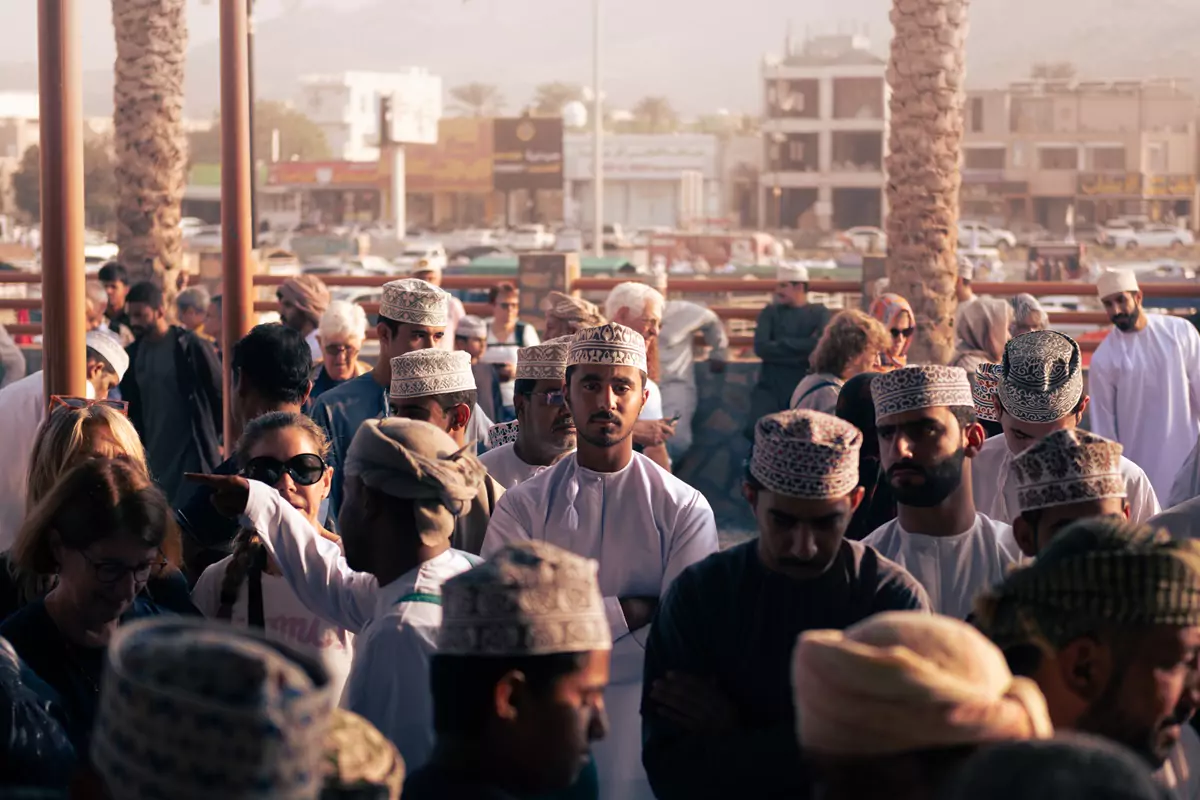
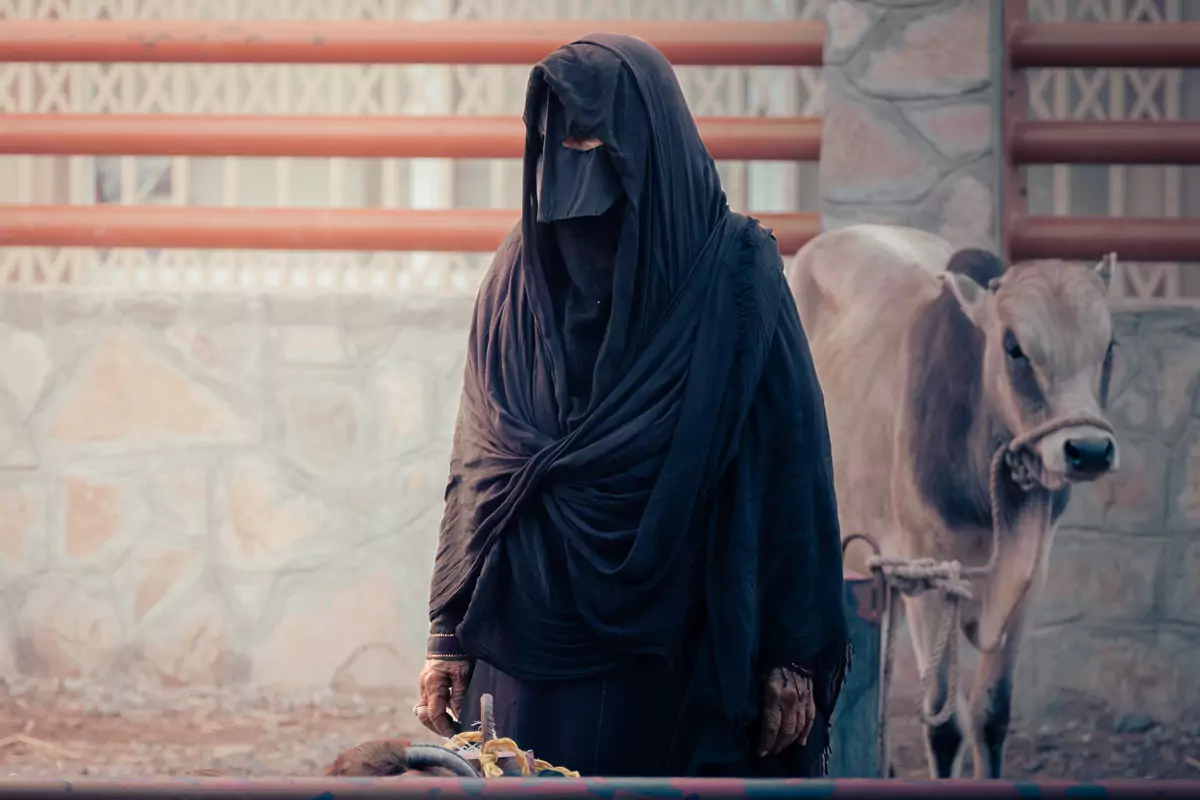
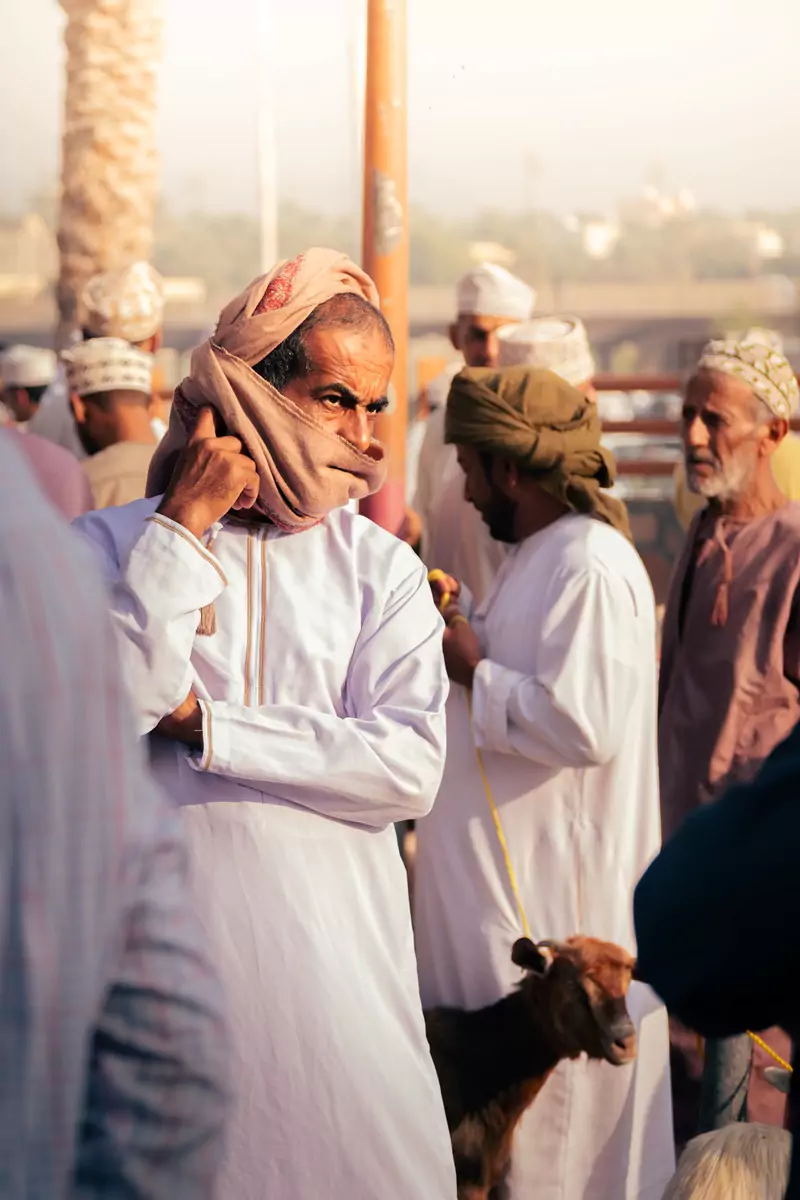
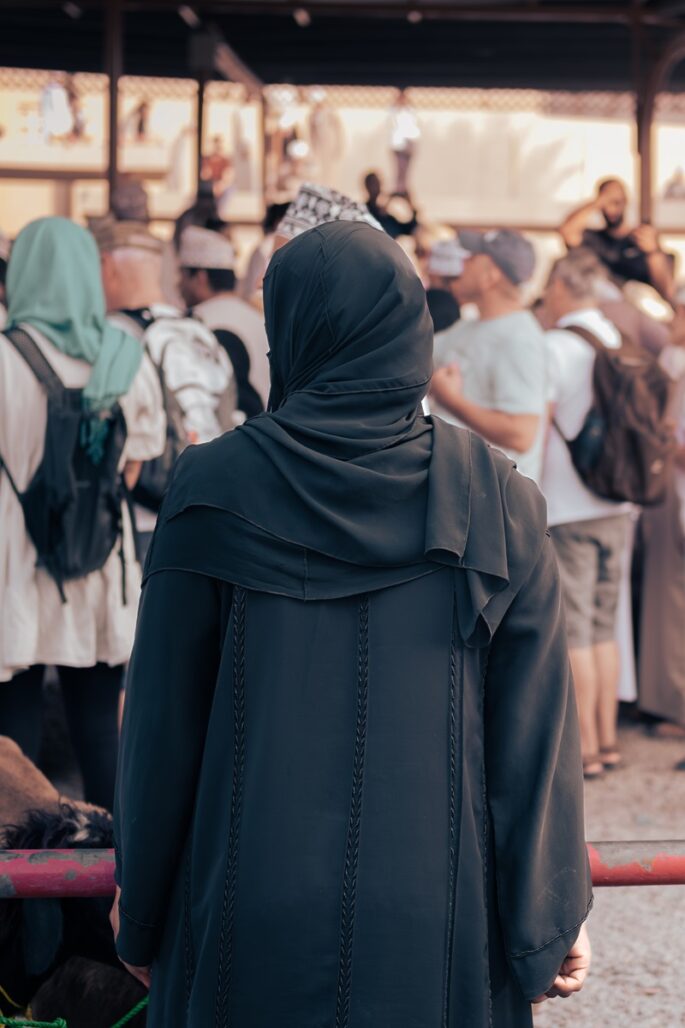
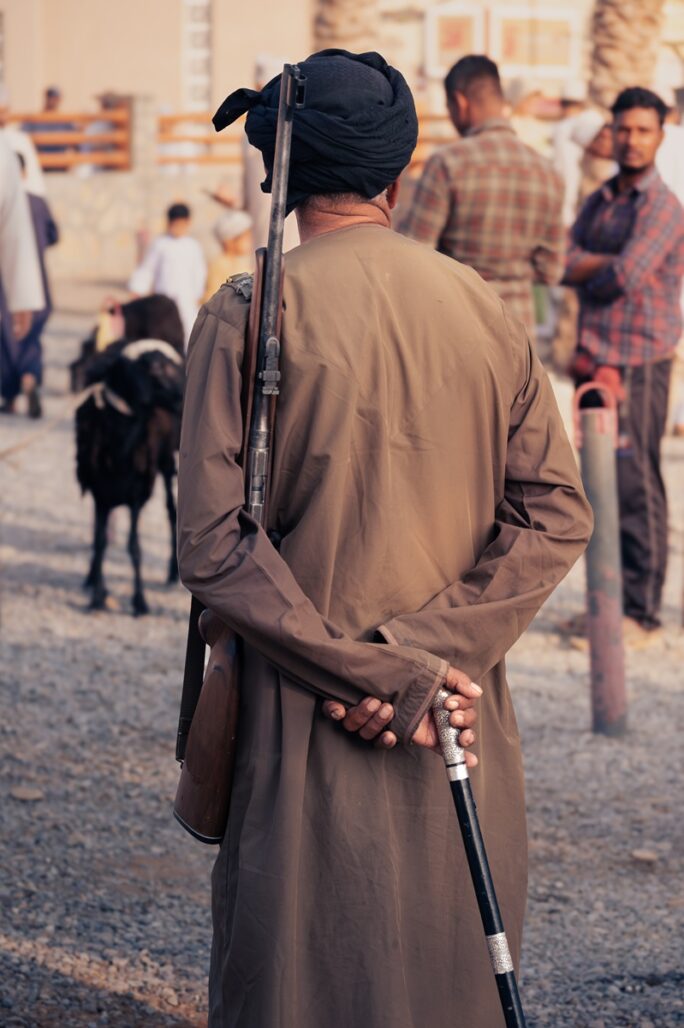
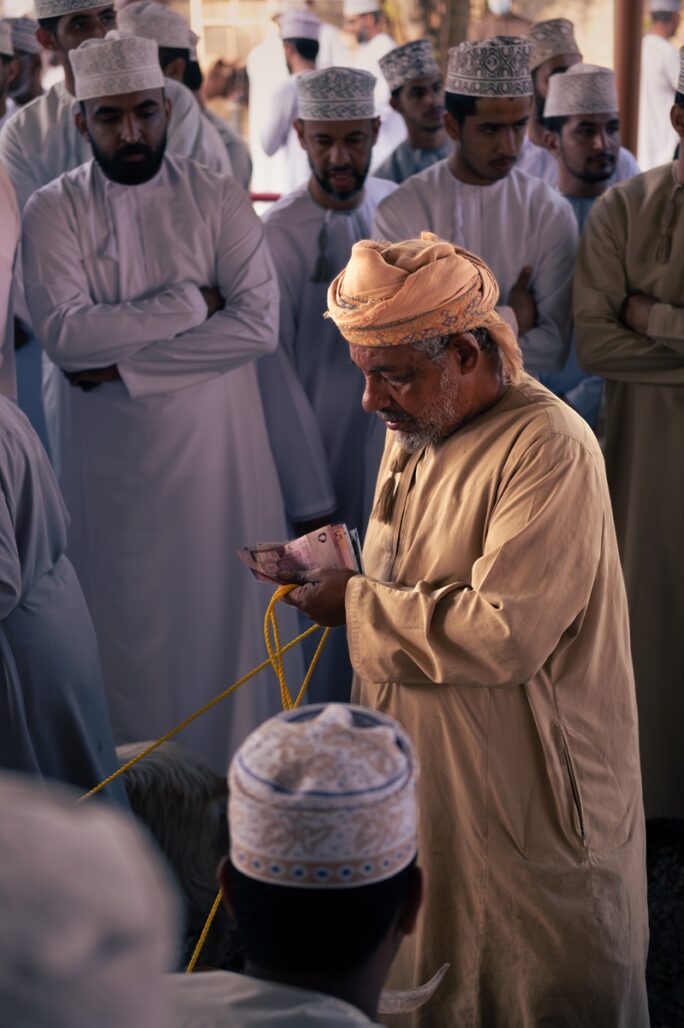
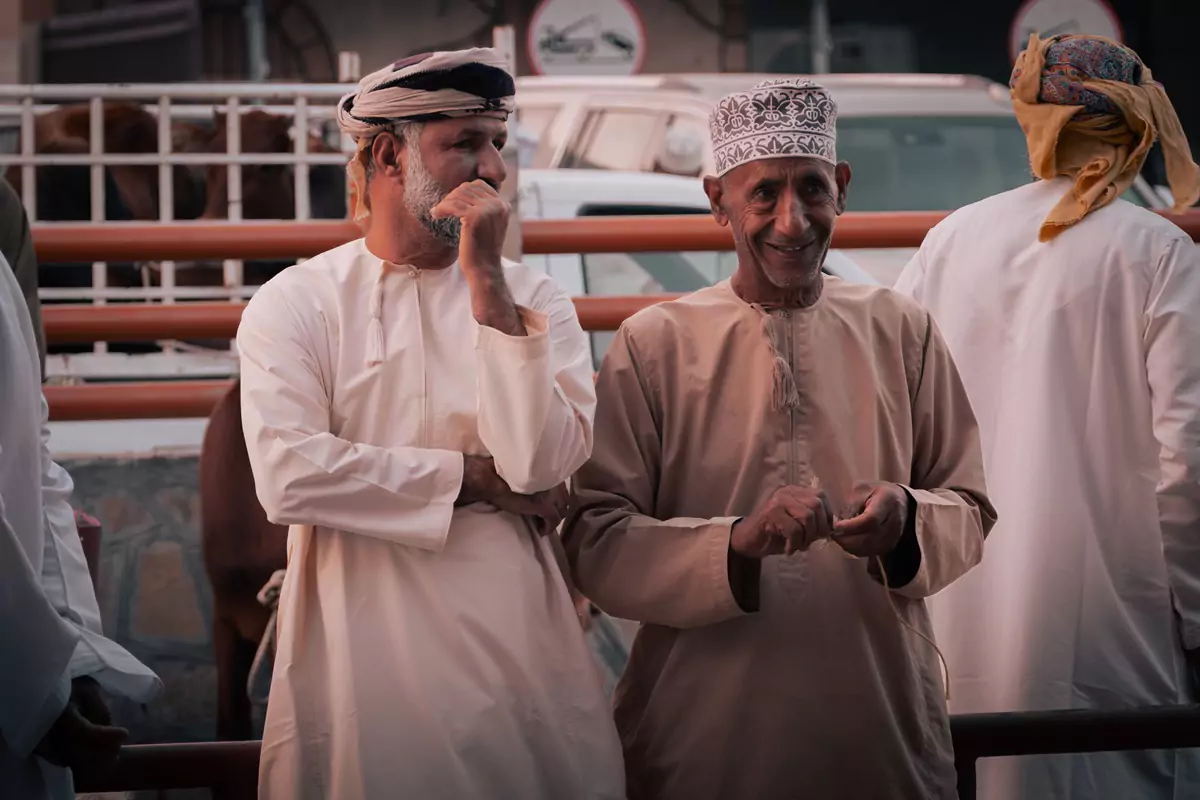
It was noisy, but not hectic. Small clusters of men donning pale dishdashas were chatting away, tea in hand, ignoring the hundreds of bleating animals that were secured to worn red metal poles by various coloured ropes. The sea of pale robes was characteristic of Oman, with the occasional woman dressed all in black punctuating the scene.
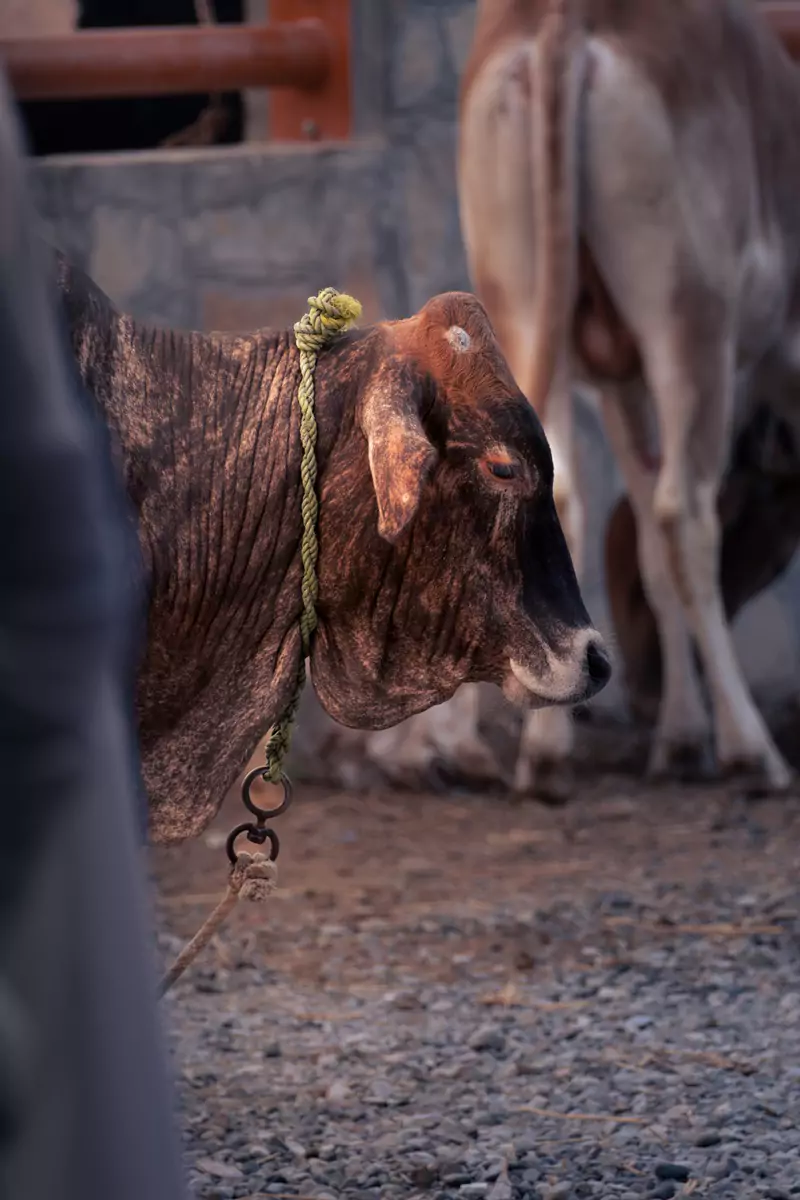
Around the circular venue there were a surprising number of cows. These cows are exclusively kept around the edges, spaced out, whereas goats are everywhere (I learned later that it is because cows are dicks and like to fight or get their bone on).
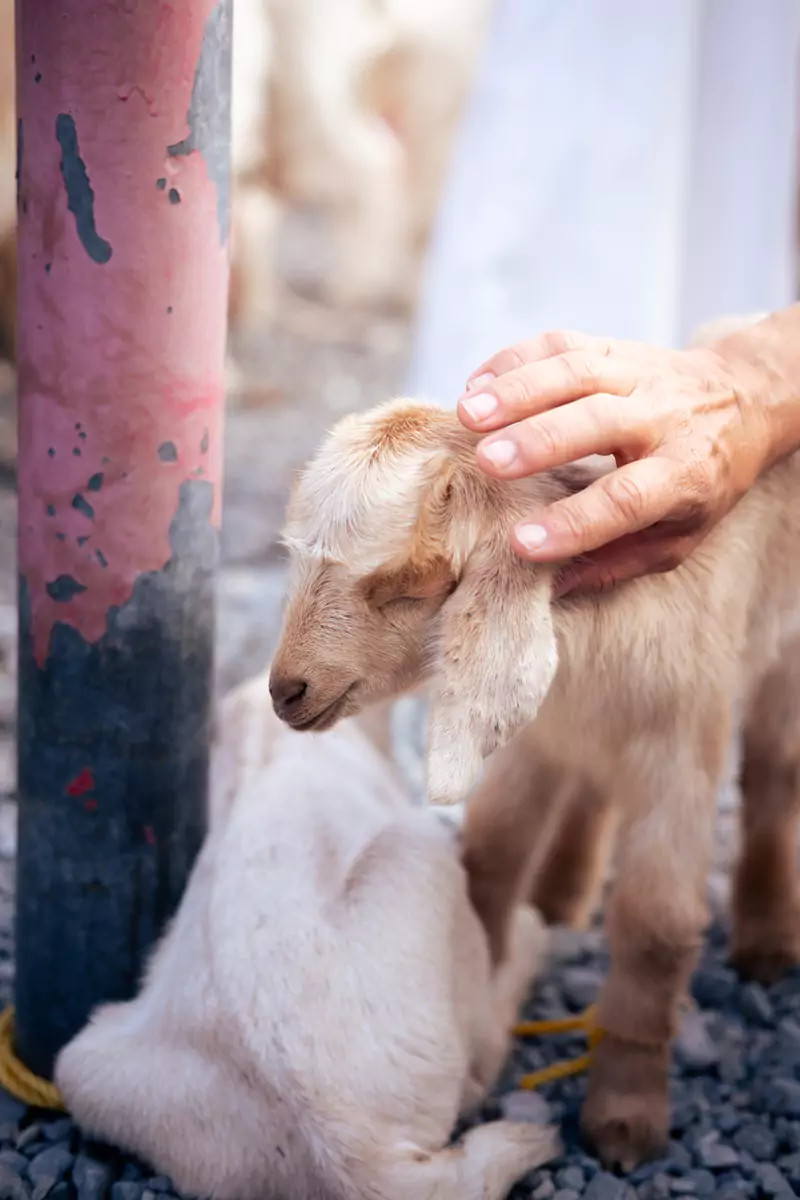
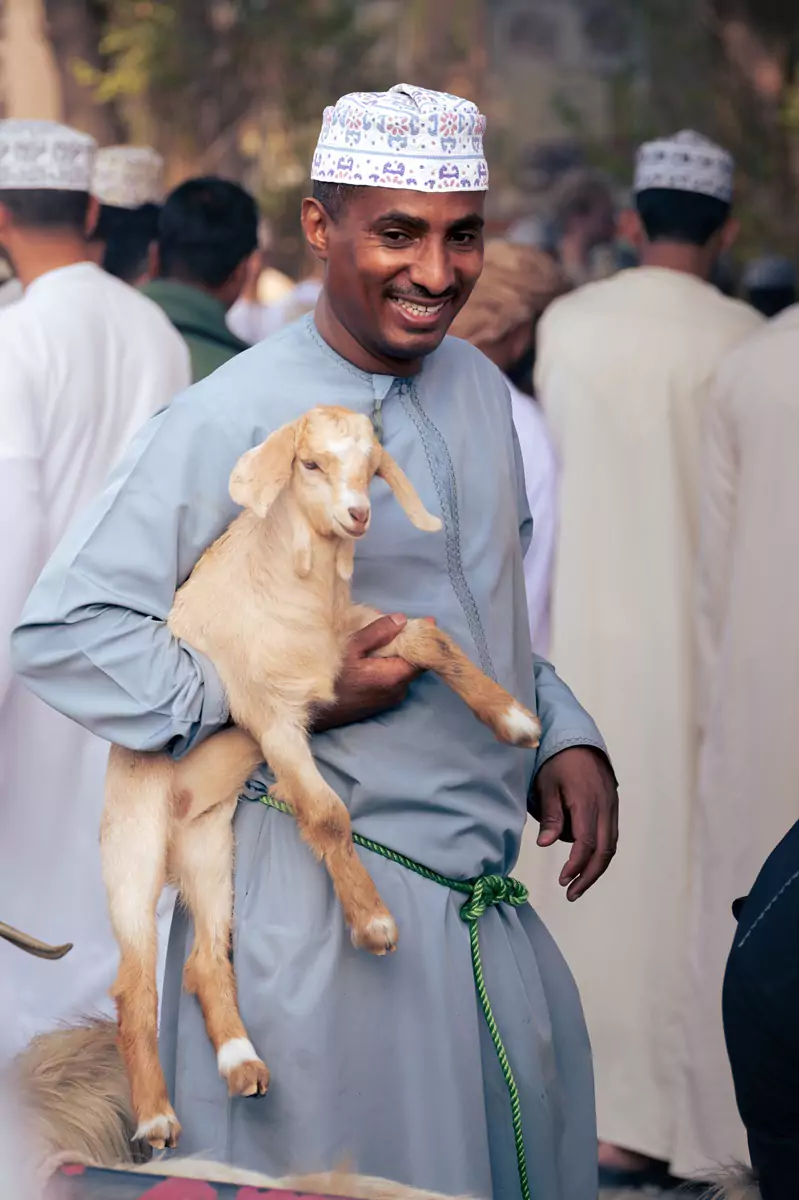
Scratty goats, fluffy goats, groomed goats – all the types of goats. Chunky ones, brash ones, opinionated ones, adorable baby ones; it felt like a goat festival.
Now, I don’t know shit about livestock, but here’s a surprising thing – I was told that some of these goats are worth more than 300 OMR, around US$750 – which is a lot. I can’t tell which goats are the exclusive, limited-edition ones, but it does explain why all the men were walking around with gigantic wads of cash in hand.
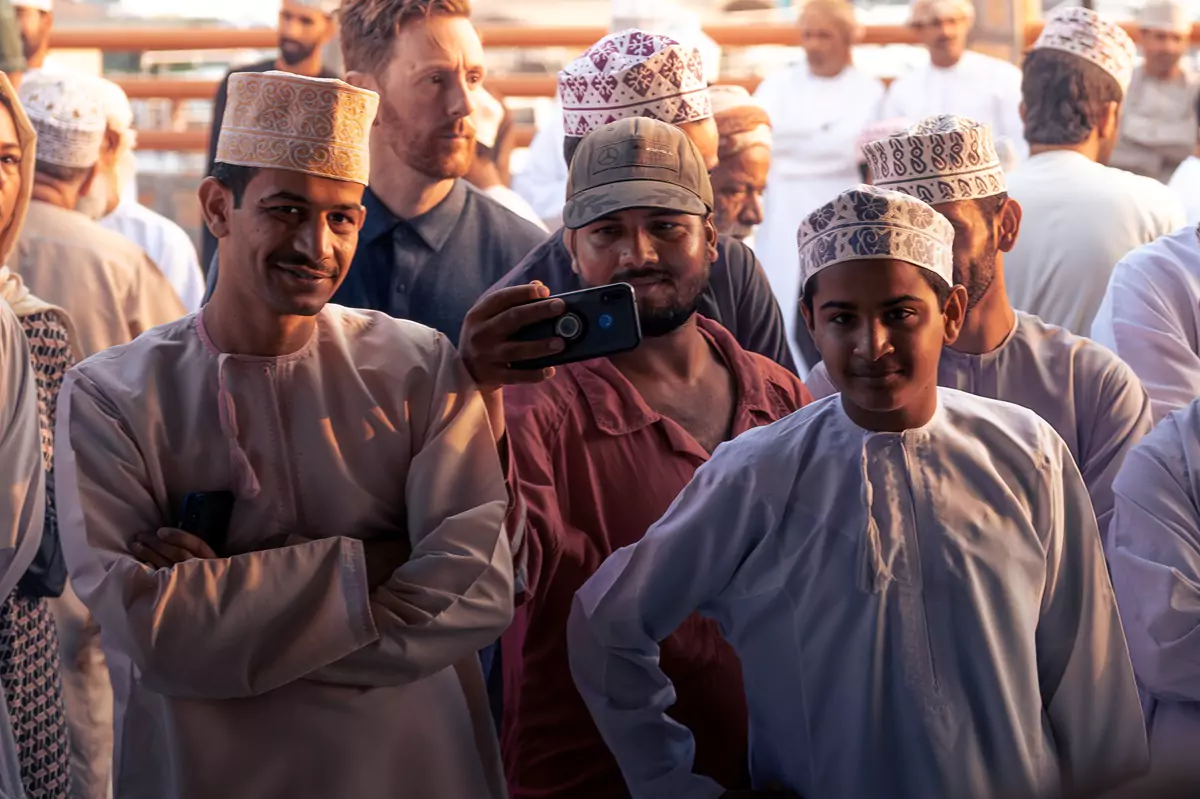
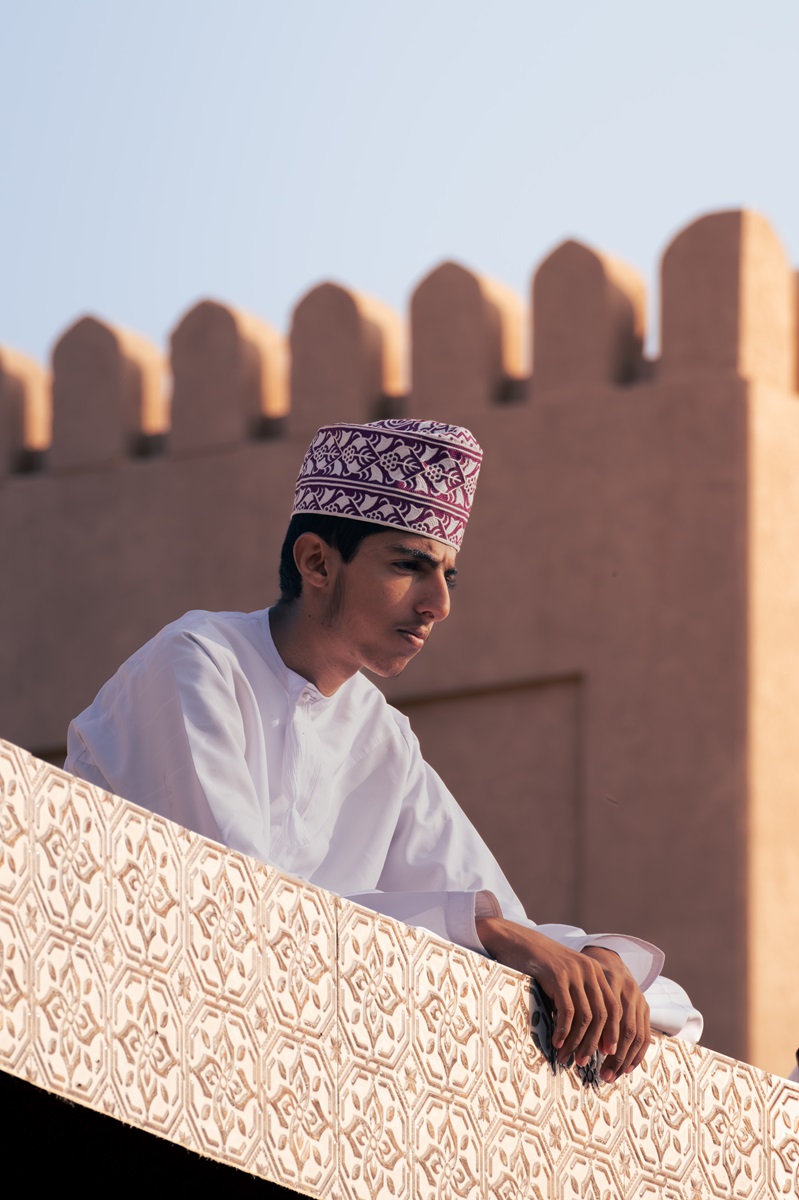
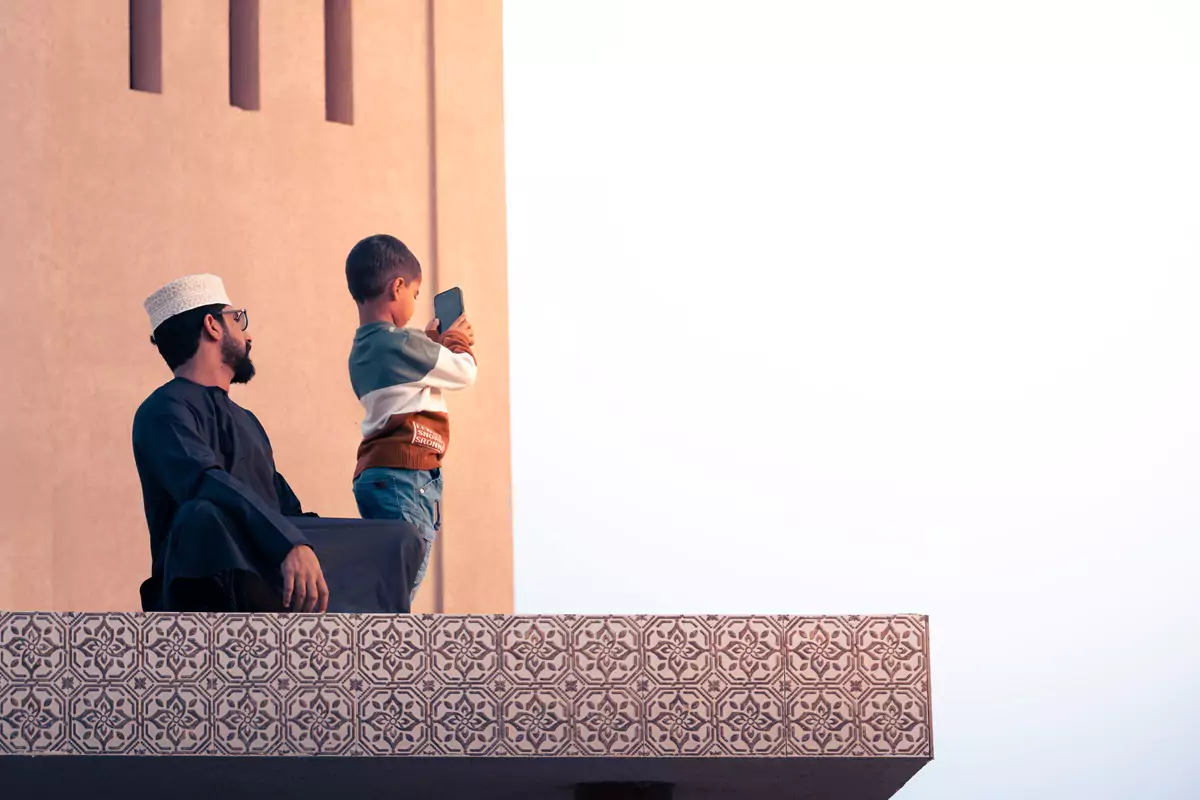
As time went on, the circular arena filled up with men in white, lots of younger boys (they appear to enjoy sitting on the roof – I wonder if this is an act of rebellion?) and tourists. The tourists stick out like a sore thumb in their commonly colourful attire, but don’t seem to be overly resented by the residents (I hope I’m correct here).
It was around 7am when the rising sun peeked its head over the Hajar mountains to east, prompting me to retreat, looking for shade (it’s already too hot when wearing all black). We finally sat down on a raised section of the inner circle, next to some younger Omani guys, hoping to avoid being an obstacle to the traders (after all, I’m not the one there wanting to acquire a new goat).
‘As Salama’ I repeat, over and over to all the men around me. ‘Wa Alaykum Salam’ I hear back. I feel ingratiated, and like I’m not in the way. These guys let me take their photos and proceed to tell me a little about what is going on.

How to Buy a Goat
Okay, so I didn’t buy a goat. I also still have no real idea what type of goat I’d want or need. Nor how to buy one at the market, but this is how everybody else bought a goat.
It was around 7.30am when the exhibition began. A minute earlier, a larger man in the centre shouted something in Arabic and then the process kicked into gear, like cogs turning. A throng of people began closing in on all sides to create a narrow, circular path under the white, angular roof.
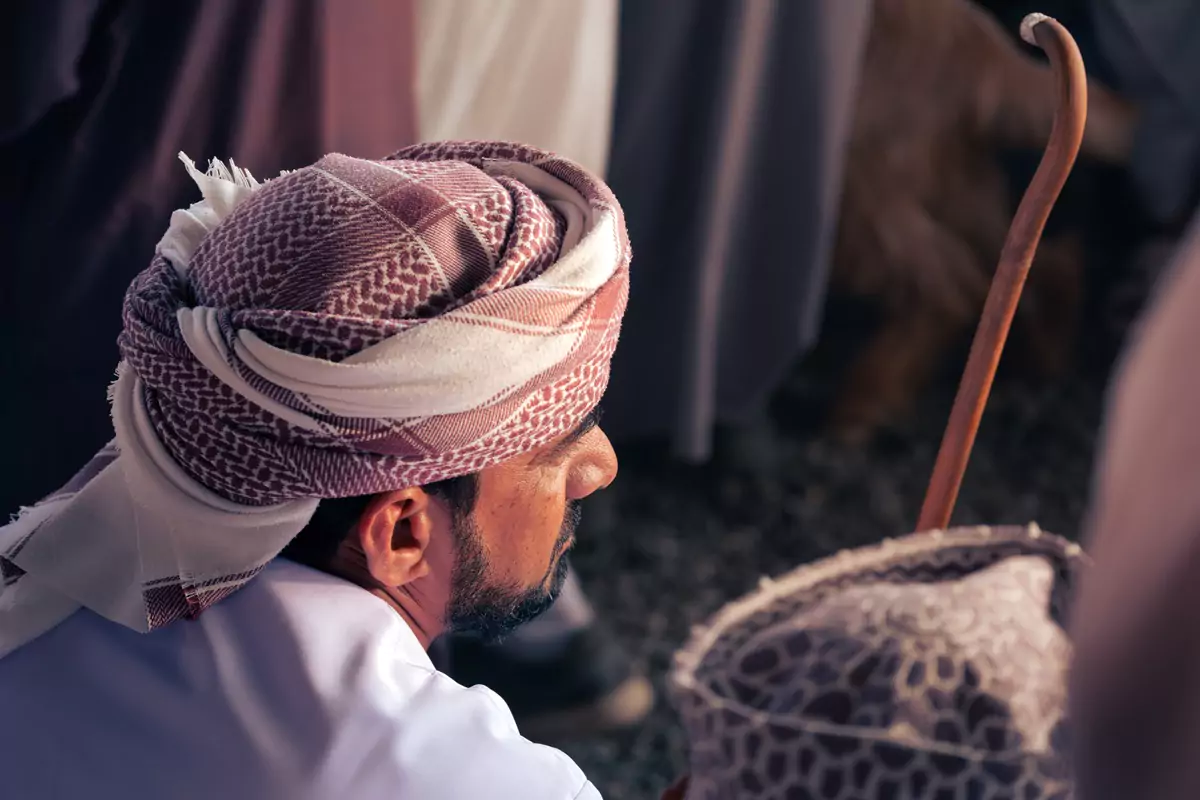
The goats are hastily paraded around this orbitual corridor by their owners. This display was at far too fast a pace for me to figure out the quality of a goat (my untrained eye had no chance, anyway). Despite the feverish backdrop, the goats seemed quite well-behaved – I wonder how many have been sold here more than once for things like breeding?
The animals are grabbed, fondled, prodded and otherwise inspected by traders who are bellowing ‘huna, huna’ from around the edge (I think this means ‘here’ in Arabic). Masked women sit on the floor, in front of the men, throwing small stones to show interest in the goats.
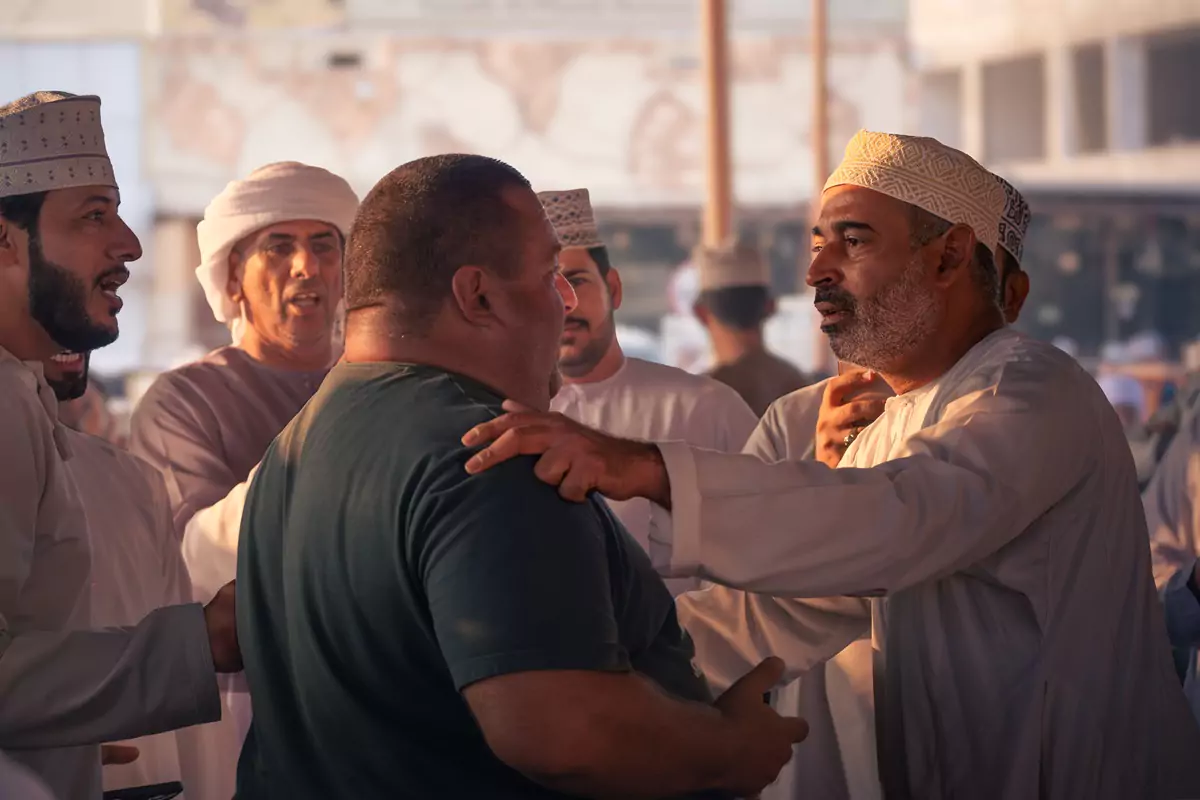
Teeth are checked, testicles cupped, eyes stretched, and then, for whatever reason, a goat is sold! Men shout aggressively but not angrily (I think?) to each other, and women gesture wildly at the various men handling the goats. It’s all very frenetic and fun (but I suppose pretty orthodox for the vendors and purchasers).
This goes on for a while, but I didn’t get bored. It’s a novelty and privilege to be welcomed as an outsider to these regular, normal Omani gatherings. I’m always curious and grateful.
Angry Cows
The crowd begins to thin and people are shuffling around, so we bought a small karak tea from the beaming man by the entrance (100 baisa a cup, if you’re interested). Then, there’s a sort of yell, and I turned to see one large, chunky brown bull, charging at a smaller grey one; a hapless man, dragged along behind by a rope.
I’d forgotten there were cows at this market.
As it turns out, the cows are far less cooperative than their goat cousins. They charge at the crowds, try to mate with anything that moves, or just refuse to move at all. It was easily the most entertaining part of the market for me. I grew up around friendly, obedient cows in fields near my house, not these hostile giants. It was quite a surprise.
The crowd already knew to give these animals a wider berth, so I guess they’re always a bit temperamental. Fathers were shielding their kids and there was very little bull fondling going on.
It’s definitely worth hanging around until the end, if you’re thinking of visiting. There are far fewer cows than goats, so this part of the process was fast. Before we knew it, the arena was emptying and people were pouring through the arched souq entrance and back into the car park. It was over.

Omani Women at the Nizwa Goat Market
There were few women at the Nizwa livestock market, but the ones who were there seemed to be strong, not in stature, but in dominance. They kind of allude to a power, like a stereotype Mexican abuela. One woman would be addressing four men, all stood intently listening. The body language of the women seemed almost dismissive – I loved the rare opportunity to watch these interactions.
Women from the mountains around Nizwa often have a very particular style of dress that includes a battoulah/batula, a distinctive type of face mask common in coastal southern Iran. This was something I was keen to see, as my interactions with women in Oman, outside of Muscat anyway, have always been minimal.


What to Wear at the Market
Dress conservatively at the Nizwa goat market. This goes for anywhere in Oman, but particularly in Nizwa, especially as a woman.
This wouldn’t be a post by me if it didn’t have some complaint about tourists. I know, I know, I’m always complaining, but I’ve spent a lot of time in Oman, and there’s always one person (or three or seven) who can’t figure this out.
At the goat market, most tourists were dressed respectfully, but there were a few (always women) who rock up in something utterly inappropriate. Some were in lowish cut dresses, and one lady (who I’ll never forget), wearing a very short skirt with bare legs and tight top. Maybe her too-polite tour guide told her it’s okay, I don’t know. Anybody who did even the slightest bit of research would know that Nizwa is a super conservative, traditional place though.
So, yeah. Less skin please, and more flowy, loose clothing.



GOT EVEN MORE TIME IN OMAN?
Go camping:
Sleep under the stars at these amazing wild camping locations
Plan your trip with our Oman camping guide
Camp atop Oman’s highest mountain
or camp in the palest of Oman’s deserts at the Sugar Dunes
or have a totally unique adventure:
Wander around Oman’s most photogenic fort
Spot the most remote beehive tombs in Oman
Take a look around Oman’s most unique fortification
–
Should you Visit the Goat Market?
The Nizwa goat market is definitely a noteworthy experience. In the name of responsible travel and the longevity of culture, however, I have some thoughts.
After missing the market for several years, I was glad to finally go, however I was surprised by the number of tourists in attendance. It’s possible I was unlucky, because I spotted tour buses in the car park. Maybe there were more than usual that day?
I don’t mind tourists (I am one too, after all), but I am concerned about how this market will endure as visitor numbers increase. I’m picturing the event becoming ever more popular, with larger buses in the car park. When three 55-seater buses are turning up every week – where will those people go? There were already tourists obstructing the proceedings, taking up space where the goat-purchasers would usually sit, showing little regard for the fact that this is a regular event with essential purpose for the community.
The goat market may end up changing, irreparably, to accommodate more visitors.
Currently, nobody will charge you for attending the livestock auction or for parking, yet at some point, maybe that will change? Possibly with money-making as a motivation (not really the Omani style though), or just to limit the numbers of visitors. That would have a knock-on impact to regular attendees and also Omani visitors from other areas of the country.
It’s not a carnival. It’s a weekly market. I worry it will become like the fake floating markets in Vietnam and Thailand – a complete pageant and display, purely for tourists’ money. It’ll gradually become less and less about the traditions of the residents and more about tolerating/pleasing/accommodating visitors.
I don’t have a solution to over-tourism, but I’d encourage you not to visit as part of a larger tour group. Go with a private guide, or even by yourself. That way, at least we can avoid the mass influx of people, all at the same time. The Nizwa goat market is an easy, safe place to visit independently. Also, it goes without saying, but behave respectfully and dress appropriately.

Where to Stay
Many people visit Nizwa from Muscat on a day trip, but it’s worth staying overnight in Nizwa to arrive at the goat market first thing in the morning. Plus, there is so much to do in the city that it’s worth a few days of your time anyway.
There are lots of decent accommodation options in Nizwa. Here are our suggestions (we’ve stayed in all of these):
Nizwa Inn ($$) | Simple, modern, clean rooms, affordable (we’ve stayed here four times and every time it’s been the best value option for a comfortable room).
Antique Inn ($$$) | Stunning heritage building with tonnes of character and adjacent to Nizwa Fort and souq. Excellent breakfast on the terrace with lovely views of the fort and old town. This is a perfect choice if you don’t want to drive at 6am! We’d recommend getting an upgraded room – the lowest room class doesn’t come with a window and is significantly inferior to the nicer ones.
InterCity ($$$+) | A higher-end, Western hotel right next to Nizwa Mall and the Lulu Supermarket. It’s clean, comfortable and hyper modern. Great, but often expensive, especially if you don’t book in advance (which we never do). It’s super convenient, though (we’ve stayed here twice).
If you are staying in Nizwa for a few days (and we thoroughly recommend you do), check out our list of things to do in Nizwa.
TRAVELLING TO NIZWA FROM MUSCAT?
Many tourists opt to visit the Nizwa goat market from Muscat as a day trip.
If you do, we recommend these hotels in Muscat (we’ve stayed in lots and lots of hotels in the capital and know them well):
Super Upper-Range ($$$$): Al Bustan Palace – outrageously beautiful scenery accompanies even more outrageously beautiful rooms. Nestled into the mountains on a stunning beach along the coast to the east of Muscat – if you can afford this one snap up a room without question. I’d live here and never leave.
Mid-Range ($$): Royal Tulip Muscat – centrally located in Al Khuwair, near malls and some of our favourite restaurants, with classy, great sized rooms and underground parking. This hotel is almost always a bargain for the price you pay.
Lower Mid-Range (-$$): Al Murooj Grand Hotel – surprisingly lovely rooms for the very reasonable price (they smelt amazing too!), easy parking, friendly staff. Good central location too.
Lower Mid-Range (-$$): Citadines Al Ghubrah Muscat – excellent little apartment rooms, perfect if you live out of the supermarket like we do! Once again, fantastically located in a quiet area just outside the busy Al Khuwair area.
Budget (+$): Swiss-Belinn Airport Muscat Oman – outside of Muscat, near the airport but cheap as chips for the money if you have a car to get around. Really decent modern rooms, easy parking and all-around pleasant stay.
–
IS TRAVELLING IN OMAN EXPENSIVE? | OMAN’S VISION 2040 – WHAT IS IT?
Frequently Asked Questions
When is the Nizwa goat market held?
The Nizwa goat market is held every Friday of the year starting around 6am.
Is there an entry fee?
No, there is no entry fee for the Nizwa goat market.
When is the best time to arrive at the Nizwa goat market?
The best time to arrive is before 7am. However, the later you arrive, the harder it will be to park.
Is there parking?
Yes, there is free parking at the Nizwa goat market. It gets busier later in the morning, but there is always some space on the street.
Is there animal slaughter at the Nizwa goat market?
No, there is no animal slaughter or obvious animal cruelty at the Nizwa goat market.
Do women need to cover their head?
No, women do not need a head covering to attend the Nizwa goat market, although they should dress very conservatively.
What time does the livestock sales begin?
The livestock sales process begins around 7.30am at the Nizwa goat market.
Some Thoughts
Somehow, we never managed to stay in Nizwa on a Thursday night, until recently. I’d been to the empty goat arena a few times on non-Fridays but seeing the Nizwa goat market in full swing was a whole experience.
Truthfully, I was cynical about whether I would enjoy the livestock spectacle – I’m a vegetarian who actively avoids all animal tourism. However, I’m also accepting of traditions that don’t always align with my values (plus I’d heard that there was no animal slaughtering etc. at this market – super not keen on watching that).
It turned out to be quite fun. I learned a lot about Oman’s mountain shepherds and the selling of livestock (although I still know shit about identifying a quality goat). I chatted with lots of people that I otherwise would not have the opportunity to and, although some of these animals are going to meet a gritty end, they seemed happy enough at the market. In all honesty, I was expecting a little more brutality or something. The baby goats were also adorable – I would have caved and bought one if I lived there.
So, to conclude, we would recommend visiting, considerately. Have a great time!
Hi, thanks for visiting our blog! If our free content has been of help to you, or you’ve just enjoyed our random ramblings and musings, say thank you by buying us a coffee! It helps keep The Restless Beans blog up and running.
Thank you, Claire + Nick


